Square Footage Calculator
Area & volume calculator • 2026 standards
Area & Volume Formulas:
Show the calculator\( \text{Rectangle Area} = \text{Length} \times \text{Width} \)
\( \text{Triangle Area} = \frac{1}{2} \times \text{Base} \times \text{Height} \)
\( \text{Circle Area} = \pi \times \text{Radius}^2 \)
\( \text{Volume} = \text{Area} \times \text{Depth/Height} \)
\( \text{Total Area} = \sum(\text{Individual Room Areas}) \)
These formulas calculate the square footage of various shapes and spaces. The rectangle formula applies to most rooms, while triangles and circles are used for special architectural features. Volume calculations are essential for concrete pours, excavation, and material estimation.
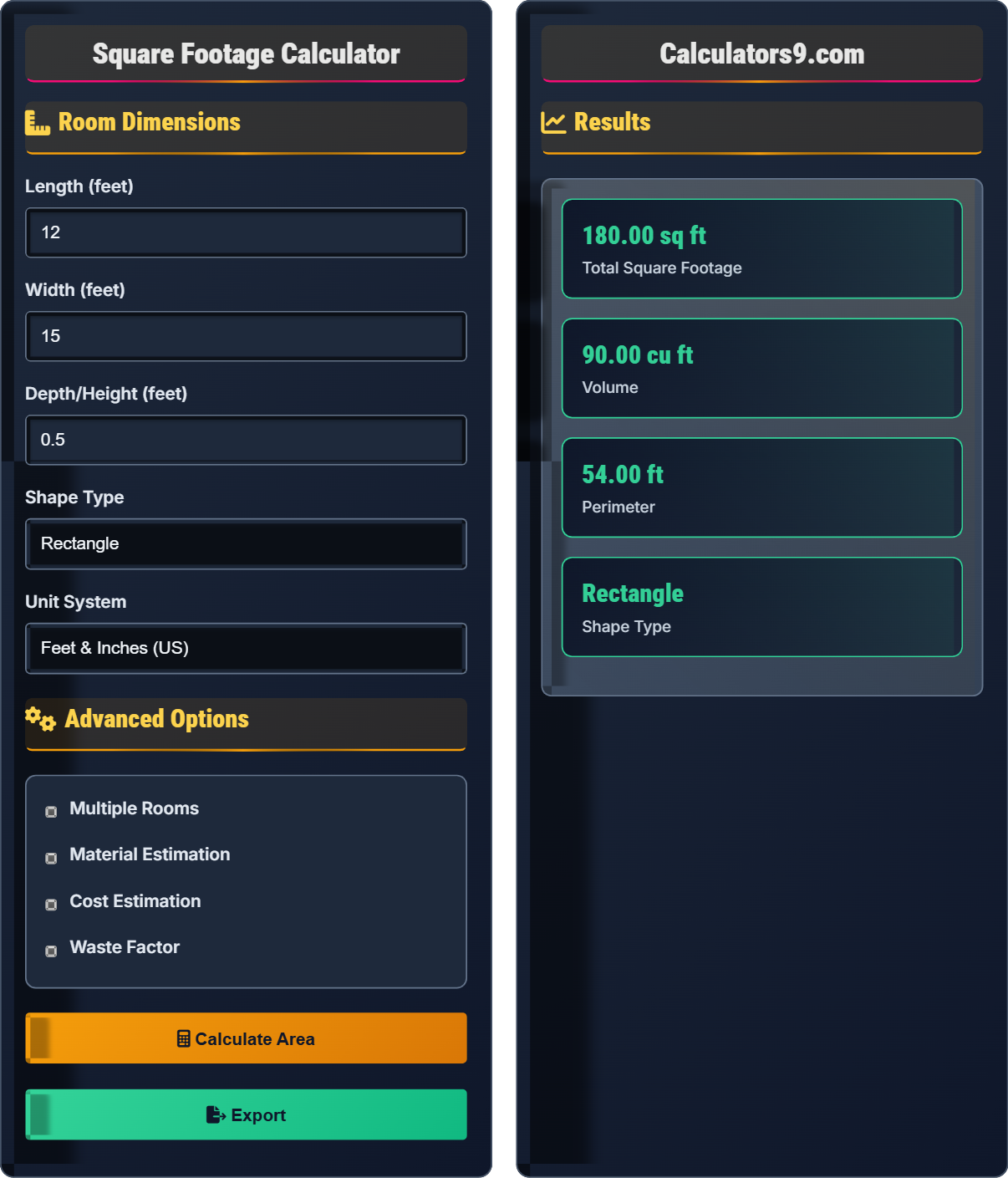
Example: For a rectangular room 12 feet by 15 feet:
Area = 12 × 15 = 180 sq ft
For a circular area with radius 5 feet:
Area = π × 5² = 3.14159 × 25 = 78.54 sq ft
For a volume with area 200 sq ft and depth 0.5 feet:
Volume = 200 × 0.5 = 100 cubic ft
Room Dimensions
Advanced Options
Results
Area Calculation Fundamentals
Square footage is the area of a space measured in square feet. It's calculated by multiplying the length by the width of a space. This measurement is essential for construction, real estate, and renovation projects.
Common area calculations:
- Rectangle: Length × Width
- Triangle: ½ × Base × Height
- Circle: π × Radius²
- Volume: Area × Depth
- Always measure twice, cut once
- Include waste factor in material estimates
- Round up for safety margins
- Convert all measurements to same units
Construction Applications
Square footage calculations are essential for various construction applications including flooring installation, paint estimation, concrete pours, and HVAC sizing.
Estimating materials:
- Calculate total area
- Add waste factor (typically 10%)
- Convert to appropriate units
- Account for pattern matching
- Residential flooring: 10% waste factor
- Commercial flooring: 15% waste factor
- Paint coverage: 350 sq ft per gallon
- Concrete: Ordered by cubic yard
Square Footage Learning Quiz
What is the area of a rectangular room that measures 14 feet by 18 feet?
The correct answer is A) 252 sq ft. For a rectangle, the area is calculated as length × width. Therefore: 14 ft × 18 ft = 252 sq ft.
The area of a rectangle is found by multiplying its length by its width. This fundamental formula is used extensively in construction for calculating flooring needs, paint requirements, and material estimates. The units remain squared (sq ft) because we're measuring a two-dimensional space.
Square Footage: The area of a surface measured in square feet (ft²)
Two-Dimensional Space: A flat surface measured in length and width
Area: The extent of a surface measured in square units
• Rectangle area = Length × Width
• Always use the same units for both dimensions
• Result is expressed in square units
• Draw a diagram to visualize the space
• Double-check your multiplication
• Round up for material estimates
• Adding dimensions instead of multiplying
• Mixing different units (feet and inches)
• Forgetting to include unit notation
Calculate the area of a triangular section with a base of 10 feet and a height of 8 feet. What is the area?
The area of a triangle is calculated using the formula: Area = ½ × Base × Height
Step 1: Area = ½ × 10 ft × 8 ft
Step 2: Area = ½ × 80 sq ft
Step 3: Area = 40 sq ft
The area of the triangular section is 40 square feet.
Triangular areas are common in construction for gable ends, bay windows, and decorative architectural features. The triangle formula is derived from the rectangle formula, recognizing that a triangle is half of a rectangle with the same base and height.
Triangle: A three-sided polygon with three angles
Base: The bottom side of a triangle used for area calculation
Height: The perpendicular distance from the base to the opposite vertex
• Triangle area = ½ × Base × Height
• Height must be perpendicular to base
• Applies to all triangle types
• Any side can be the base
• Height is always perpendicular to the chosen base
• Visualize the triangle as half of a rectangle
• Using slanted sides instead of perpendicular height
• Forgetting the ½ factor in the formula
• Confusing base with other sides
A contractor needs to install flooring in a rectangular room that measures 15 feet by 20 feet. Flooring is sold in square feet, and the contractor wants to include a 15% waste factor. How many square feet of flooring should be ordered?
Step 1: Calculate the area of the room
Area = Length × Width = 15 ft × 20 ft = 300 sq ft
Step 2: Calculate the waste factor
Waste = 300 sq ft × 0.15 = 45 sq ft
Step 3: Calculate total material needed
Total = 300 sq ft + 45 sq ft = 345 sq ft
The contractor should order 345 square feet of flooring.
This problem demonstrates practical application of area calculation in construction. Waste factors are essential in construction to account for cutting, fitting, damage, and pattern matching. The standard waste factor varies by material type and complexity of installation.
Waste Factor: Additional material ordered to account for cuts, damage, and installation errors
Material Estimation: Calculating the amount of materials needed for a project
Installation Errors: Waste due to cutting mistakes, damage during handling, or fitting issues
• Calculate base area first
• Multiply by waste factor percentage
• Add to base area for total
• Round up to nearest whole unit
• Consider pattern complexity for higher waste
• Check manufacturer recommendations
• Forgetting to add waste factor
• Using wrong percentage for waste
• Not rounding up for safety margin
A homeowner wants to pour a concrete patio that measures 12 feet by 16 feet with a thickness of 4 inches. How many cubic feet of concrete are needed? (Note: 1 foot = 12 inches)
Step 1: Convert thickness to feet
Thickness = 4 inches ÷ 12 inches/foot = 0.333 feet
Step 2: Calculate the volume
Volume = Length × Width × Thickness
Volume = 12 ft × 16 ft × 0.333 ft = 63.94 cubic feet
Step 3: Round up for practical purposes
Concrete needed: Approximately 64 cubic feet
This problem demonstrates volume calculation, which is essential for concrete, excavation, and other three-dimensional construction materials. Volume is calculated by multiplying length, width, and depth. It's crucial to ensure all measurements are in the same units before multiplying.
Volume: The amount of space occupied by a three-dimensional object
Cubic Feet: Volume measurement in feet³
Three-Dimensional: Having length, width, and depth
• Volume = Length × Width × Depth
• All measurements must be in same units
• Concrete is often ordered in cubic yards
• Convert all measurements to feet first
• To convert to cubic yards: divide by 27
• Order slightly more than calculated
• Not converting units consistently
• Using area formula instead of volume
• Forgetting to account for depth/thickness
Which of the following is the most accurate method for calculating the area of an L-shaped room?
The correct answer is B) Divide into rectangles and add areas. For irregular shapes like L-shaped rooms, the most accurate method is to subdivide the shape into simpler geometric forms (usually rectangles), calculate the area of each, and sum them to get the total area.
This technique is fundamental in construction surveying and material estimation. Complex shapes are broken down into simple geometric shapes for accurate calculation. This approach works for L-shapes, T-shapes, and other irregular configurations commonly found in buildings.
Irregular Shapes: Geometric figures that cannot be described by simple geometric formulas
Subdivision Method: Breaking complex shapes into simpler geometric forms
Geometric Decomposition: Dividing complex shapes into basic geometric components
• Break complex shapes into rectangles
• Calculate each rectangle separately
• Sum all areas for total
• Sketch the shape and draw dividing lines
• Label dimensions for each section
• Double-check that sections don't overlap
• Attempting to use single formula for complex shape
• Counting overlapping areas twice
• Missing sections when subdividing
FAQ
Q: How do I measure irregular shaped rooms accurately?
A: For irregular shaped rooms, use the subdivision method. Break the room into simpler geometric shapes (rectangles, squares, triangles). Calculate the area of each section separately and sum them up.
For example, if you have an L-shaped room with dimensions 10×12 and 8×6:
Area₁ = 10 × 12 = 120 sq ft
Area₂ = 8 × 6 = 48 sq ft
Total Area = 120 + 48 = 168 sq ft
This method ensures accuracy and is the standard approach used by professionals for complex room layouts.
Q: What waste factor should I use for different materials?
A: Waste factors vary by material and installation complexity:
- Flooring: 10% for standard installations, 15% for complex patterns
- Tile: 10-15% depending on layout complexity
- Carpet: 5-10% for standard installations
- Paint: 10-15% for coverage variations
- Concrete: 5-10% for spillage and overage
For complex geometric patterns or diagonal installations, add an additional 5-10% to account for increased cutting waste.