Stair Calculator
Rise & run calculator • 2026 standards
Stair Building Formulas:
Show the calculator\( \text{Rise} = \frac{\text{Total Height}}{\text{Number of Steps}} \)
\( \text{Run} = \frac{\text{Total Horizontal Distance}}{\text{Number of Steps}} \)
\( \text{Angle} = \arctan\left(\frac{\text{Rise}}{\text{Run}}\right) \)
\( \text{Stringer Length} = \sqrt{(\text{Rise} \times \text{Steps})^2 + (\text{Run} \times \text{Steps})^2} \)
\( \text{Building Code Rule: } 2 \times \text{Rise} + \text{Run} = 24-26 \text{ inches} \)
These formulas calculate stair dimensions according to building codes. The rise is the vertical height of each step, and the run is the horizontal depth. The angle determines the steepness of the staircase, which should comply with safety standards.
Example: For a total height of 120 inches with 10 steps:
Rise = 120 ÷ 10 = 12 inches
If run is 10 inches:
Angle = arctan(12/10) = arctan(1.2) = 50.2°
Code compliance: 2×12 + 10 = 34 inches (above code range)
Stair Specifications
Advanced Options
Results
Stair Building Fundamentals
Rise is the vertical height of each step. Run is the horizontal depth of each step. Stringer is the structural support that holds the treads and risers. Building codes regulate these dimensions for safety and accessibility.
Key building code standards:
- Rise: 7.5-8 inches maximum
- Run: 10-11 inches minimum
- 2R + G Rule: 24-26 inches
- Angle: 30-35 degrees
- All steps must be uniform
- Maximum variation allowed: 3/8 inch
- Handrails required for 4+ risers
- Minimum 6'8" headroom
Stair Safety Standards
Stair safety is regulated by building codes to prevent accidents. Proper dimensions, handrails, and lighting are mandatory for public and residential buildings.
Formula for safe stairs:
- 2R + G = 24-26 inches
- R + G = 17-18 inches
- Angle should be 30-35°
- Consistent rise/run throughout
- IBC (International Building Code)
- OSHA safety requirements
- ADA accessibility standards
- Local building codes
Stair Building Learning Quiz
According to building codes, what is the maximum allowed rise for a residential stair step?
The correct answer is C) 8.25 inches. According to the International Residential Code (IRC), the maximum rise for residential stairs is 8.25 inches. This regulation ensures stairs are not too steep and dangerous to climb.
Building codes establish maximum rise heights to ensure stair safety. A higher rise makes stairs steeper and more difficult to climb, increasing the risk of falls. The 8.25-inch limit balances space efficiency with safety considerations.
Rise: The vertical distance between the surfaces of two consecutive steps
Building Code: Regulations that specify safety and accessibility standards for construction
International Residential Code (IRC): Building code for residential structures
• Maximum rise: 8.25 inches
• Minimum run: 10 inches
• Consistent dimensions throughout
• Use the 2R + G rule for optimal comfort
• Keep all steps identical in dimensions
• Measure carefully to meet code requirements
• Exceeding maximum rise limits
• Inconsistent step dimensions
• Not accounting for code requirements
Calculate the number of steps needed for a staircase that rises 120 inches with a desired rise of 7.5 inches per step. How many steps will be required?
To calculate the number of steps, divide the total rise by the desired rise per step:
Number of steps = Total rise ÷ Rise per step
Number of steps = 120 inches ÷ 7.5 inches = 16 steps
Therefore, 16 steps are required to achieve a total rise of 120 inches with 7.5-inch risers.
This calculation is fundamental to stair design. The total vertical distance to be climbed is divided by the desired height of each individual step to determine the total number of steps needed. This ensures the stairs will reach the required elevation while maintaining consistent step heights.
Total Rise: The overall vertical distance between the floors or platforms connected by the stairs
Individual Rise: The vertical height of each individual step
Step Count: The total number of steps in the staircase
• Number of steps = Total rise ÷ Individual rise
• Round to nearest whole number
• Adjust individual rise if needed
• Adjust individual rise to get whole number of steps
• Recalculate actual rise after rounding
• Verify code compliance after adjustment
• Not rounding to whole number of steps
• Forgetting to recalculate actual rise
• Exceeding code limits after adjustment
A contractor designs stairs with a rise of 8 inches and a run of 9 inches. Does this design comply with the building code rule of 2R + G = 24-26 inches? (Where R = rise, G = run)
Step 1: Apply the building code formula 2R + G
2R + G = 2(8) + 9 = 16 + 9 = 25 inches
Step 2: Compare to code requirements
The code requires 2R + G to be between 24 and 26 inches
25 inches falls within the range of 24-26 inches
Yes, the design complies with the building code rule.
The 2R + G rule is a fundamental building code requirement that ensures stair comfort and safety. This formula balances the vertical and horizontal dimensions of steps to create stairs that are neither too steep nor too shallow, making them comfortable to climb.
2R + G Rule: Building code formula for stair comfort (2 × rise + run)
Code Compliance: Meeting all applicable building code requirements
Stair Comfort: The ease with which stairs can be climbed safely
• 2R + G should equal 24-26 inches
• R + G should equal 17-18 inches
• Maintain consistent dimensions
• Aim for 2R + G = 25 for optimal comfort
• Test multiple combinations
• Verify all code requirements
• Forgetting the 2R + G rule
• Not checking all code requirements
• Calculating incorrectly
Calculate the length of a stringer for a staircase with 10 steps, each with a rise of 8 inches and a run of 10 inches. What is the total stringer length?
Step 1: Calculate total vertical rise
Total rise = Number of risers × Individual rise = 10 × 8 = 80 inches
Step 2: Calculate total horizontal run
Total run = Number of treads × Individual run = 10 × 10 = 100 inches
Step 3: Use Pythagorean theorem for stringer length
Stringer length = √(Total rise² + Total run²)
Stringer length = √(80² + 100²) = √(6400 + 10000) = √16400 = 128.06 inches
The stringer length is approximately 128.06 inches.
The stringer is the structural component that supports the treads and risers. Its length follows the hypotenuse of a right triangle formed by the total rise and total run. This calculation is essential for cutting stringers to the correct length during construction.
Stringer: The inclined structural member that supports the treads and risers
Pythagorean Theorem: a² + b² = c² for right triangles
Hypotenuse: The longest side of a right triangle
• Stringer length = √(rise² + run²)
• Count number of risers correctly
• Use total rise and run for calculation
• Account for material thickness in cuts
• Add extra length for mounting
• Cut two stringers for stability
• Confusing number of risers with treads
• Forgetting to account for total distances
• Incorrectly applying Pythagorean theorem
According to building codes, when are handrails required on stairs?
The correct answer is C) When there are 4 or more risers. Building codes typically require handrails on stairs with 4 or more risers (3 or more steps) to provide safety for users ascending and descending the stairs.
Handrails are required when stairs become long enough to pose a safety risk. The 4-riser threshold represents the point at which stairs become steep enough that a handrail becomes necessary for safe navigation. This is a critical safety feature that prevents falls and injuries.
Riser: The vertical face of a step
Handrail: A rail designed to be grasped by the hand for guidance and support
Safety Feature: An element added to protect users from hazards
• Handrails required at 4+ risers
• Height: 34-38 inches above nosing
• Continuous along entire length
• Install on both sides if width > 44"
• Ensure proper height and grip
• Check local code variations
• Installing handrails only on one side
• Incorrect height placement
• Not following continuity requirements
FAQ
Q: What's the difference between rise and run in stair construction?
A: Rise and run are fundamental stair dimensions:
Rise: The vertical height of each step (from one tread to the next)
Run: The horizontal depth of each step (the surface you step on)
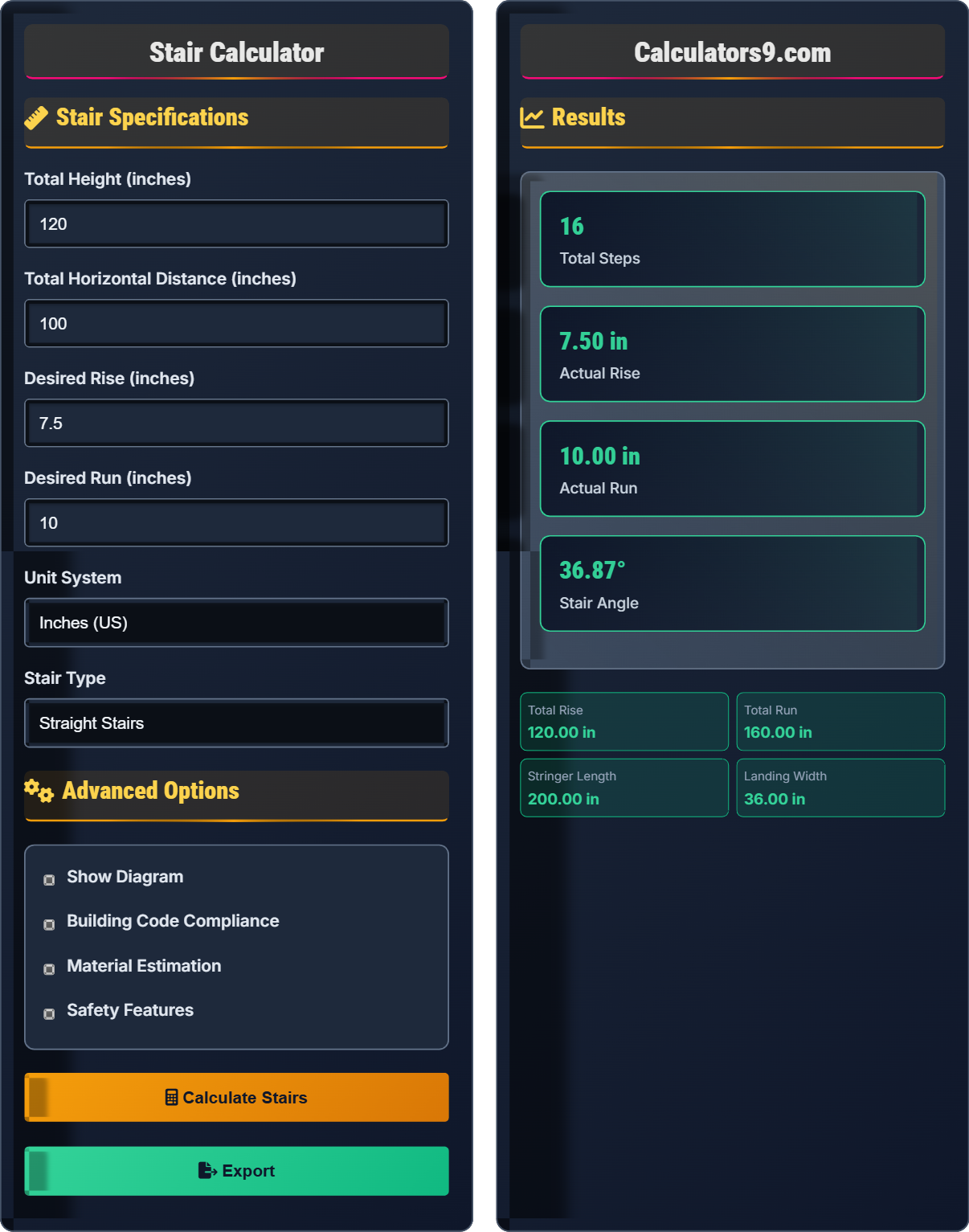
Mathematically, if you have a staircase with a total rise of 120 inches and 16 steps:
Individual Rise = 120 ÷ 16 = 7.5 inches
The run is typically between 10-11 inches for comfort. Building codes regulate both dimensions to ensure safety and usability.
Q: How do I calculate the angle of my stairs?
A: The angle of stairs is calculated using trigonometry:
$$ \text{Angle} = \arctan\left(\frac{\text{Rise}}{\text{Run}}\right) $$
For example, if your rise is 7.5 inches and run is 10 inches:
Angle = arctan(7.5/10) = arctan(0.75) = 36.87°
Building codes typically require stair angles between 30-35° for residential applications, though up to 45° may be acceptable for utility stairs.