Tip Calculator
Accurate tip calculation • 2026 standards
Bill Details
Advanced Options
Tip Results
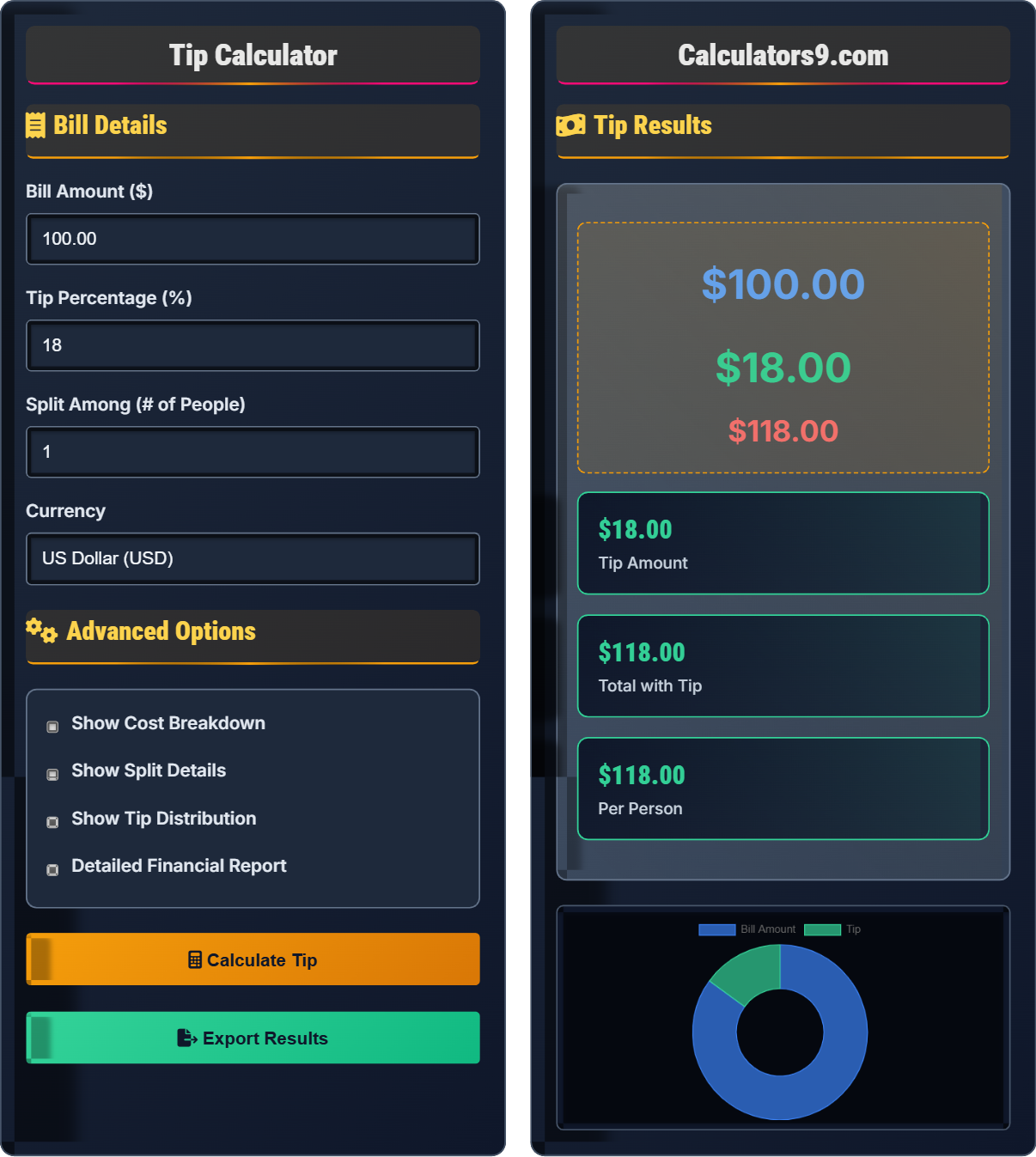
| Item | Amount | Percentage |
|---|---|---|
| Bill Amount | $100.00 | 84.7% |
| Tip | $18.00 | 15.3% |
| Total | $118.00 | 100% |
| Category | Amount | Details |
|---|---|---|
| Base Bill | $100.00 | Original amount |
| Service Fee | $0.00 | Additional charges |
| Tip (18%) | $18.00 | Standard gratuity |
| Total | $118.00 | Final amount |
Tip Calculation Guide
A tip (or gratuity) is a sum of money given to service workers in addition to the basic price of a service. It is typically offered as a sign of appreciation for good service, and is usually calculated as a percentage of the total bill. Tipping customs vary significantly by country, with the United States having one of the highest tipping cultures.
The basic tip calculation formula is:
Where:
- \(Tip\) = Amount to tip
- \(Bill\) = Total bill amount before tip
- \(Percentage\) = Tip percentage (typically 15-25%)
Tipping practices vary by service type:
- Restaurants: 15-25% depending on service quality
- Food Delivery: 10-20% or $2-5 minimum
- Hotel Staff: $2-5 per night for housekeeping
- Taxis/Rideshares: 10-20% of fare
- Salon Services: 15-25% of service cost
- Budgeting: Set aside 15-20% of dining budget for tips
- Splitting: Calculate tip before splitting to ensure fair distribution
- Cash vs Card: Cash tips go directly to service worker
- Group Dining: Consider service charge for parties of 6+
- Round Numbers: Rounding up can simplify mental math
Tip Calculation Learning Quiz
What is the standard tip percentage for good service in restaurants?
The answer is C) 15-20%. In the United States, the standard tip for good service in restaurants is typically 15-20%. This range acknowledges quality service while being reasonable for the customer. 15% is the minimum for acceptable service, while 20% is standard for good service.
Understanding standard tipping percentages is important for social etiquette and financial planning. The 15-20% range is considered standard practice in the U.S., where tipped wages are part of the service industry compensation structure. This differs significantly from many other countries where service charges are included or tipping is less common.
Tip: Gratuity given to service workers in addition to bill
Gratuity: Payment for service quality
Tipped Wages: Minimum wage system where tips supplement earnings
• Standard tip range is 15-20% for good service
• Below 15% indicates poor service
• Above 20% indicates exceptional service
• Remember: 10% = move finger one decimal place left
• 15% = 10% + half of 10%
• 20% = double the 10% amount
• Calculating tip on tax-included amount
• Not considering service quality in tip percentage
• Forgetting to round appropriately for convenience
Calculate the tip for a $85.00 restaurant bill with an 18% tip percentage. Show your work and calculate the total amount.
Step 1: Calculate tip amount
Tip = Bill × (Percentage ÷ 100)
Tip = $85.00 × (18 ÷ 100) = $85.00 × 0.18 = $15.30
Step 2: Calculate total amount
Total = Bill + Tip = $85.00 + $15.30 = $100.30
Therefore, the tip is $15.30 and the total amount is $100.30.
This problem demonstrates the mathematical process of calculating a tip. The key steps involve converting the percentage to a decimal (by dividing by 100) and multiplying by the bill amount. This method works for any tip percentage and bill amount combination.
Decimal Conversion: Converting percentage to decimal (divide by 100)
Percentage: Fraction of 100
Mathematical Process: Systematic approach to calculation
• Convert percentage to decimal before multiplication
• Add tip to original bill for total
• Tip is calculated on pre-tax amount
• 10% = move decimal one place left (e.g., $85.00 → $8.50)
• 18% = 10% + 8% (or 20% - 2%)
• For mental math: round bill to nearest $10
• Multiplying by percentage instead of decimal (e.g., 18 instead of 0.18)
• Forgetting to add tip to original bill
• Including tax in tip calculation
Four friends went to dinner and the total bill was $160.00 before tax. They decided to leave an 18% tip for excellent service. How much should each person pay if they split the bill evenly including the tip?
Step 1: Calculate tip amount
Tip = $160.00 × (18 ÷ 100) = $160.00 × 0.18 = $28.80
Step 2: Calculate total bill with tip
Total = $160.00 + $28.80 = $188.80
Step 3: Divide by number of people
Per person = $188.80 ÷ 4 = $47.20
Each person should pay $47.20 to split the bill evenly including tip.
This example shows how to handle group dining situations. It's important to calculate the tip on the total bill amount first, then divide the total (including tip) by the number of people. This ensures everyone contributes fairly to both the meal cost and the service tip.
Group Dining: Multiple people sharing a bill
Even Split: Equal division of costs
Fair Contribution: Equal payment including tip
• Calculate tip on total bill before splitting
• Divide total (bill + tip) by number of people
• Everyone pays equal share of tip
• Calculate total first, then divide by people
• Consider rounding to make payment easier
• One person can pay total and collect from others
• Dividing bill first, then adding individual tips
• Not including tip in the split calculation
• Calculating different tips per person
You had dinner at a restaurant where the service was exceptional. The bill was $75.00 before tax. The standard tip is 18%, but for exceptional service you decide to tip 22%. Calculate the difference in tip amount between standard and exceptional service, and determine the total bill for each scenario.
Standard tip calculation:
Standard tip = $75.00 × (18 ÷ 100) = $75.00 × 0.18 = $13.50
Standard total = $75.00 + $13.50 = $88.50
Exceptional service tip calculation:
Exceptional tip = $75.00 × (22 ÷ 100) = $75.00 × 0.22 = $16.50
Exceptional total = $75.00 + $16.50 = $91.50
Difference in tip = $16.50 - $13.50 = $3.00
The difference is $3.00 more for exceptional service.
This example demonstrates how tip percentage should reflect service quality. The additional $3.00 represents recognition for exceptional service. Understanding this relationship helps ensure fair compensation for service staff based on their performance.
Service Quality: Level of service provided
Fair Compensation: Payment reflecting service quality
Performance Recognition: Rewarding good service
• Tip percentage should reflect service quality
• 15% = minimum acceptable
• 20%+ = good to exceptional service
• 4% difference in tip = 4% of bill amount
• For $75 bill, 4% = $3.00
• Service quality justifies tip adjustments
• Not adjusting tip for service quality
• Tipping same amount regardless of service
• Over-tipping for average service
Which of the following is NOT a standard tipping practice?
The answer is D) Tipping grocery store cashiers 5% of purchase. Tipping grocery store cashiers is not a standard practice in most places. Unlike restaurants, taxis, and hotels where service quality can vary significantly, grocery store cashiers typically receive full wages and are not dependent on tips for their income.
This question highlights the importance of understanding context-specific tipping practices. Different service industries have different expectations based on their compensation structures and cultural norms. Tipping is generally expected in service industries where workers rely on tips to supplement lower base wages.
Tipping Culture: Social expectations around gratuities
Tipping Culture: Social expectations around gratuities
Industry Standards: Accepted practices within service sectors
Wage Structure: How employees are compensated
• Tipping varies by industry and region
• Service workers often rely on tips
• Not all service positions expect tips
• Research local customs when traveling
• Tipping expected where service is personal
• Many service workers depend on tips
• Tipping in situations where it's not expected
• Not tipping where it's customary
• Confusing service industries with different practices
Tip Basics
Gratuity given to service workers as appreciation.
\(Tip = Bill \times \frac{Percentage}{100}\)
Where Bill=original amount, Percentage=tip rate.
- Standard range is 15-20% for good service
- Tip is calculated on pre-tax amount
- Reflects service quality
Etiquette
Below Average: 10-15%, Standard: 15-18%, Good: 20-22%, Exceptional: 25%+.
- Restaurants: 15-25%
- Delivery: 10-20%
- Hotels: $2-5/night
- Taxis: 10-20%
- Always tip on pre-tax amount
- Consider service quality
- Cash preferred by workers
- Round numbers for convenience
FAQ
Q: Should I tip on tax?
A: No, tip on pre-tax amount. Standard is 15-20% of pre-tax bill for good service.
Q: How much for exceptional service?
A: 20-25% or higher for exceptional service. Consider the effort put into your experience.