Mass Calculator
Weight conversion • BMI calculation • Health metrics
Mass Conversion Formulas:
Show the calculator\( 1 \text{ kg} = 2.20462 \text{ lbs} \)
\( 1 \text{ lbs} = 0.453592 \text{ kg} \)
\( 1 \text{ stone} = 14 \text{ lbs} \)
\( 1 \text{ ton (US)} = 2000 \text{ lbs} \)
\( \text{BMI} = \frac{\text{weight (kg)}}{\text{height (m)}^2} \)
These formulas allow for accurate conversion between different mass units and calculation of Body Mass Index (BMI), a key health metric used to assess whether a person has a healthy body weight for their height.
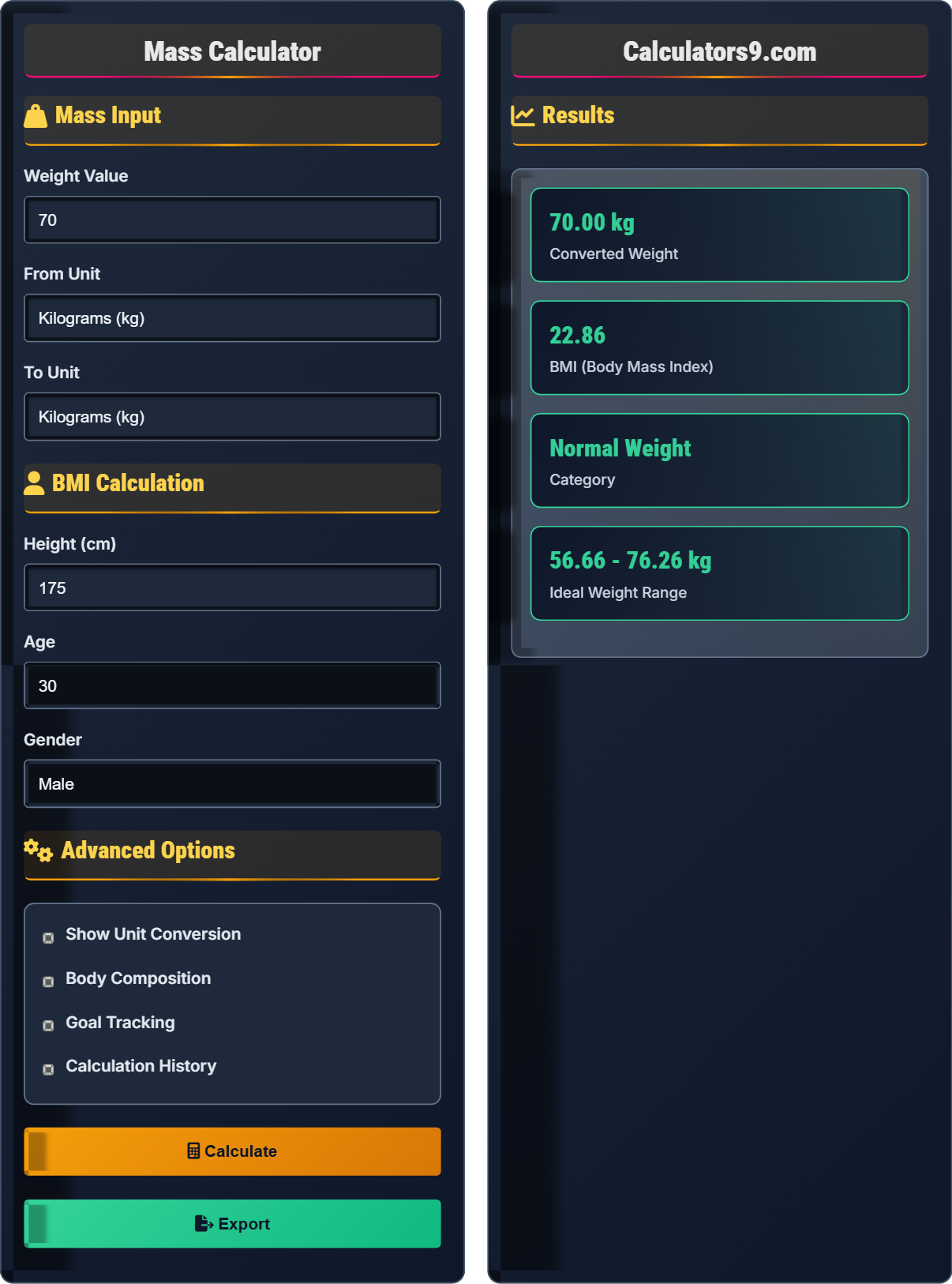
Example: Converting 70 kg to pounds:
\( 70 \text{ kg} \times 2.20462 = 154.32 \text{ lbs} \)
For BMI calculation with 70 kg and 1.75 m height:
\( \text{BMI} = \frac{70}{1.75^2} = \frac{70}{3.0625} = 22.86 \)
Result: Normal weight category (18.5-24.9)
Mass Input
BMI Calculation
Advanced Options
Results
Mass & Weight Fundamentals
Mass is a measure of the amount of matter in an object, independent of gravity. It is measured in kilograms (kg) in the International System of Units. Weight, on the other hand, is the force exerted by gravity on an object and varies depending on gravitational strength.
Key conversion factors:
- 1 kg = 2.20462 lbs
- 1 lbs = 0.453592 kg
- 1 stone = 14 lbs = 6.35029 kg
- 1 ton (US) = 2000 lbs = 907.185 kg
- Mass remains constant regardless of location
- Weight changes with gravitational force
- SI unit for mass is kilogram
- Always specify units in calculations
BMI Categories
Body Mass Index categories according to WHO standards:
\( \text{BMI} = \frac{\text{weight (kg)}}{\text{height (m)}^2} \)
Or: \( \text{BMI} = \frac{\text{weight (lbs)} \times 703}{\text{height (in)}^2} \)
- Underweight: BMI < 18.5
- Normal weight: BMI 18.5-24.9
- Overweight: BMI 25-29.9
- Obesity Class I: BMI 30-34.9
- Obesity Class II: BMI 35-39.9
- Obesity Class III: BMI ≥ 40
Mass & Health Learning Quiz
How many pounds are equivalent to 85 kilograms?
The correct answer is A) 187.39 lbs. To convert kilograms to pounds, we use the conversion factor: 1 kg = 2.20462 lbs. Therefore: 85 kg × 2.20462 = 187.39 lbs.
Unit conversion is fundamental in health measurements. The conversion factor between kilograms and pounds is fixed at 2.20462. When converting from kg to lbs, you multiply by this factor. When converting from lbs to kg, you divide by this factor. This relationship is consistent across all mass measurements.
Kilogram (kg): SI unit of mass, defined as the mass of the international prototype kilogram
Pound (lb): Imperial unit of mass, equal to 0.45359237 kg
Conversion Factor: A number used to change one set of units to another
• 1 kg = 2.20462 lbs
• 1 lb = 0.453592 kg
• Always verify units match the required format
• Remember: kg to lbs = multiply by 2.2
• lbs to kg = divide by 2.2
• Use online calculators for verification
• Confusing mass and weight
• Using incorrect conversion factors
• Forgetting to specify units
Calculate the BMI for a person who weighs 75 kg and is 1.70 meters tall. What category does this BMI fall into?
Using the BMI formula: BMI = weight(kg) / height(m)²
Step 1: BMI = 75 / (1.70)²
Step 2: BMI = 75 / 2.89
Step 3: BMI = 25.95
According to WHO standards, a BMI of 25.95 falls into the "Overweight" category (BMI 25-29.9).
BMI is calculated by dividing weight in kilograms by the square of height in meters. The formula is dimensionally consistent and provides a standardized measure of body fatness. The result is interpreted against established ranges to assess health risks associated with weight.
BMI (Body Mass Index): A person's weight in kilograms divided by the square of height in meters
Dimensional Analysis: The study of relationships between physical quantities by identifying their base quantities
WHO Standards: World Health Organization guidelines for BMI categories
• Always square the height in meters
• Use consistent units (kg and m)
• Interpret results against WHO ranges
• Remember: BMI = kg/m²
• Height must be in meters, not cm
• Convert cm to m by dividing by 100
• Forgetting to square the height
• Using centimeters instead of meters
• Misinterpreting the result category
A person is 1.65 meters tall. Calculate their ideal weight range using the normal BMI range (18.5-24.9). What is the minimum and maximum healthy weight for this person?
Using the BMI formula rearranged: Weight = BMI × Height²
Step 1: Calculate minimum weight (BMI = 18.5)
Weight_min = 18.5 × (1.65)² = 18.5 × 2.7225 = 50.37 kg
Step 2: Calculate maximum weight (BMI = 24.9)
Weight_max = 24.9 × (1.65)² = 24.9 × 2.7225 = 67.79 kg
Therefore, the ideal weight range for this person is 50.37 kg to 67.79 kg.
This problem demonstrates how BMI can be used in reverse to calculate ideal weight ranges. By using the lower and upper bounds of the normal BMI range (18.5-24.9), we can determine the weight range that would correspond to a healthy BMI for a given height.
Ideal Weight Range: The weight range corresponding to a healthy BMI for a given height
Rearrangement: Algebraic manipulation of formulas to solve for different variables
Healthy BMI: The range considered optimal for health (18.5-24.9)
• Use BMI formula rearranged: Weight = BMI × Height²
• Apply both bounds of normal range
• Results provide a weight range, not a single value
• Always use the same units for height
• Calculate both bounds for complete range
• Express answer as a range, not a single number
• Only calculating one bound of the range
• Forgetting to square the height in calculations
• Using incorrect BMI ranges
Sarah weighs 85 kg and is 1.68 m tall. She wants to reach a BMI of 22.0. How much weight does she need to lose? What will be her target weight?
Step 1: Calculate Sarah's current BMI
BMI_current = 85 / (1.68)² = 85 / 2.8224 = 30.12 (Obese)
Step 2: Calculate target weight for BMI = 22.0
Weight_target = 22.0 × (1.68)² = 22.0 × 2.8224 = 62.09 kg
Step 3: Calculate weight to lose
Weight_loss = 85 - 62.09 = 22.91 kg
Sarah needs to lose approximately 22.9 kg to reach her target BMI of 22.0.
This application problem combines BMI calculation with weight loss planning. It demonstrates how BMI can be used as a goal-setting tool in health management. By determining the target weight needed to achieve a specific BMI, individuals can set concrete, measurable goals for weight management.
Target BMI: The desired BMI value for health goals
Weight Management: The practice of achieving and maintaining a healthy body weight
Health Goals: Specific, measurable objectives related to improving health outcomes
• Calculate current BMI first
• Use target BMI to find target weight
• Subtract to find weight loss needed
• Set realistic BMI targets (18.5-24.9)
• Calculate progress percentage regularly
• Consider other health metrics alongside BMI
• Setting unrealistic BMI targets
• Not accounting for muscle mass vs. fat
• Ignoring other health indicators
How many ounces are equivalent to 2.5 stone? (Note: 1 stone = 14 lbs, 1 lb = 16 oz)
The correct answer is B) 560 oz. First convert stone to pounds: 2.5 stone × 14 lbs/st = 35 lbs. Then convert pounds to ounces: 35 lbs × 16 oz/lb = 560 oz.
This problem demonstrates multi-step unit conversions. When converting between units that are not directly related, you must go through intermediate units. Here, stone must first be converted to pounds, then pounds to ounces. The key is to identify the conversion path and apply the appropriate conversion factors sequentially.
Multi-step Conversion: A conversion that requires multiple steps through intermediate units
Conversion Path: The sequence of units used to convert from the starting unit to the ending unit
Intermediate Unit: A unit used temporarily in a multi-step conversion
• Identify the conversion path first
• Apply conversion factors sequentially
• Verify units cancel appropriately
• Write out the conversion chain
• Cancel units as you go
• Double-check each step
• Skipping intermediate steps
• Using incorrect conversion factors
• Mixing up multiplication and division
FAQ
Q: Is BMI an accurate measure of health?
A: BMI is a useful screening tool but has limitations. It measures weight relative to height but doesn't distinguish between muscle and fat mass. For example, a muscular athlete might have a high BMI but low body fat percentage.
Mathematically, BMI is calculated as: \( \text{BMI} = \frac{\text{weight (kg)}}{\text{height (m)}^2} \)
Despite its limitations, BMI remains valuable because it correlates with body fat percentage and health risks in most populations. For more accurate assessments, consider combining BMI with other measures like waist circumference, body fat percentage, and metabolic markers.
Q: How much weight should I aim to lose per week?
A: Health experts recommend losing 1-2 pounds (0.45-0.9 kg) per week for sustainable weight loss. This translates to a calorie deficit of 3,500-7,000 calories per week, or 500-1,000 calories per day.
For example, if you currently weigh 80 kg and want to reach 70 kg, that's a 10 kg (22 lb) goal. At 1 lb/week, this would take approximately 22 weeks or 5.5 months.
Rapid weight loss (more than 2 lbs/week) can lead to muscle loss, nutritional deficiencies, and difficulty maintaining the weight loss long-term.