Shoe Size Calculator
International size converter & foot measurement • 2026 edition
Shoe Size Conversion Formula:
Show the calculator\( \text{EU Size} = \text{Foot Length (cm)} \times 1.5 - 2 \)
\( \text{US Men Size} = \text{Foot Length (cm)} \times 0.787 - 22.5 \)
\( \text{UK Size} = \text{US Size} - 0.5 \)
\( \text{CM} = \text{Foot Length (inches)} \times 2.54 \)
This formula converts between different international shoe sizing systems. The conversion factors account for different starting points and increments used in various countries. These approximations help standardize measurements across different sizing standards, though manufacturers may have slight variations.
Example: For a foot length of 26.5 cm:
EU Size: 26.5 × 1.5 - 2 = 39.75 - 2 = 37.75 ≈ 38
US Men Size: 26.5 × 0.787 - 22.5 = 20.86 - 22.5 = -1.64 ≈ 9.5
Therefore, a 26.5 cm foot length corresponds to approximately EU size 38, US size 9.5.
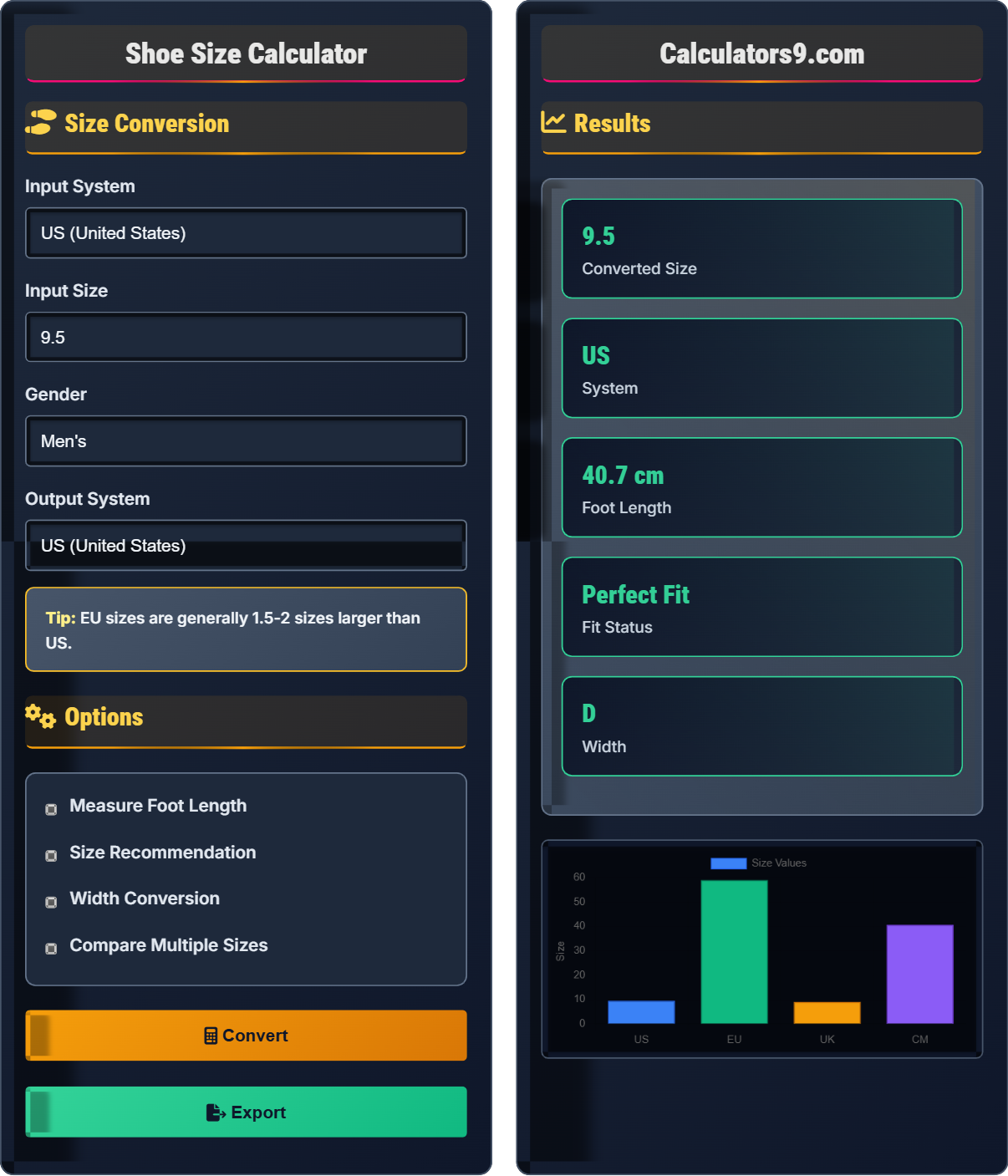
Size Conversion
Options
Results
| System | Size | Equivalent | Notes |
|---|
| Activity | Recommendation | Size Adjustment | Reason |
|---|
Comprehensive Shoe Size Guide
Shoe sizing is a standardized system used to indicate the length and width of shoes to ensure proper fit. Different countries and regions use different sizing systems, which can make international shopping challenging. Understanding these systems helps consumers select appropriate footwear and manufacturers create consistent sizing standards.
The standard shoe size conversion formulas are:
These formulas provide approximate conversions between different sizing systems. Note that actual conversions may vary slightly between manufacturers and shoe types.
Accurate shoe fitting requires precise foot measurement:
- Measure at end of day: Feet swell throughout the day
- Stand while measuring: Weight affects foot shape
- Measure both feet: Feet are rarely identical
- Use the longer foot: Fit to the larger foot
- Leave room: 1-1.5 cm space at toe for comfort
- Try on shoes: Never buy without testing fit
- Check width: Width is as important as length
- Walk around: Test in store before purchasing
- Consider activity: Sports shoes may need different fit
- Seasonal changes: Feet may swell in heat
Shoe Sizing Basics
Standardized measurement indicating shoe dimensions.
\( \text{EU Size} \approx \text{Foot Length (cm)} \times 1.5 - 2 \)
Result expressed in various international systems.
- US Men = EU - 33 (approximate)
- UK = US - 0.5 (men), US - 1 (women)
- Measure in afternoon when feet are largest
Strategies
Convert between international sizing systems.
- Identify input system (US, EU, UK, etc.)
- Apply appropriate conversion formula
- Account for gender differences
- Verify accuracy with reference chart
- Manufacturers may vary from standard
- Width measurements also important
- Activity-specific sizing recommendations
- Brand-specific size charts
Shoe Size Learning Quiz
What is the approximate US men's size for EU size 42?
The answer is C) 9.5. Using the standard conversion:
US Size ≈ EU Size - 32.5
US Size ≈ 42 - 32.5 = 9.5
This is the standard conversion used by most manufacturers, though individual brands may vary slightly.
This problem demonstrates the standard conversion between EU and US shoe sizes. The key insight is that EU sizes are generally larger than US sizes by about 32.5 points for men. This conversion factor accounts for the different starting points and increment systems used in each sizing standard. The approximation is necessary because the exact conversion involves more complex formulas based on foot length.
Shoe Sizing System: Standardized method for indicating shoe dimensions
Conversion Factor: Number used to convert between sizing systems
Approximation: Close but not exact mathematical relationship
• EU ≈ US + 32.5 (men's sizes)
• EU ≈ US + 30.5 (women's sizes)
• Always try shoes before purchasing
• Remember: EU sizes are larger than US
• Women's US sizes are typically 1.5 sizes larger than men's
• Check brand-specific size charts for accuracy
• Confusing men's and women's size conversions
• Assuming exact mathematical conversions are always accurate
• Not accounting for brand variations
A person's foot measures 25.4 cm in length. What is their approximate EU size? Show your work.
Step 1: Use the EU size formula
EU Size ≈ Foot Length (cm) × 1.5 - 2
Step 2: Apply the formula
EU Size ≈ 25.4 × 1.5 - 2
EU Size ≈ 38.1 - 2
EU Size ≈ 36.1
Step 3: Round to standard size
EU Size ≈ 36
Therefore, the person's foot length of 25.4 cm corresponds to approximately EU size 36.
This problem demonstrates how to convert from actual foot measurement to shoe size. The formula EU Size ≈ Foot Length × 1.5 - 2 is based on the European sizing system where each size corresponds to approximately 6.67mm (2/3 cm) of foot length. The constant of -2 accounts for the different starting points of the sizing systems. This direct measurement approach is more accurate than conversion from other sizing systems.
Direct Measurement: Measuring actual foot dimensions
Paris Points: European unit of measurement (2/3 cm)
Size Increment: Distance between consecutive sizes
• EU = Foot Length × 1.5 - 2
• Always measure foot in centimeters
• Round to nearest standard size
• Measure foot in afternoon when swollen
• Use ruler or measuring tape for accuracy
• Consider both length and width for fit
• Using inches instead of centimeters
• Forgetting to subtract the constant
• Not accounting for width measurements
Sarah wears US women's size 8.5. She wants to order shoes from a European retailer that only lists sizes in EU sizing. What EU size should she order? (Note: US women's sizes are typically 1.5 sizes larger than men's sizes)
Step 1: Convert US women's to US men's equivalent
US Men's Size = US Women's Size - 1.5
US Men's Size = 8.5 - 1.5 = 7
Step 2: Convert US men's to EU size
EU Size ≈ US Men's Size + 32.5
EU Size ≈ 7 + 32.5 = 39.5
Step 3: Round to standard size
EU Size ≈ 40
Therefore, Sarah should order EU size 40.
This problem demonstrates the complexity of international shoe shopping when dealing with gender-specific sizing differences. The key is to first convert to the equivalent men's size (since the conversion formula is typically based on men's sizes), then apply the standard conversion. This multi-step process ensures accuracy when converting between international sizing systems that may have different gender-based standards.
Gender Conversion: Adjusting for men's vs women's sizing differences
International Shopping: Purchasing from retailers using different sizing systems
Equivalent Sizing: Matching sizes across different systems
• Women's = Men's + 1.5 (US system)
• EU ≈ US + 32.5 (for men's)
• Always check brand-specific charts
• Convert to men's size first for consistency
• Check return policy before ordering
• Consider width as well as length
• Forgetting gender conversion factor
• Applying men's conversion to women's sizes directly
• Not accounting for brand variations
John normally wears US men's size 10. He wants to buy running shoes. How should he adjust his size for optimal running shoe fit? Explain the reasoning.
For running shoes, John should consider going up 0.5 to 1 size from his normal size.
Recommended size: US 10.5 or US 11
Reasoning:
• Running causes feet to swell during exercise
• Downward toe movement during running requires extra space
• Sweating can cause feet to expand slightly
• Proper running shoe fit prevents blisters and injuries
Therefore, John should try size 10.5 first, and if needed, size 11 for longer runs.
This problem addresses the practical application of shoe sizing beyond basic conversion. Different activities have different fit requirements. Running shoes need extra room in the toe box to accommodate the downward pressure and swelling that occurs during running. This is an important consideration for athletic performance and injury prevention, demonstrating that proper sizing involves more than just length measurements.
Activity-Specific Sizing: Adjusting size for particular activities
Toe Box Space: Room in front of toes for comfort
Performance Fit: Size optimized for specific activity
• Running shoes: +0.5 to 1 size
• Dress shoes: Exact fit preferred
• Athletic shoes: Prioritize comfort over fashion fit
• Try on shoes with activity-appropriate socks
• Leave thumb-width space at toe
• Consider width as well as length
• Using same size for all activities
• Not accounting for foot swelling during activity
• Prioritizing appearance over function
Which of the following is NOT a standard shoe width measurement?
The answer is D) L (Large). Standard US shoe width measurements include:
• B (Narrow) for women, D (Medium) for men
• C/D (Medium-Wide)
• E (Wide)
• EE (Extra Wide)
• EEE (Triple Wide)
The letter "L" is not a standard width designation in US shoe sizing. Width is measured in letters, not size categories like "large".
This question addresses the often-overlooked aspect of shoe width sizing. While most people focus on length, width is equally important for proper fit. US width sizing uses letters that increase with width, with D being standard for men and B for women. Understanding width options helps achieve better overall fit and comfort, especially for people with wider or narrower feet than average.
Width Sizing: Measurement of shoe width
Standard Width: D for men, B for women
Width Increments: Each letter represents about 3.175mm difference
• Width increases with alphabet letters
• D is standard for men, B for women
• Each width letter = ~3.175mm difference
• Check width if length fits but feels tight
• Many brands offer width options
• Width can vary significantly between brands
• Only considering length when buying shoes
• Assuming all brands use same width measurements
• Not understanding width letter system
FAQ
Q: Why do shoe sizes vary between brands?
A: Shoe sizes vary between brands due to several factors:
Construction Differences: Some brands build shoes with more internal space, different lasts (foot-shaped molds), or thicker insoles.
Target Market: Brands may size differently for specific demographics (e.g., athletic vs. casual wear).
Manufacturing Standards: While sizing systems provide guidelines, exact interpretations vary by manufacturer.
Regional Standards: Even within a country, different manufacturers may follow slightly different interpretations of sizing standards.
This is why it's essential to try shoes on before purchasing and to consult brand-specific size charts when shopping online.
Q: How do I measure my foot length accurately for shoe fitting?
A: For accurate foot measurement:
Timing: Measure in the afternoon when feet are naturally more swollen.
Position: Stand on a flat surface with full weight on the foot.
Technique: Use a ruler or measuring tape from the heel to the longest toe (usually the big toe).
Footwear: Measure with the type of socks you'll wear with the shoes.
Both Feet: Measure both feet and use the larger measurement.
Marking: Use a pencil to mark the heel and longest toe on paper, then measure the distance between marks.
This method provides the most accurate measurement for proper shoe fitting.