Weight Calculator
Weight converter & health tracker • 2026 edition
Weight Conversion Formula:
Show the calculator\( \text{Weight in kg} = \text{Weight in lbs} \times 0.45359237 \)
\( \text{Weight in lbs} = \text{Weight in kg} \times 2.20462262 \)
\( \text{Weight in g} = \text{Weight in kg} \times 1000 \)
\( \text{BMI} = \frac{\text{Weight in kg}}{(\text{Height in meters})^2} \)
This formula converts between different weight measurement systems. The conversion factor of 0.45359237 kg per pound is based on the international standard definition. These formulas allow for accurate conversion between imperial (pounds) and metric (kilograms) systems.
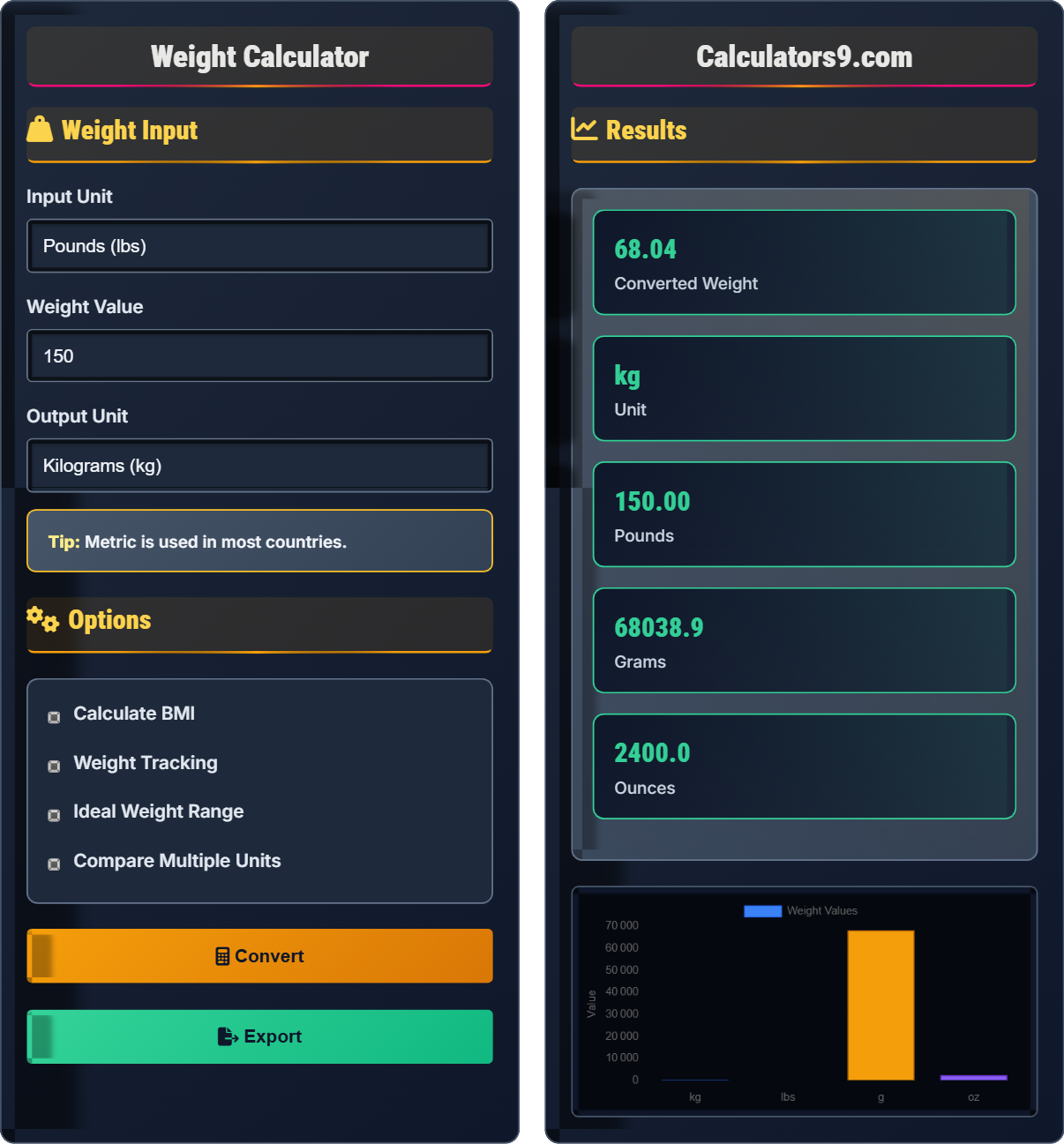
Example: Converting 150 lbs to kilograms:
Weight in kg = 150 × 0.45359237 = 68.04 kg
Therefore, 150 lbs equals 68.04 kg.
Weight Input
Options
Results
| Unit | Value | Equivalent | Notes |
|---|
| Health Metric | Value | Range | Status |
|---|
Comprehensive Weight Measurement Guide
Weight is the measurement of gravitational force acting on an object. In the context of human health, body weight is a fundamental metric used in medicine, nutrition, and fitness. Accurate weight measurement requires proper technique and standardized equipment to ensure reliability and comparability across measurements.
The standard weight conversion formulas are:
Where:
- \( 1 \text{ lb} = 0.45359237 \text{ kg} \) (exact conversion)
- \( 1 \text{ kg} = 2.20462262 \text{ lbs} \)
- \( 1 \text{ kg} = 1000 \text{ g} \)
Proper weight measurement requires specific techniques for accuracy:
- Calibrated Scale: Digital or mechanical scale calibrated to national standards
- Consistent Conditions: Same time of day, same clothing, same scale
- Proper Positioning: Center of scale platform, feet flat, standing still
- Timing: Weight varies throughout the day due to hydration and food intake
- Body Mass Index (BMI): Weight (kg) / Height (m)² - indicates weight status
- Healthy Range: BMI 18.5-24.9 for adults
- Medical Monitoring: Significant changes may indicate health conditions
- Target Goals: Sustainable weight loss is 1-2 lbs per week
Weight Measurement Basics
Force exerted by gravity on an object's mass.
\( \text{kg} = \text{lbs} \times 0.45359237 \)
Result expressed in various units (lbs, kg, g, oz).
- 1 lb = 0.45359237 kg (exact)
- 1 kg = 1000 g
- 1 oz = 28.35 g
Strategies
Convert between imperial and metric systems.
- Identify input unit (lbs, kg, g, oz)
- Apply appropriate conversion factor
- Calculate equivalent value
- Verify accuracy of result
- Imperial system: pounds and ounces
- Metric system: kilograms and grams
- Most countries use metric system
- Accuracy requires precise conversion factors
Weight Measurement Learning Quiz
How many kilograms are in 200 pounds?
The answer is A) 90.72 kg. Here's the calculation:
Weight in kg = Weight in lbs × 0.45359237
Weight in kg = 200 × 0.45359237 = 90.718474 kg
Rounded to 2 decimal places: 90.72 kg
This problem demonstrates the fundamental conversion between pounds and kilograms. The conversion factor 0.45359237 is an exact value defined by international standards. It's important to use this precise value for accurate conversions. The result shows that pounds are heavier units than kilograms, so the numerical value in kilograms is smaller than in pounds.
Unit Conversion: Changing from one measurement unit to another
Conversion Factor: Ratio used to convert between units
International Standard: Globally accepted measurement definitions
• 1 lb = 0.45359237 kg (exact)
• Multiply pounds by conversion factor
• Round to appropriate decimal places
• Remember: 1 kg ≈ 2.2 lbs
• For quick estimate: divide lbs by 2.2
• Use calculator for exact conversions
• Using incorrect conversion factor (like 0.45 or 0.5)
• Dividing instead of multiplying
• Forgetting to use exact conversion factor
Convert 75 kg to pounds. Show your work.
Step 1: Use the conversion formula
Weight in lbs = Weight in kg × 2.20462262
Step 2: Apply the formula
Weight in lbs = 75 × 2.20462262 = 165.3466965 lbs
Step 3: Round to appropriate precision
75 kg = 165.35 lbs (rounded to 2 decimal places)
This problem demonstrates the reverse conversion from metric to imperial units. We use the reciprocal of the pound-to-kilogram conversion factor. Since 1 kg = 2.20462262 lbs, we multiply kilograms by this factor to get pounds. The result shows that the numerical value in pounds is larger than in kilograms because pounds are smaller units.
Reciprocal Factor: Inverse of the original conversion factor
Decimal Places: Number of digits after decimal pointPrecision: Accuracy of measurement
• 1 kg = 2.20462262 lbs
• Multiply kg by conversion factor
• Round to 2 decimal places for weight
• Remember: kg → lbs = multiply by 2.2
• lbs → kg = multiply by 0.45
• Verify with approximation (75 × 2.2 ≈ 165)
• Using wrong conversion factor direction
• Dividing instead of multiplying
• Forgetting to round appropriately
Person A weighs 160 lbs and Person B weighs 70 kg. Who is heavier and by how much in grams?
Step 1: Convert 160 lbs to kg
160 lbs × 0.45359237 = 72.5747792 kg
Step 2: Compare weights
Person A: 72.57 kg
Person B: 70.00 kg
Person A is heavier
Step 3: Calculate difference in grams
Difference: 72.57 - 70.00 = 2.57 kg
Convert to grams: 2.57 kg × 1000 = 2,570 g
Therefore, Person A is heavier by 2,570 grams.
This problem requires converting between different units to make a direct comparison. Both weights must be in the same unit for comparison. After determining the difference in kilograms, we convert to grams since the question asks for the difference in grams. This demonstrates the importance of unit consistency in comparisons.
Unit Consistency: Using the same units for comparison
Gram: 1/1000 of a kilogram
Direct Comparison: When measurements are in same units
• Convert to same unit before comparing
• 1 kg = 1000 g
• Use exact conversion factors
• Convert both measurements to metric for easier comparison
• Keep extra decimal places during intermediate steps
• Verify with approximate conversions
• Comparing different units without conversion
• Forgetting to convert final answer to requested unit
• Using wrong conversion factor
A person weighs 180 lbs and is 5'10" tall. Calculate their BMI. Is it in the healthy range? (Healthy BMI: 18.5-24.9)
Step 1: Convert weight to kg
180 lbs × 0.45359237 = 81.65 kg
Step 2: Convert height to meters
5'10" = (5 × 12) + 10 = 70 inches
70 inches × 2.54 cm/inch = 177.8 cm = 1.778 meters
Step 3: Calculate BMI
BMI = Weight (kg) ÷ Height (m)²
BMI = 81.65 ÷ (1.778)² = 81.65 ÷ 3.161 = 25.83
Step 4: Assess health status
BMI of 25.83 is above the healthy range of 18.5-24.9, indicating overweight status.
This problem combines weight conversion with BMI calculation, showing how weight measurements are used in health assessments. BMI is calculated as weight in kilograms divided by height in meters squared. The result of 25.83 indicates the person is in the overweight category according to standard BMI classifications.
BMI: Body Mass Index - weight relative to height
Overweight: BMI between 25.0-29.9
Healthy Range: BMI between 18.5-24.9
• BMI = kg ÷ m²
• Height must be in meters
• Weight must be in kilograms
• Always convert to metric units for BMI
• Remember: 1 inch = 2.54 cm
• BMI is only one health indicator
• Forgetting to convert to metric units
• Squaring height in wrong units
• Misremembering BMI ranges
According to health experts, what is a safe and sustainable rate of weight loss?
The answer is A) 1-2 lbs per week. Health experts, including the CDC and American Heart Association, recommend losing 1-2 lbs per week for sustainable weight loss. This rate allows for healthy changes in diet and exercise habits while preserving muscle mass. Faster weight loss often leads to regain and can be unhealthy.
This question addresses the practical application of weight measurement in health management. The recommended rate of 1-2 lbs per week is based on research showing this pace allows for sustainable lifestyle changes. At this rate, a person would lose 4-8 lbs in a month, which is considered both safe and achievable for most people.
Sustainable Weight Loss: Long-term weight reduction that can be maintained
Safe Rate: Speed that preserves health and prevents muscle loss
Lifestyle Changes: Permanent modifications to eating and exercise habits
• Safe rate: 1-2 lbs per week
• Gradual changes are more sustainable
• Rapid weight loss often causes regain
• Focus on consistent small changes
• Combine diet and exercise for best results
• Track progress with accurate measurements
• Expecting rapid weight loss results
• Following unsustainable extreme diets
• Not tracking weight accurately
FAQ
Q: How often should I weigh myself for accurate tracking?
A: For accurate weight tracking:
Frequency: Once a week at most, ideally at the same time of day (morning after using the bathroom is best).
Reasoning: Daily fluctuations of 2-4 lbs are normal due to water retention, food intake, and hormonal changes. Weekly weighing provides a more accurate trend than daily weigh-ins.
Best Practices: Use the same calibrated scale, wear similar clothing (or none), and don't obsess over small daily changes. Focus on the overall trend over 2-4 weeks.
Research shows that frequent weighing can lead to unnecessary stress and obsession with numbers rather than focusing on healthy behaviors.
Q: What's the difference between mass and weight in medical contexts?
A: Technically, there's an important distinction:
Mass: The amount of matter in an object, measured in kilograms (kg). This is constant regardless of location (Earth, Moon, space).
Weight: The force exerted by gravity on an object's mass, measured in Newtons (N). This varies with gravitational strength.
On Earth's surface, mass and weight are proportional (W = mg, where g = 9.8 m/s²), so they're often used interchangeably in daily life. However, in medical contexts, "body weight" technically refers to mass, which is why we measure in kilograms rather than Newtons.
For practical purposes in medicine, body weight refers to the mass measurement, and both terms are used synonymously.