pH Calculator
Acid-base equilibrium & concentration tool • 2026 edition
pH Formula:
Show the calculator\( \text{pH} = -\log_{10}[\text{H}^+] \)
\( \text{pOH} = -\log_{10}[\text{OH}^-] \)
\( \text{pH} + \text{pOH} = 14 \)
\( [\text{H}^+] = 10^{-\text{pH}} \)
These formulas define the relationship between hydrogen ion concentration and pH. The pH scale measures acidity/basicity on a logarithmic scale from 0 to 14. A pH of 7 is neutral, values below 7 are acidic, and values above 7 are basic. The logarithmic nature means each pH unit represents a tenfold change in hydrogen ion concentration.
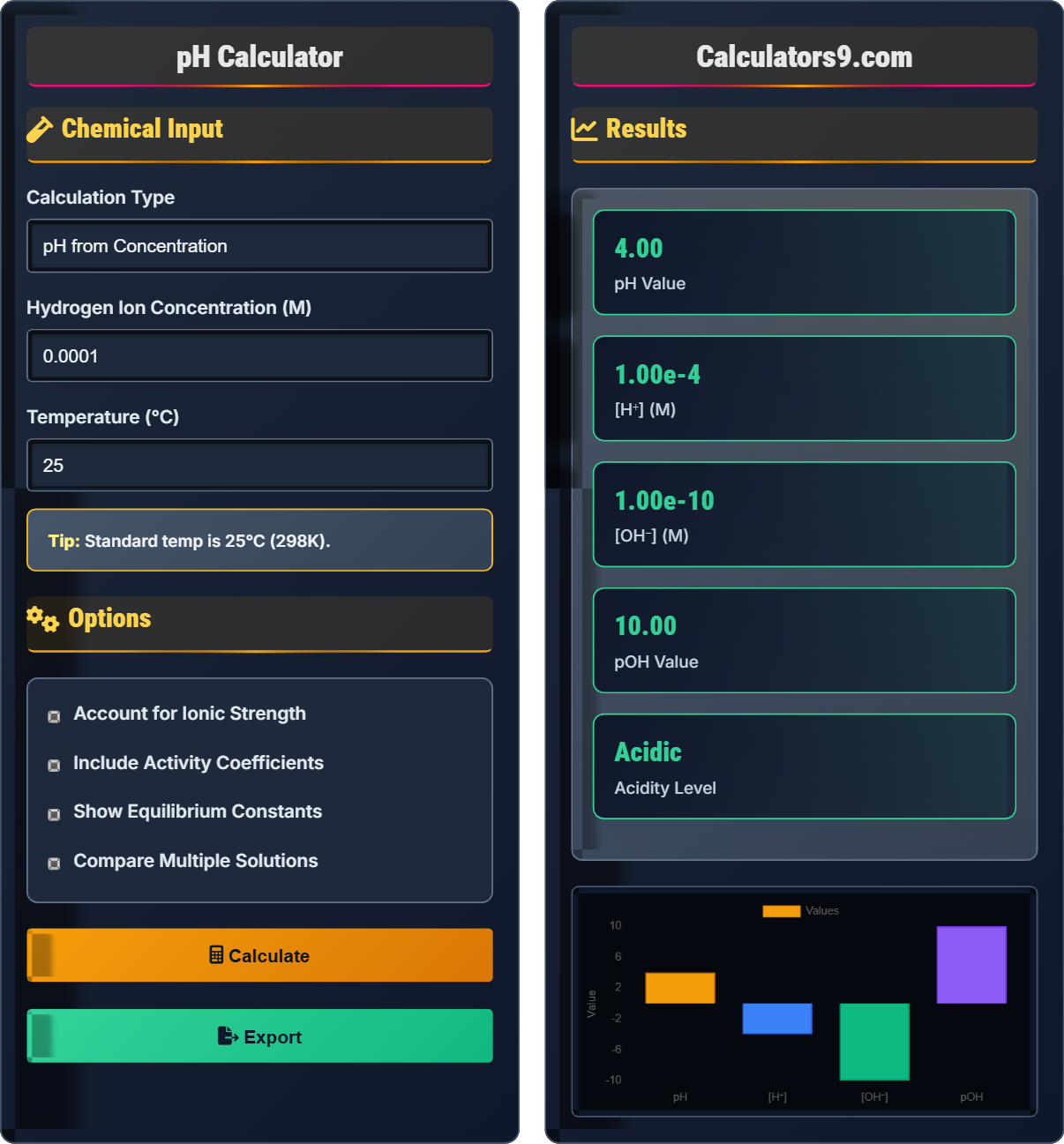
Example: For a solution with [H⁺] = 1.0 × 10⁻⁴ M:
pH = -log₁₀(1.0 × 10⁻⁴) = -(-4) = 4
Therefore, the solution has a pH of 4 (acidic).
Chemical Input
Options
Results
| Parameter | Value | Unit | Significance |
|---|
| Constant | Value | Temperature | Application |
|---|
Comprehensive pH Calculation Guide
pH is a measure of the acidity or basicity of an aqueous solution. It quantifies the concentration of hydrogen ions (H⁺) in a solution on a logarithmic scale from 0 to 14. The pH scale is fundamental in chemistry, biology, environmental science, and industrial processes. Understanding pH is crucial for controlling chemical reactions, biological processes, and environmental conditions.
The fundamental pH calculation formulas are:
Where:
- \( [\text{H}^+] \) = hydrogen ion concentration in moles per liter
- \( [\text{OH}^-] \) = hydroxide ion concentration in moles per liter
- \( \text{pH} \) = measure of acidity (0-14)
Different methods are used for calculating pH depending on the type of solution:
- Strong Acids/Bases: Complete dissociation, pH = -log[H⁺] or pOH = -log[OH⁻]
- Weak Acids/Bases: Partial dissociation using equilibrium constants (Ka/Kb)
- Buffers: Henderson-Hasselbalch equation: pH = pKa + log([A⁻]/[HA])
- Salts: Hydrolysis reactions affecting pH
- Temperature Consideration: Kw (water's ionization constant) changes with temperature
- Activity vs. Concentration: For concentrated solutions, use activity coefficients
- Significant Figures: pH values should have decimal places matching significant figures in concentration
- Equilibrium Assumptions: Verify if approximations are valid for weak acids/bases
- Buffer Capacity: Effective buffers have comparable acid/base concentrations
pH Basics
Measure of hydrogen ion concentration in solution.
\( \text{pH} = -\log_{10}[\text{H}^+] \)
Result expressed on 0-14 scale (logarithmic).
- pH 7 = Neutral (at 25°C)
- pH < 7 = Acidic
- pH > 7 = Basic
- Each unit = 10x change in [H⁺]
Strategies
Choose calculation method based on acid/base strength.
- Identify acid/base type (strong/weak)
- Determine dissociation behavior
- Apply appropriate formula
- Verify assumptions (if any)
- Strong acids: [H⁺] = initial acid concentration
- Weak acids: Use Ka and equilibrium expression
- Temperature affects Kw value
- Concentration affects accuracy of approximations
pH Calculation Learning Quiz
What is the pH of a solution with [H⁺] = 1.0 × 10⁻³ M?
The answer is B) 3.0. Using the pH formula:
pH = -log₁₀[H⁺]
pH = -log₁₀(1.0 × 10⁻³)
pH = -(-3) = 3
Therefore, the pH is 3.0.
This problem demonstrates the fundamental pH calculation using the logarithmic relationship. The key insight is that the pH equals the negative exponent of the hydrogen ion concentration when expressed in scientific notation. Since the concentration is 1.0 × 10⁻³ M, the pH is simply 3. This logarithmic relationship means that each whole number difference in pH represents a tenfold change in hydrogen ion concentration.
Hydrogen Ion Concentration: [H⁺] in moles per liter
Logarithmic Scale: Each unit represents a power of 10
Acidic Solution: pH < 7
• pH = -log₁₀[H⁺]
• For 1.0 × 10⁻ⁿ M, pH = n
• Lower pH = more acidic
• For 1.0 × 10⁻ⁿ, pH = n
• For 2.0 × 10⁻ⁿ, use calculator
• Remember: 10⁻³ = 0.001
• Forgetting the negative sign in the formula
• Confusing pH with pOH
• Not recognizing logarithmic nature
Calculate the hydrogen ion concentration of a solution with pH = 5.5. Show your work.
Step 1: Use the inverse of the pH formula
pH = -log₁₀[H⁺]
Therefore: [H⁺] = 10⁻ᵖᴴ
Step 2: Apply the formula
[H⁺] = 10⁻⁵·⁵
Step 3: Calculate
[H⁺] = 3.16 × 10⁻⁶ M
Therefore, the hydrogen ion concentration is 3.16 × 10⁻⁶ M.
This problem demonstrates the inverse relationship between pH and hydrogen ion concentration. When given pH, we use the exponential function to find [H⁺]. The key is remembering that pH is the negative logarithm of [H⁺], so to go from pH to [H⁺], we raise 10 to the negative pH power. This inverse relationship is crucial for understanding how pH measurements relate to actual ion concentrations.
Inverse Relationship: pH and [H⁺] are inversely related
Exponential Function: 10ˣ function to reverse logarithm
Scientific Notation: Expressing very small numbers
• [H⁺] = 10⁻ᵖᴴ
• Use scientific notation for small numbers
• Verify result makes sense (pH 5.5 should be 10⁻⁵ to 10⁻⁶ M)
• Use calculator's 10ˣ function
• For pH = n.0, [H⁺] = 1.0 × 10⁻ⁿ
• For fractional pH, use calculator
• Forgetting to make exponent negative
• Using natural log instead of base-10 log
• Incorrectly handling decimal pH values
A buffer solution contains 0.1 M acetic acid (CH₃COOH) and 0.1 M sodium acetate (CH₃COONa). The pKa of acetic acid is 4.76. What is the pH of this buffer solution?
Step 1: Identify the buffer components
Acid: CH₃COOH (0.1 M)
Conjugate base: CH₃COO⁻ from NaCH₃COO (0.1 M)
Step 2: Apply Henderson-Hasselbalch equation
pH = pKa + log([A⁻]/[HA])
Step 3: Substitute values
pH = 4.76 + log(0.1/0.1)
pH = 4.76 + log(1)
pH = 4.76 + 0 = 4.76
Therefore, the pH of the buffer solution is 4.76.
This problem demonstrates the Henderson-Hasselbalch equation for buffer solutions. When the acid and conjugate base concentrations are equal, the log term becomes zero, making the pH equal to the pKa. This is a special case where the buffer has maximum capacity to resist pH changes. Buffers are crucial in biological systems and laboratory applications where stable pH is essential.
Buffer Solution: Resists pH changes upon addition of acid/base
Conjugate Base: Base formed when acid donates H⁺
Henderson-Hasselbalch: Equation for buffer pH calculation
• pH = pKa + log([base]/[acid])
• Equal concentrations: pH = pKa
• Maximum buffering capacity at pH = pKa
• When [acid] = [base], pH = pKa
• Buffer works best within 1 pH unit of pKa
• Concentrations cancel when equal
• Confusing acid and base concentrations in ratio
• Using Ka instead of pKa in formula
• Forgetting to take logarithm
Calculate the pH of a 0.005 M HCl solution. HCl is a strong acid that completely dissociates in water.
Step 1: Determine H⁺ concentration
Since HCl is a strong acid, it completely dissociates:
HCl → H⁺ + Cl⁻
Therefore: [H⁺] = [HCl] = 0.005 M
Step 2: Apply pH formula
pH = -log₁₀[H⁺]
pH = -log₁₀(0.005)
Step 3: Calculate
0.005 = 5 × 10⁻³
pH = -log₁₀(5 × 10⁻³) = -[log₁₀(5) + log₁₀(10⁻³)] = -[0.699 + (-3)] = -(-2.301) = 2.301
Therefore, the pH is approximately 2.30.
This problem demonstrates pH calculation for strong acids. Strong acids completely dissociate in water, meaning all acid molecules release H⁺ ions. Therefore, the hydrogen ion concentration equals the initial acid concentration. This simplification is valid for strong acids like HCl, HNO₃, and H₂SO₄, but not for weak acids that only partially dissociate.
Strong Acid: Completely dissociates in solution
Dissociation: Breaking apart into ions
Complete Ionization: 100% of molecules ionize
• For strong acids: [H⁺] = initial acid concentration
• Common strong acids: HCl, HBr, HI, HNO₃, H₂SO₄, HClO₄
• No equilibrium calculation needed
• Remember: Strong acids → complete dissociation
• [H⁺] = original acid concentration
• Check if acid is listed as strong
• Treating strong acid as weak acid
• Using equilibrium constants for strong acids
• Forgetting to convert to scientific notation
Which of the following statements about pH is TRUE?
The answer is B) A solution with pH 3 is 1000 times more acidic than pH 6. Because the pH scale is logarithmic, each unit represents a tenfold difference in hydrogen ion concentration. The difference between pH 3 and pH 6 is 3 units, so the concentration difference is 10³ = 1000 times.
This question tests understanding of the logarithmic nature of the pH scale. Since pH = -log₁₀[H⁺], a difference of n pH units corresponds to a 10ⁿ difference in hydrogen ion concentration. This exponential relationship means that small changes in pH represent large changes in acidity. This is why pH is so important in biological and environmental systems where small pH changes can have significant effects.
Logarithmic Scale: Each unit represents a power of 10
Acidity: Concentration of H⁺ ions
Concentration Ratio: Multiplicative difference
• Each pH unit = 10x change in [H⁺]
• Difference of n units = 10ⁿ difference in concentration
• Lower pH = higher acidity
• For pH difference of n, concentration difference is 10ⁿ
• pH 1 = 10x more acidic than pH 2
• pH 1 = 100x more acidic than pH 3
• Thinking pH difference is linear (not exponential)
• Confusing additive vs. multiplicative relationships
• Forgetting the logarithmic nature of pH scale
FAQ
Q: How do I calculate pH for weak acids when the approximation isn't valid?
A: For weak acids where the approximation [H⁺] ≈ √(Ka × [HA]₀) isn't valid (when Ka is large or acid concentration is small), you must solve the full quadratic equation:
Starting with: Ka = [H⁺][A⁻]/[HA]
And: [HA] = [HA]₀ - [H⁺], [A⁻] = [H⁺]
This gives: Ka = [H⁺]²/([HA]₀ - [H⁺])
Rearranging: [H⁺]² + Ka[H⁺] - Ka[HA]₀ = 0
Using the quadratic formula: [H⁺] = (-Ka + √(Ka² + 4Ka[HA]₀))/2
Then: pH = -log₁₀[H⁺]
Use this method when [H⁺]/[HA]₀ > 0.05 (5% rule is violated).
Q: How does temperature affect pH calculations?
A: Temperature significantly affects pH calculations through its impact on water's ionization constant (Kw). At 25°C, Kw = 1.0 × 10⁻¹⁴, making neutral pH = 7.0. However:
• At 0°C: Kw ≈ 0.114 × 10⁻¹⁴, neutral pH ≈ 7.5
• At 50°C: Kw ≈ 5.47 × 10⁻¹⁴, neutral pH ≈ 6.6
• At 100°C: Kw ≈ 51.3 × 10⁻¹⁴, neutral pH ≈ 6.0
The relationship changes because water auto-ionization is endothermic. Additionally, acid and base dissociation constants (Ka and Kb) also vary with temperature, affecting the pH of solutions. For precise calculations, always specify the temperature and use temperature-corrected equilibrium constants.