Conversion Calculator
Unit conversion tool • 2026 edition
Unit Conversion Formulas:
Convert UnitsTemperature: C = (F - 32) × 5/9, F = (C × 9/5) + 32
Length: 1 inch = 2.54 cm, 1 mile = 1.609 km
Weight: 1 kg = 2.205 lbs, 1 lb = 453.592 g
Volume: 1 gal = 3.785 L, 1 qt = 0.946 L
Where:
- C = Celsius temperature
- F = Fahrenheit temperature
- Conversion Factor = Ratio between units
- Base Unit = Standard unit of measurement
These formulas convert measurements between different unit systems. The conversion factor is the multiplier needed to change from one unit to another.
Example: To convert 100°F to Celsius:
C = (100 - 32) × 5/9 = 68 × 5/9 ≈ 37.78°C
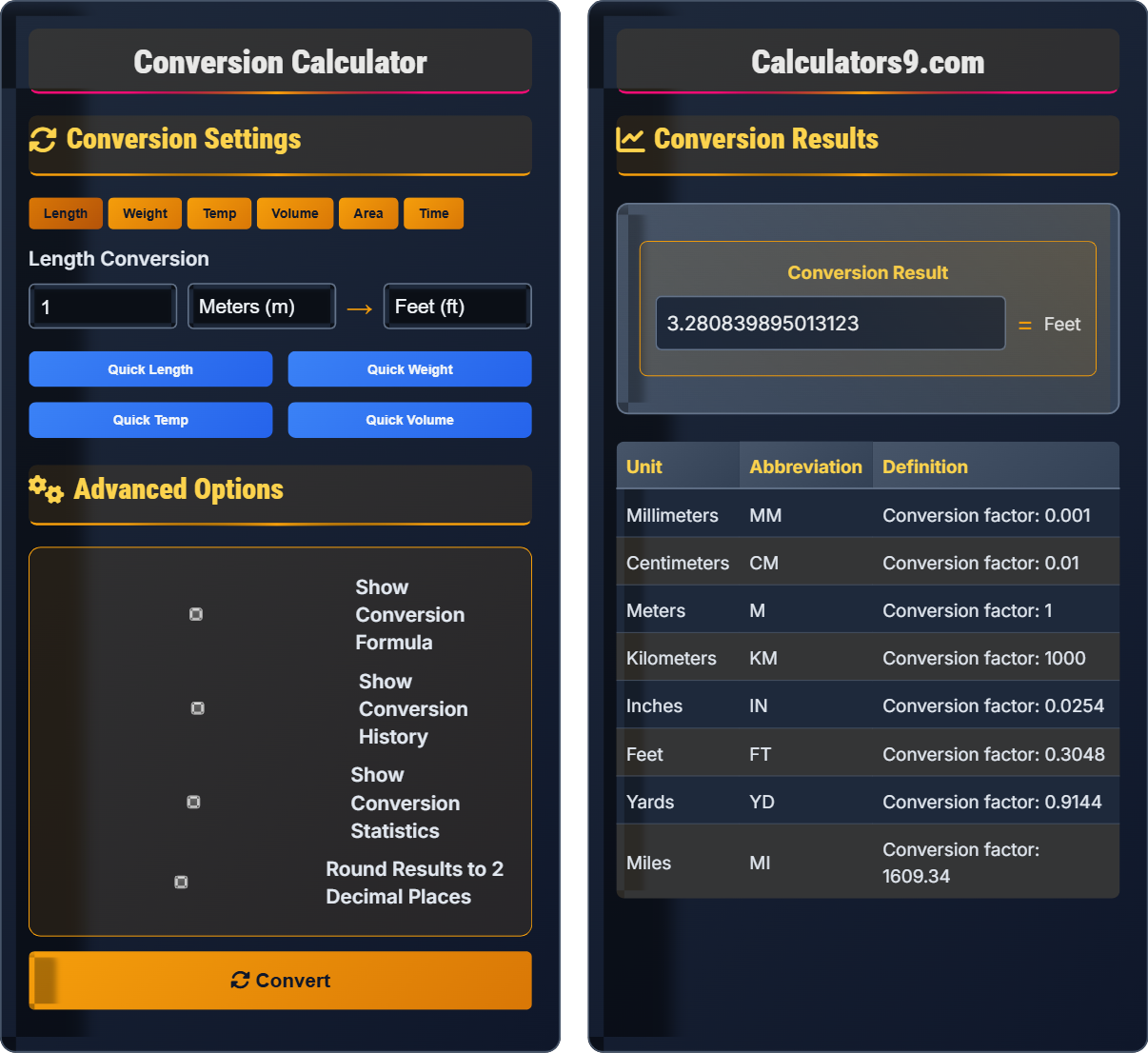
Conversion Settings
Advanced Options
Conversion Results
| Unit | Abbreviation | Definition |
|---|---|---|
| Meter | m | Base unit of length in SI system |
| Foot | ft | Imperial unit of length (12 inches) |
| Kilogram | kg | Base unit of mass in SI system |
| Pound | lb | Imperial unit of mass (453.592 g) |
Unit Conversion Fundamentals
Unit conversion is the process of changing a quantity from one unit of measurement to another while preserving the same physical value.
Converted Value = Original Value × Conversion Factor
Where conversion factor = New Unit / Old Unit.
- Conversion factor is the ratio between units
- Multiplication converts from base unit
- Division converts to base unit
- Always verify units cancel correctly
Common Conversions
Length: m↔ft, km↔mi; Weight: kg↔lb; Temperature: C↔F; Volume: L↔gal
- Dimensional analysis
- Conversion factors
- Unit cancellation
- Reference tables
- SI units are international standard
- Imperial units used in US
- Always specify units clearly
- Check for rounding errors
Unit Conversion Learning Quiz
How many feet are in 10 yards?
The answer is B) 30 feet. The conversion factor between yards and feet is 1 yard = 3 feet. Therefore, 10 yards × 3 feet/yard = 30 feet.
Unit conversion uses dimensional analysis. We multiply by a conversion factor that equals 1 but changes the units. In this case: 10 yards × (3 feet/1 yard) = 30 feet. The "yards" unit cancels out, leaving "feet".
Unit Conversion: Changing measurement units while preserving value
Conversion Factor: Ratio of equivalent measurements
Dimensional Analysis: Method using unit cancellation
• Multiply by conversion factor equal to 1
• Units cancel out appropriately
• 1 yard = 3 feet = 36 inches
• Remember: 1 foot = 12 inches, 1 yard = 3 feet
• Use dimensional analysis for complex conversions
• Forgetting conversion factors
• Incorrect unit cancellation
Convert 100°C to Fahrenheit using the conversion formula. Show all steps and explain the mathematical reasoning.
The formula to convert Celsius to Fahrenheit is: F = (C × 9/5) + 32
Step 1: Substitute the Celsius value into the formula
F = (100 × 9/5) + 32
Step 2: Perform multiplication inside parentheses
F = (180) + 32
Step 3: Add the constant
F = 212°F
Therefore, 100°C = 212°F.
The Celsius and Fahrenheit scales have different zero points and degree intervals. The conversion formula accounts for both differences: multiplying by 9/5 adjusts for the different degree sizes, and adding 32 adjusts for the different zero points.
Celsius Scale: Water freezes at 0°C, boils at 100°C
Fahrenheit Scale: Water freezes at 32°F, boils at 212°F
Conversion Formula: Mathematical relationship between scales
• C to F: F = (C × 9/5) + 32
• F to C: C = (F - 32) × 5/9
• Kelvin: K = C + 273.15
• Remember: C and F are equal at -40°
• Fahrenheit degrees are smaller than Celsius degrees
• Forgetting to add 32 in C to F conversion
• Mixing up the order of operations
Unit Conversion FAQ
Q: What's the difference between mass and weight, and why does it matter in conversions?
A: Mass and weight are fundamentally different:
Mass:
• Measure of matter in an object
• Constant regardless of location
• Measured in kilograms (kg) or pounds-mass (lbm)
• SI base unit: kilogram
Weight:
• Force exerted by gravity on mass
• Varies with gravitational field strength
• Measured in Newtons (N) or pounds-force (lbf)
• Formula: Weight = Mass × Gravity
This distinction matters because a person's mass (70 kg) remains constant on Earth and Mars, but their weight would be different due to different gravitational forces.
Q: How do I ensure accuracy when performing multiple unit conversions?
A: Follow these best practices for accurate conversions:
1. Use dimensional analysis: Multiply by conversion factors that equal 1
2. Cancel units systematically: Ensure unwanted units cancel out
3. Verify significant figures: Maintain appropriate precision
4. Double-check conversion factors: Use reliable references
5. Estimate reasonableness: Check if result makes sense
Example: Converting 100 mph to m/s:
100 mph × (1609 m/1 mi) × (1 hr/3600 s) = 44.7 m/s
Notice how "miles" and "hours" cancel, leaving meters per second.