Dice Roller
Virtual dice simulator • 2026 edition
Dice Probability Formula:
Roll DiceP(X) = \(\frac{1}{n}\)
Where:
- P(X) = probability of rolling a specific number
- n = number of sides on the die
- d4 = 4-sided die (tetrahedron)
- d6 = 6-sided die (cube)
- d8 = 8-sided die (octahedron)
- d10 = 10-sided die (pentagonal trapezohedron)
- d12 = 12-sided die (dodecahedron)
- d20 = 20-sided die (icosahedron)
This formula calculates the probability of rolling a specific number on a fair die. Each face has an equal chance of appearing.
Example: For a standard 6-sided die:
P(rolling a 3) = \(\frac{1}{6}\) ≈ 16.67%
For multiple dice, probabilities become more complex, following binomial distribution patterns.
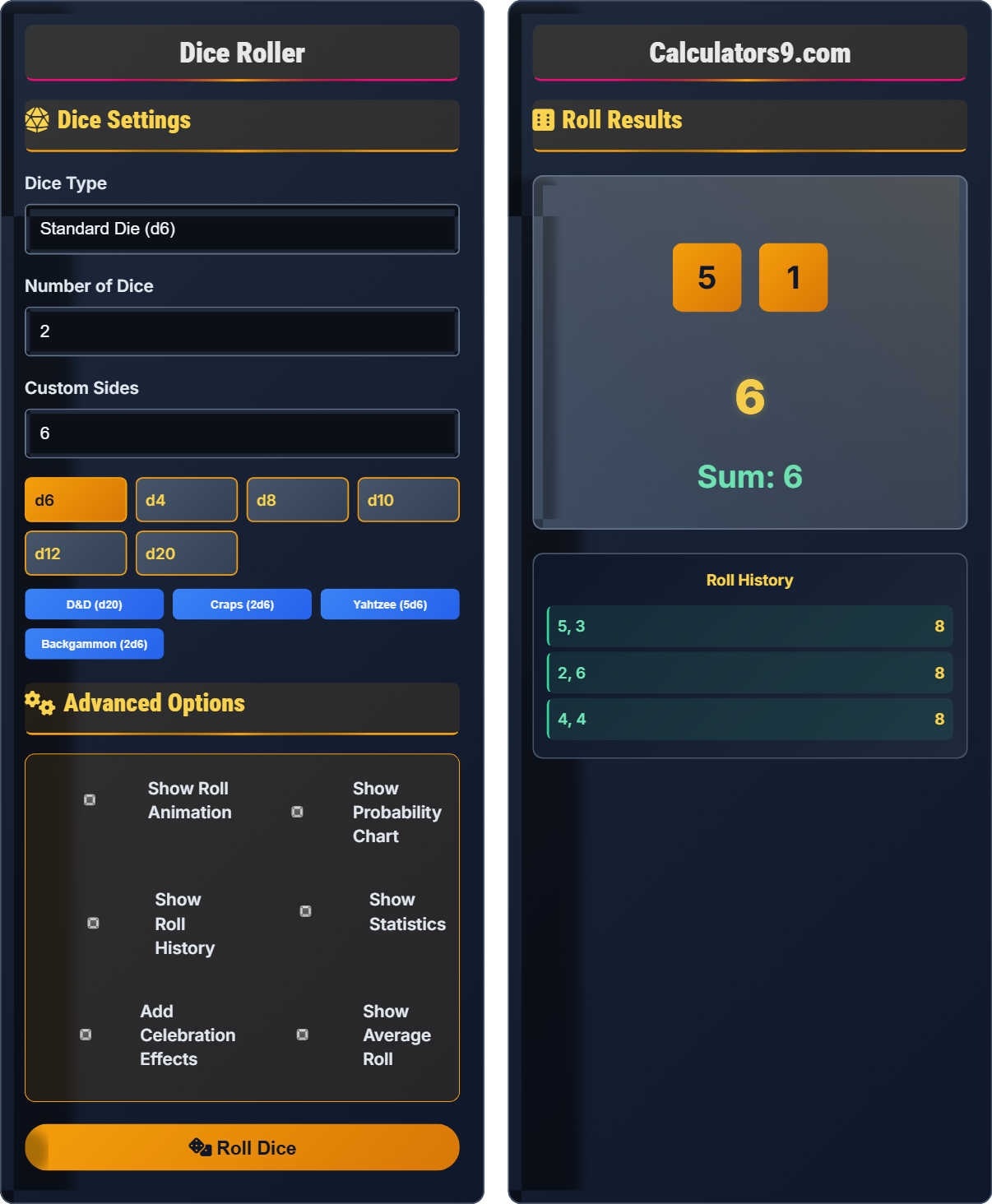
Dice Settings
Advanced Options
Roll Results
Dice Rolling Fundamentals
Dice probability is the likelihood of rolling a specific outcome. For a fair die, each side has an equal chance of appearing.
P(X) = \(\frac{1}{n}\)
Where n is the number of sides on the die.
- Each die roll is independent
- Expected value = \(\frac{n+1}{2}\) for n-sided die
- Multiple dice follow binomial distribution
- Law of large numbers applies over time
Dice Types
d4, d6, d8, d10, d12, d20 - Standard polyhedral dice used in gaming.
- Board games and RPGs
- Probability education
- Decision making
- Random selection
- Fair dice have equal probability
- Weighted dice alter outcomes
- More dice = more complex probability
- Expected value increases with sides
Dice Probability Learning Quiz
What is the probability of rolling a 6 on a standard 6-sided die?
The answer is A) 1/6 ≈ 16.67%. For a standard 6-sided die, there is 1 favorable outcome (rolling a 6) out of 6 possible outcomes (1, 2, 3, 4, 5, 6). Using the probability formula: P(rolling a 6) = 1/6 ≈ 0.1667 or 16.67%.
Probability is calculated as the number of favorable outcomes divided by the total number of possible outcomes. For a fair die, each side has an equal chance of appearing, so the probability of any specific number is always 1/n, where n is the number of sides.
Probability: Likelihood of a specific outcome occurring
Favorable Outcome: The desired result in an experiment
Sample Space: All possible outcomes of an experiment
• P(X) = Favorable Outcomes / Total Outcomes
• Each die roll is independent
• Fair dice have equal probability for each side
• Remember: 1/n for each side of an n-sided die
• Convert fractions to percentages: 1/6 = 16.67%
• Forgetting that each side has equal probability
• Confusing total possible outcomes
Calculate the probability of rolling exactly two 6's when rolling three 6-sided dice simultaneously. Explain the calculation process.
This follows a binomial probability distribution. We need exactly 2 successes (rolling a 6) in 3 trials (rolls), with success probability p = 1/6.
Formula: P(k successes in n trials) = C(n,k) × p^k × (1-p)^(n-k)
Where C(n,k) is the combination formula: n!/(k!(n-k)!)
Calculation:
C(3,2) = 3!/(2!(3-2)!) = 6/(2×1) = 3
p^k = (1/6)^2 = 1/36
(1-p)^(n-k) = (5/6)^1 = 5/6
P(exactly 2 sixes) = 3 × (1/36) × (5/6) = 15/216 ≈ 6.94%
When rolling multiple dice, we use the binomial probability formula. The combination C(n,k) counts the number of ways to arrange k successes in n trials. The probability is the product of getting k successes and (n-k) failures in any order.
Binomial Distribution: Probability of k successes in n independent trials
Combination: C(n,k) = n!/(k!(n-k)!) - number of ways to choose k items from n
Independent Events: Each die roll doesn't affect others
• Use binomial formula for multiple dice
• Each die roll is independent
• Total possible outcomes = n^number_of_dice
• C(n,k) tells you arrangement possibilities
• p^k × (1-p)^(n-k) gives probability of specific sequence
• Forgetting to account for arrangements (combinations)
• Treating multiple dice as dependent events
Dice Probability FAQ
Q: What's the difference between rolling 2d6 and rolling 1d12 in terms of probability distribution?
A: The key difference lies in the probability distribution:
Rolling 2d6 (two 6-sided dice):
• Possible sums: 2 to 12
• Distribution: Bell curve (more likely to get middle values)
• Most common sum: 7 (6 ways to achieve: 1+6, 2+5, 3+4, 4+3, 5+2, 6+1)
• Least common: 2 and 12 (only 1 way each)
Rolling 1d12 (one 12-sided die):
• Possible values: 1 to 12
• Distribution: Uniform (each value equally likely)
• Each number has 1/12 ≈ 8.33% probability
2d6 creates more predictable results centered around 7, while 1d12 offers completely random outcomes across the range.
Q: How does the law of large numbers apply to dice rolling?
A: The law of large numbers states that as the number of trials increases, the average of the results approaches the expected value.
For a standard 6-sided die:
• Expected value = (1+2+3+4+5+6)/6 = 3.5
• After 10 rolls, average might vary significantly
• After 1000 rolls, average will be very close to 3.5
This principle explains why casinos always win in the long run - while individual outcomes are unpredictable, the aggregate results converge to mathematical expectations. It's why gambling houses can rely on consistent profits despite occasional large payouts.