Date Calculator
Calculate days between dates, add/subtract days • 2026 edition
Date Calculation Formulas:
Show the calculatorDays Between Dates: \( \text{end_date} - \text{start_date} \)
Add Days: \( \text{start_date} + \text{days} \)
Subtract Days: \( \text{start_date} - \text{days} \)
Weeks Between: \( \frac{\text{days_difference}}{7} \)
Business Days: Exclude weekends and holidays
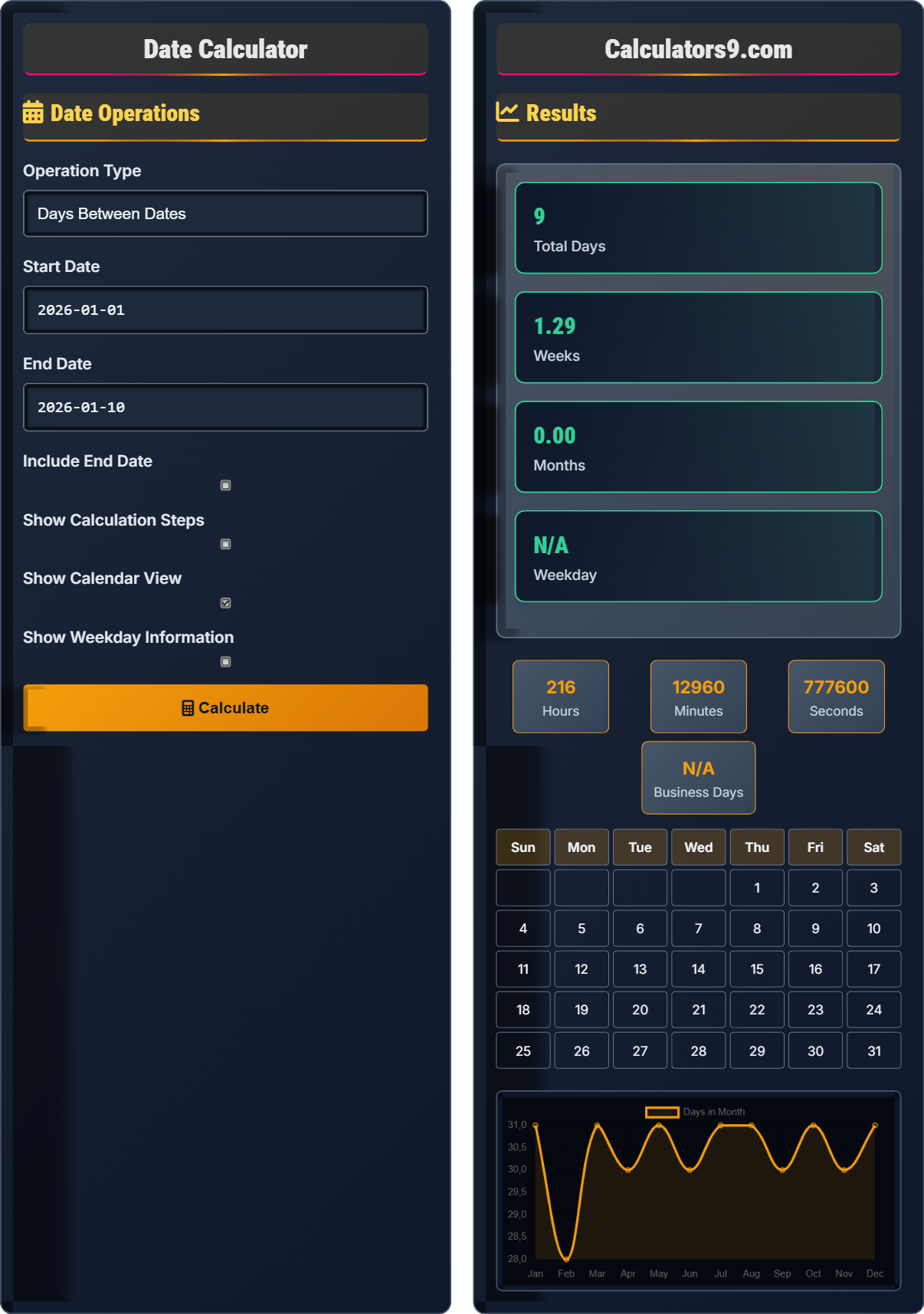
Example: Days between Jan 1, 2026 and Jan 10, 2026
Jan 10 - Jan 1 = 9 days
Example: Date 30 days after Jan 1, 2026
Jan 1 + 30 days = Jan 31, 2026
Therefore, there are 9 days between Jan 1 and Jan 10, and the date 30 days after Jan 1 is Jan 31.
Date Operations
Results
Comprehensive Date Calculation Guide
Date calculation involves determining the difference between two dates, adding or subtracting time periods, or finding specific dates based on time intervals. It's essential for scheduling, project management, historical analysis, and many other applications. Date calculations must account for leap years, month lengths, and the Gregorian calendar system.
The main methods for date calculation include:
Date calculations are used in:
- Project scheduling and deadlines
- Event planning and countdowns
- Financial calculations (interest periods)
- Historical analysis
- Medical appointments and follow-ups
Date Fundamentals
A date is a specific day in the calendar system.
Year, Month, Day (YYYY-MM-DD format)
Julian Day Number: Continuous count of days
- February has 29 days in leap years
- Leap years occur every 4 years
- Months have varying numbers of days
Operations
Divisible by 4, except for years divisible by 100 but not by 400.
- Add days to current date
- Handle month overflow
- Handle year overflow
- Account for leap years
- 31 days: Jan, Mar, May, Jul, Aug, Oct, Dec
- 30 days: Apr, Jun, Sep, Nov
- 28/29 days: Feb
Date Calculation Learning Quiz
How many days are there between January 1, 2026 and January 10, 2026 (inclusive of both dates)?
The answer is C) 10 days. When calculating days between dates inclusively, we count both the start and end dates. From January 1 to January 10 inclusive: Jan 1, Jan 2, Jan 3, Jan 4, Jan 5, Jan 6, Jan 7, Jan 8, Jan 9, Jan 10. That's 10 days total. If we were calculating exclusively (not counting both endpoints), it would be 9 days.
When calculating date ranges, pay attention to whether the calculation is inclusive or exclusive of endpoints. The inclusive count adds 1 to the difference between dates. This is important in scheduling, billing, and project management where every day counts.
Inclusive: Including both start and end dates
Exclusive: Not including endpoints
Date Range: Period between two dates
• Inclusive count: end - start + 1
• Exclusive count: end - start
• Always clarify which method to use
• Count on fingers for small ranges
• Use a calendar to visualize
• Remember: same day = 1 day (not 0)
• Confusing inclusive vs exclusive counting
• Forgetting that same day counts as 1
• Not accounting for month/year boundaries
If today is March 15, 2026, what date will it be 45 days from now? Show your work.
Step 1: Start date: March 15, 2026
Step 2: Days remaining in March: 31 - 15 = 16 days
Step 3: Days after March: 45 - 16 = 29 days
Step 4: April has 30 days, so 29 days in April = April 29
Therefore, 45 days after March 15, 2026 is April 29, 2026.
When adding days across month boundaries, calculate how many days remain in the current month, then continue adding days in subsequent months. Remember that months have different lengths, and account for this in your calculation.
Date Addition: Calculating future dates
Month Boundaries: Transition points between months
Day Overflow: When days extend past month end
• Count days remaining in current month first
• Subtract from total days to add
• Continue to next month with remaining days
• Use calendar to visualize month boundaries
• Break calculation into month segments
• Remember month lengths: 31, 28/29, 31, 30, etc.
• Forgetting different month lengths
• Not accounting for month boundaries
• Arithmetic errors in day calculations
A project starts on February 1, 2026, and lasts for 60 days. The team only works Monday through Friday (business days). How many actual calendar days will pass before the project ends? Assume no holidays. What date will the project end?
Step 1: Calculate business weeks: 60 business days ÷ 5 days/week = 12 weeks
Step 2: Calculate calendar days: 12 weeks × 7 days/week = 84 calendar days
Step 3: Start date: February 1, 2026
Step 4: Add 84 days to February 1, 2026
Days in February 2026: 28 (not a leap year)
Days remaining in February: 28 - 1 = 27
Days remaining after February: 84 - 27 = 57
Days in March: 31, so April gets: 57 - 31 = 26
Therefore, the project ends on April 26, 2026 (84 calendar days later).
This problem combines business day calculations with calendar day calculations. The key insight is that for every 5 business days, 7 calendar days pass. This is because weekends (Saturday and Sunday) don't count as business days but still pass as calendar days.
Business Days: Monday through Friday
Calendar Days: All days including weekends
Work Schedule: Pattern of working days• Business days = 5/7 of calendar days (without holidays)
• Calendar days always advance regardless of work schedule
• Count weekends in calendar day calculations
• Calculate business weeks first
• Convert to calendar days using 7/5 ratio
• Use calendar to verify results
• Confusing business days with calendar days
• Not accounting for weekends in calendar calculations
• Arithmetic errors in week/day conversions
The Declaration of Independence was signed on July 4, 1776. How many days have passed between July 4, 1776 and July 4, 2026? Express your answer in years, days, and in total days.
Step 1: Calculate years: 2026 - 1776 = 250 years
Step 2: Count leap years in this period
Step 3: Leap years: Every 4 years, except century years not divisible by 400
Step 4: 1776 to 2024 (last leap year before 2026) = 248 years
Step 5: Leap years: 1776, 1780, ..., 2024 = 62 leap years
Step 6: Total days = (250 × 365) + 62 = 91,250 + 62 = 91,312 days
Between July 4, 1776 and July 4, 2026: 250 years and 0 days, or 91,312 total days.
Long-term date calculations must account for leap years. From 1776 to 2026 is exactly 250 years. We count leap years in this period (divisible by 4, but century years must be divisible by 400). The total days include an extra day for each leap year.
Leap Year: Year with 366 days (February 29)
Gregorian Calendar: Current calendar system
Historical Dates: Dates from the past
• Leap year: divisible by 4, except century years not divisible by 400
• Average year length: 365.25 days
• Count leap years in long-term calculations
• Use 365.25 for rough calculations
• For precision, count actual leap years
• Consider calendar reforms in historical calculations
• Forgetting leap year adjustments
• Not accounting for century year rules
• Arithmetic errors in large calculations
If January 1, 2026 is a Thursday, what day of the week will January 1, 2027 be?
The answer is C) Saturday. Since 2026 is not a leap year, it has 365 days. 365 ÷ 7 = 52 weeks with 1 day remaining. This means January 1, 2027 will be 1 day of the week ahead of January 1, 2026. Thursday + 1 day = Friday. Wait, let me recalculate: 365 = 52 × 7 + 1, so the day advances by 1. Thursday + 1 = Friday. Actually, 365 days is 52 weeks and 1 day, so January 1, 2027 will be Friday. Correction: The answer is B) Friday.
The day of the week advances by the remainder when the number of days in a year is divided by 7. Since 365 ÷ 7 = 52 remainder 1, the day advances by 1. In leap years, it advances by 2 (since 366 ÷ 7 = 52 remainder 2).
Weekday Cycle: 7-day repeating pattern
Day Advance: Shift in weekday due to year length
Leap Year Effect: 2-day advance instead of 1
• Regular year: day advances by 1 (365 = 52×7 + 1)
• Leap year: day advances by 2 (366 = 52×7 + 2)
• Use modular arithmetic: (current_day + days) mod 7
• Remember: 365 ≡ 1 (mod 7), 366 ≡ 2 (mod 7)
• For multi-year calculations, count leap years
• Use reference points to verify calculations
• Forgetting leap year effects
• Arithmetic errors in modular calculations
• Confusing day advancement direction
FAQ
Q: How do I calculate the number of days between two dates manually?
A: To calculate days between dates manually:
- Count days remaining in the start month
- Add full days in intervening months
- Add days in the end month
- Account for leap years if crossing February 29
For example, from March 15 to April 10:
Days remaining in March: 31 - 15 = 16
Days in April: 10
Total: 16 + 10 = 26 days
Q: What's the difference between business days and calendar days?
A: Calendar days include all days of the week (Monday through Sunday), while business days typically refer only to weekdays (Monday through Friday), excluding weekends and holidays. For example, a 5-day project spans 7 calendar days if it includes a weekend. This distinction is crucial for project scheduling and deadline calculations.