Day Counter Calculator
Date difference & countdown tool • 2026 edition
Day Counter Formula:
Show the calculator\( \text{Days Difference} = \left| \frac{\text{End Date} - \text{Start Date}}{86400 \text{ seconds}} \right| \)
\( \text{Julian Day Number} = \text{floor}(365.25 \times (\text{year} + 4716)) + \text{floor}(30.6001 \times (\text{month} + 1)) + \text{day} - 1524.5 \)
This formula calculates the absolute number of days between two dates by finding the difference in their Julian Day Numbers. The Julian Day Number system assigns a continuous count of days since January 1, 4713 BCE, allowing for precise date calculations across different calendar systems.
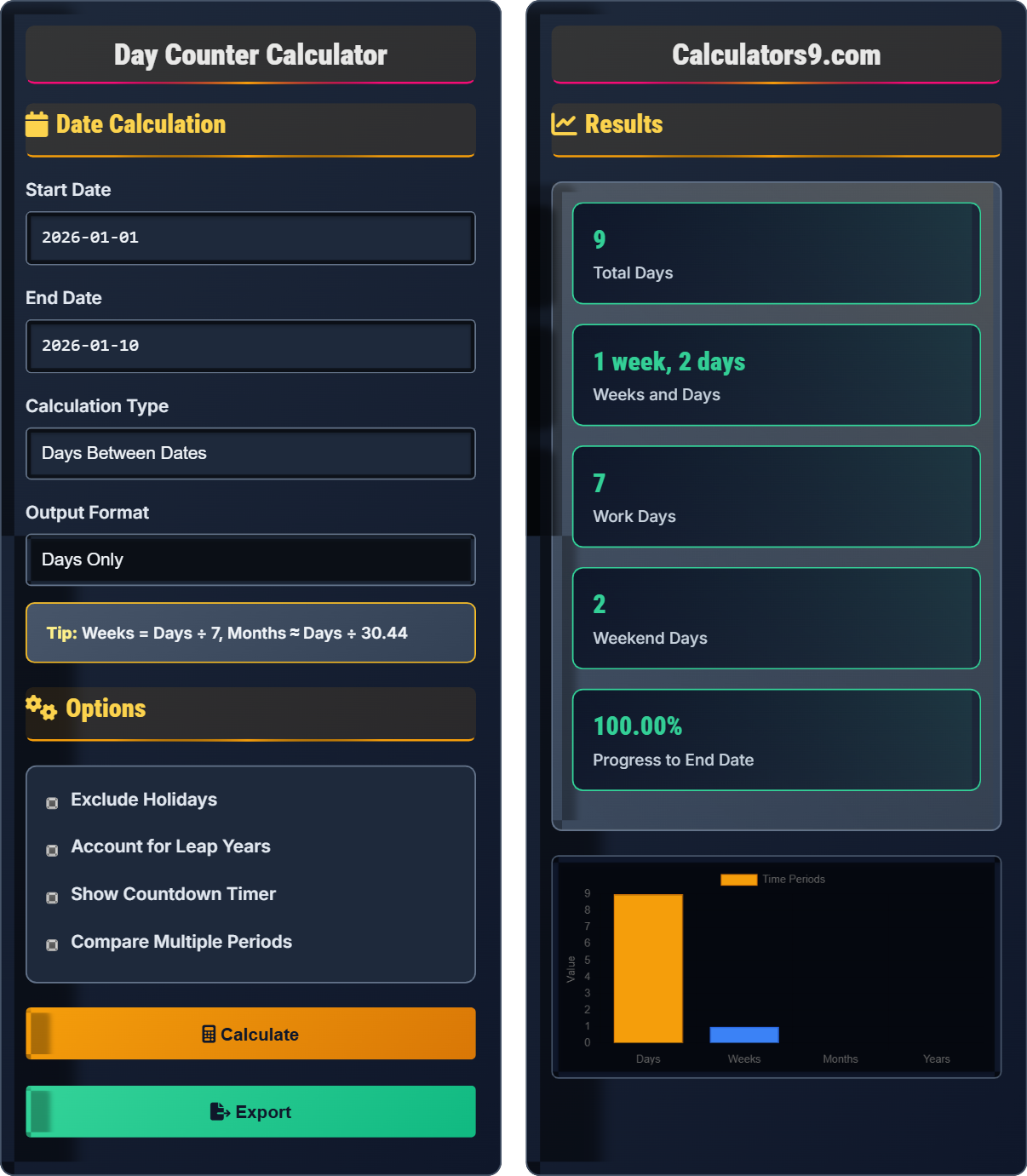
Example: From January 1, 2026 to January 10, 2026:
Start Date: 2026-01-01
End Date: 2026-01-10
Days Difference: 9 days
Thus, there are 9 days between January 1 and January 10, 2026.
Date Calculation
Options
Results
| Unit | Count | Equivalent | Significance |
|---|
| Date | Day | Type | Day # |
|---|
Comprehensive Day Counter Guide
Day counting is the process of calculating the number of days between two dates. This fundamental operation is essential for various applications including project planning, scheduling, age calculations, anniversary tracking, and deadline management. Understanding different methods of day counting helps ensure accuracy in time-sensitive calculations.
The standard day counting formula is:
For more complex calculations using Julian Day Numbers:
- \( \text{JDN} = \text{floor}(365.25 \times (\text{year} + 4716)) + \text{floor}(30.6001 \times (\text{month} + 1)) + \text{day} - 1524.5 \)
- \( \text{Days Difference} = |\text{JDN}_{\text{end}} - \text{JDN}_{\text{start}}| \)
When calculating day differences, consider these important factors:
- Leap Years: February 29th occurs every 4 years (except century years not divisible by 400)
- Month Lengths: Vary from 28-31 days depending on the month
- Holidays: Public holidays may need exclusion from business calculations
- Time Zones: May affect day boundaries for international calculations
- Specify Inclusion: Clarify whether start/end dates are included in the count
- Consider Context: Choose the appropriate counting method for your use case
- Verify Leap Years: Ensure calculations account for February 29th in leap years
- Document Assumptions: Record which days are included/excluded in your calculation
- Test Edge Cases: Verify calculations across month/year boundaries
Day Counting Basics
Calculating the number of days between two dates.
\( \text{Days Difference} = |\text{End Date} - \text{Start Date}| \)
Result expressed in days, weeks, months, or years.
- End date must be after or equal to start date
- Account for leap years when spanning multiple years
- Consider whether to include start/end dates
Strategies
Vary calculation based on business or calendar requirements.
- Identify start and end dates
- Determine counting method (inclusive/exclusive)
- Select appropriate day type (all days/work days)
- Apply calculation formula
- 1 week = 7 days
- 1 month ≈ 30.44 days (average)
- 1 year = 365 days (non-leap year)
- Business days exclude weekends
Day Counter Learning Quiz
How many days are there from January 1st to January 10th, inclusive?
The answer is C) 10 days. When counting inclusively from January 1st to January 10th, you count both the starting and ending dates. This means you count: Jan 1, Jan 2, Jan 3, Jan 4, Jan 5, Jan 6, Jan 7, Jan 8, Jan 9, Jan 10 = 10 days total.
This problem highlights the importance of understanding inclusive vs. exclusive counting. When dates are inclusive, both the start and end dates are counted in the total. This is commonly used in contracts, rentals, and other legal agreements where partial days still count as full days. The key insight is that the difference between two numbers (10 - 1 = 9) gives you the exclusive count, but when counting inclusively, you add 1 to include both endpoints.
Inclusive Counting: Including both start and end dates in the count
Exclusive Counting: Excluding one or both endpoints from the count
Calendar Days: All days including weekends and holidays
• Inclusive count = End date - Start date + 1
• Exclusive count = End date - Start date
• Always clarify counting method in applications
• Count on fingers to visualize small ranges
• Add 1 when counting inclusively
• Use a calendar to verify manual calculations
• Forgetting to include both start and end dates when inclusive
• Confusing inclusive with exclusive counting
• Subtracting dates without considering the counting method
Calculate the number of work days (Monday to Friday) between March 1st and March 15th, 2026. Show your work.
First, identify the dates: March 1-15, 2026
March 2026 starts on a Sunday (March 1 is Sunday)
Days in the range: Sun(Mar 1), Mon(Mar 2), Tue(Mar 3), Wed(Mar 4), Thu(Mar 5), Fri(Mar 6), Sat(Mar 7), Sun(Mar 8), Mon(Mar 9), Tue(Mar 10), Wed(Mar 11), Thu(Mar 12), Fri(Mar 13), Sat(Mar 14), Sun(Mar 15)
Work days (Mon-Fri): Mar 2, 3, 4, 5, 6, 9, 10, 11, 12, 13 = 10 work days
Weekends: Mar 1, 7, 8, 14, 15 = 5 weekend days
This problem demonstrates how to calculate work days by identifying and excluding weekends. The key is to first determine what day of the week the start date falls on, then count through each day to classify it as a work day or weekend day. For longer periods, you can use the pattern that every 7-day period contains 5 work days and 2 weekend days, but you must account for partial weeks at the beginning and end.
Work Days: Monday through Friday (excluding weekends)
Weekend Days: Saturday and Sunday
Business Days: Work days excluding holidays
• Work days = Monday, Tuesday, Wednesday, Thursday, Friday
• Weekend days = Saturday, Sunday
• Every 7-day period contains 5 work days
• Determine the starting weekday first
• Use the 5/7 ratio for longer periods
• Count full weeks separately from partial weeks
• Including weekends in work day counts
• Forgetting to check what day the start date falls on
• Not accounting for partial weeks at the ends
A project starts on a Monday and lasts for 25 calendar days. If the team only works Monday through Friday, how many actual work days will the project take? Assume no holidays fall within this period.
Step 1: Determine the structure of 25 days starting on Monday
25 ÷ 7 = 3 full weeks with 4 days remaining
Each full week contains 5 work days: 3 × 5 = 15 work days
The remaining 4 days starting from Monday are: Mon, Tue, Wed, Thu (all work days)
Total work days = 15 + 4 = 19 work days
This problem demonstrates how to convert calendar days to work days by recognizing the repeating 7-day pattern of 5 work days and 2 weekend days. The approach is to divide the total days by 7 to get complete weeks, multiply the number of complete weeks by 5 work days, then add the work days from the remaining partial week. This method is more efficient than counting day by day for longer periods.
Calendar Days: All days regardless of work status
Work Days: Days when work is performed (typically Mon-Fri)
Partial Week: A week that doesn't contain all 7 days
• Every complete 7-day period = 5 work days
• Calculate complete weeks first, then remainder
• Remaining days depend on starting day of week
• Divide total days by 7 to find complete weeks
• Multiply complete weeks by 5 for work days
• Count remaining days based on start day
• Assuming calendar days equal work days
• Forgetting that weekends don't count as work days
• Not accounting for the starting day of the week
A commercial lease runs from March 15, 2026 to June 15, 2026 (inclusive). The tenant must provide 30 calendar days notice before termination. What is the latest date the tenant can give notice to terminate at the end of the lease? How many total calendar days are in the lease period?
Step 1: Calculate total lease period (March 15 to June 15, inclusive)
March: 31 - 15 + 1 = 17 days (including March 15)
April: 30 days
May: 31 days
June: 15 days (including June 15)
Total = 17 + 30 + 31 + 15 = 93 calendar days
Step 2: Find latest notice date
Notice must be given 30 days before June 15
June 15 - 30 days = May 16, 2026
The tenant can give notice until May 16, 2026.
This problem combines day counting with practical application in legal/contract contexts. The key is to recognize that lease periods are typically calculated inclusively (both start and end dates count). The calculation requires adding up the days in each month, being careful with the partial months at the beginning and end. For the notice period, we count backward from the end date, demonstrating how day counting is used in real-world deadline calculations.
Lease Period: Duration of a rental agreement
Notice Period: Required advance notification timeCalendar Days: All days including weekends and holidays
• Lease periods are typically inclusive of start and end dates
• Count backwards from end date for notice deadlines
• Account for different month lengths in calculations
• Use subtraction for partial months: Days in month - start day + 1
• For counting backward, subtract the notice period from end date
• Verify calculations using a calendar tool
• Forgetting to include both start and end dates in inclusive counting
• Not accounting for different month lengths
• Counting forward instead of backward for notice periods
How many days are there from February 28, 2024 to March 1, 2024, inclusive? (Note: 2024 is a leap year)
The answer is C) 3 days. Since 2024 is a leap year, February has 29 days. The dates from February 28 to March 1, inclusive, are: February 28, February 29, March 1 = 3 days total.
This problem emphasizes the importance of considering leap years in date calculations. In a leap year, February has 29 days instead of 28, which affects calculations that span the end of February. The key rule for leap years is that they occur every 4 years, except for century years not divisible by 400. So 2024 is a leap year, but 1900 was not, while 2000 was.
Leap Year: Year with 366 days, February has 29 days
Leap Day: February 29th added in leap years
Leap Year Rule: Divisible by 4, except century years not divisible by 400
• Leap year: divisible by 4
• Century year: must be divisible by 400 to be leap year
• February has 29 days in leap years
• Remember: 2000 was a leap year, 1900 was not
• Use leap year calendars for verification
• Consider leap years when calculations span late February
• Forgetting that leap years have 29 days in February
• Not considering leap years in date calculations
• Confusing leap year rules for century years
FAQ
Q: What's the difference between calendar days and business days in project management?
A: The distinction between calendar days and business days is crucial in project management:
Calendar Days: Include every day of the year without exception - all 365 days (366 in leap years). This includes weekends, holidays, and any other days.
Business Days: Typically refer to Monday through Friday, excluding weekends and public holidays. This is the standard for most work-related schedules.
For example, a 10-calendar-day project that starts on a Monday will end on the 10th day regardless of the day of the week. However, a 10-business-day project that starts on a Monday will end after 10 working days, potentially spanning 2 weeks if it includes weekends.
Many project management tools allow you to specify which calendar to use for scheduling, and it's essential to clarify this in project documentation to avoid confusion about deadlines and milestones.
Q: How do courts typically interpret "30 days" in legal documents?
A: In legal contexts, the interpretation of "30 days" depends on the specific statute or court rule, but there are general principles:
Calendar Days: Unless specifically stated otherwise, "days" in legal documents typically mean calendar days, including weekends and holidays. This is especially true for statutes of limitations and filing deadlines.
Business Days: When the law intends to exclude weekends and holidays, it will usually specify "business days," "working days," or "court days."
For example, Federal Rule of Civil Procedure 6(a) defines how to count days for procedural deadlines. When the last day falls on a weekend or holiday, the deadline is typically extended to the next business day.
It's crucial to check the specific jurisdiction's rules, as variations exist. When drafting legal documents, attorneys should be explicit about whether they mean calendar days or business days to avoid disputes about deadlines.