Day of the Week Calculator
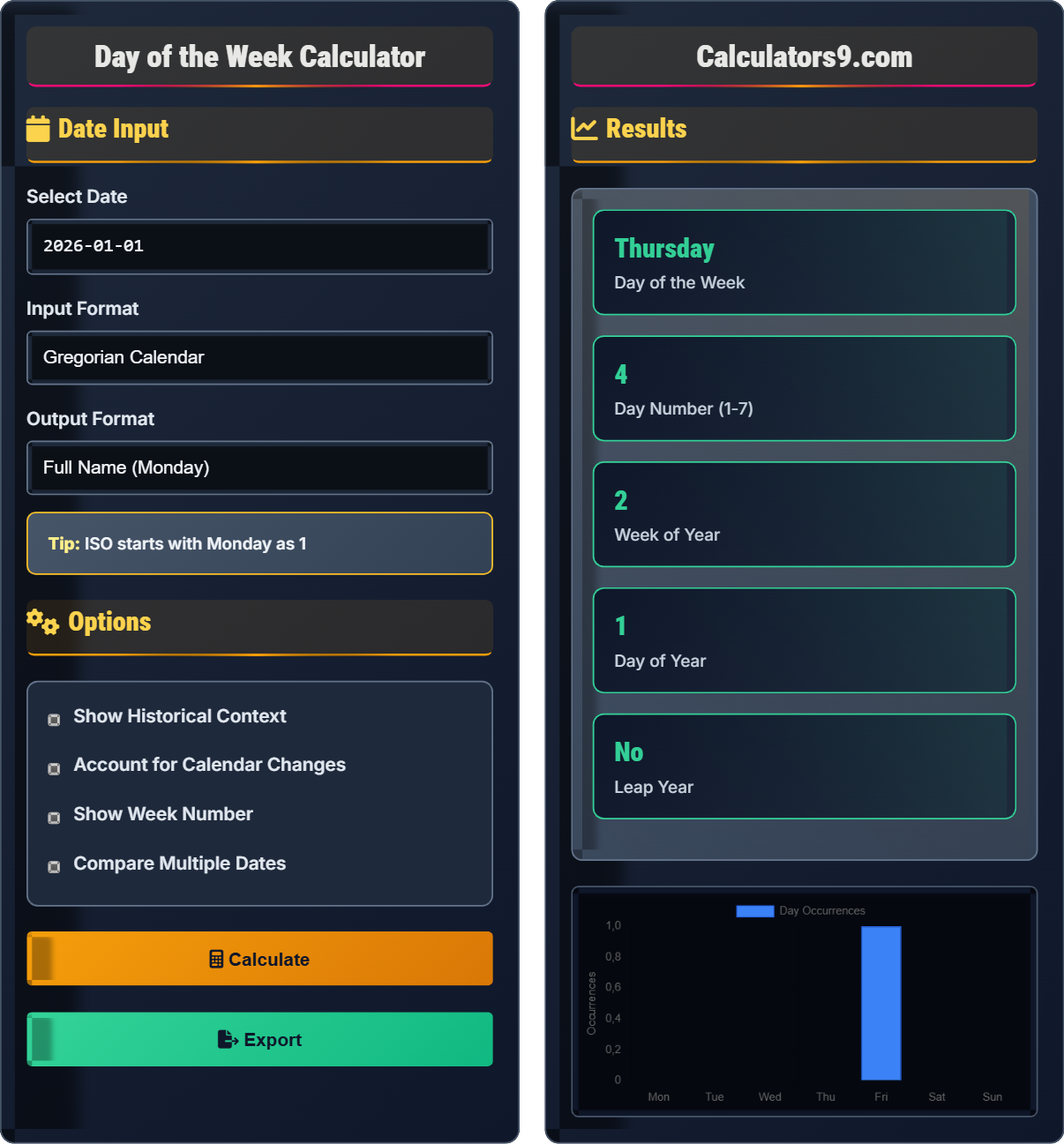
Date to day converter • 2026 edition
Zeller's Congruence Formula:
Show the calculator\( h = \left(q + \left\lfloor\frac{13(m+1)}{5}\right\rfloor + K + \left\lfloor\frac{K}{4}\right\rfloor + \left\lfloor\frac{J}{4}\right\rfloor - 2J\right) \mod 7 \)
Where:
- \( h \) = day of week (0=Saturday, 1=Sunday, 2=Monday, ..., 6=Friday)
- \( q \) = day of month
- \( m \) = month (3=March, 4=April, ..., 14=February)
- \( K \) = year of century (\( \text{year} \bmod 100 \))
- \( J \) = zero-based century (\( \left\lfloor \text{year}/100 \right\rfloor \))
This algorithm calculates the day of the week for any Gregorian calendar date. Note that in Zeller's congruence, January and February are treated as months 13 and 14 of the previous year.
Example: For January 1, 2026:
January becomes month 13 of 2025: \( q=1, m=13, \text{year}=2025 \)
\( K = 25, J = 20 \)
\( h = (1 + \lfloor\frac{13(13+1)}{5}\rfloor + 25 + \lfloor\frac{25}{4}\rfloor + \lfloor\frac{20}{4}\rfloor - 2(20)) \mod 7 \)
\( h = (1 + 36 + 25 + 6 + 5 - 40) \mod 7 = 33 \mod 7 = 5 \)
So January 1, 2026 is a Thursday (where 5=Thursday).
Date Input
Options
Results
| Attribute | Value | Description | Significance |
|---|
| Week | Mon | Tue | Wed | Thu | Fri | Sat | Sun |
|---|
Comprehensive Day of the Week Guide
Day of the week calculation is the mathematical process of determining which day of the week corresponds to a specific date. This fundamental operation has been essential for centuries, from ancient calendar systems to modern computer algorithms. Various methods exist to perform this calculation, from simple lookup tables to complex mathematical formulas.
Zeller's Congruence is one of the most famous algorithms for calculating the day of the week:
Where:
- \( h \) = day of week (0=Saturday, 1=Sunday, 2=Monday, ..., 6=Friday)
- \( q \) = day of month
- \( m \) = month (3=March, 4=April, ..., 14=February)
- \( K \) = year of century (\( \text{year} \bmod 100 \))
- \( J \) = zero-based century (\( \left\lfloor \text{year}/100 \right\rfloor \))
Different calendar systems require different calculation methods:
- Gregorian Calendar: Introduced in 1582, currently used worldwide
- Julian Calendar: Used before Gregorian, still used by some Orthodox churches
- ISO 8601: International standard defining Monday as day 1 of the week
- Hebrew Calendar: Lunisolar calendar with different weekday calculations
- Account for Calendar Changes: Be aware of the transition from Julian to Gregorian calendar
- Handle Edge Cases: Verify calculations for month/year boundaries
- Consider Time Zones: May affect the day boundary for international dates
- Validate Inputs: Ensure valid dates before calculation
- Test Historical Dates: Algorithms may differ for dates before calendar reforms
Day of Week Basics
Determining the day of the week for a given date.
\( h = \left(q + \left\lfloor\frac{13(m+1)}{5}\right\rfloor + K + \left\lfloor\frac{K}{4}\right\rfloor + \left\lfloor\frac{J}{4}\right\rfloor - 2J\right) \mod 7 \)
Result: 0=Saturday, 1=Sunday, 2=Monday, ..., 6=Friday.
- January and February are treated as months 13 and 14 of previous year
- Results vary by calendar system (Gregorian vs Julian)
- ISO 8601 starts week with Monday as day 1
Strategies
Vary calculation based on calendar being used.
- Identify the date and calendar system
- Apply appropriate formula for the calendar
- Adjust for month/year boundary cases
- Calculate modulo 7 for day of week
- Gregorian calendar introduced in 1582
- Julian calendar used before 1582 in most places
- ISO 8601: Monday = 1, Sunday = 7
- Some countries adopted Gregorian at different times
Day of Week Learning Quiz
According to the ISO 8601 standard, what day of the week is represented by the number 1?
The answer is B) Monday. According to the ISO 8601 international standard, Monday is designated as day 1 of the week, with Sunday being day 7. This standard is widely used in Europe and many other parts of the world for business and technical purposes.
This question highlights the importance of understanding different cultural and regional conventions for day numbering. While many countries start the week with Sunday as day 1, the ISO 8601 standard was developed to create a consistent international convention. This is particularly important in computing, international business, and technical applications where standardized formats are essential.
ISO 8601: International standard for date and time representations
Day Numbering: Assigning numeric values to days of the week
Standardization: Creating consistent international conventions
• ISO 8601: Monday = 1, Sunday = 7
• Traditional US: Sunday = 1, Saturday = 7
• Cultural variations exist globally
• Always verify the standard being used in international contexts
• Remember ISO 8601 starts with Monday
• Consider audience when presenting day numbers
• Confusing ISO standard with traditional numbering
• Assuming universal day numbering conventions
• Not clarifying which standard is being used
Using Zeller's Congruence, calculate the day of the week for March 14, 2024 (Pi Day). Show your work and identify the day.
For March 14, 2024: q = 14, m = 3, year = 2024
Since March is month 3, no adjustment needed for month/year
K = 24 (year of century: 2024 mod 100)
J = 20 (zero-based century: floor(2024/100))
Applying Zeller's Congruence:
h = (14 + floor(13×(3+1)/5) + 24 + floor(24/4) + floor(20/4) - 2×20) mod 7
h = (14 + floor(52/5) + 24 + 6 + 5 - 40) mod 7
h = (14 + 10 + 24 + 6 + 5 - 40) mod 7
h = (59 - 40) mod 7 = 19 mod 7 = 5
In Zeller's system: 0=Saturday, 1=Sunday, 2=Monday, 3=Tuesday, 4=Wednesday, 5=Thursday, 6=Friday
Therefore, March 14, 2024 is a Thursday.
This problem demonstrates the step-by-step application of Zeller's Congruence, one of the most elegant mathematical formulas for day-of-week calculation. The key insight is understanding how the formula accounts for the irregularities in our calendar system, particularly the varying month lengths and leap years. The modulo 7 operation ensures the result cycles through the 7 days of the week.
Zeller's Congruence: Algorithm for calculating day of the week
Modulo Operation: Finding remainder after division
Century Adjustment: Accounting for calendar reforms
• January and February treated as months 13 and 14 of previous year
• h mod 7 gives day of week (0=Saturday to 6=Friday)
• Apply floor function to division results
• Remember to adjust January and February
• Carefully compute floor functions
• Double-check the day mapping system
• Forgetting to adjust January and February months
• Incorrectly calculating floor functions
• Confusing day number mappings
The Gregorian calendar was introduced in October 1582, replacing the Julian calendar. If Columbus landed in the Americas on October 12, 1492, what day of the week was it according to the calendar in use at that time? (Note: This was before the Gregorian reform, so use the Julian calendar).
October 12, 1492 in the Julian calendar:
For Julian calendar calculation: q = 12, m = 10, year = 1492
K = 92 (1492 mod 100), J = 14 (floor(1492/100))
Using modified Zeller's for Julian calendar:
h = (12 + floor(13×11/5) + 92 + floor(92/4) + floor(14/4) - 14) mod 7
h = (12 + 28 + 92 + 23 + 3 - 14) mod 7
h = 144 mod 7 = 4
In Zeller's system: 4 = Wednesday
Therefore, October 12, 1492 was a Wednesday in the Julian calendar.
This problem illustrates the importance of understanding historical calendar systems when working with dates before 1582. The Julian calendar had a different leap year rule than the Gregorian, leading to slight differences in day calculations. For dates before the Gregorian reform, it's essential to use the calendar system that was in effect at that time, as modern calculators might apply the current Gregorian system.
Julian Calendar: Calendar system used before 1582
Gregorian Calendar: Current calendar system introduced in 1582
Calendar Reform: Change from Julian to Gregorian system
• Dates before 1582 typically use Julian calendar
• Different countries adopted Gregorian at different times
• Identify the calendar system in use for historical dates
• Consider the date of Gregorian adoption in different regions
• Use appropriate formulas for different calendar systems
• Applying Gregorian calculations to pre-1582 dates
• Not considering regional adoption differences
• Ignoring calendar reform impacts
If January 1, 2026 is a Thursday, what day of the week will January 1, 2027 be? Explain your reasoning, considering whether 2026 is a leap year.
Step 1: Determine if 2026 is a leap year
2026 ÷ 4 = 506.5, so 2026 is not evenly divisible by 4
Therefore, 2026 is not a leap year (it has 365 days)
Step 2: Calculate the day shift
365 days = 52 weeks + 1 day
Step 3: Apply the shift
January 1, 2026: Thursday
January 1, 2027: Thursday + 1 day = Friday
Therefore, January 1, 2027 will be a Friday.
This problem demonstrates the relationship between calendar years and day progression. Since a regular year has 365 days, which is 52 weeks plus 1 day, each subsequent year begins one day later in the week cycle. However, leap years have 366 days (52 weeks + 2 days), causing the following year to begin two days later in the week cycle. This pattern is essential for understanding long-term date relationships.
Leap Year: Year with 366 days, occurring every 4 years
Day Progression: How days shift from year to year
Calendar Cycle: Repetitive pattern of days and dates
• Regular year: day advances by 1 (365 = 52×7 + 1)
• Leap year: day advances by 2 (366 = 52×7 + 2)
• Leap year: divisible by 4, except century years not divisible by 400
• Remember: 365 ÷ 7 = 52 remainder 1
• For leap years: 366 ÷ 7 = 52 remainder 2
• Check leap year rules before calculating
• Forgetting to check if a year is a leap year
• Assuming all years advance by the same number of days
• Incorrect leap year calculation
Which of the following dates always falls on the same day of the week as the "doomsday" in John Conway's algorithm?
The answer is D) All of the above. In Conway's Doomsday algorithm, certain memorable dates always fall on the "doomsday" for any given year. These include: 4/4 (April 4), 6/6 (June 6), 8/8 (August 8), 10/10 (October 10), 12/12 (December 12), as well as 5/9 and 9/5, 7/11 and 11/7. For January and February, the doomsday is January 3 (or January 4 in leap years) and February 28 (or February 29 in leap years).
The Doomsday algorithm is a human-executable method for calculating the day of the week. The concept relies on memorizing "anchor" dates that fall on the same day each year. These dates are chosen to be easily memorable (like 4/4, 6/6, 8/8, etc.). Once you know the "doomsday" for a particular year, you can calculate the day of the week for any date by counting forward or backward from the nearest doomsday date.
Doomsday Algorithm: Mental calculation method by John Conway
Doomsday: Reference day of the week for a given year
Anchor Dates: Memorized dates that share the doomsday
• Even months: m/m (4/4, 6/6, 8/8, 10/10, 12/12)
• Odd months: 5/9, 9/5, 7/11, 11/7 (mnemonic: "working 9 to 5")
• January: 3rd (or 4th in leap years), February: 28th (or 29th in leap years)
• Remember "working 9 to 5" for May/September and July/November
• Even months are easy: 4/4, 6/6, 8/8, 10/10, 12/12
• Use doomsday as reference point for other dates
• Forgetting the special cases for January and February
• Confusing the anchor dates
• Not accounting for leap years in February
FAQ
Q: Why do some historical dates have different days of the week when calculated with modern algorithms?
A: The discrepancy occurs due to calendar reforms, particularly the transition from the Julian to the Gregorian calendar in 1582. The Julian calendar accumulated an error of about 1 day every 128 years, causing seasonal drift. When Pope Gregory XIII introduced the Gregorian calendar:
• 10 days were skipped (October 4, 1582 was followed by October 15, 1582)
• The leap year rule was refined (century years not divisible by 400 are not leap years)
• Different countries adopted the change at different times (some as late as the 20th century)
Therefore, for dates before calendar reforms, you must use the calendar system in effect at that time. For example, October 12, 1492 (Columbus's landing) was calculated using the Julian calendar, which gives a different result than using the modern Gregorian system.
Q: How do computers accurately calculate days of the week for any date?
A: Modern computers use sophisticated algorithms that account for calendar complexities:
Zeller's Congruence: A mathematical formula that works for the Gregorian calendar, accounting for month adjustments and leap years.
Julian Day Number (JDN): Converts any date to a continuous count of days since January 1, 4713 BCE, then uses modulo 7 for day of week.
Unix Time: Seconds since January 1, 1970, with leap seconds handled by the system.
Library Functions: Most programming languages provide built-in functions (like JavaScript's Date.getDay()) that handle all calendar complexities internally.
These implementations consider leap years, calendar reforms, and time zones to provide accurate calculations across a wide range of dates.