Time Calculator
Calculate hours, minutes, seconds, durations • 2026 edition
Time Conversion Formulas:
Show the calculatorHours to Minutes: \( \text{minutes} = \text{hours} \times 60 \)
Minutes to Seconds: \( \text{seconds} = \text{minutes} \times 60 \)
Hours to Seconds: \( \text{seconds} = \text{hours} \times 3600 \)
Time Addition: \( \text{total_time} = \text{time}_1 + \text{time}_2 \)
Time Subtraction: \( \text{duration} = \text{end_time} - \text{start_time} \)
Example: Convert 2.5 hours to minutes and seconds
Minutes: \( 2.5 \times 60 = 150 \) minutes
Seconds: \( 2.5 \times 3600 = 9000 \) seconds
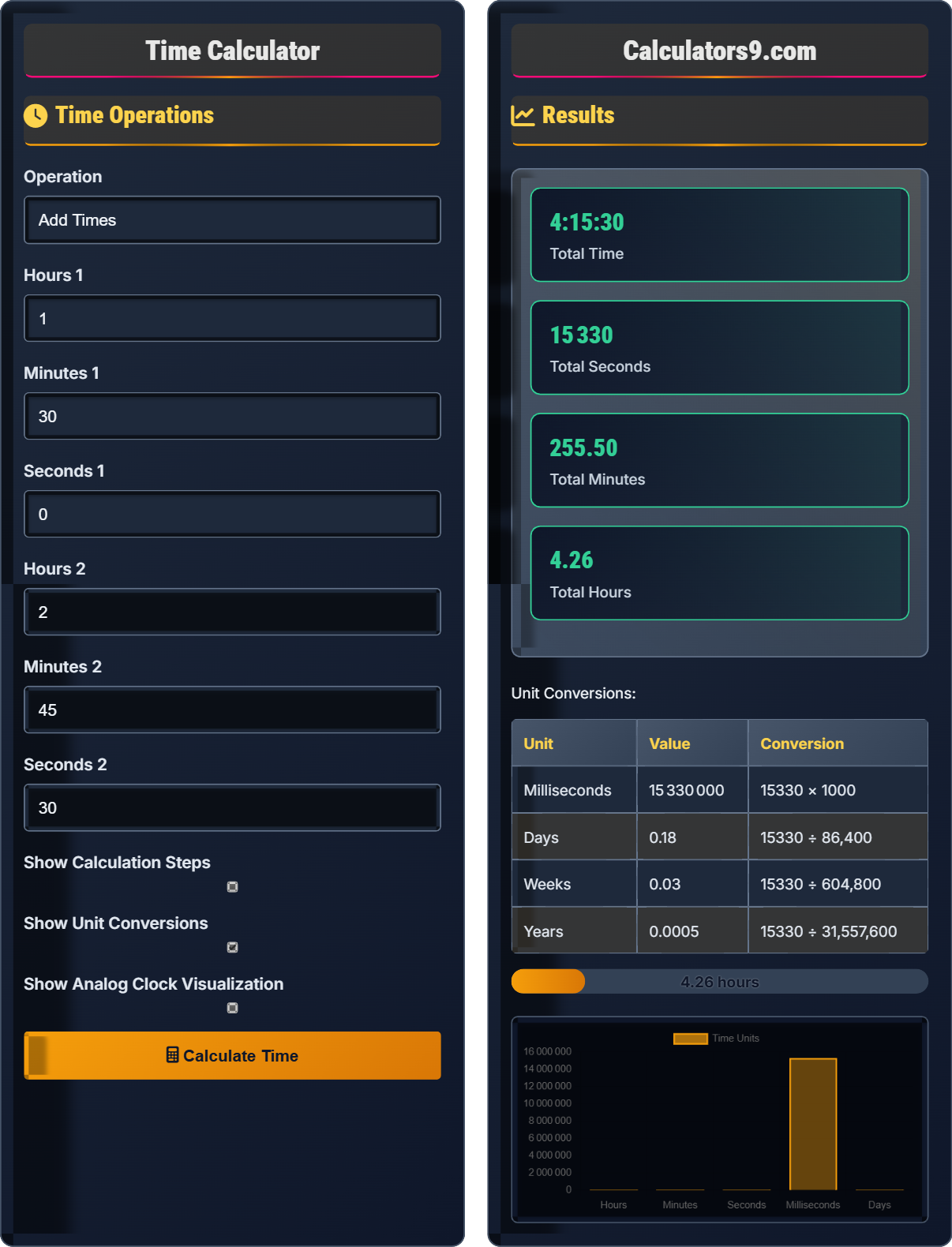
Example: Add 1 hour 30 minutes to 2 hours 45 minutes
Hours: \( 1 + 2 = 3 \) hours
Minutes: \( 30 + 45 = 75 \) minutes = 1 hour 15 minutes
Total: \( 3 + 1 = 4 \) hours 15 minutes
Therefore, the total is 4 hours 15 minutes.
Time Operations
Results
| Unit | Value | Conversion |
|---|---|---|
| Milliseconds | 15,330,000 | 15,330 × 1000 |
| Days | 0.18 | 15,330 ÷ 86,400 |
| Weeks | 0.03 | 0.18 ÷ 7 |
| Years | 0.0005 | 0.18 ÷ 365.25 |
Comprehensive Time Calculation Guide
Time calculation involves mathematical operations with time units including hours, minutes, seconds, and their conversions. It's essential for scheduling, project management, scientific measurements, and everyday activities. Time calculations must account for the base-60 system (60 seconds in a minute, 60 minutes in an hour) and the base-24 system (24 hours in a day).
The main time conversion formulas include:
Time calculations are used in:
- Project scheduling and time management
- Travel planning and duration calculations
- Scientific measurements and experiments
- Financial calculations (interest periods)
- Sports timing and performance analysis
Time Fundamentals
Time is a measure of duration between events.
1 hour = 60 minutes = 3600 seconds
1 minute = 60 seconds
- Time uses base-60 system
- Always carry over when exceeding unit limits
- Convert to same units before operations
Operations
\( \text{time}_1 + \text{time}_2 = \text{total_time} \)
- Subtract seconds first
- Borrow from minutes if needed
- Subtract minutes
- Borrow from hours if needed
- Subtract hours
- 1 hour = 60 minutes
- 1 minute = 60 seconds
- 1 hour = 3600 seconds
Time Calculation Learning Quiz
How many seconds are in 2 hours and 30 minutes?
The answer is B) 9,000 seconds. First, convert hours to seconds: 2 hours × 60 minutes/hour × 60 seconds/minute = 7,200 seconds. Then convert minutes to seconds: 30 minutes × 60 seconds/minute = 1,800 seconds. Add them together: 7,200 + 1,800 = 9,000 seconds.
When converting time units, use the chain of conversion: hours → minutes → seconds. Each step multiplies by 60 (the base of the time system). This ensures all units are converted to the target unit before addition.
Time Conversion: Changing from one unit to another
Base-60 System: Time system where each unit has 60 subunits
Chain Conversion: Converting through intermediate units
• Always convert to the same unit before adding
• 1 hour = 3600 seconds
• 1 minute = 60 seconds
• Remember: 1 hour = 3600 seconds
• Convert each component separately
• Add converted values together
• Forgetting to convert hours to seconds
• Adding different units without conversion
• Arithmetic errors in multiplication
Add 3 hours 45 minutes 30 seconds to 2 hours 35 minutes 45 seconds. Show your work.
Step 1: Add seconds: 30 + 45 = 75 seconds = 1 minute 15 seconds
Step 2: Add minutes: 45 + 35 + 1 (carry-over) = 81 minutes = 1 hour 21 minutes
Step 3: Add hours: 3 + 2 + 1 (carry-over) = 6 hours
Step 4: Combine: 6 hours 21 minutes 15 seconds
The result is 6 hours 21 minutes 15 seconds.
When adding time, always add the smallest units first (seconds), then carry over to larger units. This is similar to addition with regrouping in regular arithmetic, but using base-60 instead of base-10.
Carry-Over: Moving excess to next higher unit
Base-60: Time system with 60 as base
Time Addition: Combining time durations
• Add seconds first, then minutes, then hours
• 60 seconds = 1 minute
• 60 minutes = 1 hour
• Always carry over when reaching 60 in any unit
• Work from smallest to largest unit
• Double-check carry-over calculations
• Forgetting to carry over when reaching 60
• Adding different units directly
• Arithmetic errors in carry-over calculations
A train departs at 9:45 AM and arrives at 2:30 PM. How long was the journey? Express your answer in hours and minutes.
Step 1: Convert to 24-hour format: Departure = 09:45, Arrival = 14:30
Step 2: Calculate hours: 14 - 9 = 5 hours
Step 3: Calculate minutes: 30 - 45 = -15 minutes
Step 4: Since minutes are negative, borrow 1 hour: 5 hours - 1 hour = 4 hours
Step 5: Add 60 minutes to negative minutes: -15 + 60 = 45 minutes
The journey lasted 4 hours and 45 minutes.
When subtracting time and getting negative minutes, borrow 1 hour (60 minutes) from the hours column. This is similar to borrowing in regular subtraction but adapted for the time system.
Duration: Length of time between events
24-Hour Format: Time from 00:00 to 23:59
Time Subtraction: Finding duration between times
• Convert to same format (AM/PM or 24-hour)
• Borrow 60 minutes when minutes go negative
• Always express result as positive duration
• Use 24-hour format to avoid AM/PM confusion
• Remember: 1 hour = 60 minutes
• Check: result should be positive
• Not converting AM/PM to same format
• Forgetting to borrow when minutes are negative
• Getting negative duration as final answer
A runner completes a marathon (26.2 miles) in 3 hours, 15 minutes, and 30 seconds. What is the runner's average speed in miles per hour? Express your answer to 2 decimal places.
Step 1: Convert total time to hours: 3 hours + (15 minutes ÷ 60) + (30 seconds ÷ 3600)
Step 2: Calculate: 3 + (15/60) + (30/3600) = 3 + 0.25 + 0.0083 = 3.2583 hours
Step 3: Calculate average speed: Distance ÷ Time = 26.2 miles ÷ 3.2583 hours
Step 4: Speed = 8.04 mph
The runner's average speed is 8.04 miles per hour.
This problem combines time conversion with speed calculation. When converting mixed time units to decimal hours, divide minutes by 60 and seconds by 3600. The speed formula is distance divided by time.
Average Speed: Total distance divided by total time
Marathon Distance: 26.2 milesDecimal Hours: Time expressed as decimal number
• Convert all time to same unit for calculations
• Average speed = distance ÷ time
• 1 hour = 60 minutes = 3600 seconds
• Convert time to decimal hours for mph calculations
• Always round to specified precision
• Verify that units match in formulas
• Not converting time to decimal hours
• Using wrong conversion factors
• Forgetting to divide seconds by 3600
Which of the following represents the longest duration?
The answer is A) 1 day 3 hours. Converting all to hours: A) 1 day 3 hours = 24 + 3 = 27 hours; B) 27 hours = 27 hours; C) 1,620 minutes ÷ 60 = 27 hours; D) 97,200 seconds ÷ 3600 = 27 hours. All options equal 27 hours, so they are all the same length.
To compare time durations in different units, convert all values to the same unit. This problem demonstrates that 1 day 3 hours, 27 hours, 1620 minutes, and 97200 seconds are all equivalent amounts of time.
Time Equivalence: Different representations of same duration
Unit Conversion: Changing from one unit to another
Time Comparison: Determining relative durations
• Convert all values to same unit for comparison
• 1 day = 24 hours
• 1 hour = 60 minutes = 3600 seconds
• Convert to the smallest common unit
• Use consistent conversion factors
• Double-check calculations with alternative method
• Comparing different units directly
• Using wrong conversion factors
• Arithmetic errors in conversion
FAQ
Q: Why does time use a base-60 system instead of base-10?
A: The base-60 (sexagesimal) system was developed by the ancient Sumerians around 3000 BCE and later adopted by the Babylonians. The number 60 was chosen because it has many divisors (1, 2, 3, 4, 5, 6, 10, 12, 15, 20, 30, 60), making it convenient for fractions. This system was ideal for astronomical calculations and timekeeping. The legacy continues today in time (60 seconds in a minute, 60 minutes in an hour) and angles (60 minutes in a degree).
Q: How do I convert time to decimal hours for calculations?
A: To convert time to decimal hours:
- Minutes to hours: divide by 60
- Seconds to hours: divide by 3600
- For 2 hours 30 minutes: 2 + (30÷60) = 2.5 hours
- For 1 hour 45 minutes 30 seconds: 1 + (45÷60) + (30÷3600) = 1.7583 hours
This conversion is essential for speed calculations (mph) and other time-based rate problems.