Time Card Calculator
Work hours & overtime tracker • 2026 edition
Time Card Formula:
Show the calculator\( \text{Regular Hours} = \min(\text{Total Hours}, 40) \)
\( \text{Overtime Hours} = \max(0, \text{Total Hours} - 40) \)
\( \text{Regular Pay} = \text{Regular Hours} \times \text{Hourly Rate} \)
\( \text{Overtime Pay} = \text{Overtime Hours} \times \text{Hourly Rate} \times 1.5 \)
\( \text{Total Pay} = \text{Regular Pay} + \text{Overtime Pay} \)
This formula calculates regular and overtime pay based on federal labor standards. Overtime is typically paid at 1.5 times the regular rate for hours worked beyond 40 in a workweek.
Example: For 45 hours worked at $20/hour:
Regular Hours: \( \min(45, 40) = 40 \)
Overtime Hours: \( \max(0, 45 - 40) = 5 \)
Regular Pay: \( 40 \times 20 = \$800 \)
Overtime Pay: \( 5 \times 20 \times 1.5 = \$150 \)
Total Pay: \( \$800 + \$150 = \$950 \)
Thus, the employee would earn $950 for the week.
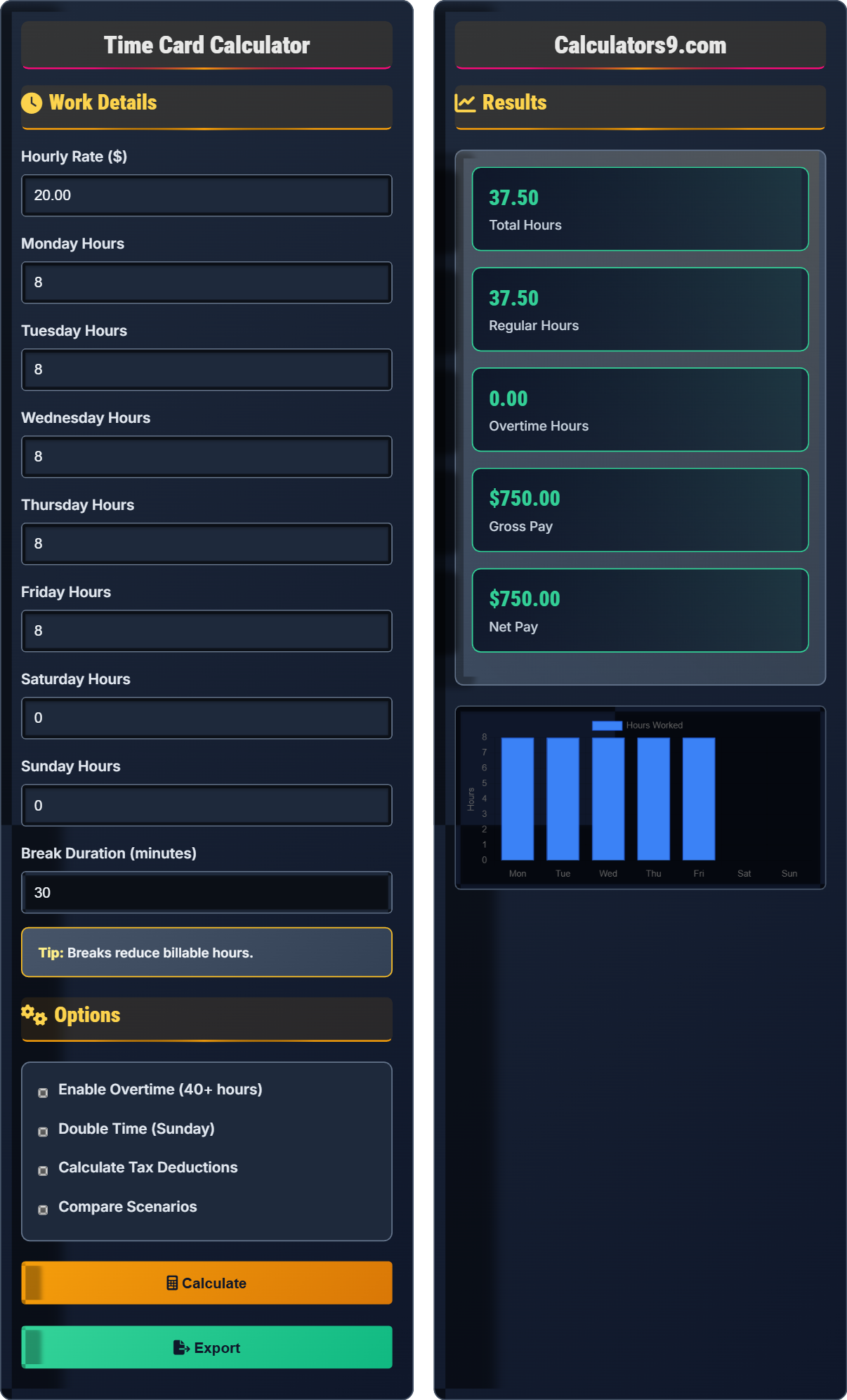
Work Details
Options
Results
| Day | Hours | Rate | Pay |
|---|
| Type | Hours | Rate | Amount |
|---|
Comprehensive Time Card Guide
A time card is a record of an employee's working hours used for payroll purposes. It tracks when employees clock in and out, breaks taken, and calculates regular and overtime hours. Time cards ensure accurate compensation and compliance with labor laws regarding maximum working hours and overtime pay.
The standard time card calculation uses the following formulas:
Where:
- Regular Hours = Hours worked up to 40 per week
- Overtime Hours = Hours worked beyond 40 per week
- Regular Pay = Standard compensation for regular hours
- Overtime Pay = Premium compensation for overtime hours
Time card calculations must comply with federal and state labor laws:
- Federal Fair Labor Standards Act (FLSA): Requires overtime pay for hours worked over 40 in a workweek at 1.5 times the regular rate
- State Variations: Some states have additional requirements like daily overtime or rest periods
- Record Keeping: Employers must maintain accurate records of hours worked for at least 3 years
- Meal Breaks: Many jurisdictions require unpaid meal breaks after a certain number of consecutive hours
- Accurate Recording: Log hours as they occur, not estimated at the end of the week
- Immediate Corrections: Fix errors promptly to maintain compliance
- Break Tracking: Record all breaks to ensure accurate pay calculations
- Signature Verification: Both employee and supervisor should review and approve time cards
- Regular Audits: Periodically verify accuracy of time entries
Time Card Basics
Record of employee work hours for payroll calculation.
\( \text{Regular Hours} = \min(\text{Total Hours}, 40) \)
\( \text{Overtime Hours} = \max(0, \text{Total Hours} - 40) \)
- Overtime applies after 40 hours per week
- Overtime rate is 1.5x regular rate
- All hours must be accurately recorded
Strategies
Hours beyond 40 in a workweek qualify for premium pay.
- Calculate regular hours (up to 40)
- Calculate overtime hours (beyond 40)
- Apply appropriate rates
- Sum total compensation
- Some states have daily overtime rules
- Break times don't count as hours worked
- Double time may apply on holidays
- Travel time sometimes counts as work time
Time Card Learning Quiz
If an employee works 45 hours in a week at $20 per hour, what is their total pay including overtime?
The answer is B) $950. Here's the calculation:
Regular Hours: 40 hours
Overtime Hours: 45 - 40 = 5 hours
Regular Pay: 40 × $20 = $800
Overtime Pay: 5 × $20 × 1.5 = $150
Total Pay: $800 + $150 = $950
Understanding overtime calculations is crucial for fair compensation. The standard overtime rate is 1.5 times the regular hourly rate for hours worked beyond 40 in a workweek. This calculation ensures that employees are compensated fairly for extended work hours. The key is to separate regular hours from overtime hours before applying the respective rates.
Regular Hours: Hours worked up to 40 in a workweek
Overtime Hours: Hours worked beyond 40 in a workweek
Overtime Rate: 1.5 times the regular hourly rate
• Overtime applies to hours worked over 40 per week
• Overtime rate is 1.5 times the regular rate
• Calculate regular and overtime separately
• Remember: Overtime = Total Hours - 40 (if positive)
• Regular hours never exceed 40 per week
• Always calculate overtime pay separately
• Applying overtime rate to all hours instead of just overtime hours
• Forgetting to subtract the first 40 hours from total hours for overtime calculation
• Confusing daily overtime with weekly overtime rules
An employee works 38 hours in a week at $25 per hour. Calculate their gross pay. Show your work.
Since the employee worked fewer than 40 hours, there is no overtime.
Regular Hours: min(38, 40) = 38 hours
Overtime Hours: max(0, 38 - 40) = 0 hours
Regular Pay: 38 × $25 = $950
Overtime Pay: 0 × $25 × 1.5 = $0
Gross Pay: $950 + $0 = $950
This problem demonstrates that when total hours are less than 40, all hours are paid at the regular rate. There is no overtime premium since the threshold of 40 hours has not been reached. The key is understanding that overtime only applies to hours worked beyond the 40-hour threshold in a workweek.
Workweek: A period of 7 consecutive days used for overtime calculation
Regular Rate: The employee's normal hourly wage
Gross Pay: Total compensation before deductions
• Overtime only applies to hours beyond 40 per week
• Regular hours are capped at 40 per week
• Hours under 40 receive regular rate pay
• Use min() function to calculate regular hours
• Use max() function to calculate overtime hours
• Remember: max(0, X) returns 0 if X is negative
• Calculating overtime when total hours are under 40
• Assuming all hours get overtime premium
• Not capping regular hours at 40
Sarah works 9 hours on Monday, 8 hours on Tuesday, 10 hours on Wednesday, 8 hours on Thursday, 10 hours on Friday, and 5 hours on Saturday. She earns $22 per hour. Calculate her total weekly pay including overtime.
Step 1: Calculate total hours worked
Monday: 9 + Tuesday: 8 + Wednesday: 10 + Thursday: 8 + Friday: 10 + Saturday: 5 = 50 hours
Step 2: Calculate regular and overtime hours
Regular Hours: min(50, 40) = 40 hours
Overtime Hours: max(0, 50 - 40) = 10 hours
Step 3: Calculate pay
Regular Pay: 40 × $22 = $880
Overtime Pay: 10 × $22 × 1.5 = $330
Total Pay: $880 + $330 = $1,210
This problem combines addition skills with overtime calculations. First, we sum all daily hours to find the total workweek hours. Then we apply the overtime formula to determine which hours qualify for premium pay. The calculation shows how working more than 40 hours significantly increases total compensation due to the overtime premium.
Total Hours: Sum of all hours worked in a workweek
Daily Hours: Hours worked on individual days
Weekly Total: Combined hours across all days
• Sum all daily hours to get weekly total
• Apply overtime after reaching 40 hours
• Overtime rate is 1.5 times regular rate
• Add daily hours systematically to avoid errors
• Double-check total hours calculation
• Apply overtime formula consistently
• Adding up hours incorrectly
• Forgetting to apply overtime formula
• Miscalculating the overtime premium
John clocks in at 8:00 AM and clocks out at 6:00 PM with a 30-minute unpaid lunch break. He works this schedule Monday through Friday at $18 per hour. Calculate his weekly gross pay accounting for the break time.
Step 1: Calculate daily hours worked
Clock-in to clock-out: 8:00 AM to 6:00 PM = 10 hours
Subtract unpaid break: 10 - 0.5 = 9.5 hours per day
Step 2: Calculate weekly hours
9.5 hours/day × 5 days = 47.5 hours per week
Step 3: Calculate regular and overtime hours
Regular Hours: min(47.5, 40) = 40 hours
Overtime Hours: max(0, 47.5 - 40) = 7.5 hours
Step 4: Calculate pay
Regular Pay: 40 × $18 = $720
Overtime Pay: 7.5 × $18 × 1.5 = $202.50
Total Pay: $720 + $202.50 = $922.50
This problem introduces the concept of break deductions, which is critical for accurate time card calculations. Unpaid breaks must be subtracted from total clocked time to determine actual billable hours. This example shows how break policies affect both total hours worked and overtime eligibility. Understanding this distinction is essential for compliance with labor laws.
Billable Hours: Actual hours worked excluding unpaid breaks
Unpaid Break: Time not compensated but deducted from work hoursClocked Time: Total time between clock-in and clock-out
• Unpaid breaks are not counted as work time
• Only actual work time qualifies for pay
• Breaks reduce total billable hours
• Always subtract unpaid breaks from total time
• Convert break minutes to decimal hours
• Verify break policies with employer
• Including unpaid breaks in work hours
• Misunderstanding break policies
• Forgetting to adjust hours for breaks
Which of the following statements about double time is TRUE?
The answer is B) Double time is 2 times the regular rate. Double time is a premium pay rate that is twice the regular hourly rate (2.0x), which is higher than the standard overtime rate of 1.5x. While some employers and states offer double time for specific circumstances (like Sunday work or holiday work), it is not universally required by federal law like overtime is for hours over 40 per week.
It's important to distinguish between overtime and double time. Overtime (1.5x rate) is required by federal law for hours worked over 40 in a workweek. Double time (2.0x rate) is typically only required in specific situations defined by state law or collective bargaining agreements. Understanding these differences helps ensure proper compensation calculations and legal compliance.
Double Time: Pay rate that is 2 times the regular hourly rate
Overtime: Pay rate that is 1.5 times the regular hourly rate
Premium Pay: Additional compensation for special work conditions
• Overtime (1.5x) is federally required after 40 hours/week
• Double time (2.0x) is usually state-specific or contract-based
• Double time is higher than overtime rate
• Check local and state labor laws for double time requirements
• Review employment contracts for special provisions
• Understand the difference between federal and state standards
• Confusing overtime with double time requirements
• Assuming double time is federally mandated
• Not verifying applicable laws for specific situations
FAQ
Q: How do I calculate overtime when I work different hours each day?
A: Overtime is calculated based on the total hours worked in a workweek, not per day. According to federal law, you must be paid overtime for all hours worked over 40 in a workweek, regardless of how those hours are distributed across days.
For example, if you work 10 hours on Monday, 10 hours on Tuesday, 10 hours on Wednesday, 10 hours on Thursday, and 5 hours on Friday (45 total hours), you would earn overtime for 5 hours at 1.5 times your regular rate.
The formula is: \( \text{Overtime Hours} = \max(0, \text{Total Weekly Hours} - 40) \)
This means even if you work 12 hours on Monday and 4 hours on Tuesday, it's still the total weekly hours that determine overtime eligibility.
Q: Should I round employee time entries?
A: Yes, time rounding is allowed under federal regulations, but it must be done properly. The Department of Labor permits rounding if:
- Rounding is neutral over time (not consistently favoring the employer)
- Employees are paid for all time actually worked
- The rounding policy is applied consistently
Common rounding practices include rounding to the nearest quarter-hour (15 minutes), half-hour (30 minutes), or hour. For example, if an employee clocks in at 8:07 AM and you round to the nearest quarter-hour, this would round to 8:15 AM.
However, rounding policies must be documented and applied fairly to avoid wage and hour violations.