Time Zone Calculator
Global time converter • 2026 edition
Time Zone Conversion Formula:
Show the calculator\( \text{Target Time} = \text{Source Time} + (\text{Target Offset} - \text{Source Offset}) \)
\( \text{UTC Offset} = \text{Local Time} - \text{UTC Time} \)
This formula calculates the time in a target timezone based on the source time and the difference in UTC offsets. The offset represents how many hours a timezone is ahead (+) or behind (-) UTC (Coordinated Universal Time).
Example: Converting 3:00 PM EST to PST:
EST Offset: -5 hours
PST Offset: -8 hours
Difference: -8 - (-5) = -3 hours
Target Time: 3:00 PM + (-3) = 12:00 PM
Thus, 3:00 PM EST equals 12:00 PM PST.
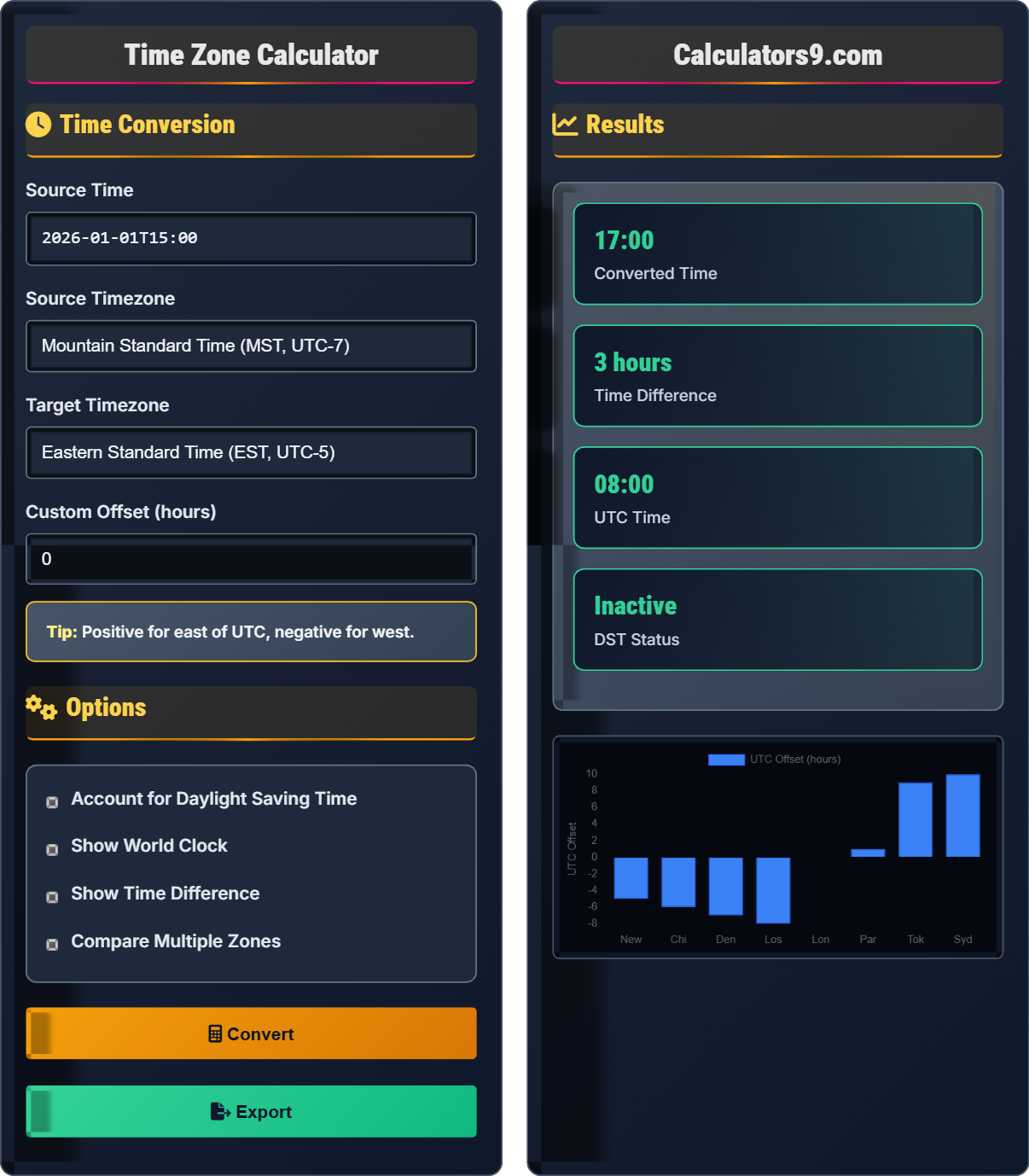
Time Conversion
Options
Results
| Location | Time | Offset | DST |
|---|
| City | Time | Offset | Day |
|---|
Comprehensive Time Zone Guide
A time zone is a region of the Earth that observes a uniform standard time for legal, commercial, and social purposes. Time zones follow the lines of longitude and are measured as offsets from Coordinated Universal Time (UTC). The system was established to standardize time across different regions and facilitate global communication and travel.
The standard time zone conversion formula is:
Where:
- Target Time = Time in destination timezone
- Source Time = Time in origin timezone
- Target Offset = UTC offset of destination timezone
- Source Offset = UTC offset of origin timezone
Daylight Saving Time is the practice of advancing clocks during warmer months to extend evening daylight. Key facts about DST:
- Spring Forward: Clocks move forward 1 hour (typically March)
- Fall Back: Clocks move back 1 hour (typically November)
- Not Universal: Many countries and regions do not observe DST
- Variable Dates: Start and end dates vary by country
- Use UTC: When coordinating internationally, consider using UTC to avoid confusion
- Account for DST: Always verify whether DST is currently in effect
- Check Dates: DST transitions occur on specific dates, not automatically
- Be Specific: Always specify time zones when scheduling meetings across regions
- Consider Business Hours: Be mindful of working hours in different time zones
Time Zone Basics
Region with standardized time based on UTC offset.
\( \text{Target Time} = \text{Source Time} + (\text{Target Offset} - \text{Source Offset}) \)
Where offsets are in hours relative to UTC.
- Positive offset = ahead of UTC
- Negative offset = behind UTC
- DST changes offset by ±1 hour
Strategies
Convert to UTC first for easier multi-zone calculations.
- Identify source and target time zones
- Determine current UTC offsets
- Account for DST if applicable
- Apply the conversion formula
- DST dates vary by country
- Some regions don't observe DST
- Half-hour offsets exist (e.g., India)
- International Date Line affects days
Time Zone Learning Quiz
If it's 3:00 PM in New York (EST, UTC-5), what time is it in Los Angeles (PST, UTC-8)?
The answer is B) 12:00 PM. Here's the calculation:
Source Time: 3:00 PM (New York)
Source Offset: -5 hours (EST)
Target Offset: -8 hours (PST)
Difference: -8 - (-5) = -3 hours
Target Time: 3:00 PM + (-3 hours) = 12:00 PM
When converting between time zones, you need to account for the difference in UTC offsets. Since Los Angeles is 3 hours behind New York (both at -8 and -5 respectively), you subtract 3 hours from the New York time. The key is remembering that a more negative offset means the location is further behind UTC, resulting in an earlier local time.
UTC Offset: The difference in hours from Coordinated Universal Time
Time Zone: Region observing uniform standard time
Conversion: Adjusting time based on offset differences
• Subtract the source offset from the target offset
• More negative offset = earlier local time
• Positive result adds hours, negative subtracts
• Think: "West is Less" (time decreases going west)
• Use the formula: Target = Source + (Target - Source)
• Remember: Larger negative number is further behind
• Adding instead of subtracting the time difference
• Confusing the direction of the time change
• Forgetting that more negative offsets mean earlier times
Calculate the time in Tokyo (JST, UTC+9) when it's 10:00 AM in London (GMT, UTC+0). Show your work.
Using the time zone conversion formula:
Target Time = Source Time + (Target Offset - Source Offset)
Given:
Source Time = 10:00 AM (London)
Source Offset = 0 hours (GMT)
Target Offset = +9 hours (JST)
Step 1: Calculate offset difference = 9 - 0 = 9 hours
Step 2: Apply to source time = 10:00 AM + 9 hours = 7:00 PM
Therefore, when it's 10:00 AM in London, it's 7:00 PM in Tokyo.
This example demonstrates how positive UTC offsets work. Tokyo is 9 hours ahead of London, so when it's morning in London, it's evening in Tokyo. The formula consistently works regardless of whether offsets are positive or negative, as long as you properly calculate the difference between them.
Positive Offset: Time zone ahead of UTC
Negative Offset: Time zone behind UTC
Coordinated Universal Time (UTC): Primary time standard
• Positive offsets indicate time ahead of UTC
• Negative offsets indicate time behind UTC
• Always subtract source from target offset
• East of prime meridian = positive offset
• West of prime meridian = negative offset
• Remember: +9 means 9 hours later than UTC
• Confusing positive and negative offset directions
• Adding instead of subtracting in the formula
• Forgetting to account for the sign of offsets
A company headquartered in New York (EST, UTC-5) wants to schedule a meeting with their team in Sydney (AEDT, UTC+11). If the meeting is scheduled for 9:00 AM New York time, what time will it be in Sydney? Consider that both locations are observing standard time.
Step 1: Identify the time zones and offsets
New York: EST (UTC-5), 9:00 AM
Sydney: AEDT (UTC+11)
Step 2: Calculate the offset difference
Target Offset - Source Offset = 11 - (-5) = 16 hours
Step 3: Apply to source time
9:00 AM + 16 hours = 1:00 AM (next day)
Therefore, when it's 9:00 AM in New York, it's 1:00 AM the next day in Sydney.
This problem demonstrates the extreme time differences that exist between opposite sides of the globe. With a 16-hour difference, business hours in one location often correspond to nighttime in another. This example also shows how the date changes when crossing the International Date Line, which is why the Sydney time is on the next day.
International Date Line: Imaginary line where calendar date changes
Business Hours: Standard working hours in a region
Opposite Hemispheres: Locations on different sides of the globe
• Large time differences can span multiple days
• Crossing the date line changes the calendar date
• Always consider practical meeting times across zones
• Use online world clocks for verification
• Consider "overlap hours" for international meetings
• Plan for the date change when scheduling
• Forgetting that large differences cross midnight
• Not accounting for date changes
• Assuming similar time zones due to similar names
During summer, when both New York and London observe Daylight Saving Time (EDT, UTC-4 and BST, UTC+1 respectively), what time will it be in London when it's 3:00 PM in New York? How does this differ from standard time?
Step 1: Determine DST offsets
New York: EDT (UTC-4)
London: BST (UTC+1)
Step 2: Calculate offset difference
Target Offset - Source Offset = 1 - (-4) = 5 hours
Step 3: Apply to source time
3:00 PM + 5 hours = 8:00 PM
Step 4: Compare with standard time difference
Standard time: EST (UTC-5) to GMT (UTC+0) = 5 hours
During DST: EDT (UTC-4) to BST (UTC+1) = 5 hours
In this case, the time difference remains the same (5 hours), but both cities are operating on different time zones than standard time.
This example shows that when both locations observe DST simultaneously, the time difference between them may remain unchanged. However, the actual time zones they're operating under have shifted. This is important for scheduling because knowing the underlying time zone (not just the current offset) helps predict future changes when DST ends.
DST (Daylight Saving Time): Practice of advancing clocks in summer
EDT (Eastern Daylight Time): UTC-4
BST (British Summer Time): UTC+1
• DST dates vary by country
• Both locations may change simultaneously
• Time difference can stay the same despite zone changes
• Verify current DST status before scheduling
• Use tools that automatically adjust for DST
• Note the exact DST transition dates
• Assuming DST affects time differences uniformly
• Forgetting that DST transition dates differ
• Not verifying current DST status
Which of the following countries uses a half-hour time zone offset?
The answer is B) India (UTC+5:30). India Standard Time (IST) is set at UTC+5:30, which is a half-hour offset. This unique positioning allows India to be in the middle of the two whole-hour time zones that would otherwise divide the country. Other countries that use half-hour offsets include Myanmar (UTC+6:30), Afghanistan (UTC+4:30), Iran (UTC+3:30), and North Korea (UTC+8:30).
While most time zones use whole-hour offsets from UTC, some countries have chosen half-hour or even quarter-hour offsets for geographical, political, or economic reasons. India's half-hour offset is particularly notable because it allows the entire country to operate on a single time zone despite spanning several degrees of longitude. These fractional offsets add complexity to international time conversions.
Half-Hour Offset: Time zone with 30-minute increment (e.g., UTC+5:30)
Quarter-Hour Offset: Time zone with 15-minute increment (e.g., UTC+5:45)
Geographic Meridians: Lines of longitude that define time zones
• Most time zones use whole-hour offsets
• Some countries use half-hour or quarter-hour offsets
• Fractional offsets complicate conversion calculations
• Convert half-hours to decimal (.5) for calculations
• Verify time zone details for unusual locations
• Use specialized tools for complex offset conversions
• Assuming all time zones use whole-hour offsets
• Rounding fractional offsets incorrectly
• Not accounting for the complexity of partial hours
FAQ
Q: How do I quickly convert time when traveling across multiple time zones?
A: The most effective method is to use the UTC as a reference point. Convert your departure time to UTC first, then convert to your destination time zone.
For example, if flying from New York (EST, UTC-5) at 6:00 AM to London (GMT, UTC+0):
6:00 AM EST = 11:00 AM UTC (add 5 hours)
11:00 AM UTC = 11:00 AM GMT (same time zone)
This approach eliminates the need to remember multiple time differences and is especially helpful when planning layovers in different time zones. Modern smartphones automatically adjust for time zones, but understanding the principle helps when technology isn't available.
Q: Should I schedule international meetings using local times or UTC?
A: For international coordination, use both local times and UTC to avoid confusion. For example, schedule a meeting as:
"Meeting: 9:00 AM EST / 2:00 PM GMT / 14:00 UTC"
This ensures everyone understands when the meeting occurs in their local time. UTC is particularly valuable because it's consistent year-round (no DST changes) and serves as a neutral reference point.
Additionally, consider the business hours in each location. A 9:00 AM meeting in New York is 3:00 PM in London, which works well. However, the same meeting would be 6:00 AM in Tokyo, which may not be ideal for participants there.