Dew Point Calculator
Accurate dew point • 2026 standards
Temperature & Humidity
Advanced Options
Dew Point Results
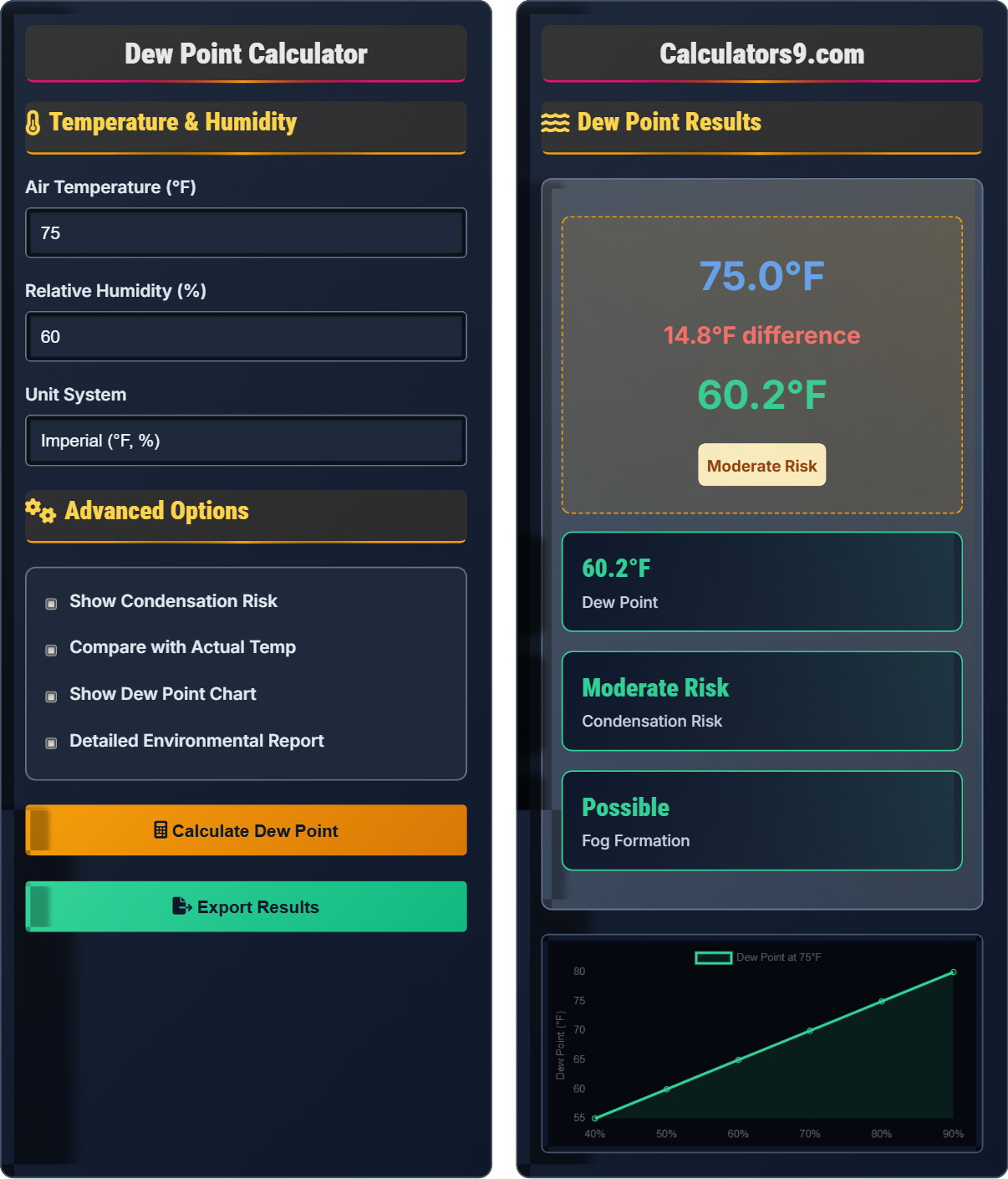
| Metric | Value |
|---|---|
| Actual Temperature | 75°F |
| Humidity | 60% |
| Dew Point | 63°F |
| Moisture Level | Moderate |
| Condition | Threshold | Impact |
|---|---|---|
| Low | Dew point < 55°F | Comfortable, minimal condensation |
| Moderate | 55°F to 65°F | Some condensation possible |
| High | 65°F to 70°F | Significant condensation risk |
| Very High | > 70°F | Constant condensation |
Dew Point Technology Guide
Dew point is the temperature at which air becomes saturated with water vapor and dew or frost begins to form. It is a measure of the amount of moisture in the air. The higher the dew point, the more moisture the air contains. Unlike relative humidity, dew point is an absolute measurement that does not depend on the temperature.
The Magnus formula for calculating dew point is:
Where:
- \(T_d\) = Dew point temperature in °C
- \(T\) = Air temperature in °C
- \(RH\) = Relative humidity in %
- \(\alpha(T,RH) = \ln(RH/100) + \frac{a \cdot T}{b + T}\)
- \(a = 17.27, b = 237.7\)
The concept of dew point has been known since ancient times, but it was formally defined in the 18th century. The term "dew point" was coined by scientists studying atmospheric moisture. The modern formulas for calculating dew point were developed in the late 19th and early 20th centuries. The Magnus formula, developed by O.G. Magnus in 1844, remains one of the most widely used methods today.
- Aviation: Pilots use dew point to predict fog formation and carburetor icing
- Agriculture: Farmers monitor dew point to predict crop diseases
- Construction: Builders use dew point to prevent condensation on surfaces
- Weather Forecasting: Meteorologists use dew point to predict precipitation
- Indoor Climate: HVAC systems use dew point for humidity control
Dew Point Learning Quiz
What does the dew point represent?
The answer is B) The temperature at which air becomes saturated with water vapor. The dew point is the temperature at which air becomes saturated with water vapor and dew or frost begins to form. It is a measure of the amount of moisture in the air and does not depend on the actual temperature.
Understanding dew point is important because it represents the absolute amount of moisture in the air, unlike relative humidity which is dependent on temperature. A higher dew point indicates more moisture in the air, regardless of the actual temperature. This makes dew point a more reliable indicator of atmospheric moisture content.
Dew Point: Temperature at which air becomes saturated with water vapor
Saturation: Condition when air holds maximum possible water vapor
Atmospheric Moisture: Water vapor content in the air
• Dew point is independent of actual temperature
• Higher dew point = more moisture in the air
• Dew point is always ≤ actual temperature
• Remember: Dew point measures absolute moisture content
• Dew point never exceeds actual temperature
• Dew point is more reliable than relative humidity for moisture assessment
• Confusing dew point with actual air temperature
• Thinking dew point can be higher than actual temperature
• Equating dew point with relative humidity
Calculate the approximate dew point if the air temperature is 80°F and the relative humidity is 70%. Explain your reasoning.
Using the approximation formula: \(T_d \approx T - \frac{(100 - RH)}{5}\)
Substituting values: \(T_d \approx 80 - \frac{(100 - 70)}{5} = 80 - \frac{30}{5} = 80 - 6 = 74°F\)
Reasoning: The approximation formula shows that for every 5% decrease in relative humidity from 100%, the dew point decreases by 1°F from the actual temperature. With 70% humidity, the dew point is 6°F below the actual temperature.
This problem demonstrates the relationship between temperature, humidity, and dew point. The approximation formula provides a quick way to estimate dew point, though more precise calculations use the Magnus formula. The result shows that with 70% humidity at 80°F, the dew point is 74°F, indicating high moisture content.
Approximation Formula: Simplified method for estimating dew point
Moisture Content: Amount of water vapor in the air
Relative Humidity: Percentage of water vapor compared to saturation point
• Dew point is always ≤ actual temperature
• Higher humidity = dew point closer to actual temperature
• Lower humidity = dew point further from actual temperature
• When RH is 100%, dew point equals actual temperature
• When RH is 50%, dew point is about halfway between actual temp and frost point
• Dew point gives a more accurate feel for moisture than RH alone
• Calculating dew point higher than actual temperature
• Forgetting that dew point is always ≤ actual temperature
• Misapplying the approximation formula outside its valid range
During a construction project, the outdoor temperature is 70°F with 85% relative humidity. The inside of the building is maintained at 72°F. Based on the dew point, what is the risk of condensation forming on the inside surfaces? What preventive measures should be taken?
Step 1: Calculate dew point - Using the approximation: \(T_d \approx 70 - \frac{(100 - 85)}{5} = 70 - 3 = 67°F\)
Step 2: Assess risk - The inside temperature (72°F) is above the dew point (67°F), so condensation risk is low
Step 3: Preventive measures - Monitor humidity levels, ensure proper ventilation, and maintain consistent indoor temperature.
This example demonstrates the practical application of dew point knowledge in construction. Condensation occurs when surface temperatures fall below the dew point. Since the indoor temperature (72°F) is above the dew point (67°F), condensation is unlikely to form on interior surfaces. However, monitoring humidity is still important.
Condensation: Water vapor turning to liquid when air cools to dew point
Surface Temperature: Temperature of object surfaces
Preventive Measures: Actions to avoid unwanted condensation
• Condensation occurs when surface temperature < dew point
• Dew point is independent of temperature differences
• Ventilation helps manage indoor humidity levels
• Always compare surface temperatures to dew point, not air temperature
• Cold surfaces are more prone to condensation
• Dehumidifiers can lower dew point in enclosed spaces
• Comparing only air temperature to dew point
• Not accounting for temperature differences between surfaces
• Ignoring the role of ventilation in moisture control
On a summer day, the temperature is 85°F with 40% humidity. On another day, the temperature is 70°F with 80% humidity. Which day has a higher dew point and therefore more moisture in the air? Calculate both dew points.
Day 1: \(T_d \approx 85 - \frac{(100 - 40)}{5} = 85 - 12 = 73°F\)
Day 2: \(T_d \approx 70 - \frac{(100 - 80)}{5} = 70 - 4 = 66°F\)
Despite the higher temperature on Day 1, Day 2 has more moisture in the air as indicated by the lower temperature difference between actual temperature and dew point. Day 1 has a dew point of 73°F while Day 2 has 66°F.
This example highlights why dew point is a better indicator of moisture content than temperature alone. Even though Day 1 is hotter, Day 2 has more moisture in the air as evidenced by the higher relative humidity. The dew point correctly identifies Day 1 as having more absolute moisture content due to the higher dew point value.
Absolute Moisture: Actual water vapor content in air (measured by dew point)
Relative Humidity: Percentage of water vapor compared to saturation
Moisture Content: Amount of water vapor present
• Higher dew point = more absolute moisture in air
• Temperature alone doesn't indicate moisture content
• Dew point is superior to relative humidity for comparing moisture levels
• Use dew point to compare moisture content across different temperatures
• A 70°F dew point indicates high moisture content regardless of temperature
• Dew point remains constant unless moisture is added or removed
• Assuming higher temperature means more moisture
• Using relative humidity alone to compare moisture content
• Not understanding that dew point measures absolute moisture
In which field is dew point most commonly used to predict fog formation?
The answer is B) Aviation. While dew point is used in all these fields, aviation is the most common application for predicting fog formation. Pilots and air traffic controllers closely monitor dew point to anticipate fog conditions that could affect visibility and flight safety. The proximity of temperature to dew point indicates fog likelihood.
This question highlights the critical importance of dew point in aviation safety. When the air temperature approaches the dew point, fog formation becomes likely, significantly reducing visibility. This knowledge is essential for flight planning, takeoff and landing operations, and air traffic control decisions.
Fog Formation: Condensation of water vapor near ground level
Visibility: Distance at which objects can be clearly seen
Flight Safety: Measures to prevent accidents during flight
• Fog forms when temperature approaches dew point
• Aviation relies heavily on dew point for flight planning
• Dew point is crucial for predicting atmospheric phenomena
• Fog is likely when temperature and dew point are within 2°F
• Dew point is essential for predicting dew, frost, and cloud formation
• Monitor dew point changes to anticipate weather transitions
• Confusing dew point with temperature for fog prediction
• Not understanding the relationship between temperature and dew point
• Underestimating the importance of dew point in weather forecasting
Dew Point Basics
Temperature at which air becomes saturated with water vapor.
\(T_d = \frac{b \cdot \alpha(T,RH)}{a - \alpha(T,RH)}\)
Where \(T_d\)=Dew point, T=temp, RH=relative humidity.
- Dew point is always ≤ actual temperature
- Higher dew point = more moisture in air
- Independent of temperature
Applications
Low: <55°F, Moderate: 55-65°F, High: 65-70°F, Very High: >70°F.
- Aviation (fog prediction)
- Agriculture (crop disease)
- Construction (condensation)
- Weather forecasting
- More accurate than relative humidity
- Indicates fog formation risk
- Essential for HVAC systems
- Used in meteorological reports
FAQ
Q: How does dew point help predict fog?
A: Fog forms when temperature approaches dew point. If they're within 2°F, fog is likely. Dew point indicates moisture content.
Q: When is condensation risk highest?
A: When surface temperature drops below dew point. Risk increases significantly when dew point is above 65°F.