Heat Index Calculator
Accurate heat index • 2026 standards
Temperature & Humidity
Advanced Options
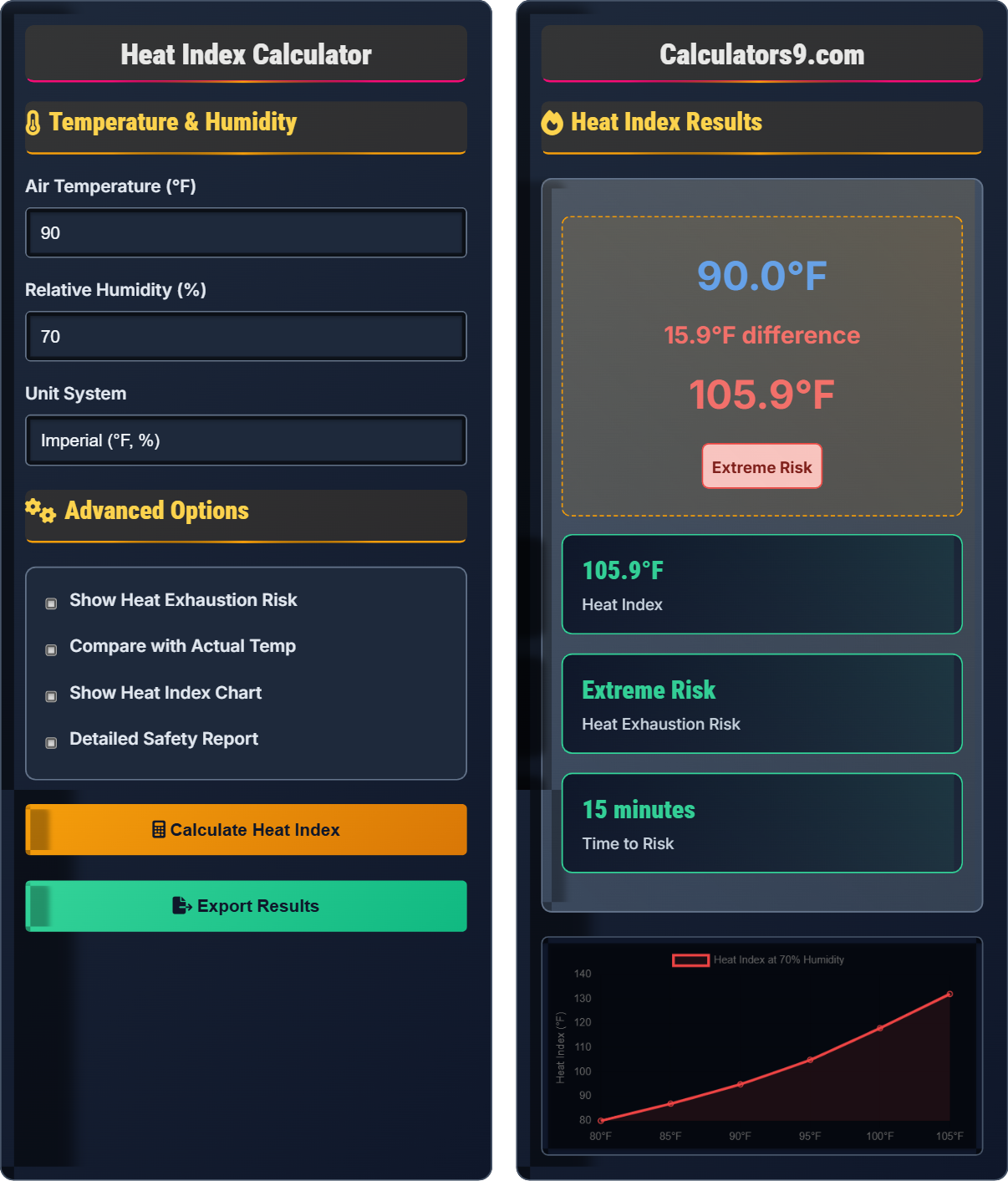
Heat Index Results
| Metric | Value |
|---|---|
| Actual Temperature | 90°F |
| Humidity | 70% |
| Heat Index | 105°F |
| Perceived Heat | Dangerous |
| Risk Level | Threshold | Precaution |
|---|---|---|
| Low | < 80°F | Minimal risk |
| Moderate | 80-90°F | Careful during exertion |
| High | 90-105°F | Heat exhaustion risk |
| Extreme | > 105°F | Heat stroke likely |
Heat Index Technology Guide
Heat index is the measure of how hot it really feels when relative humidity is combined with the actual air temperature. It measures the combined effect of heat and humidity on the human body. When humidity is high, sweat evaporates more slowly, reducing the body's ability to cool itself, making the temperature feel higher than it actually is.
The heat index formula used by the National Weather Service is:
Where:
- \(HI\) = Heat Index (temperature in °F)
- \(T\) = Air temperature in °F
- \(R\) = Relative humidity in percent
- \(c_1...c_9\) = Constants in the regression equation
The heat index was developed by Robert G. Steadman in the 1970s. The National Weather Service began using it in 1979 to better inform the public about heat-related health risks. The current formula was refined in 1990 based on research showing how different combinations of temperature and humidity affect human comfort and health. The index is based on a person with average build wearing lightweight clothing in the shade.
- Hydration: Drink plenty of water, even if not thirsty
- Rest: Take frequent breaks in cool, shaded areas
- Clothing: Wear lightweight, light-colored, loose-fitting clothing
- Schedule: Plan outdoor activities during cooler parts of the day
- Monitor: Watch for signs of heat exhaustion and heat stroke
Heat Index Learning Quiz
What does the heat index measure?
The answer is B) Perceived temperature due to heat and humidity. The heat index measures how hot it feels to the human body when relative humidity is combined with the actual air temperature. It represents the combined effect of heat and humidity on thermal comfort.
Understanding heat index is important because it represents the actual thermal stress experienced by the human body. While a thermometer might read a certain temperature, the heat index tells us how hot it actually feels to our bodies. This is critical for safety planning in hot weather conditions.
Heat Index: Measure of how hot it feels when humidity is factored in with actual temperature
Perceived Temperature: Temperature as felt by the human body, not measured by instruments
Thermal Stress: Physiological strain caused by temperature extremes
• Heat index measures perceived heat, not actual air temperature
• High humidity increases the heat index significantly
• Heat index only applies to living things, not inanimate objects
• Remember: Heat index affects living organisms, not thermometers
• The higher the humidity, the higher the heat index
• Heat index becomes more significant at temperatures above 80°F
• Confusing heat index with actual air temperature
• Thinking heat index affects non-living objects the same way
• Underestimating the impact of humidity on perceived heat
Calculate the approximate heat index if the air temperature is 85°F and the relative humidity is 80%. Explain your reasoning.
Using the heat index formula conceptually (without exact calculation):
At 85°F and 80% humidity, the heat index would be approximately 95°F.
Reasoning: The heat index effect increases significantly with higher humidity levels. At 80% humidity, the body's ability to cool itself through evaporation is greatly reduced. The combination of warm temperature and high humidity creates a dangerous situation where the perceived temperature is significantly higher than the actual air temperature.
This problem demonstrates the exponential relationship between humidity and heat perception. As humidity increases, the cooling effect of sweat evaporation decreases dramatically. This is why even moderate temperatures can feel oppressive when humidity is high.
Evaporative Cooling: Body's primary method of heat dissipation through sweat evaporation
Humidity Effect: Reduced evaporation rate in high humidity conditions
Exponential Relationship: Effect increases disproportionately with humidity
• Heat index increases exponentially with humidity
• The effect is most pronounced at temperatures above 80°F
• Heat index formula is valid for temperatures above 80°F and humidity above 40%
• Humidity above 75% significantly increases heat index
• Double humidity roughly doubles the heat index effect
• Very high humidity (above 85%) creates extreme conditions
• Assuming heat index is linear with humidity
• Applying heat index formula to very low humidity conditions
• Ignoring the exponential nature of humidity's heating effect
During a summer outdoor event, the temperature reaches 95°F with relative humidity at 75%. Based on the heat index, what is the heat exhaustion risk and how long could it take for someone to experience heat-related illness? What safety precautions should organizers take?
Step 1: Calculate heat index - At 95°F and 75% humidity, the heat index is approximately 120°F
Step 2: Assess risk level - 120°F falls into the "Extreme Risk" category
Step 3: Determine risk time - Heat exhaustion is possible within 15 minutes of exposure
Step 4: Safety precautions - Organizers should provide abundant water, shade areas, air conditioning, and consider canceling or postponing activities.
This example demonstrates the practical application of heat index knowledge for safety. Understanding the relationship between heat index and heat illness risk times is crucial for outdoor events. The extreme risk category indicates life-threatening conditions that require immediate action.
Heat Exhaustion: Illness caused by overheating and dehydration
Extreme Risk: Conditions where heat illness occurs rapidly
Exposure Time: Duration of contact with hot conditions
• At heat indexes above 105°F, heat stroke risk is extreme
• Exposure times for heat illness decrease rapidly with higher heat index
• Immediate cooling and hydration are required in extreme conditions
• Always check forecasted heat index before outdoor events
• Prepare cooling stations and water supplies for high heat index days
• Know the signs of heat exhaustion and heat stroke
• Underestimating the danger of high humidity in hot weather
• Not accounting for changing humidity conditions during outdoor events
• Assuming normal heat tolerance is sufficient for high heat index conditions
A weather report shows the actual temperature is 85°F, but the heat index is 98°F. By what percentage does the perceived heat increase compared to the actual temperature? How does this affect the danger level for outdoor workers?
Step 1: Calculate the temperature difference - 98°F - 85°F = 13°F difference
Step 2: Calculate percentage change - (13°F / 85°F) × 100% = 15.3% increase in heat perception
Step 3: Risk assessment - Actual temperature (85°F) is moderate risk, but heat index (98°F) is high risk
Step 4: Worker safety - Outdoor workers face significantly increased heat exhaustion risk and need enhanced protective measures.
This example highlights the significant impact humidity can have on perceived temperature. A 15.3% increase in heat perception represents a jump in risk category. Workers who plan for the actual temperature may be inadequately prepared for the heat index conditions, potentially leading to heat-related illnesses.
Perceived Heat: Subjective feeling of hot temperature
Risk Category: Classification system for hot weather danger levels
Protective Measures: Equipment and practices to prevent heat illness
• Heat index can increase perceived heat by 15% or more
• Risk categories change significantly with heat index
• Safety protocols should be based on heat index, not just temperature
• Always plan safety measures based on forecasted heat index
• Consider humidity conditions when scheduling outdoor work
• Adjust break times and cooling facilities based on heat index
• Planning safety measures based only on temperature, not heat index
• Underestimating the impact of moderate humidity levels
• Not adjusting work schedules for changing humidity conditions
Which of the following is a limitation of the heat index?
The answer is D) All of the above. The heat index has several limitations: it's only applicable at temperatures above 80°F with humidity above 40%, it doesn't account for solar radiation (direct sunlight can make it feel 15°F hotter), and it assumes a standard person of average build in the shade. These assumptions may not match real-world conditions for all individuals.
Understanding the limitations of the heat index is important for proper interpretation. The index is based on specific assumptions about human physiology and environmental conditions. Individual factors like metabolism, clothing, and activity level can significantly affect the actual perceived temperature.
Limited Validity: Range of conditions for which the formula is accurate
Standard Assumptions: Default conditions used in calculations
Individual Variation: Differences in perception based on personal factors
• Heat index is only valid above 80°F with humidity >40%
• Solar radiation is not considered in the calculation
• Individual factors affect actual heat perception
• Use heat index as a general guide, not absolute measure
• Consider additional factors like sun exposure and wind
• Adjust safety measures based on individual tolerance
• Applying heat index formula outside its valid range
• Ignoring other environmental factors beyond heat and humidity
• Treating heat index as an absolute measurement for all conditions
Heat Index Basics
Perceived temperature combining air temp and humidity.
\(HI = c_1 + c_2T + c_3R + c_4TR + c_5R^2 + c_6T^2 + c_7TR^2 + c_8T^2R + c_9T^2R^2\)
Where HI=Heat Index, T=temp in °F, R=humidity in %.
- Only valid above 80°F with humidity >40%
- Higher humidity = higher perceived heat
- Exponential relationship with humidity
Safety Guidelines
Low: <80°F, Moderate: 80-90°F, High: 90-105°F, Extreme: >105°F.
- Stay hydrated
- Seek shade
- Wear light clothing
- Monitor time outdoors
- Doesn't account for solar radiation
- Based on standard person in shade
- Individual tolerance varies
- Valid only for humans, not objects
FAQ
Q: How much does humidity affect perceived temperature?
A: Significant impact! At 90°F and 70% humidity, it feels like 105°F. Humidity doubles the heating effect exponentially.
Q: When does heat index become dangerous?
A: High risk at 90-105°F heat index. Extreme risk above 105°F. Heat exhaustion possible within 30 minutes.