Humidity Calculator
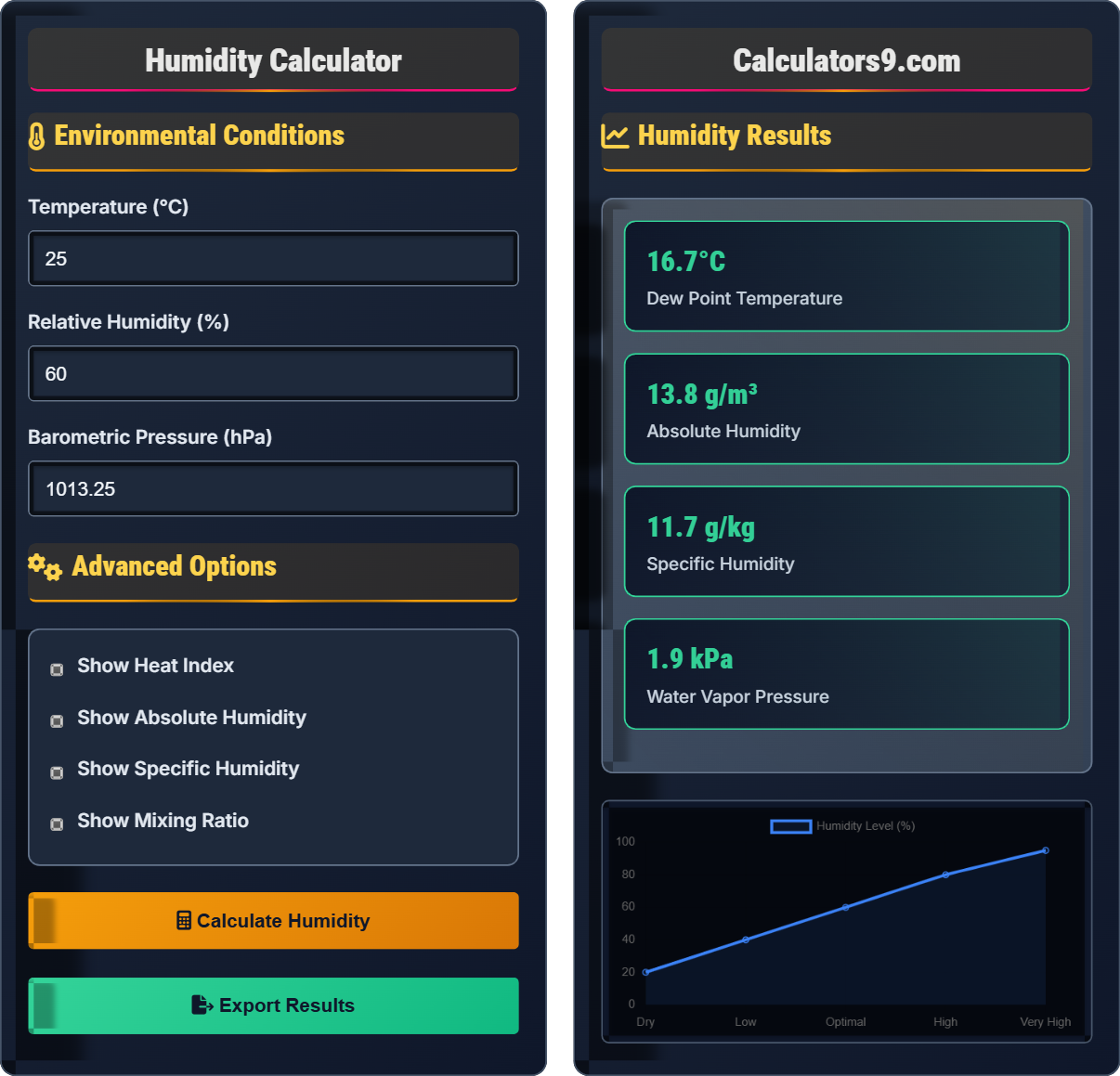
Dew point, relative humidity, absolute humidity • 2026
Environmental Conditions
Advanced Options
Humidity Results
| Metric | Value | Description |
|---|---|---|
| Relative Humidity | 60% | Percentage of water vapor in air |
| Dew Point | 20.1°C | Temperature at which dew forms |
| Absolute Humidity | 14.4 g/m³ | Mass of water per unit volume |
| Comfort Level | Range | Status |
|---|---|---|
| Optimal Comfort | 30-50% | Moderate |
| Dry Air | <30% | No |
| Humid Discomfort | >70% | Yes |
Comprehensive Humidity Guide
Humidity is the concentration of water vapor present in the air. Water vapor, the gaseous state of water, is generally invisible to the human eye. Humidity indicates the likelihood of precipitation, dew, or fog. Higher humidity reduces the effectiveness of sweating in cooling the body by reducing the rate of evaporation of moisture from the skin.
Several formulas are used to calculate different types of humidity:
Where:
- \(RH\) = Relative Humidity (%)
- \(e\) = Actual vapor pressure
- \(e_s\) = Saturation vapor pressure
For dew point calculation using Magnus formula:
Where \(a = 6.112\), \(b = 17.67\), and \(T_n = 243.5°C\).
Humidity levels significantly impact human comfort and health:
- Low Humidity (<30%): Can cause dry skin, respiratory irritation, increased static electricity, and greater susceptibility to colds and flu
- Optimal Range (30-50%): Most comfortable for humans, reduces spread of airborne viruses, prevents mold growth
- High Humidity (>70%): Creates discomfort, promotes mold and bacteria growth, increases allergens, makes it harder for the body to cool itself
- Very High Humidity (>80%): Can lead to heat exhaustion, especially when combined with high temperatures
- Use multiple sensors: Humidity can vary significantly in different areas of a room
- Calibrate regularly: Hygrometers can drift over time and need recalibration
- Consider temperature: Warmer air holds more moisture than cooler air
- Ventilate properly: Good airflow helps maintain consistent humidity levels
- Monitor trends: Daily fluctuations are normal, but consistent high or low readings indicate issues
Humidity Learning Quiz
What is the dew point temperature?
The answer is B) The temperature at which air becomes saturated with water vapor. The dew point is the temperature at which air becomes saturated with water vapor and dew or frost begins to form. It is a measure of the amount of moisture in the air and remains constant regardless of the actual air temperature.
The dew point is a critical meteorological parameter because it indicates the actual amount of moisture in the air. Unlike relative humidity, which changes with temperature, the dew point provides a direct measure of atmospheric moisture content. When air temperature cools to the dew point, condensation occurs, forming dew, fog, or clouds.
Dew Point: Temperature at which air becomes saturated with water vapor and condensation begins
Saturation: State where air contains the maximum amount of water vapor it can hold at a given temperature
Condensation: Process where water vapor turns into liquid water droplets
• Dew point remains constant regardless of air temperature changes
• Higher dew point indicates more moisture in the air
• Dew point cannot exceed air temperature
• Remember: Dew point measures actual moisture content
• Higher dew point = more humid conditions
• Dew point above 20°C (68°F) feels uncomfortable
• Confusing dew point with freezing point
• Thinking dew point changes with air temperature
• Assuming dew point and relative humidity mean the same thing
If the actual vapor pressure is 1.5 kPa and the saturation vapor pressure at the current temperature is 2.5 kPa, what is the relative humidity percentage? Show your work.
Using the relative humidity formula: \(RH = \frac{e}{e_s} \times 100\%\)
Given:
- Actual vapor pressure (e) = 1.5 kPa
- Saturation vapor pressure (e_s) = 2.5 kPa
Step 1: Calculate the ratio of actual to saturation vapor pressure: 1.5 ÷ 2.5 = 0.6
Step 2: Multiply by 100% to get the percentage: 0.6 × 100% = 60%
Therefore, the relative humidity is 60%.
This calculation demonstrates the fundamental relationship in humidity measurements. The relative humidity represents how close the air is to saturation at a given temperature. When the actual vapor pressure equals the saturation vapor pressure, the relative humidity is 100%, indicating the air is completely saturated.
Relative Humidity: Percentage of water vapor present compared to maximum possible at current temperature
Vapor Pressure: Pressure exerted by water vapor in the atmosphere
Saturation Vapor Pressure: Maximum vapor pressure air can hold at a given temperature
• Relative humidity cannot exceed 100% under normal conditions
• Higher temperatures allow air to hold more moisture
• The formula is always actual/saturation × 100%
• Remember: RH = (actual/saturation) × 100%
• Always ensure both pressures are in the same units
• RH of 50% means air is holding half its capacity
• Forgetting to multiply by 100% to get percentage
• Using different units for actual and saturation vapor pressures
• Confusing relative humidity with absolute humidity
During summer, the outdoor temperature is 32°C (90°F) with a relative humidity of 75%. The dew point is calculated to be 27°C (81°F). Based on humidity comfort levels, describe the comfort level and potential health risks associated with these conditions.
Step 1: Assess the relative humidity level - 75% is considered high humidity (>70%)
Step 2: Evaluate the dew point - 27°C (81°F) indicates very humid conditions
Step 3: Determine comfort level - High humidity combined with high temperature creates uncomfortable conditions
Step 4: Identify health risks - High humidity impairs the body's ability to cool itself through evaporation, increasing risk of heat exhaustion and heat stroke. The combination of 32°C and 75% RH creates a heat index of approximately 44°C (111°F), which is dangerous.
Therefore, these conditions represent a high-risk scenario for heat-related illnesses.
This example illustrates the practical importance of understanding humidity levels beyond simple percentages. The combination of temperature and humidity creates the heat index, which reflects the apparent temperature felt by humans. High dew points indicate high moisture content in the air, making it difficult for sweat to evaporate and for the body to regulate temperature effectively.
Heat Index: Combination of temperature and humidity representing perceived temperature
Heat Exhaustion: Condition caused by overheating and dehydration
Evaporative Cooling: Body's primary mechanism for heat dissipation
• Dew point above 20°C (68°F) feels uncomfortable
• Dew point above 24°C (75°F) feels oppressive
• High humidity reduces effectiveness of sweating
• Monitor dew point as a more reliable indicator than RH alone
• Stay hydrated in high humidity conditions
• Seek shade and air conditioning during high heat index days
• Focusing only on temperature and ignoring humidity
• Underestimating the health risks of high humidity
• Not accounting for heat index in safety planning
An indoor environment has a temperature of 22°C (72°F) and a relative humidity of 85%. To achieve optimal comfort (RH between 30-50%), what dew point range should be targeted? Calculate the current dew point and determine how much it needs to be reduced.
Step 1: Calculate current dew point using the Magnus formula
Current saturation vapor pressure at 22°C: e_s = 6.112 × exp((17.67×22)/(22+243.5)) = 2.64 kPa
Actual vapor pressure: e = (85/100) × 2.64 = 2.24 kPa
Current dew point: T_d = (17.67 × ln(2.24/6.112))/(17.67 - ln(2.24/6.112)) = 19.4°C
Step 2: Target dew point range for 30-50% RH at 22°C
At 30% RH: e = 0.30 × 2.64 = 0.79 kPa, T_d = 6.7°C
At 50% RH: e = 0.50 × 2.64 = 1.32 kPa, T_d = 12.9°C
Step 3: Calculate reduction needed
Current dew point (19.4°C) needs to be reduced to 6.7-12.9°C range
Reduction required: 6.5-12.7°C
Therefore, the dew point needs to be reduced by 6.5-12.7°C to achieve optimal comfort.
This demonstrates how dew point provides a more stable target for humidity control than relative humidity. While RH changes with temperature, dew point remains constant for a given moisture content. This makes it easier to set consistent comfort parameters regardless of temperature fluctuations. Controlling dew point is essential in HVAC systems for maintaining comfort and preventing condensation.
Optimal Comfort Zone: RH range of 30-50% for human comfort
HVAC: Heating, Ventilation, and Air Conditioning systemsCondensation: Formation of water droplets when air cools below dew point
• Dew point control is more effective than RH control
• Optimal indoor RH is 30-50%
• Dew point above 12°C causes discomfort
• Use dehumidifiers to lower dew point
• Improve ventilation to reduce indoor moisture
• Monitor dew point in basements and crawl spaces
• Setting RH too high in warm conditions
• Not accounting for temperature changes affecting RH
• Ignoring dew point when controlling humidity
Which of the following statements about absolute humidity and relative humidity is TRUE?
The answer is C) Absolute humidity remains constant as temperature changes. Absolute humidity is the mass of water vapor per unit volume of air, which does not change with temperature unless water is added or removed from the air. Relative humidity, however, changes with temperature because the saturation vapor pressure varies with temperature. As temperature increases, relative humidity decreases if the absolute humidity remains constant.
This distinction is crucial for understanding atmospheric moisture. Absolute humidity measures the actual amount of water vapor present, while relative humidity measures how close the air is to saturation. This is why relative humidity can be misleading - 50% RH at 30°C represents much more moisture than 50% RH at 10°C. Absolute humidity provides a consistent measure of moisture content regardless of temperature variations.
Absolute Humidity: Mass of water vapor per unit volume of air (g/m³)
Relative Humidity: Percentage of water vapor compared to maximum possible at current temperature
Saturation Vapor Pressure: Maximum vapor pressure air can hold at a given temperature
• Absolute humidity depends only on water content
• Relative humidity depends on both water content and temperature
• As temperature increases, RH decreases if absolute humidity is constant
• Use absolute humidity for scientific calculations
• Use relative humidity for comfort assessments
• Consider dew point for consistent moisture measurement
• Confusing absolute and relative humidity as interchangeable
• Not understanding how temperature affects RH
• Assuming RH tells you the actual amount of moisture
Humidity Fundamentals
Concentration of water vapor in air.
\(RH = \frac{e}{e_s} \times 100\%\)
Where RH=relative humidity, e=actual vapor pressure, e_s=saturation vapor pressure.
- Dew point remains constant regardless of temperature
- Higher temperature = more moisture capacity
- Optimal comfort: 30-50% RH
Measurement & Control
Temperature at which air becomes saturated and dew forms.
- Dehumidification
- Improved ventilation
- Temperature control
- Moisture source removal
- Health risks above 70% RH
- Mold growth above 60% RH
- Optimal preservation: 45-55% RH
- Energy efficiency: moderate humidity
FAQ
Q: Why does high humidity make it feel hotter?
A: High humidity reduces evaporation of sweat from skin, impairing body's cooling mechanism. At 75% RH, sweat evaporates 25% slower.
Q: What's ideal indoor humidity?
A: 30-50% RH is optimal. Prevents mold growth, reduces allergens, and maintains comfort. Below 30% causes dryness, above 60% promotes mold.