Wind Chill Calculator
Accurate wind chill index • 2026 standards
Temperature & Wind
Advanced Options
Wind Chill Results
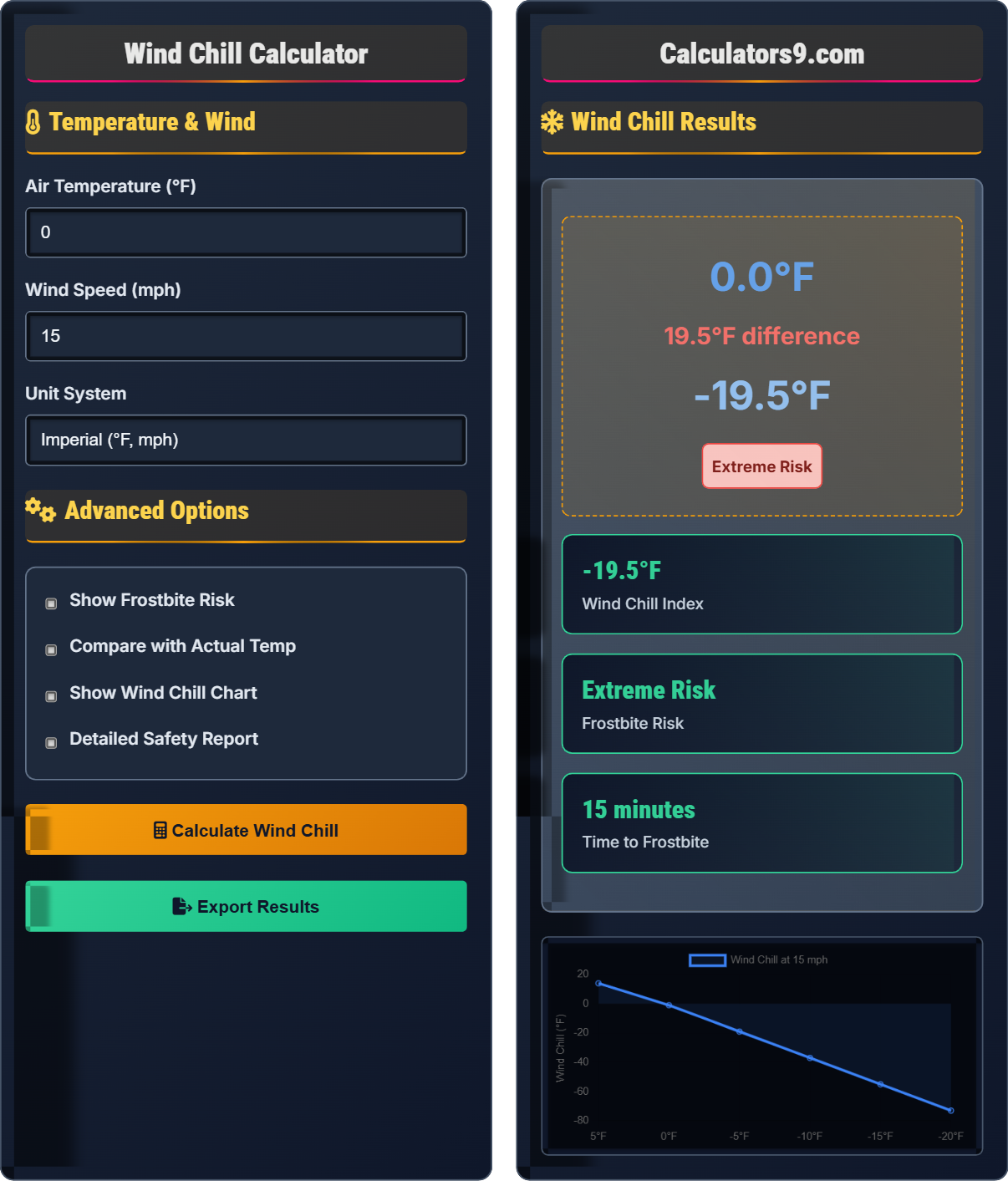
| Metric | Value |
|---|---|
| Actual Temperature | 0°F |
| Wind Speed | 15 mph |
| Wind Chill | -19°F |
| Perceived Cold | Extremely Cold |
| Risk Level | Threshold | Precaution |
|---|---|---|
| Low | > 16°F | Minimal risk |
| Moderate | 0 to 16°F | Cover exposed skin |
| High | -17 to -1°F | Severe exposure risk |
| Extreme | < -17°F | Life-threatening |
Wind Chill Technology Guide
Wind chill is the perceived decrease in air temperature felt by the body on exposed skin due to the flow of air. It measures how cold it feels to human skin when exposed to specific combinations of temperature and wind speed. The faster the wind speed, the more heat is carried away from the body, making the temperature feel colder than the actual air temperature.
The current wind chill index formula used by the National Weather Service is:
Where:
- \(WCI\) = Wind Chill Index (temperature in °C)
- \(T\) = Air temperature in °C
- \(V\) = Wind speed in km/h
The wind chill concept was developed in the 1940s by Antarctic explorers Paul Siple and Charles Passel. They measured the cooling power of wind on water bottles. The modern wind chill index was updated in 2001 by the National Weather Service to better reflect how humans actually feel cold. The new model is based on heat transfer studies and considers factors like walking speed, average body mass, and face exposure.
- Layer Clothing: Wear loose, lightweight, warm layers that trap air
- Cover Exposed Skin: Protect face, hands, and head from wind exposure
- Stay Dry: Moisture increases heat loss and cold sensitivity
- Monitor Time: Limit outdoor exposure in extreme wind chill conditions
- Watch for Signs: Recognize early symptoms of frostbite and hypothermia
Wind Chill Learning Quiz
What does the wind chill index measure?
The answer is B) Perceived temperature due to wind and cold. The wind chill index measures how cold it feels to human skin when exposed to specific combinations of temperature and wind speed. It represents the cooling effect of wind on the human body.
Understanding wind chill is important because it represents the actual thermal stress experienced by the human body. While the thermometer might read a certain temperature, the wind chill tells us how cold it actually feels to our exposed skin. This is critical for safety planning in cold weather conditions.
Wind Chill Index: Measure of how cold it feels when wind is factored in with actual temperature
Perceived Temperature: Temperature as felt by the human body, not measured by instruments
Thermal Stress: Physiological strain caused by temperature extremes
• Wind chill measures perceived cold, not actual air temperature
• Wind increases heat loss from the human body
• Wind chill only applies to living things, not inanimate objects
• Remember: Wind chill affects living organisms, not thermometers
• The greater the wind speed, the lower the wind chill
• Wind chill becomes more significant at temperatures below 50°F
• Confusing wind chill with actual air temperature
• Thinking wind chill affects non-living objects the same way
• Underestimating the impact of wind on perceived cold
Calculate the approximate wind chill if the air temperature is 5°F and the wind speed is 20 mph. Explain your reasoning.
Using the wind chill formula conceptually (without exact calculation):
At 5°F and 20 mph wind, the wind chill would be approximately -10°F.
Reasoning: The wind chill effect increases significantly with higher wind speeds. At 20 mph, the wind removes heat from exposed skin much more rapidly than at lower speeds. The combination of cold temperature and moderate-high wind creates a dangerous situation where the perceived temperature is significantly lower than the actual air temperature.
This problem demonstrates the exponential relationship between wind speed and heat loss. As wind speed increases, the cooling effect doesn't increase linearly but rather exponentially. This is why even modest increases in wind speed can dramatically increase the wind chill factor.
Heat Loss: Transfer of thermal energy from body to environment
Convection: Heat transfer through fluid movement (air in this case)
Exponential Relationship: Effect increases disproportionately with cause
• Wind chill increases exponentially with wind speed
• The effect is most pronounced at temperatures below 50°F
• Wind chill formula is valid for wind speeds above 3 mph
• Wind speeds above 3 mph are needed for wind chill effect
• Double wind speed roughly halves the wind chill temperature
• Very high winds (above 40 mph) create extreme conditions
• Assuming wind chill is linear with wind speed
• Applying wind chill formula to very low wind speeds
• Ignoring the exponential nature of wind's cooling effect
During a winter hiking trip, the temperature drops to -5°F with sustained winds of 25 mph. Based on the wind chill index, what is the frostbite risk and how long could it take for exposed skin to develop frostbite? What safety precautions should the hikers take?
Step 1: Calculate wind chill - At -5°F and 25 mph, the wind chill is approximately -35°F
Step 2: Assess risk level - -35°F falls into the "Extreme Risk" category
Step 3: Determine frostbite time - Frostbite is possible within 10-15 minutes of exposure
Step 4: Safety precautions - Hikers should seek shelter immediately, cover all exposed skin, wear multiple layers, and consider turning back to avoid dangerous conditions.
This example demonstrates the practical application of wind chill knowledge for safety. Understanding the relationship between wind chill and frostbite risk times is crucial for outdoor activities in cold weather. The extreme risk category indicates life-threatening conditions that require immediate action.
Frostbite: Injury caused by freezing of skin and underlying tissues
Extreme Risk: Conditions where frostbite occurs rapidly
Exposure Time: Duration of contact with cold conditions
• At wind chills below -17°F, frostbite risk is extreme
• Exposure times for frostbite decrease rapidly with colder wind chills
• Immediate shelter and protection are required in extreme conditions
• Always check forecasted wind chill before outdoor activities
• Prepare extra layers for unexpected cold/windy conditions
• Know the signs of frostbite and hypothermia
• Underestimating the danger of high wind speeds in cold weather
• Not accounting for changing wind conditions during outdoor activities
• Assuming normal cold weather gear is sufficient for extreme wind chill
A weather report shows the actual temperature is 15°F, but the wind chill is -5°F. By what percentage does the perceived coldness increase compared to the actual temperature? How does this affect the danger level for outdoor workers?
Step 1: Calculate the temperature difference - 15°F - (-5°F) = 20°F difference
Step 2: Calculate percentage change - (20°F / 15°F) × 100% = 133% increase in cold perception
Step 3: Risk assessment - Actual temperature (15°F) is moderate risk, but wind chill (-5°F) is high risk
Step 4: Worker safety - Outdoor workers face significantly increased frostbite risk and need enhanced protective measures.
This example highlights the dramatic impact wind can have on perceived temperature. A 133% increase in cold perception represents a significant jump in risk category. Workers who plan for the actual temperature may be inadequately prepared for the wind chill conditions, potentially leading to cold-related injuries.
Perceived Coldness: Subjective feeling of cold temperature
Risk Category: Classification system for cold weather danger levels
Protective Measures: Equipment and practices to prevent cold injury
• Wind chill can increase perceived coldness by over 100%
• Risk categories change significantly with wind chill
• Safety protocols should be based on wind chill, not just temperature
• Always plan safety measures based on forecasted wind chill
• Consider wind conditions when scheduling outdoor work
• Adjust break times and warming facilities based on wind chill
• Planning safety measures based only on temperature, not wind chill
• Underestimating the impact of moderate wind speeds
• Not adjusting work schedules for changing wind conditions
Which of the following is a limitation of the wind chill index?
The answer is D) All of the above. The wind chill index has several limitations: it's only applicable at temperatures below 50°F with wind speeds above 3 mph, it doesn't account for solar radiation (sunlight can make it feel warmer), and it assumes a standard walking speed of 3 mph. These assumptions may not match real-world conditions for all individuals.
Understanding the limitations of the wind chill index is important for proper interpretation. The index is based on specific assumptions about human activity and environmental conditions. Individual factors like metabolism, clothing, and activity level can significantly affect the actual perceived temperature.
Limited Validity: Range of conditions for which the formula is accurate
Standard Assumptions: Default conditions used in calculations
Individual Variation: Differences in perception based on personal factors
• Wind chill is only valid below 50°F with wind >3 mph
• Solar radiation is not considered in the calculation
• Individual factors affect actual cold perception
• Use wind chill as a general guide, not absolute measure
• Consider additional factors like sun exposure and humidity
• Adjust safety measures based on individual tolerance
• Applying wind chill formula outside its valid range
• Ignoring other environmental factors beyond wind and temperature
• Treating wind chill as an absolute measurement for all conditions
Wind Chill Basics
Perceived temperature combining air temp and wind speed.
\(WCI = 13.12 + 0.6215T - 11.37V^{0.16} + 0.3965TV^{0.16}\)
Where WCI=Wind Chill Index, T=temp in °C, V=wind in km/h.
- Only valid below 50°F with wind >3 mph
- Higher wind = lower perceived temp
- Exponential relationship with wind speed
Safety Guidelines
Low: >16°F, Moderate: 0-16°F, High: -17 to -1°F, Extreme: <-17°F.
- Layer clothing system
- Cover all exposed skin
- Stay dry
- Monitor time outdoors
- Doesn't account for solar radiation
- Based on standard walking speed
- Individual tolerance varies
- Valid only for humans, not objects
FAQ
Q: How much does wind affect perceived temperature?
A: Significant impact! At 0°F and 15 mph wind, it feels like -19°F. Wind doubles the cooling effect exponentially.
Q: When does wind chill become dangerous?
A: High risk at -17°F to -1°F wind chill. Extreme risk below -17°F. Frostbite possible within 30 minutes.