Angle Converter Calculator
Degrees • Radians • Gradians • Trigonometry
Angle Conversion Formulas:
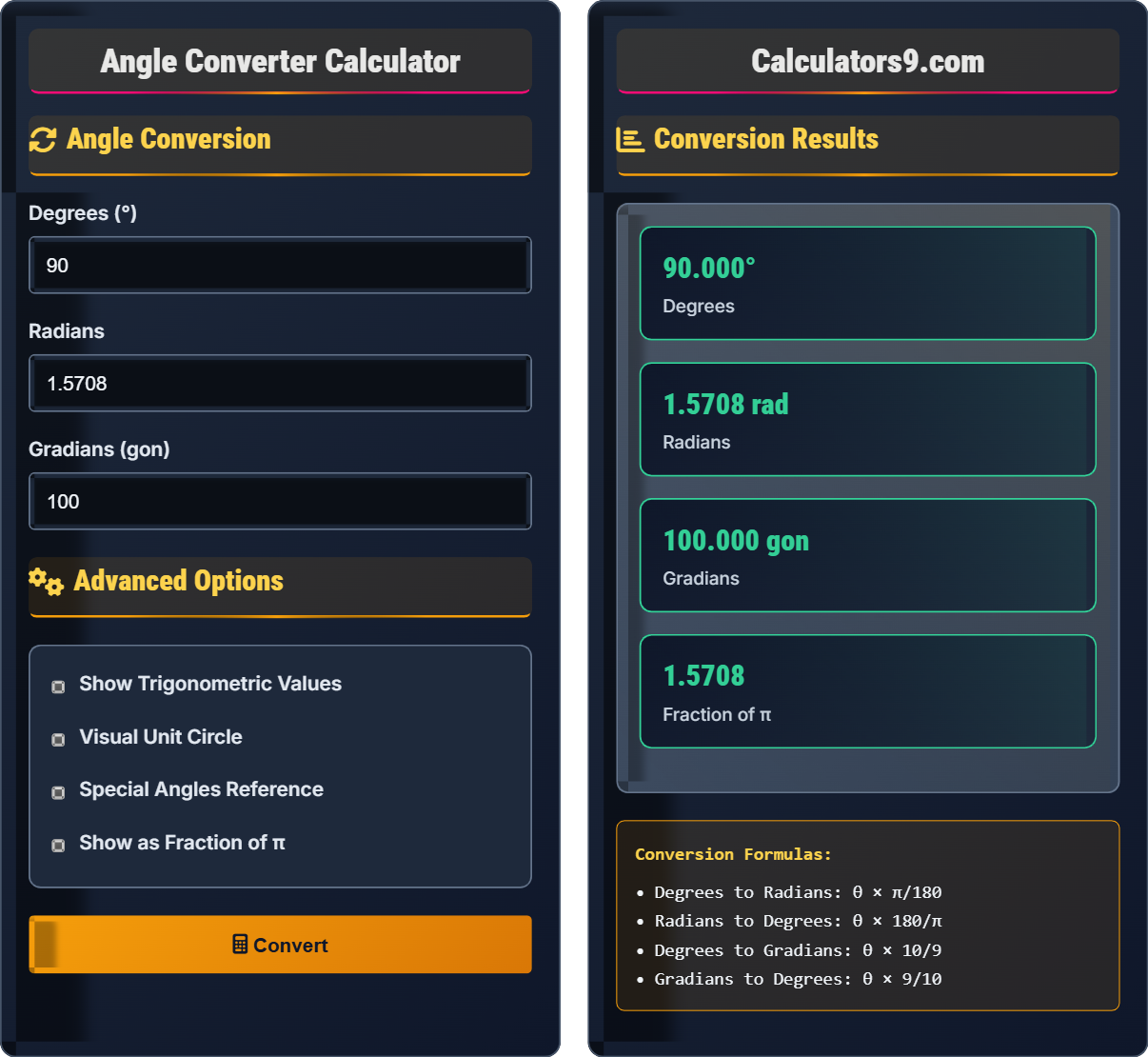
Show the calculator\( \text{Radians} = \text{Degrees} \times \frac{\pi}{180} \)
\( \text{Degrees} = \text{Radians} \times \frac{180}{\pi} \)
\( \text{Gradians} = \text{Degrees} \times \frac{10}{9} \)
\( \text{Degrees} = \text{Gradians} \times \frac{9}{10} \)
These formulas convert between different angular measurement systems:
- Degrees: Full circle = 360°
- Radians: Full circle = 2π radians
- Gradians: Full circle = 400 gradians
Example: Converting 90° to radians:
\( \text{Radians} = 90 \times \frac{\pi}{180} = \frac{\pi}{2} \approx 1.5708 \)
Thus, 90° equals π/2 radians.
Angle Conversion
Advanced Options
Conversion Results
Comprehensive Angle Conversion Guide
Angular measurement quantifies rotation between two lines or rays meeting at a point. There are three main systems: degrees, radians, and gradians. Each system divides a full circle differently, serving various mathematical and practical purposes.
The fundamental conversion relationships are:
These formulas establish the proportional relationship between measurement systems.
Each unit system excels in specific contexts:
- Degrees: Navigation, construction, basic geometry, and general education
- Radians: Calculus, physics, engineering, and computer graphics
- Gradians: Surveying, geodesy, and some European technical applications
- Memorize special angles: 30°=π/6, 45°=π/4, 60°=π/3, 90°=π/2
- Use proportion: Set up ratios for quick conversions
- Estimate first: Check if result makes sense
- Verify with unit circle: Cross-check with known values
Angle Measurement Systems
Divides a circle into 360 equal parts. Historical origin from Babylonian mathematics.
Based on radius length. One radian subtends an arc equal to the radius length.
- 180° = π radians
- 360° = 2π radians
- 1 radian ≈ 57.3°
Conversion Techniques
Set up proportions: degrees/360° = radians/2π = gradians/400
- Multiply by conversion factor
- Simplify if possible
- Verify with known angles
- Small angles remain small
- Larger than 360° indicates multiple rotations
- Check against special angle values
Angle Conversion Learning Quiz
Convert 45° to radians. Which expression represents the correct conversion?
The answer is A) 45 × π/180. To convert degrees to radians, multiply by π/180. This is derived from the relationship that 180° = π radians. So, 45° = 45 × π/180 = π/4 radians.
When converting from degrees to radians, we use the conversion factor π/180 because we want to cancel out the degree units and leave radians. This is a dimensional analysis approach: 45° × (π radians/180°) = 45π/180 radians = π/4 radians. The fraction π/180 acts as a conversion multiplier.
Radian: Angle subtended by an arc equal to the radius length
Conversion Factor: Ratio used to convert between units
Dimensional Analysis: Method of converting units by multiplying by ratios
• Degrees to Radians: Multiply by π/180
• Radians to Degrees: Multiply by 180/π
• Always verify your answer makes sense dimensionally
• Remember: 180° = π radians is the key relationship
• Memorize common conversions: 30°=π/6, 45°=π/4, 60°=π/3
• Using wrong conversion factor (π/180 vs 180/π)
• Forgetting to simplify fractions
• Mixing up degrees and radians in calculations
Convert 120° to radians and express the answer as both a decimal and as a fraction of π. Then find the exact values of sin(120°) and cos(120°).
Step 1: Convert 120° to radians using the formula: radians = degrees × π/180
120° = 120 × π/180 = 120π/180 = 2π/3 radians
Step 2: As a decimal: 2π/3 ≈ 2(3.14159)/3 ≈ 2.094 radians
Step 3: Find sin(120°) and cos(120°):
120° is in the second quadrant, where sine is positive and cosine is negative.
120° = 180° - 60°, so it has the same sine as 60° and opposite cosine of 60°
sin(120°) = sin(60°) = √3/2
cos(120°) = -cos(60°) = -1/2
This problem demonstrates multiple concepts: angle conversion, reference angles, and trigonometric values. The key insight is recognizing that 120° is a reference angle for 60° in the second quadrant. In the second quadrant, sine remains positive while cosine becomes negative. This pattern holds for all trigonometric functions based on the ASTC rule (All Students Take Calculus).
Reference Angle: Acute angle formed with x-axis
ASTC Rule: All, Sine, Tangent, Cosine positive in quadrants I, II, III, IV
Quadrant Signs: Determine positive/negative of trig functions
• Conversion: degrees × π/180 = radians
• Quadrant I: All functions positive
• Quadrant II: Only sine positive
• Remember special triangles: 30-60-90 and 45-45-90
• Use reference angles to find values in other quadrants
• Forgetting to adjust signs based on quadrant
• Incorrectly simplifying fractions
• Misapplying conversion formulas
FAQ
Q: Why do we need radians if we already have degrees? Aren't degrees sufficient for measuring angles?
A: While degrees work well for basic geometry and everyday applications, radians are superior for advanced mathematics, especially calculus. The key advantage is that radians provide a natural measure of angles based on the radius of a circle.
In calculus, the derivative of sin(x) is cos(x) only when x is measured in radians. With degrees, the derivative would be (π/180)cos(x), introducing an unnecessary constant. This happens because the limit definition of derivatives works most elegantly with the natural relationship in radians: arc length = radius × angle in radians.
Additionally, for small angles, sin(θ) ≈ θ when θ is in radians, which is fundamental in physics and engineering approximations. This relationship doesn't hold with degrees.
Q: How do I quickly convert between degrees and radians without a calculator?
A: The fastest mental conversion method relies on the fundamental relationship: 180° = π radians. From this, you can derive other conversions:
• 90° = π/2 radians
• 45° = π/4 radians
• 30° = π/6 radians
• 60° = π/3 radians
For non-special angles, think in terms of proportions. For example, 135° is 3/4 of 180°, so it's 3/4 of π radians = 3π/4 radians.
For radians to degrees: if you have 5π/6 radians, think: "This is 5/6 of π radians, so it's 5/6 of 180° = 150°."