Polygon Calculator
Fast polygon geometry • 2026 edition
Polygon Formulas:
Show the calculatorArea (Regular Polygon): \(A = \frac{1}{4}ns^2 \cot\left(\frac{\pi}{n}\right)\)
Perimeter: \(P = ns\)
Interior Angle: \(\alpha = \frac{(n-2) \times 180°}{n}\)
Sum of Interior Angles: \(S = (n-2) \times 180°\)
Number of Diagonals: \(D = \frac{n(n-3)}{2}\)
A polygon is a closed plane figure formed by connecting line segments. Regular polygons have equal sides and angles. As the number of sides increases, a regular polygon approaches a circle. The formulas above allow for calculating key geometric properties of any polygon.
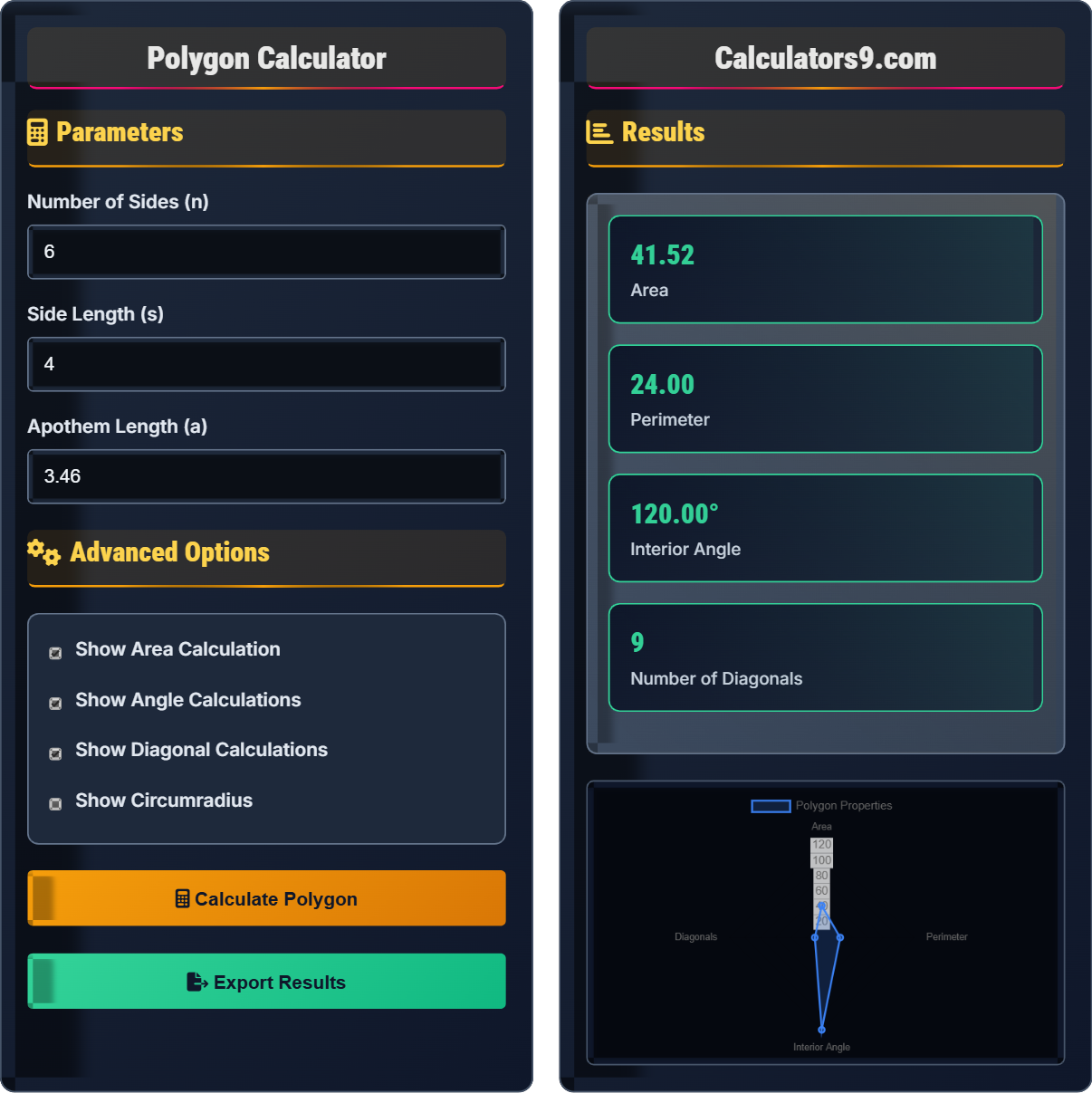
Example: For a regular hexagon (n=6) with side length s=4:
- Perimeter: P = 6 × 4 = 24
- Interior angle: α = (6-2) × 180°/6 = 720°/6 = 120°
- Sum of interior angles: S = (6-2) × 180° = 720°
- Number of diagonals: D = 6(6-3)/2 = 9
- Area: A = (1/4) × 6 × 4² × cot(π/6) = 24√3 ≈ 41.57
These formulas are fundamental in geometry and engineering applications.
Parameters
Advanced Options
Results
| Property | Value |
|---|---|
| Area | 41.57 |
| Perimeter | 24.00 |
| Interior Angle | 120.00° |
| Sum of Interior Angles | 720.00° |
| Number of Diagonals | 9 |
| Property | Value |
|---|---|
| Number of Sides (n) | 6 |
| Side Length (s) | 4.00 |
| Apothem (a) | 3.46 |
| Exterior Angle | 60.00° |
Comprehensive Polygon Guide
A polygon is a closed two-dimensional figure made up of straight line segments. The word "polygon" comes from Greek, where "poly" means many and "gon" means angle. Polygons are classified by the number of sides they have. Regular polygons have equal sides and equal angles, while irregular polygons have sides and/or angles of different measures.
Key formulas for regular polygons:
Area: \(A = \frac{1}{4}ns^2 \cot\left(\frac{\pi}{n}\right)\)
Perimeter: \(P = ns\)
Interior Angle: \(\alpha = \frac{(n-2) \times 180°}{n}\)
Where:
- \(n\) = number of sides
- \(s\) = side length
- \(\alpha\) = interior angle
- \(A\) = area
- \(P\) = perimeter
Names of polygons based on number of sides:
Two important measurements in regular polygons:
Apothem: Distance from center to midpoint of any side
Circumradius: Distance from center to any vertex
- Architecture: Building design and floor plans
- Engineering: Structural design and mechanical parts
- Computer Graphics: 3D modeling and rendering
- Nature: Honeycomb structures, crystal formations
Polygon Concepts
Closed plane figure with straight sides.
\(A = \frac{1}{4}ns^2 \cot\left(\frac{\pi}{n}\right)\)
For regular polygons only.
- Must have at least 3 sides
- Must be closed figure
- Sides are straight lines
Advanced Concepts
Line segments connecting non-adjacent vertices.
\(D = \frac{n(n-3)}{2}\)
- Each vertex connects to (n-3) others
- Divide by 2 to avoid double counting
- Triangle has 0 diagonals
- Regular polygons have equal sides/angles
- Irregular polygons have varying measures
- As n increases, polygon approaches circle
Polygon Learning Quiz
What is the sum of interior angles of a regular decagon (10-sided polygon)?
The answer is A) 1440°. The sum of interior angles of any polygon is calculated using the formula: Sum = (n - 2) × 180°, where n is the number of sides. For a decagon, n = 10, so Sum = (10 - 2) × 180° = 8 × 180° = 1440°. Each interior angle of a regular decagon would be 1440° ÷ 10 = 144°.
This formula works because any polygon can be divided into (n-2) triangles by drawing diagonals from one vertex. Since each triangle has interior angles summing to 180°, the total sum is (n-2) × 180°. This is a fundamental concept in polygon geometry.
Decagon: A polygon with 10 sides
Interior angle: An angle inside the polygon at a vertex
Regular polygon: A polygon with equal sides and angles
• Sum of interior angles = (n-2) × 180°
• Each interior angle of regular polygon = [(n-2) × 180°] / n
• Sum of exterior angles always equals 360°
• Remember: triangle (n=3) = 180°
• Square (n=4) = 360°
• Pentagon (n=5) = 540°
• Forgetting to subtract 2 from n
• Using the formula for exterior angles
• Confusing interior with exterior angles
Calculate all the properties of a regular hexagon with side length 6 cm. Show the area, perimeter, interior angle, sum of interior angles, and number of diagonals.
Given: Regular hexagon (n = 6), side length s = 6 cm
Step 1: Calculate Perimeter
Perimeter = n × s = 6 × 6 = 36 cm
Step 2: Calculate Sum of Interior Angles
Sum = (n - 2) × 180° = (6 - 2) × 180° = 4 × 180° = 720°
Step 3: Calculate Each Interior Angle
Interior angle = Sum ÷ n = 720° ÷ 6 = 120°
Step 4: Calculate Area
Area = (1/4) × n × s² × cot(π/n) = (1/4) × 6 × 6² × cot(π/6)
Area = (1/4) × 6 × 36 × √3 = (216√3)/4 = 54√3 ≈ 93.53 cm²
Step 5: Calculate Number of Diagonals
Diagonals = n(n-3)/2 = 6(6-3)/2 = 6 × 3/2 = 18/2 = 9
Final Answer:
Perimeter = 36 cm
Area ≈ 93.53 cm²
Interior angle = 120°
Sum of interior angles = 720°
Number of diagonals = 9
This problem demonstrates how to systematically calculate all properties of a regular polygon. The key insight is that knowing just the number of sides and side length allows you to calculate all other properties using standard formulas. The apothem (distance from center to side) can also be calculated as s/(2×tan(π/n)), which for a hexagon is 6/(2×tan(π/6)) = 6/(2×√3/3) = 3√3 ≈ 5.196 cm.
Regular polygon: Equal sides and angles
Apothem: Distance from center to side
Diagonal: Line connecting non-adjacent vertices
• Area = (1/2) × Perimeter × Apothem
• Interior angle = [(n-2) × 180°] / n
• Diagonals = n(n-3)/2
• Hexagons tessellate perfectly
• Regular hexagon = 6 equilateral triangles
• Each interior angle = 120°
• Confusing formulas for area and perimeter
• Forgetting to divide by 2 in diagonal formula
• Using wrong angle measures in radians vs degrees
FAQ
Q: What's the difference between a regular and irregular polygon?
A: The key difference lies in uniformity:
Regular Polygon: All sides are equal in length AND all interior angles are equal. Examples include equilateral triangles, squares, regular pentagons, and regular hexagons. These polygons have high symmetry and can be inscribed in a circle (all vertices touch the circumference).
Irregular Polygon: Sides and/or angles have different measures. The shape lacks uniformity. Examples include rectangles (opposite sides equal but adjacent sides different), rhombuses (equal sides but different angles), and random quadrilaterals.
The formulas we use in this calculator assume regular polygons. Irregular polygons require different approaches for area calculation, often involving triangulation or coordinate geometry.
Q: How do you calculate the area of an irregular polygon?
A: For irregular polygons, several methods can be used:
Triangulation: Divide the polygon into triangles and sum their areas. This works for any polygon by drawing non-intersecting diagonals from one vertex.
Shoelace Formula: Given vertex coordinates (x₁,y₁), (x₂,y₂), ..., (xₙ,yₙ), the area is: A = ½|∑(xᵢyᵢ₊₁ - xᵢ₊₁yᵢ)| where indices wrap around.
Coordinate Geometry: Use the coordinates of vertices in various formulas depending on the polygon's complexity.
Our calculator focuses on regular polygons because their symmetrical properties allow for simpler, general formulas. Irregular polygons require more complex computational approaches.