Trigonometry Calculator
Fast trigonometry functions • 2026 edition
Trigonometry Formulas:
Show the calculatorSine: \(\sin(\theta) = \frac{\text{Opposite}}{\text{Hypotenuse}}\)
Cosine: \(\cos(\theta) = \frac{\text{Adjacent}}{\text{Hypotenuse}}\)
Tangent: \(\tan(\theta) = \frac{\text{Opposite}}{\text{Adjacent}}\)
Pythagorean Identity: \(\sin^2(\theta) + \cos^2(\theta) = 1\)
SOH CAH TOA: Memory aid for sine, cosine, tangent ratios
Trigonometry studies relationships between angles and sides of triangles. The six basic trigonometric functions (sine, cosine, tangent, cosecant, secant, cotangent) relate the angles of a right triangle to the ratios of its sides. These functions extend to all angles using the unit circle.
Example: For a right triangle with angle θ = 30°:
- \(\sin(30°) = 0.5\)
- \(\cos(30°) = \sqrt{3}/2 ≈ 0.866\)
- \(\tan(30°) = 1/\sqrt{3} ≈ 0.577\)
- \(\csc(30°) = 1/\sin(30°) = 2\)
- \(\sec(30°) = 1/\cos(30°) ≈ 1.155\)
- \(\cot(30°) = 1/\tan(30°) ≈ 1.732\)
Trigonometry is fundamental in physics, engineering, architecture, and navigation.
Input Parameters
Advanced Options
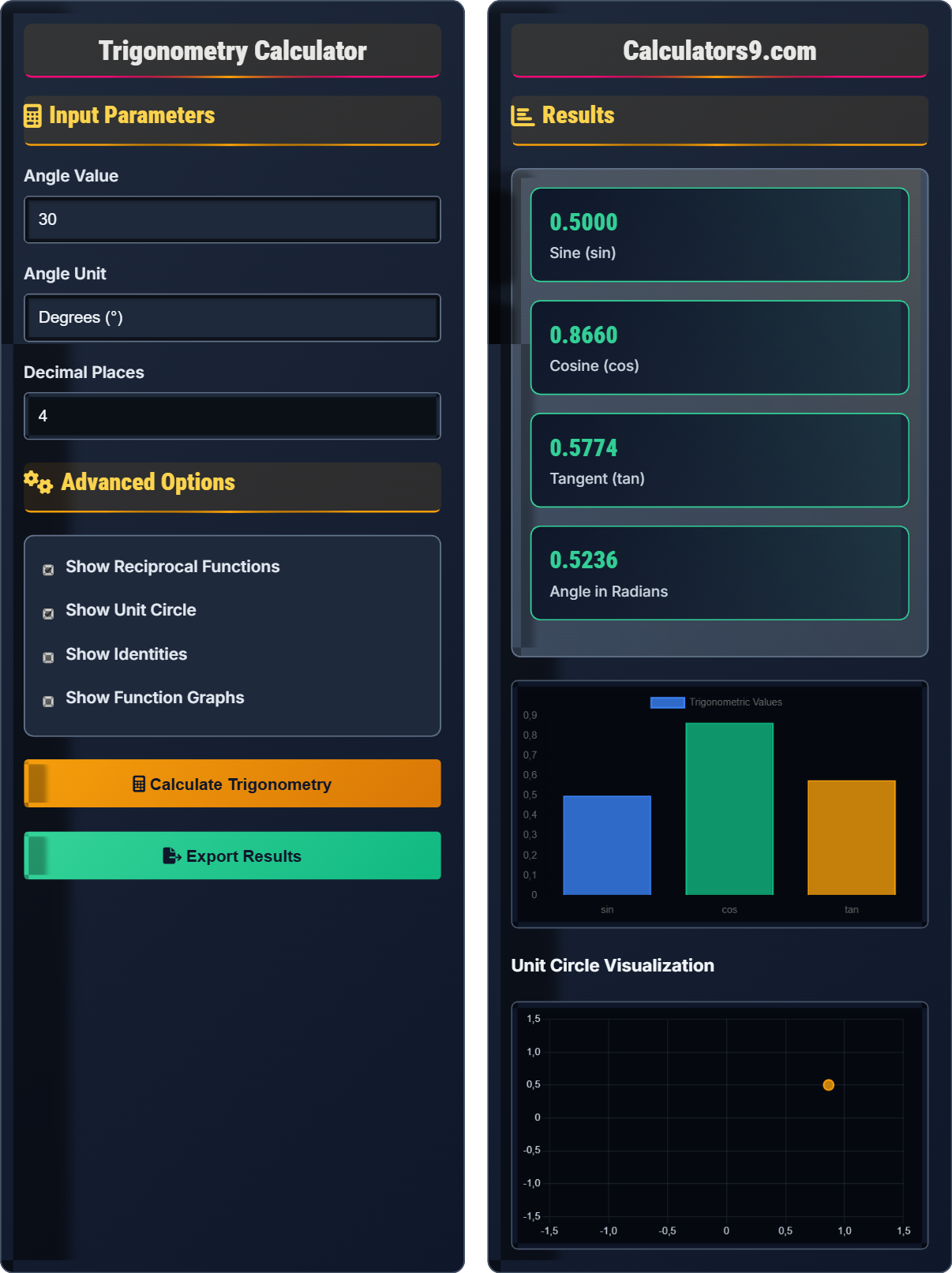
Results
| Function | Value |
|---|---|
| Sine (sin) | 0.5000 |
| Cosine (cos) | 0.8660 |
| Tangent (tan) | 0.5774 |
| Function | Value |
|---|---|
| Cosecant (csc) | 2.0000 |
| Secant (sec) | 1.1547 |
| Cotangent (cot) | 1.7321 |
Comprehensive Trigonometry Guide
Trigonometry is the branch of mathematics that studies relationships between side lengths and angles of triangles. The word comes from Greek "trigonon" (triangle) and "metron" (measure). It primarily deals with right triangles and the relationships between their sides and angles.
The three primary trigonometric functions are defined in a right triangle:
Sine: \(\sin(\theta) = \frac{\text{Opposite}}{\text{Hypotenuse}}\)
Cosine: \(\cos(\theta) = \frac{\text{Adjacent}}{\text{Hypotenuse}}\)
Tangent: \(\tan(\theta) = \frac{\text{Opposite}}{\text{Adjacent}}\)
Memory aid: SOH CAH TOA (Sine = Opposite/Hypotenuse, Cosine = Adjacent/Hypotenuse, Tangent = Opposite/Adjacent)
The reciprocal trigonometric functions are:
Key trigonometric identities:
Pythagorean: \(\sin^2(\theta) + \cos^2(\theta) = 1\)
Quotient: \(\tan(\theta) = \frac{\sin(\theta)}{\cos(\theta)}\)
Reciprocal: \(\sin(\theta) \cdot \csc(\theta) = 1\)
- Engineering: Structural analysis and wave mechanics
- Physics: Harmonic motion and optics
- Navigational: GPS and astronomy calculations
- Architecture: Roof slopes and structural design
Trigonometry Concepts
Trigonometric ratios in a right triangle.
Memorize the basic ratios.
Sine = Opposite/Hypotenuse, Cosine = Adjacent/Hypotenuse, Tangent = Opposite/Adjacent.
- Only applies to right triangles
- Hypotenuse is always longest side
- Angles sum to 180°
Advanced Concepts
Circle with radius 1 centered at origin.
\(\cos(\theta) = x\)-coordinate, \(\sin(\theta) = y\)-coordinate
- Extends trig to all angles
- Shows periodic nature
- Connects geometry and algebra
- Functions are periodic (repeat)
- Sine and cosine range from -1 to 1
- Tangent has vertical asymptotes
Trigonometry Learning Quiz
In a right triangle, if the opposite side to angle θ is 3 and the hypotenuse is 5, what is sin(θ)?
The answer is A) 3/5. By definition, sine of an angle is the ratio of the length of the opposite side to the hypotenuse. So sin(θ) = Opposite/Hypotenuse = 3/5. The adjacent side would be √(5² - 3²) = √16 = 4, but that's not needed for sine.
This question tests the fundamental definition of sine. Remember SOH CAH TOA: Sine = Opposite/Hypotenuse, Cosine = Adjacent/Hypotenuse, Tangent = Opposite/Adjacent. The hypotenuse is always the longest side in a right triangle, opposite the right angle.
Right triangle: Triangle with one 90° angle
Hypotenuse: Side opposite the right angle
Opposite side: Side across from the angle θ
• sin(θ) = Opposite/Hypotenuse
• cos(θ) = Adjacent/Hypotenuse
• tan(θ) = Opposite/Adjacent
• Remember SOH CAH TOA
• Hypotenuse is always longest side
• Always identify the angle first
• Mixing up opposite and adjacent
• Using the wrong side as hypotenuse
• Forgetting which ratio corresponds to which function
A ladder leans against a wall, forming a 60° angle with the ground. If the ladder is 10 feet long, how high up the wall does it reach? Solve using trigonometry.
We have a right triangle where the ladder is the hypotenuse (10 ft), the angle with the ground is 60°, and we want to find the height (opposite side).
Step 1: Identify what we know
- Hypotenuse = 10 ft
- Angle θ = 60°
- Need to find: Opposite side (height)
Step 2: Choose the appropriate trig function
Since we know the hypotenuse and want the opposite side, we use sine:
sin(θ) = Opposite/Hypotenuse
Step 3: Set up the equation
sin(60°) = Height/10
Step 4: Solve for height
Height = 10 × sin(60°)
Height = 10 × (√3/2)
Height = 5√3 ≈ 8.66 ft
Step 5: Verify with Pythagorean theorem
Adjacent side = 10 × cos(60°) = 10 × 0.5 = 5 ft
Check: 5² + (5√3)² = 25 + 75 = 100 = 10² ✓
Final Answer: The ladder reaches approximately 8.66 feet up the wall.
This problem demonstrates the practical application of trigonometry. The key is identifying the right triangle in the physical situation and choosing the appropriate trigonometric function. The 60° angle creates a special 30-60-90 triangle, which has exact trigonometric values that simplify calculations.
Right triangle: Triangle with one 90° angle
Reference angle: The angle we're using for calculations
Special triangles: Triangles with exact trig values
• Draw a diagram first
• Identify the sides relative to the angle
• Choose the correct trig function
• Memorize special angles (30°, 45°, 60°)
• Always verify with Pythagorean theorem
• Draw diagrams to visualize
• Using the wrong angle as reference
• Choosing the wrong trig function
• Not verifying the answer
FAQ
Q: What's the difference between degrees and radians?
A: Degrees and radians are two different units for measuring angles:
Degrees: A full circle is 360°. This system originated from ancient civilizations and divides the circle into 360 equal parts. It's commonly used in everyday applications.
Radians: A full circle is 2π radians. One radian is the angle subtended by an arc equal in length to the radius. Radians are more natural in mathematics because they relate directly to the geometry of the circle.
Conversion: 180° = π radians, so 1° = π/180 radians and 1 radian = 180°/π. For example, 30° = π/6 radians, and π/4 radians = 45°.
Q: Why do we need the reciprocal trigonometric functions?
A: Reciprocal functions are essential for several reasons:
Completeness: They provide a complete set of relationships between the sides of a right triangle. If sine relates opposite to hypotenuse, cosecant relates hypotenuse to opposite.
Calculus: Derivatives and integrals of trigonometric functions often involve reciprocal functions. For example, the derivative of tan(x) is sec²(x).
Applications: In physics and engineering, reciprocal functions appear in wave equations, harmonic motion, and electromagnetic field calculations.
Identities: Many important trigonometric identities involve reciprocal functions, such as 1 + tan²(θ) = sec²(θ) and 1 + cot²(θ) = csc²(θ).