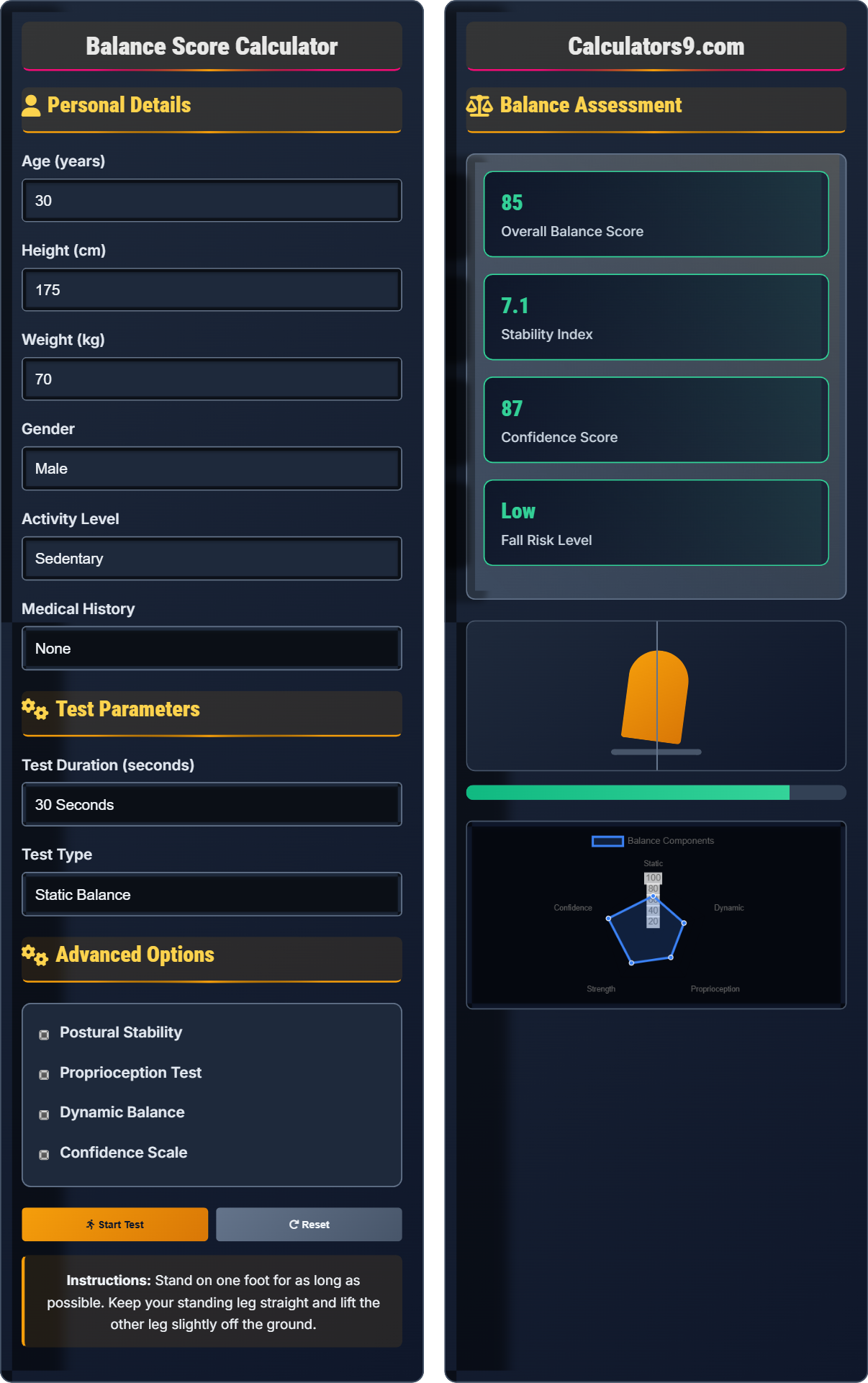
Balance Score Calculator
Fast stability assessment • 2026 standards
Balance Score Formula:
Show the calculator\( BS = \frac{1}{n} \sum_{i=1}^{n} \left( \frac{T_i}{T_{max}} \times W_i \right) \times 100 \)
Where:
- \( BS \) = Balance Score (0-100)
- \( T_i \) = Time maintained in position i
- \( T_{max} \) = Maximum time for position i
- \( W_i \) = Weight factor for position i
- \( n \) = Number of positions tested
For the Berg Balance Scale adaptation:
\( BBS = \sum_{i=1}^{14} S_i \)
Where \( S_i \) = Score for each of 14 balance tasks (0-4 points each)
This formula calculates overall balance capability based on multiple stability tests with weighted importance.
Example: For 3 positions with times 20s, 15s, 10s out of max 30s each:
\( BS = \frac{1}{3} \left( \frac{20}{30} + \frac{15}{30} + \frac{10}{30} \right) \times 100 = 50 \)
Thus, the balance score is 50 out of 100.
Personal Details
Test Parameters
Advanced Options
Instructions: Stand on one foot for as long as possible. Keep your standing leg straight and lift the other leg slightly off the ground.
Balance Assessment
| Domain | Score | Range | Status |
|---|
| Component | Score | Weight | Contribution |
|---|
| Area | Current | Target | Action Plan |
|---|
Comprehensive Balance Health Guide
Balance is the ability to maintain the body's center of mass within its base of support. It involves complex interactions between the vestibular system (inner ear), somatosensory system (touch and pressure), and visual system. Good balance requires coordination of multiple sensory inputs and motor responses.
Balance assessment typically evaluates:
Where:
- \(Vestibular:\) Inner ear balance organs
- \(Somatosensory:\) Proprioceptive feedback
- \(Visual:\) Sight-based orientation
- \(Motor:\) Muscle control and strength
Balance varies based on multiple factors:
- Age: Declines after 65 years
- Strength: Leg muscle weakness affects stability
- Flexibility: Limited ROM impacts balance
- Medications: Some cause dizziness
- Health Conditions: Diabetes, stroke, etc.
- Balance Exercises: Tai Chi, yoga, single-leg stands
- Strength Training: Focus on legs and core
- Flexibility Work: Maintain joint mobility
- Visual Training: Eye-tracking exercises
- Proprioceptive Training: Unstable surface work
Balance Fundamentals
Maintenance of center of mass within base of support.
\( BS = \frac{1}{n} \sum_{i=1}^{n} \left( \frac{T_i}{T_{max}} \times W_i \right) \times 100 \)
Where BS=balance score, T=time, W=weight, n=tests.
- Multiple systems contribute
- Declines with age
- Trainable through exercise
Performance Factors
Score: 70-100 for good balance.
- Regular balance exercises
- Strength training
- Flexibility work
- Visual training
- Age affects performance
- Medications impact results
- Health conditions matter
- Regular assessment recommended
Balance Health Learning Quiz
Which of the following is NOT one of the three primary systems involved in maintaining balance?
The answer is C) Digestive System. The three primary systems involved in balance are: 1) The Vestibular System (inner ear structures that detect head position and movement), 2) The Visual System (provides spatial orientation), and 3) The Somatosensory System (proprioceptors in muscles and joints that detect body position). The digestive system does not directly contribute to balance.
Understanding the three sensory systems is fundamental to balance assessment. These systems work together in a process called sensory integration. When one system is compromised, the others compensate. This redundancy explains why people can still maintain balance even with impaired vision or vestibular function.
Vestibular System: Inner ear structures detecting head position
Somatosensory System: Proprioceptive feedback from muscles/joints
Sensory Integration: Combining inputs from multiple systems
• Three primary systems work together
• Compensation occurs when one system fails
• All systems must be assessed
• Remember: Vestibular, Visual, Somatosensory
• Think of "Triple V" for balance systems
• Including unrelated systems in balance assessment
• Forgetting the compensatory mechanism
If a person scores 8, 6, 7, and 5 points on four different balance tests (each worth 10 points maximum), what is their average balance score? If the tests have weights of 0.3, 0.2, 0.3, and 0.2 respectively, what is the weighted balance score?
Part 1: Simple average = (8 + 6 + 7 + 5) ÷ 4 = 26 ÷ 4 = 6.5
Part 2: Weighted average calculation:
(8 × 0.3) + (6 × 0.2) + (7 × 0.3) + (5 × 0.2)
= 2.4 + 1.2 + 2.1 + 1.0 = 6.7
Therefore, simple average is 6.5 and weighted average is 6.7.
This demonstrates the difference between simple averages and weighted averages in balance assessment. Weighted scoring gives more importance to certain tests that may be more predictive of fall risk or functional performance. In clinical settings, tests like the Timed Up and Go may receive higher weights than simpler tests.
Simple Average: Equal weight to all tests
Weighted Average: Different importance to tests
Balance Score: Quantified stability measure
• Weighted averages reflect clinical importance
• Higher weights for more predictive tests
• Scores typically range 0-100
• Multiply each score by its weight
• Sum the weighted products
• Verify weights sum to 1.0
• Forgetting to multiply by weights
• Not normalizing weights to sum to 1.0
• Using simple average when weighted needed
A 70-year-old adult has a baseline balance score of 75. Research indicates that balance scores decline by approximately 3 points per decade after age 65. If the person participates in a 6-month balance training program that improves scores by 8 points, what would be their expected balance score at age 75, considering both the age-related decline and training improvement?
Step 1: Calculate age-related decline from 70 to 75 = 5 years = 0.5 decades
Step 2: Age-related decline = 0.5 × 3 points = 1.5 points
Step 3: Apply training improvement = +8 points
Step 4: Final score = 75 (baseline) - 1.5 (decline) + 8 (training) = 81.5
Therefore, the expected balance score at age 75 is 81.5.
This problem illustrates the interaction between natural aging and intervention effects. While balance naturally declines with age, targeted training can offset this decline. The net effect is positive in this case, showing that interventions can be effective even in older adults. The key is that training gains can exceed age-related losses.
Age-Related Decline: Natural deterioration with age
Training Effect: Improvement from exercise
Net Benefit: Combined effect of decline and improvement• Age-related decline continues despite training
• Training can partially offset decline
• Older adults can still improve significantly
• Calculate decline and improvement separately
• Consider both effects for net result
• Age shouldn't prevent intervention attempts
• Only considering age decline, ignoring training benefits
• Assuming improvement negates all decline
• Incorrect time period calculations
A clinic uses a balance score threshold of 70 to determine fall risk. Scores above 70 are low risk, 50-70 are moderate risk, and below 50 are high risk. If a patient scores 65 on initial assessment and improves by 15% after therapy, what is their new score and risk category? What percentage improvement did they achieve?
Step 1: Calculate improvement amount = 65 × 0.15 = 9.75 points
Step 2: New score = 65 + 9.75 = 74.75 ≈ 75 points
Step 3: Risk category for 75 points = Low Risk (since 75 > 70)
Step 4: Percentage improvement = (74.75 - 65) ÷ 65 × 100% = 15%
Therefore, new score is 75 (Low Risk) with 15% improvement.
This demonstrates how balance scores translate to clinical categories. The patient moved from moderate to low risk category, which has significant implications for care planning and independence. The 15% improvement represents meaningful clinical change that reduces fall probability and increases confidence.
Fall Risk Categories: Low, Moderate, High
Clinical Significance: Practical implications of scores
Meaningful Change: Clinically relevant improvements
• Risk categories guide treatment decisions
• Small improvements can change categories
• Clinical significance matters more than stats
• Understand threshold values
• Calculate both absolute and percentage changes
• Consider clinical relevance
• Not understanding risk category cutoffs
• Confusing absolute and percentage changes
• Missing clinical significance of improvements
Which combination of factors would most likely result in the greatest improvement in balance scores?
The answer is A) Progressive difficulty, variety, 3x/week. This combination follows evidence-based principles: progressive overload challenges the balance systems appropriately, variety prevents accommodation and addresses multiple aspects of balance, and 3x/week provides sufficient frequency for adaptation without overtraining. This approach maximizes neuroplasticity and motor learning.
Balance training effectiveness depends on specific principles similar to strength training. Progression ensures continued adaptation, variety addresses different balance components, and appropriate frequency allows for recovery and adaptation. The specificity principle means balance training should address the particular balance demands the individual faces.
Progressive Overload: Gradually increasing challenge
Motor Learning: Acquisition of movement skills
Neuroplasticity: Brain's ability to adapt
• Progression prevents plateaus
• Variety addresses multiple systems
• Adequate frequency for adaptation
• Increase difficulty gradually
• Mix static and dynamic exercises
• Challenge different sensory systems
• Doing the same routine indefinitely
• Progressing too rapidly
• Not addressing all balance components
FAQ
Q: How can I improve my balance as I get older?
A: Improving balance with age requires targeted exercises focusing on three key areas: strength, flexibility, and proprioception. Start with simple exercises like single-leg stands, heel-to-toe walking, and tai chi movements.
Research shows that consistent balance training can improve scores by 10-15 points even in older adults. The key is progressive overload - gradually increasing difficulty as abilities improve. Begin with eyes open on stable surfaces, then progress to eyes closed or unstable surfaces.
The formula for balance improvement over time can be expressed as: \( BI = B_0 + (T \times E \times P) \), where \( BI \) is balance improvement, \( B_0 \) is baseline, \( T \) is training dose, \( E \) is exercise effectiveness, and \( P \) is progression factor. Consistent training with gradual progression yields the best results.
Q: How does balance training affect athletic performance?
A: Balance training significantly enhances athletic performance by improving proprioception, postural control, and movement efficiency. Athletes with superior balance demonstrate better agility, faster reaction times, and reduced injury risk.
Studies show that balance training can improve sports performance metrics by 5-15% depending on sport type. In sports requiring rapid direction changes (soccer, basketball), balance training reduces ankle sprain risk by up to 40%.
The relationship between balance and performance can be expressed as: \( P = f(B \times S \times C) \), where \( P \) is performance, \( B \) is balance capacity, \( S \) is sport-specific skills, and \( C \) is conditioning. Better balance provides a stable foundation for all athletic movements.