Fat-Free Mass Index Calculator
Calculate your FFMI • Body composition
\( \text{FFMI} = \frac{\text{Fat-Free Mass (kg)}}{\text{Height (m)}^2} \)
Where:
- \( \text{Fat-Free Mass} = \text{Body Weight} - (\text{Body Weight} \times \text{Body Fat \%}) \)
- \( \text{Height} \) in meters
This formula standardizes lean body mass relative to height, providing a better measure of muscular development than simple weight. Normal ranges are typically 16-18 for women and 18-20 for men.
Adjusted FFMI: \( \text{FFMI}_{\text{adj}} = \text{FFMI} + 6.1 \times (1.8 - \text{Height in meters}) \)
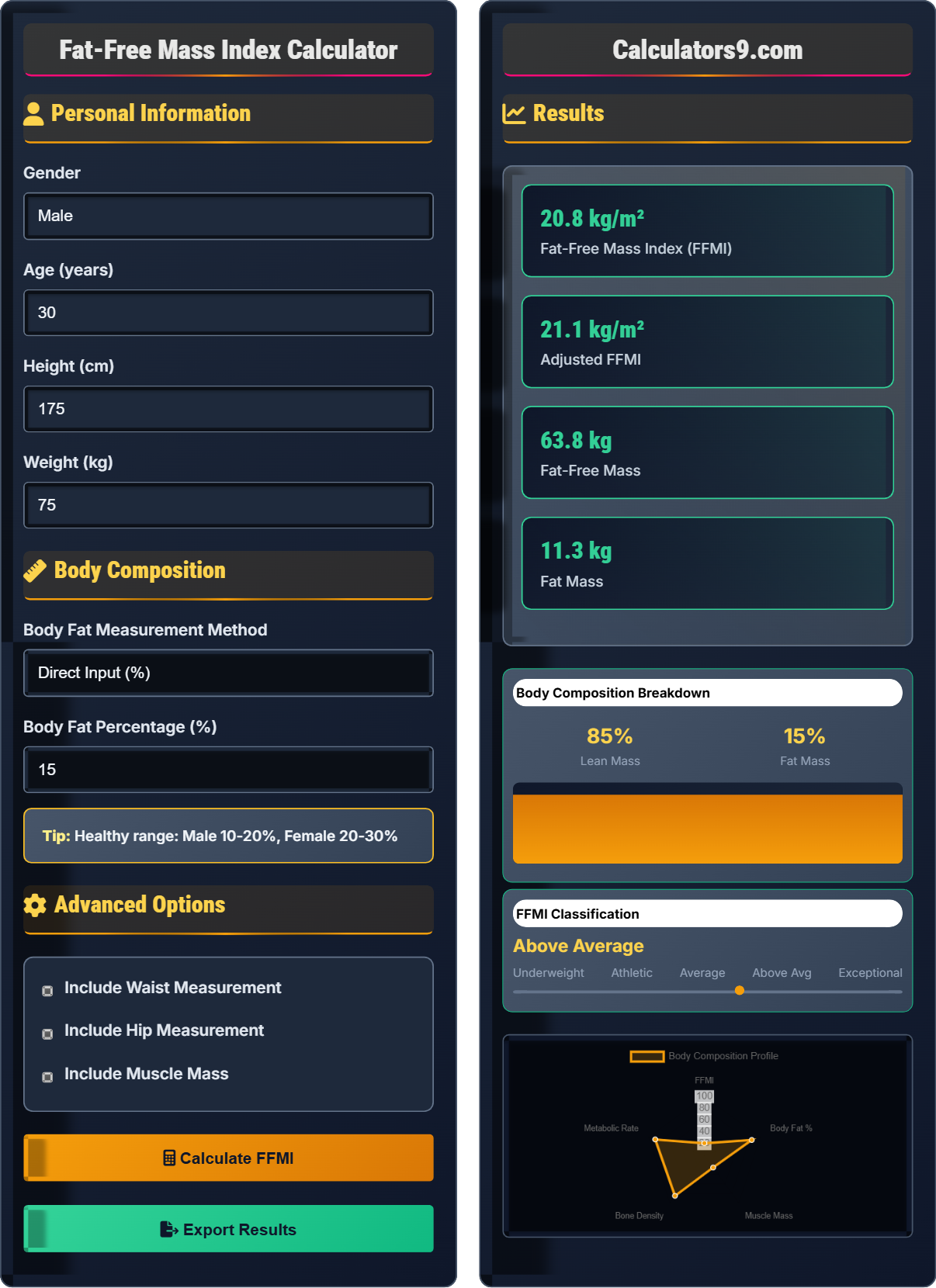
Example: For a 75kg male who is 175cm tall with 15% body fat:
Fat-Free Mass = 75kg × (1 - 0.15) = 63.75kg
FFMI = 63.75 ÷ (1.75)² = 63.75 ÷ 3.0625 = 20.82
Personal Information
Body Composition
Advanced Options
Results
| Measurement | Value | Standard Range | Status |
|---|
Understanding Fat-Free Mass Index (FFMI)
Fat-Free Mass Index (FFMI) is a measure of lean body mass relative to height, similar to BMI but excluding fat mass. It provides a better assessment of muscular development and body composition than traditional BMI, especially for individuals with higher muscle mass. FFMI helps distinguish between muscle and fat when evaluating body composition.
The standard FFMI formula is:
Where Fat-Free Mass = Body Weight × (1 - Body Fat %)
For height adjustment (especially important for taller individuals), the adjusted FFMI formula is:
- Underweight: Below 18
- Athletic: 18-20
- Average: 19-21
- Above Average: 20-22
- Exceptional (without steroids): 22-25
- Underweight: Below 16
- Athletic: 16-18
- Average: 17-19
- Above Average: 18-20
- Exceptional: 20-23
FFMI offers several advantages over traditional BMI:
- Accounts for body composition: Distinguishes between muscle and fat mass
- Better for athletes: Doesn't misclassify muscular individuals as overweight
- More accurate assessment: Provides insight into muscular development
- Health indicator: Correlates with metabolic health and physical fitness
- Resistance Training: Focus on compound movements to build lean muscle mass
- Proper Nutrition: Adequate protein intake (1.6-2.2g per kg body weight)
- Body Fat Management: Maintain healthy body fat levels while building muscle
- Progressive Overload: Gradually increase training intensity over time
- Recovery: Ensure adequate sleep and recovery between workouts
FFMI Basics
Lean mass index adjusted for height.
FFMI = Fat-Free Mass(kg) / Height(m)²
- Excludes fat mass from calculation
- Adjusts for height differences
- Higher values indicate more muscle
Improvement Strategies
Build lean mass while managing body fat.
- Strength training
- Protein intake
- Progressive overload
- Body fat management
- Genetics influence potential
- Consistency is key
- Progress takes time
- Professional guidance recommended
FFMI Learning Quiz
What is the main advantage of FFMI over traditional BMI?
The answer is B) It distinguishes between muscle and fat mass. Unlike BMI, which only considers weight and height, FFMI specifically measures lean body mass relative to height, providing a more accurate assessment of muscular development.
FFMI addresses a fundamental limitation of BMI: it cannot differentiate between muscle and fat. This distinction is crucial because muscle is denser than fat and metabolically active. Two individuals with the same BMI could have vastly different body compositions, with one having high muscle mass and low body fat (healthy) versus another having low muscle mass and high body fat (unhealthy).
FFMI: Fat-Free Mass Index - Lean mass adjusted for height
BMI: Body Mass Index - Weight relative to height squared
Fat-Free Mass: Total body weight minus fat mass
• FFMI excludes fat mass from calculation
• Muscle weighs more than fat per volume
• FFMI better assesses muscular development
• Remember: FFMI focuses on lean mass
• BMI can misclassify muscular individuals
• Confusing FFMI with BMI
• Not understanding the muscle-fat distinction
Calculate the FFMI for a 80kg male who is 180cm tall with 12% body fat. Show your work.
Step 1: Convert height to meters: 180cm = 1.8m
Step 2: Calculate fat-free mass: 80kg × (1 - 0.12) = 80kg × 0.88 = 70.4kg
Step 3: Calculate FFMI: 70.4kg ÷ (1.8m)² = 70.4 ÷ 3.24 = 21.73 kg/m²
Step 4: Calculate adjusted FFMI: 21.73 + 6.1 × (1.8 - 1.8) = 21.73 kg/m²
Therefore, the FFMI is 21.7 kg/m².
This calculation demonstrates the straightforward nature of FFMI computation. The key steps involve converting body fat percentage to actual mass, then applying the standard index formula. The adjusted version accounts for height differences, though in this case the adjustment factor is zero since the individual is exactly 1.8m tall.
Fat-Free Mass: Total body weight minus fat weight
Index Calculation: Mass divided by height squaredHeight Adjustment: Correction for taller/shorter individuals
• Convert height to meters for calculation
• Use decimal form for body fat percentage
• FFMI is in kg/m² units
• Remember: 100cm = 1m
• Convert % to decimal by dividing by 100
• Square the height in meters
• Forgetting to convert height to meters
• Using body fat % as a whole number instead of decimal
• Squaring before converting units
Two athletes weigh the same (75kg) and are the same height (175cm). Athlete A has 10% body fat, while Athlete B has 20% body fat. Calculate their respective FFMI values and determine who has better muscular development.
Step 1: Convert height to meters: 175cm = 1.75m
Step 2: Calculate Athlete A's fat-free mass: 75kg × (1 - 0.10) = 75kg × 0.90 = 67.5kg
Step 3: Calculate Athlete A's FFMI: 67.5kg ÷ (1.75m)² = 67.5 ÷ 3.0625 = 22.04 kg/m²
Step 4: Calculate Athlete B's fat-free mass: 75kg × (1 - 0.20) = 75kg × 0.80 = 60kg
Step 5: Calculate Athlete B's FFMI: 60kg ÷ (1.75m)² = 60 ÷ 3.0625 = 19.59 kg/m²
Therefore, Athlete A has a higher FFMI (22.0 vs 19.6) indicating better muscular development.
This example perfectly illustrates why FFMI is superior to simple weight comparisons. Despite identical body weights, the athletes have dramatically different muscular development due to their body composition. Athlete A, with lower body fat, has more lean mass and thus a significantly higher FFMI, indicating superior muscular development.
Body Composition: Ratio of fat to lean mass
Muscular Development: Amount of lean muscle mass
Relative Strength: Strength per unit of body weight
• Same weight ≠ same body composition
• Lower body fat = higher FFMI (same weight)
• FFMI measures muscular efficiency
• Focus on body composition, not just weight
• Lower body fat improves FFMI significantly
• Compare athletes using FFMI, not BMI
• Equating weight with muscle mass
• Ignoring body fat percentage
• Using BMI for athletic comparisons
John is a 25-year-old male who weighs 70kg with 18% body fat and is 175cm tall. After 6 months of consistent strength training, he gains 3kg of muscle and loses 2kg of fat while maintaining the same body weight. Calculate the change in his FFMI and explain the significance.
Initial State:
- Initial fat mass: 70kg × 0.18 = 12.6kg
- Initial fat-free mass: 70kg - 12.6kg = 57.4kg
- Initial FFMI: 57.4kg ÷ (1.75m)² = 57.4 ÷ 3.0625 = 18.74 kg/m²
After Training:
- New fat mass: 12.6kg - 2kg = 10.6kg
- New fat-free mass: 57.4kg + 3kg = 60.4kg
- New FFMI: 60.4kg ÷ (1.75m)² = 60.4 ÷ 3.0625 = 19.72 kg/m²
Change in FFMI: 19.72 - 18.74 = 0.98 kg/m² increase
This represents a 5.2% improvement in FFMI, indicating significant improvement in muscular development.
This problem demonstrates the effectiveness of body recomposition - simultaneously gaining muscle and losing fat. Even with no change in total body weight, John's body composition improved dramatically, resulting in a higher FFMI. This shows that FFMI responds to changes in body composition, not just weight, making it an excellent marker for tracking fitness progress.
Body Recomposition: Simultaneous fat loss and muscle gain
Metabolic Adaptation: Body's response to training stimuli
Training Response: Physiological changes from exercise
• FFMI tracks body composition changes
• Muscle gain increases FFMI
• Fat loss also contributes to higher FFMI
• Track FFMI for body composition progress
• Combine strength training with nutrition
• Focus on body composition, not just scale weight
• Measuring progress by weight alone
• Not accounting for body composition changes
• Ignoring the muscle-fat relationship
For a male athlete, which FFMI range is considered exceptional without performance-enhancing substances?
The answer is C) 22-25 kg/m². Research and observations of natural athletes suggest that FFMI values above 25 kg/m² are extremely rare without performance-enhancing substances. Values in the 22-25 range represent the upper limits of what's achievable naturally for most males.
FFMI ranges provide context for interpreting results. The 22-25 range for males represents elite natural athleticism. Values above 25 are possible but extremely uncommon without pharmaceutical assistance. This knowledge helps set realistic goals and identify potentially unrealistic expectations in fitness pursuits.
Natural Limits: Achievable levels without enhancement
Elite Athletes: Exceptional physical development
Performance Enhancement: Substances affecting development
• 22-25 represents natural elite level
• Above 25 is extremely rare naturally
• Genetics influence potential significantly
• Set realistic goals based on natural ranges
• Focus on consistent progress
• Understand genetic limitations
• Setting unrealistic FFMI targets
• Comparing to enhanced athletes
• Not understanding natural limits
FAQ
Q: How can I maximize my FFMI through training and nutrition?
A: Maximizing your FFMI requires a systematic approach combining resistance training with proper nutrition:
Training Protocol:
- Frequency: 4-6 strength training sessions per week
- Volume: 10-20 sets per muscle group weekly
- Intensity: 70-85% of 1RM for hypertrophy
- Progressive Overload: Gradually increase weight, reps, or volume
Nutrition Strategy:
- Protein Intake: 1.6-2.2g per kg of body weight daily
- Caloric Surplus: 250-500 calories above maintenance for muscle gain
- Carbohydrates: 3-7g per kg for training fuel
- Healthy Fats: 0.8-1.2g per kg for hormone production
With consistent effort, you can expect to see gradual improvements in FFMI, typically 0.2-0.5 units per year for experienced trainees.
Q: Is a higher FFMI always better for health?
A: While higher FFMI generally correlates with better health outcomes, there are important considerations:
Health Benefits of Higher FFMI:
- Metabolic Health: More muscle mass increases resting metabolic rate
- Bone Density: Resistance training improves bone mineral density
- Insulin Sensitivity: Muscle tissue improves glucose metabolism
- Functional Capacity: Better mobility and independence with aging
Important Balance:
However, extremely high FFMI values (above 25 for men, 22 for women) may indicate potential issues:
- Potentially achieved through unhealthy means
- Increased joint stress and injury risk
- Disproportionate focus on physique over health
The optimal range for health is typically 18-22 for men and 16-20 for women, balancing muscular development with overall wellness.