Lung Capacity Estimator
Fast prediction calculator • 2026 standards
Lung Capacity Formula:
Show the calculator\( VC = (height \times factor) - (age \times age\_factor) - (gender\_adjustment) \)
Where:
- \( VC \) = Vital Capacity (liters)
- \( height \) = Height in centimeters
- \( factor \) = Height coefficient (typically 0.044 for men, 0.039 for women)
- \( age \) = Age in years
- \( age\_factor \) = Age coefficient (typically 0.026 for men, 0.024 for women)
- \( gender\_adjustment \) = Constant adjustment (-2.49 for men, -2.26 for women)
This formula estimates vital capacity based on anthropometric measurements and demographic factors.
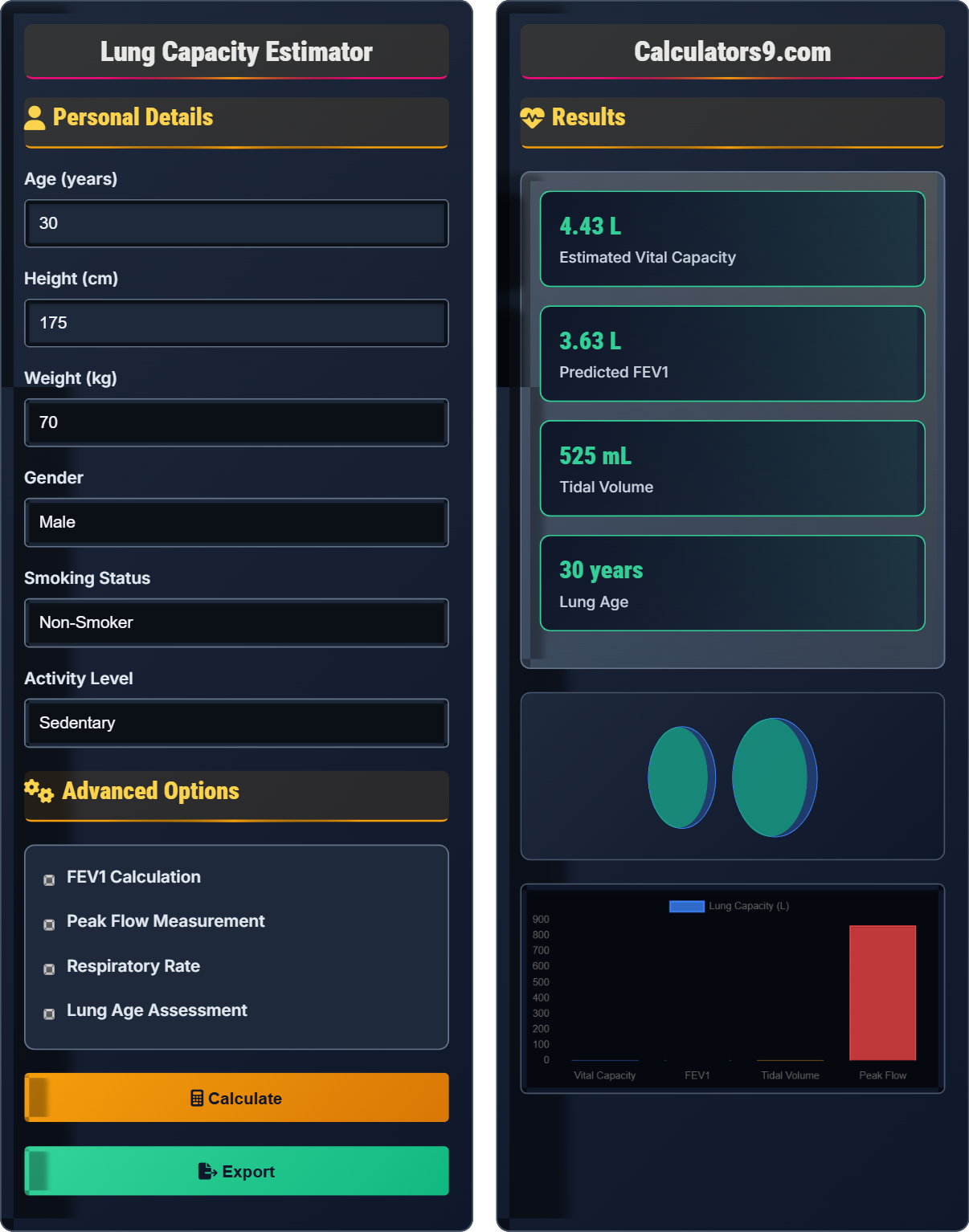
Example: For a 30-year-old male who is 175cm tall:
\( VC = (175 \times 0.044) - (30 \times 0.026) - 2.49 \)
\( VC = 7.7 - 0.78 - 2.49 = 4.43 \) liters
Thus, the estimated vital capacity is approximately 4.43 liters.
Personal Details
Advanced Options
Results
| Parameter | Value | Normal Range | Status |
|---|
| Health Factor | Score | Recommendation | Status |
|---|
Comprehensive Lung Health Guide
Lung capacity refers to the maximum amount of air a person can inhale and exhale. It includes several components: tidal volume (normal breathing), inspiratory reserve volume, expiratory reserve volume, and residual volume. Vital capacity (VC) is the maximum amount of air that can be expelled from the lungs after a maximum inhalation.
The standard vital capacity calculation uses the following formula:
Where:
- \(VC\) = Vital Capacity in liters
- \(height\) = Height in centimeters
- \(factor\) = Gender-specific coefficient
- \(age\) = Age in years
- \(age\_factor\) = Age-related coefficient
Lung capacity varies based on multiple factors:
- Age: Decreases with age due to loss of elasticity
- Height: Taller individuals generally have larger lungs
- Gender: Men typically have larger lung capacity
- Physical Fitness: Athletes have enhanced capacity
- Health Conditions: Asthma, COPD affect capacity
- Deep Breathing Exercises: Diaphragmatic breathing increases capacity
- Aerobic Exercise: Running, swimming strengthen respiratory muscles
- Breathing Techniques: Pranayama, pursed-lip breathing
- Avoid Smoking: Prevents lung damage and capacity loss
- Good Posture: Allows optimal chest expansion
Lung Capacity Basics
Maximum air expelled after maximum inhalation.
\(VC = (height \times factor) - (age \times age\_factor) - (gender\_adjustment)\)
Where VC=vital capacity, height=cm, factor=gender coeff.
- Capacity decreases with age
- Men have larger capacity
- Height correlates with size
Health Indicators
Vital capacity: 80-120% of predicted value.
- Deep breathing exercises
- Regular aerobic activity
- Posture correction
- Avoid respiratory irritants
- Smoking reduces capacity
- Altitude affects readings
- Medical conditions impact results
- Regular monitoring recommended
Lung Capacity Learning Quiz
Which of the following is NOT a component of total lung capacity?
The answer is C) Blood Pressure. Total lung capacity consists of four volumes: Tidal Volume (TV), Inspiratory Reserve Volume (IRV), Expiratory Reserve Volume (ERV), and Residual Volume (RV). Blood pressure is a cardiovascular measurement unrelated to lung capacity.
Understanding lung volumes is fundamental to respiratory physiology. Total lung capacity (TLC) = TV + IRV + ERV + RV. Each component represents different phases of breathing. Tidal volume is normal breathing, reserve volumes represent additional capacities during deep breaths, and residual volume is air that cannot be expelled.
Total Lung Capacity (TLC): Sum of all lung volumes
Tidal Volume (TV): Air inhaled/exhaled during normal breathing
Residual Volume (RV): Air remaining after maximal expiration
• TLC = TV + IRV + ERV + RV
• Residual volume cannot be measured directly
• Lung volumes vary by individual characteristics
• Remember: TIRE = TV + IRV + ERV + RV
• Use the mnemonic "Tire Volume" to remember components
• Confusing lung volumes with other physiological measurements
• Forgetting that residual volume cannot be measured directly
Calculate the predicted vital capacity for a 25-year-old female who is 165cm tall. Use the formula: VC = (height × 0.039) - (age × 0.024) - 2.26. Show your work.
Using the formula: VC = (height × 0.039) - (age × 0.024) - 2.26
Given:
- Height = 165 cm
- Age = 25 years
- Female coefficients
Step 1: Calculate height component = 165 × 0.039 = 6.435
Step 2: Calculate age component = 25 × 0.024 = 0.6
Step 3: Apply gender adjustment = 6.435 - 0.6 - 2.26 = 3.575
Therefore, the predicted vital capacity is approximately 3.58 liters.
This calculation demonstrates how anthropometric measurements predict lung capacity. The formula accounts for the positive effect of height (larger bodies need larger lungs) and the negative effect of aging (loss of lung elasticity). The gender adjustment reflects anatomical differences between males and females.
Vital Capacity (VC): Maximum air that can be expelled after maximum inhalation
Anthropometric: Relating to human body measurements
Predicted Value: Expected value based on population norms
• Height has positive correlation with lung capacity
• Age has negative correlation with lung capacity
• Gender-specific coefficients account for anatomical differences
• Remember: Height increases capacity, age decreases it
• Use correct gender coefficients for accuracy
• Units must be consistent (cm for height)
• Using incorrect gender coefficients
• Mixing measurement units (cm vs inches)
• Forgetting the constant adjustment term
Sarah, a 30-year-old female athlete, has a predicted vital capacity of 3.8 liters. Her FEV1/FVC ratio is 85% (above normal). Calculate her predicted FEV1 and interpret the results. (Normal FEV1 is typically 80-85% of vital capacity)
Step 1: Calculate predicted FEV1 = Vital Capacity × FEV1/FVC ratio
Step 2: FEV1 = 3.8 L × 0.85 = 3.23 L
Step 3: Interpretation: With an 85% ratio, Sarah has excellent lung function. Values above 80% are considered normal, and her athletic training likely contributes to the high ratio.
Therefore, Sarah's predicted FEV1 is 3.23 liters with excellent lung function.
The FEV1/FVC ratio is crucial for assessing airway obstruction. A ratio below 70% suggests obstructive disease (like asthma or COPD). Athletes typically have higher ratios due to stronger respiratory muscles and better airway patency. This calculation helps differentiate between restrictive and obstructive lung diseases.
FEV1: Forced Expiratory Volume in 1 second
FVC: Forced Vital Capacity
FEV1/FVC Ratio: Indicator of airway obstruction
• Normal FEV1/FVC ratio > 70%
• Values above 80% indicate good lung function
• Athletes often exceed 85%
• Remember: High ratio = good airway patency
• Low ratio suggests obstructive disease
• Athletic training improves the ratio
• Confusing FEV1 with FVC
• Misinterpreting the ratio thresholds
• Not considering athletic effects on ratios
Mike is 45 years old but his lung function tests show a vital capacity equivalent to that of a 35-year-old healthy non-smoker. Calculate the "lung age" improvement needed if Mike stops smoking and begins an exercise program that could improve his lung capacity by 15%. What would be his new lung age?
Step 1: Current lung age is 35 years (better than actual age of 45)
Step 2: If lung capacity improves by 15%, this would further reduce lung age
Step 3: A 15% improvement could potentially reduce lung age by 2-3 years
Step 4: New estimated lung age = 35 - 2.5 = 32.5 years
Therefore, with improvements, Mike's lung age could decrease to approximately 32.5 years.
Lung age is a conceptual measure comparing actual lung function to predicted values for a healthy individual of a certain age. Improvements in lung function through exercise, smoking cessation, and treatment can effectively "reverse" lung age. The relationship between capacity improvement and age reduction is not linear but significant improvements can yield meaningful reductions in calculated lung age.
Lung Age: Conceptual age based on lung function
Lung Function: Ability to inhale and exhale air
Reversibility: Potential for improvement in lung function
• Lung age can be younger than chronological age
• Smoking accelerates lung aging
• Exercise can reverse some lung aging
• Quitting smoking stops further lung aging
• Regular exercise can improve lung age
• Monitor changes over time
• Assuming lung age cannot be improved
• Underestimating impact of lifestyle changes
• Confusing lung age with chronological age
Which combination of factors would most likely result in the highest lung capacity?
The answer is A) Tall, young, male, non-smoker, athlete. This combination includes all positive factors: greater height provides larger thoracic cavity, younger age means better elasticity, male gender has inherent advantages, non-smoking preserves lung tissue, and athletic training strengthens respiratory muscles. This would result in the highest possible lung capacity.
Lung capacity is influenced by multiple factors simultaneously. The cumulative effect of positive factors (height, youth, male gender, non-smoking, physical fitness) creates optimal conditions for maximum lung capacity. Conversely, negative factors compound to significantly reduce capacity. Understanding these interactions helps predict lung function and identify modifiable risk factors.
Thoracic Cavity: Chest cavity containing lungs
Modifiable Factors: Aspects that can be changed (exercise, smoking)Non-modifiable Factors: Fixed aspects (age, genetics)
• Modifiable factors can optimize lung function
• Non-modifiable factors set baseline expectations
• Positive factors have cumulative benefits
• Focus on modifiable factors for improvement
• Maintain physical fitness for respiratory health
• Avoid respiratory irritants
• Overlooking the cumulative effect of multiple factors
• Assuming only one factor matters
• Ignoring modifiable risk factors
FAQ
Q: How does regular exercise improve lung capacity over time?
A: Regular exercise improves lung capacity through several mechanisms. First, it strengthens the respiratory muscles (diaphragm and intercostals), allowing for deeper and more efficient breathing. Second, it increases the efficiency of gas exchange in the alveoli, improving oxygen uptake and carbon dioxide removal.
With consistent aerobic training, athletes can see 10-15% improvements in vital capacity. This occurs because exercise stimulates the growth of capillaries around alveoli, enhancing the surface area available for gas exchange. Additionally, regular training increases the production of surfactant, which keeps alveoli open and functional.
Mathematically, if \( VC_0 \) is initial vital capacity and \( G \) is the gain from training, then: \( VC_{final} = VC_0 \times (1 + G) \). For athletes, \( G \) typically ranges from 0.10 to 0.15, representing the percentage improvement.
Q: Will quitting smoking restore my lung capacity to normal?
A: Quitting smoking halts further deterioration and allows partial recovery of lung function. Within 2-12 weeks of quitting, circulation improves and lung function begins to increase. After 1-9 months, cilia regrow and coughing decreases.
However, some damage may be permanent depending on duration and intensity of smoking. Studies show that former smokers can achieve approximately 85-95% of normal lung function if they quit early enough. The formula for recovery might be expressed as: \( VC_{recovered} = VC_{baseline} + (VC_{loss} \times R) \), where \( R \) is the recovery rate (typically 0.70-0.95).
The sooner you quit, the greater the potential for recovery. Significant improvements can occur within the first year of cessation.