Metabolic Age Estimator
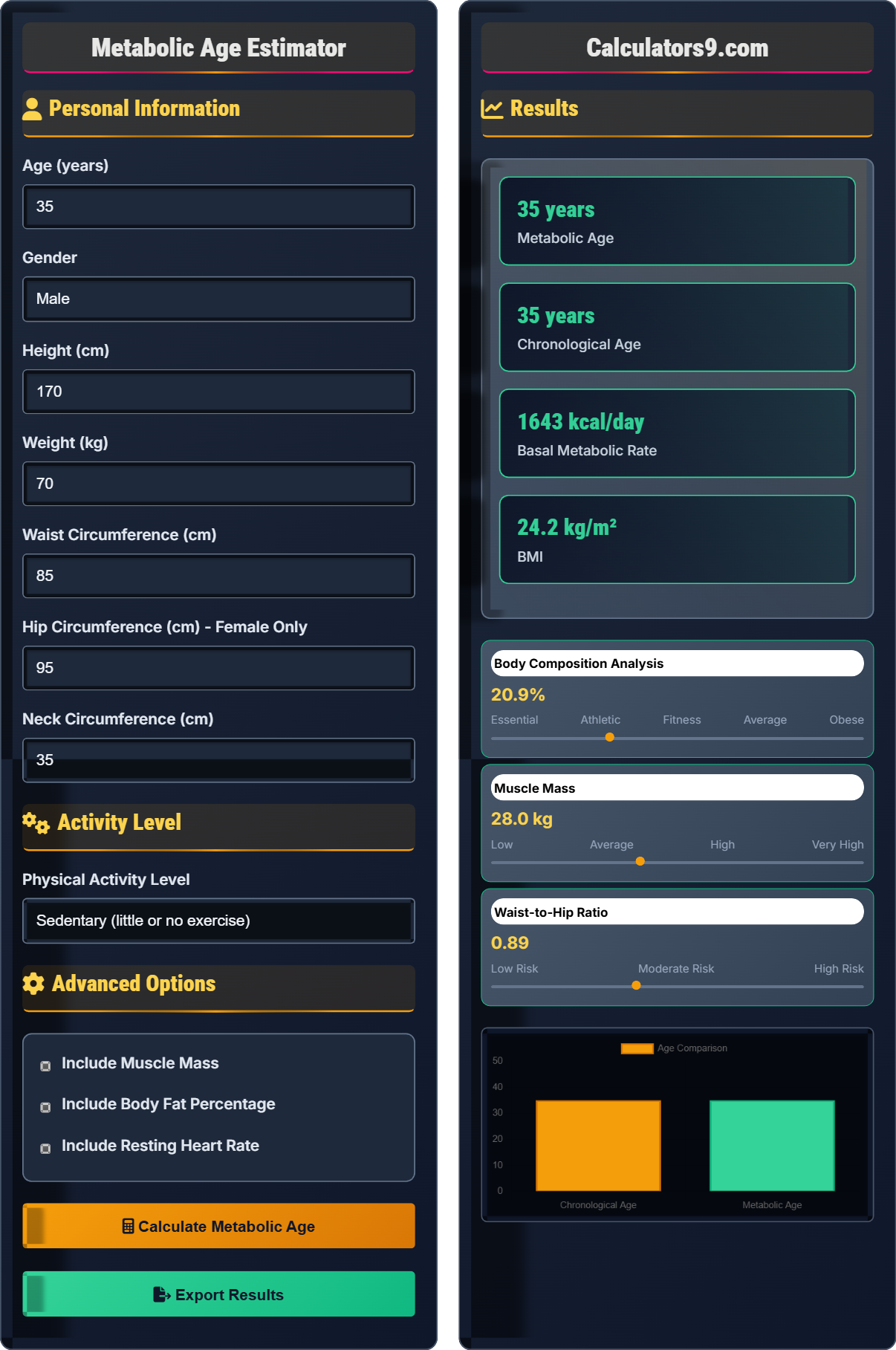
Calculate your metabolic age • Body metrics
\( \text{Metabolic Age} = \text{Chronological Age} + \left(\frac{\text{BMR}_{\text{actual}} - \text{BMR}_{\text{standard}}}{\text{BMR}_{\text{standard}}} \times 100\right) \times 0.1 \)
Where:
- \( \text{BMR}_{\text{actual}} \) = Actual Basal Metabolic Rate (calculated from measurements)
- \( \text{BMR}_{\text{standard}} \) = Standard BMR for age and gender
This formula compares your actual metabolic rate to the expected rate for someone of your chronological age. A lower metabolic age indicates better metabolic health.
Example: For a 35-year-old woman with actual BMR of 1400 kcal/day vs standard BMR of 1300 kcal/day:
\( \text{Metabolic Age} = 35 + \left(\frac{1400 - 1300}{1300} \times 100\right) \times 0.1 \)
\( = 35 + (7.69) \times 0.1 = 35.77 \approx 36 \) years
Personal Information
Activity Level
Advanced Options
Results
| Measurement | Value | Standard | Status |
|---|
Understanding Metabolic Age
Metabolic age is a measure of how efficiently your body burns calories compared to the average person of your chronological age. It reflects your metabolic health and is influenced by factors like muscle mass, body fat percentage, and overall fitness level. A lower metabolic age indicates better metabolic health than someone of the same chronological age.
Metabolic age is determined by comparing your Basal Metabolic Rate (BMR) to the standard BMR for someone of your chronological age and gender. The formula considers multiple body metrics including weight, height, age, gender, and additional factors like body composition when available.
Your metabolic age compared to your chronological age:
- Lower than chronological age: Excellent metabolic health, better than average for your age group
- Same as chronological age: Average metabolic health for your age group
- Higher than chronological age: Metabolic health could be improved through lifestyle changes
- Strength Training: Build lean muscle mass to increase resting metabolic rate
- Cardiovascular Exercise: Improve cardiovascular health and metabolic efficiency
- Quality Nutrition: Focus on whole foods, adequate protein, and proper hydration
- Consistent Sleep: Aim for 7-9 hours of quality sleep per night
- Stress Management: Chronic stress can negatively impact metabolism
Metabolic Health Basics
Measure of metabolic efficiency compared to age peers.
BMR comparison with age/gender standards.
- Muscle mass increases metabolic rate
- Lower body fat = better metabolic age
- Regular activity maintains metabolic health
Improvement Strategies
Higher muscle mass and activity = better metabolism.
- Strength training
- Cardio exercises
- Proper nutrition
- Adequate sleep
- Genetics play a role
- Consistency is key
- Progress takes time
- Professional guidance recommended
Metabolic Age Learning Quiz
What does a metabolic age lower than your chronological age indicate?
The answer is B) Better metabolic health than average for your age. When your metabolic age is lower than your chronological age, it means your body burns calories more efficiently than the average person of your age group, indicating superior metabolic health.
Metabolic age is a comparative measure that evaluates your body's metabolic efficiency against standard benchmarks for people of your age and gender. It's important to understand that this metric reflects how well your body functions metabolically, not your actual age. A lower metabolic age suggests better muscle mass, more efficient metabolism, or healthier body composition compared to peers.
Metabolic Age: Measure of metabolic efficiency compared to age/gender standards
Chronological Age: Actual age in years
Basal Metabolic Rate (BMR): Calories burned at rest
• Lower metabolic age = better metabolic health
• Metabolic age reflects metabolic efficiency
• Can be improved through lifestyle changes
• Remember: Lower is better for metabolic age
• Think of it as a performance rating vs age expectations
• Confusing chronological age with metabolic age
• Thinking higher metabolic age is better
Calculate the approximate metabolic age for a 40-year-old man with an actual BMR of 1800 kcal/day when the standard BMR for his age is 1700 kcal/day. Show your work.
Using the metabolic age formula: \( \text{Metabolic Age} = \text{Chronological Age} + \left(\frac{\text{BMR}_{\text{actual}} - \text{BMR}_{\text{standard}}}{\text{BMR}_{\text{standard}}} \times 100\right) \times 0.1 \)
Given:
- Chronological Age = 40 years
- BMR_actual = 1800 kcal/day
- BMR_standard = 1700 kcal/day
Step 1: Calculate difference = 1800 - 1700 = 100 kcal/day
Step 2: Calculate percentage difference = (100 ÷ 1700) × 100 = 5.88%
Step 3: Apply to formula = 40 + (5.88 × 0.1) = 40 + 0.59 = 40.59 ≈ 41 years
This calculation shows how a slightly higher BMR affects metabolic age. Even a modest improvement in metabolic rate (about 6% above standard) results in a metabolic age close to chronological age. The formula amplifies the effect to provide a meaningful age comparison, making small differences in metabolic efficiency visible as age differences.
BMR Difference: Variation between actual and standard metabolic rate
Metabolic Efficiency: How effectively the body burns calories
Standard BMR: Expected metabolic rate for age/gender
• Positive BMR difference increases metabolic age
• Negative BMR difference decreases metabolic age
• Formula uses percentage difference
• Higher actual BMR = higher metabolic age
• Lower actual BMR = lower metabolic age
• Use calculator for complex percentages
• Forgetting to convert to percentage
Sarah is 32 years old with a body fat percentage of 15% and muscle mass of 30kg. Her friend Lisa is also 32 but has 25% body fat and 22kg muscle mass. Both are the same height and weight. Who would likely have the lower metabolic age and why?
Step 1: Compare body compositions - Sarah has lower body fat (15% vs 25%) and higher muscle mass (30kg vs 22kg)
Step 2: Analyze metabolic impact - Muscle tissue burns more calories at rest than fat tissue
Step 3: Predict BMR - Sarah's higher muscle mass results in higher BMR
Step 4: Determine metabolic age - Higher BMR means lower metabolic age
Therefore, Sarah would have the lower metabolic age due to her superior body composition.
This example illustrates the critical relationship between body composition and metabolic age. Muscle tissue is metabolically active, burning approximately 6-7 calories per pound per day at rest, while fat tissue burns about 2-3 calories per pound. This significant difference means that two people of identical age, height, and weight can have very different metabolic ages based solely on their muscle-to-fat ratio.
Body Composition: Ratio of fat to lean mass in the body
Metabolic Activity: Calorie burning capacity of different tissues
Lean Body Mass: Total body weight minus fat weight
• More muscle = higher metabolic rate
• Less fat = better metabolic health
• Body composition matters more than weight
• Focus on body composition, not just weight
• Strength training builds metabolically active muscle
• Track changes in body fat percentage
• Judging health by weight alone
• Ignoring muscle mass importance
• Not considering body composition
John is 45 years old with a metabolic age of 52. He starts strength training 3 times per week and increases his protein intake. After 6 months, he gains 3kg of muscle and loses 4kg of fat. How would this likely affect his metabolic age? (Assume other factors remain constant)
Step 1: Current state - Metabolic age (52) > Chronological age (45), indicating poor metabolic health
Step 2: Changes implemented - Strength training + increased protein
Step 3: Physical changes - Gained 3kg muscle, lost 4kg fat
Step 4: Metabolic impact - Increased muscle mass raises BMR significantly
Step 5: Result - Higher BMR leads to lower metabolic age
Therefore, John's metabolic age would likely decrease from 52 to approximately 47-49 years.
This demonstrates how targeted lifestyle interventions can improve metabolic age. The combination of resistance training and proper nutrition creates an environment for muscle growth and fat loss. Since muscle tissue is metabolically more active than fat, even modest changes in body composition can have significant impacts on metabolic rate and age. The 3kg muscle gain represents a substantial metabolic boost.
Metabolic Adaptation: Body's response to lifestyle changes
Body Recomposition: Simultaneous fat loss and muscle gain
Metabolic Plasticity: Ability to change metabolic rate
• Lifestyle changes can improve metabolic age
• Strength training is particularly effective
• Consistent effort yields measurable results
• Combine strength training with proper nutrition
• Focus on progressive overload
• Track body composition changes
• Expecting immediate results
• Neglecting protein intake
• Not being consistent with exercise
Which of the following has the MOST significant impact on lowering metabolic age?
The answer is B) Building lean muscle mass. Muscle tissue is metabolically active and continues to burn calories even at rest. Each pound of muscle burns approximately 6-7 calories per day, while fat burns only 2-3 calories per day. Increasing muscle mass creates a permanent increase in metabolic rate, leading to a lower metabolic age.
While all factors contribute to metabolic health, muscle mass has the most lasting impact because it creates a structural change in the body's metabolic machinery. Cardio exercise provides temporary metabolic boosts, diets can be changed, and sleep varies daily, but muscle mass creates a persistent metabolic advantage. This is why strength training is considered foundational for improving metabolic age.
Metabolic Rate: Calories burned per unit time
Structural Changes: Long-lasting body composition modifications
Metabolic Advantage: Persistent metabolic benefits
• Muscle mass creates permanent metabolic benefits
• Prioritize strength training for metabolic improvements
• Combine with proper nutrition for best results
• Focus on compound movements for maximum muscle activation
• Overemphasizing cardio over strength training
• Not understanding muscle's metabolic role
• Focusing only on weight loss vs composition
FAQ
Q: How can I improve my metabolic age through exercise and nutrition?
A: Improving your metabolic age primarily involves increasing lean muscle mass and optimizing body composition. Here's how:
Exercise Strategy:
- Strength Training: 3-4 sessions per week focusing on compound movements (squats, deadlifts, rows)
- HIIT Workouts: 1-2 sessions per week to boost post-exercise oxygen consumption
- Consistency: Progressive overload to continuously challenge muscles
Nutrition Strategy:
- Adequate Protein: 1.6-2.2g per kg of body weight to support muscle synthesis
- Whole Foods: Nutrient-dense foods that support metabolic processes
- Hydration: Proper water intake supports all metabolic functions
With consistent effort, you can expect to see improvements in metabolic age within 3-6 months, as muscle mass increases and body fat percentage decreases.
Q: Is it normal for my metabolic age to be higher than my chronological age?
A: Yes, it's quite common for metabolic age to exceed chronological age, especially in sedentary populations. Studies suggest that the average adult's metabolic age is 5-10 years older than their chronological age due to factors like:
- Sedentary Lifestyle: Lack of physical activity leads to muscle loss and metabolic decline
- Age-Related Changes: Natural decrease in muscle mass starting around age 30
- Poor Nutrition: Processed foods and inadequate protein intake
- Stress and Sleep: Chronic stress and poor sleep quality affect metabolism
However, this is reversible! With targeted interventions like strength training and proper nutrition, you can improve your metabolic age. The goal is to build lean muscle mass and optimize body composition, which can lower your metabolic age below your chronological age.