Relative Fat Mass Calculator
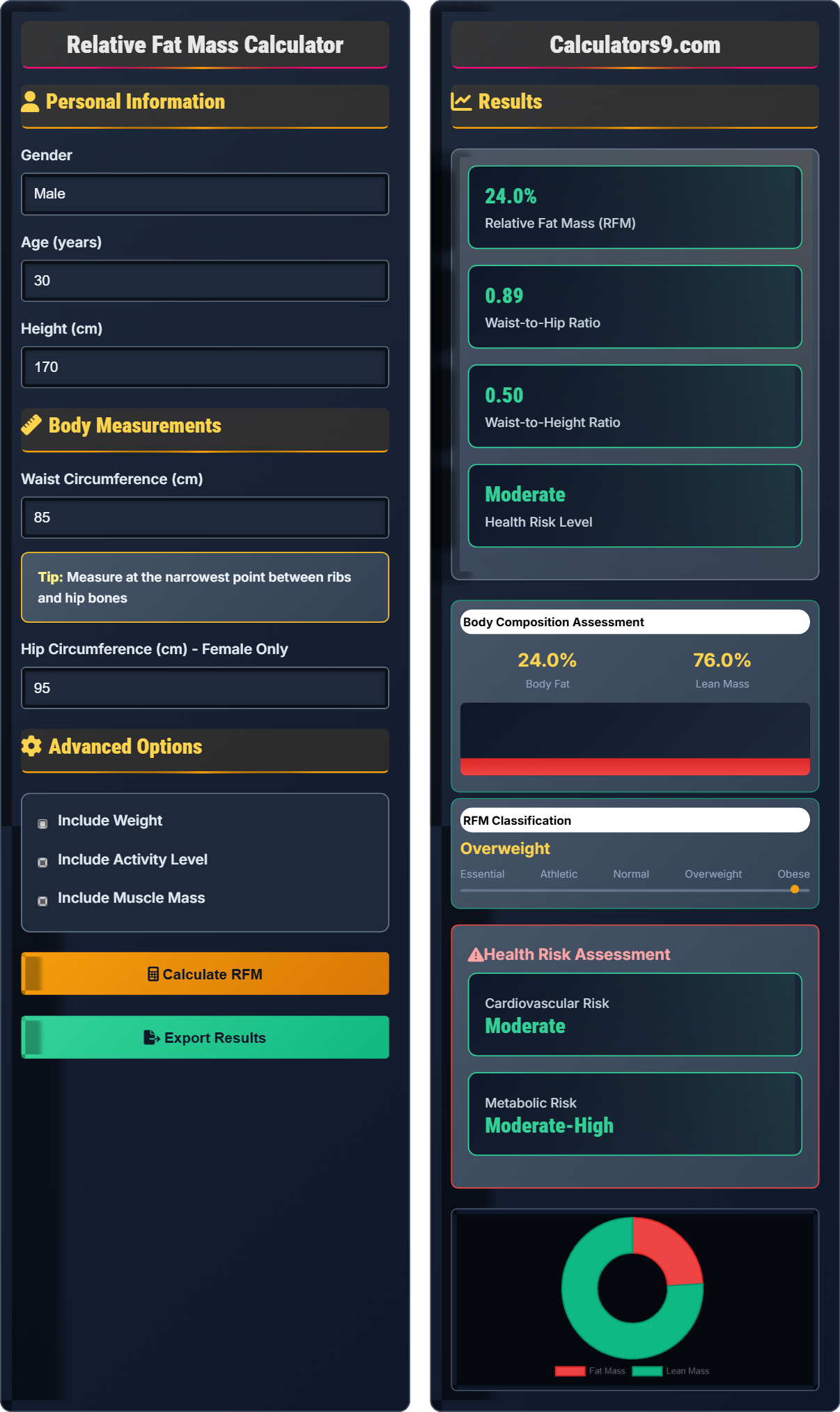
Calculate your RFM • Body composition
\( \text{RFM} = 64 - (20 \times \frac{\text{Height (cm)}}{\text{Waist Circumference (cm)}}) \)
For women, add 10 to the result:
\( \text{RFM}_{\text{women}} = 64 - (20 \times \frac{\text{Height}}{\text{Waist}}) + 10 \)
Where:
- \( \text{Height} \) in centimeters
- \( \text{Waist Circumference} \) measured at the narrowest point
This formula provides an accurate estimation of body fat percentage using only height and waist circumference. It's considered more accurate than BMI for assessing body composition and health risks.
Example: For a 170cm tall female with a 75cm waist:
\( \text{RFM} = 64 - (20 \times \frac{170}{75}) + 10 \)
\( = 64 - (20 \times 2.267) + 10 = 64 - 45.33 + 10 = 28.67\% \)
Personal Information
Body Measurements
Advanced Options
Results
| Measurement | Value | Healthy Range | Status |
|---|
Understanding Relative Fat Mass (RFM)
Relative Fat Mass (RFM) is a body composition assessment method developed in 2018 that estimates body fat percentage using only height and waist circumference. Unlike BMI, which doesn't distinguish between muscle and fat, RFM provides a more accurate assessment of body composition and associated health risks. It's particularly valuable because it doesn't require expensive equipment or complex measurements.
The standard RFM formula is:
For women, add 10 to the result:
This simple calculation has been validated against DXA scans and found to be more accurate than BMI for estimating body fat percentage.
- Essential Fat: Below 2%
- Athletic: 2-5%
- Fitness: 6-13%
- Average: 14-17%
- Obese: Above 25%
- Essential Fat: Below 10%
- Athletic: 10-13%
- Fitness: 14-20%
- Average: 21-24%
- Obese: Above 32%
RFM offers several advantages over traditional BMI:
- More accurate: Better correlation with actual body fat percentage
- Simple measurement: Uses only height and waist circumference
- Health risk assessment: More predictive of metabolic risks
- Cost-effective: No special equipment required
- Universal applicability: Works across different ethnicities
- Reduce Waist Circumference: Target visceral fat through diet and exercise
- Strength Training: Build lean muscle to improve body composition
- Nutrition: Focus on whole foods, limit processed foods
- Aerobic Exercise: Include cardio to burn fat
- Stress Management: Reduce cortisol which promotes abdominal fat storage
RFM Basics
Height-to-waist ratio for body fat estimation.
RFM = 64 - (20 × Height/Waist) + Gender Adjustment
- Uses only height and waist
- More accurate than BMI
- Gender-specific adjustments
Improvement Strategies
Focus on waist reduction and muscle preservation.
- Target waist circumference
- Strength training
- Cardiovascular exercise
- Proper nutrition
- Waist measurement is critical
- Consistency in measuring
- Progress takes time
- Professional guidance recommended
RFM Learning Quiz
What makes RFM more accurate than BMI for body composition assessment?
The answer is B) It correlates abdominal fat with health risks. RFM uses waist circumference, which directly measures central adiposity - the dangerous visceral fat around organs that's strongly linked to metabolic diseases.
Unlike BMI, which only considers height and weight, RFM incorporates waist circumference, a direct measure of abdominal fat distribution. Abdominal obesity is a stronger predictor of cardiovascular disease, diabetes, and metabolic syndrome than overall body weight. This makes RFM a more clinically relevant measure of health risk.
RFM: Relative Fat Mass - Height to waist ratio
Visceral Fat: Abdominal fat around organs
Central Adiposity: Fat accumulation in abdominal area
• Waist measurement reflects visceral fat
• Abdominal fat = higher health risks
• RFM better predicts metabolic risks
• Measure waist at narrowest point
• Exhale when measuring
• Use non-stretch tape measure
• Measuring at wrong location
• Including clothing in measurement
• Not exhaling before measurement
Calculate the RFM for a 175cm tall male with an 85cm waist circumference. Show your work.
Step 1: Apply the RFM formula for males: \( \text{RFM} = 64 - (20 \times \frac{\text{Height}}{\text{Waist}}) \)
Step 2: Substitute values: \( \text{RFM} = 64 - (20 \times \frac{175}{85}) \)
Step 3: Calculate fraction: \( \frac{175}{85} = 2.059 \)
Step 4: Multiply: \( 20 \times 2.059 = 41.18 \)
Step 5: Subtract: \( 64 - 41.18 = 22.82\% \)
Therefore, the RFM is approximately 22.8%.
This calculation demonstrates the simplicity of RFM despite its accuracy. The formula creates a ratio that inversely relates height to waist size - taller individuals with smaller waists will have lower RFM values, indicating better body composition. The constants (64 and 20) were derived from statistical analysis correlating this ratio with actual body fat percentage.
Ratio Calculation: Division of height by waist
Constants: Statistically derived values
Percentage: Result expressed as % body fat
• Height and waist in same units (cm)
• Apply gender-specific formula
• Result is in percentage format
• Keep units consistent (both cm)
• Double-check division calculation
• Remember gender adjustments
• Mixing measurement units
• Forgetting gender adjustment for females
• Incorrect order of operations
Two individuals have the same BMI of 25, but different body shapes. Person A (male) is 175cm tall with an 80cm waist, while Person B (male) is the same height with a 100cm waist. Calculate their RFM values and determine who has higher health risks.
Person A (80cm waist):
\( \text{RFM} = 64 - (20 \times \frac{175}{80}) = 64 - (20 \times 2.1875) = 64 - 43.75 = 20.25\% \)
Person B (100cm waist):
\( \text{RFM} = 64 - (20 \times \frac{175}{100}) = 64 - (20 \times 1.75) = 64 - 35 = 29.0\% \)
Person B has a significantly higher RFM (29.0% vs 20.3%), indicating higher body fat percentage and greater health risks despite having the same BMI.
This example perfectly illustrates RFM's superiority over BMI. Both individuals have the same BMI of 25, which would classify them identically under BMI standards. However, RFM reveals that Person B has significantly higher body fat percentage due to the larger waist circumference, indicating central obesity and associated health risks. This demonstrates why RFM is better at identifying metabolically unhealthy individuals who might appear "normal" by BMI standards.
Central Obesity: Excess abdominal fat
Metabolically Unhealthy: High risk despite normal weight
Visceral Adiposity: Fat around internal organs
• Same BMI ≠ same health risk
• Focus on waist measurement, not just weight
• BMI can miss health risks
• Central fat is most dangerous
• Relying solely on BMI for health assessment
• Ignoring body shape and fat distribution
• Not measuring waist regularly
Sarah is a 30-year-old female who is 165cm tall. Her initial measurements show a 75cm waist (RFM = 33.3%). After 6 months of lifestyle changes, her waist decreased to 70cm. Calculate her new RFM and determine the improvement. What does this mean for her health risks?
Initial RFM calculation (75cm waist):
\( \text{RFM} = 64 - (20 \times \frac{165}{75}) + 10 = 64 - (20 \times 2.2) + 10 = 64 - 44 + 10 = 30.0\% \)
New RFM calculation (70cm waist):
\( \text{RFM} = 64 - (20 \times \frac{165}{70}) + 10 = 64 - (20 \times 2.357) + 10 = 64 - 47.14 + 10 = 26.86\% \)
Improvement: 30.0% - 26.9% = 3.1% decrease in body fat
This significant reduction in RFM indicates substantial improvement in body composition and reduced health risks.
This problem demonstrates RFM's utility for tracking progress. A 5cm reduction in waist circumference resulted in a 3.1% decrease in estimated body fat percentage, moving Sarah from the "obese" category toward the "average" range. This improvement correlates with reduced risks of cardiovascular disease, type 2 diabetes, and metabolic syndrome. The change occurred despite no weight measurement, showing how RFM focuses on the more important metric of fat distribution.
Progress Tracking: Monitoring changes over time
Body Composition: Fat vs lean mass ratio
Health Risk Reduction: Lower RFM = lower risks
• RFM tracks body composition changes
• Waist reduction = health improvement
• Small changes have big impacts
• Measure waist regularly to track progress
• Focus on waist reduction, not just weight
• Celebrate body composition improvements
• Not tracking waist measurements
• Focusing only on scale weight
• Ignoring body composition changes
Which of the following is a key advantage of RFM over other body composition methods?
The answer is B) Simple measurement with high accuracy. RFM requires only a measuring tape for height and waist circumference, making it accessible to anyone while maintaining accuracy comparable to more expensive methods like DXA scans.
RFM's greatest strength is its combination of accessibility and accuracy. Unlike methods requiring expensive equipment (DXA, underwater weighing, bioelectrical impedance), RFM can be performed anywhere with just a measuring tape. Research has shown it correlates well with gold-standard body composition measurements, making it an ideal tool for routine health assessments in clinical and personal settings.
Accessibility: Easy to perform anywhere
Accuracy: Correlates with gold standards
Practicality: Useful for routine monitoring
• Simple tools = widespread access
• High accuracy = reliable results
• Cost-effective = sustainable
• Keep a measuring tape handy
• Track measurements monthly
• Compare to previous readings
• Assuming simple = inaccurate
• Not measuring consistently
• Relying on complex methods unnecessarily
FAQ
Q: How can I reduce my RFM and improve my health markers?
A: Reducing your RFM primarily involves decreasing waist circumference, which targets harmful visceral fat:
Nutrition Strategy:
- Caloric Deficit: 500-750 calorie deficit for safe weight loss
- Macronutrient Balance: Adequate protein (1.6-2.2g/kg), moderate carbs, healthy fats
- Food Quality: Emphasize whole foods, minimize processed items
- Meal Timing: Consider intermittent fasting for metabolic benefits
Exercise Protocol:
- Cardiovascular Training: 150-300 minutes of moderate exercise weekly
- Strength Training: 2-3 sessions targeting all major muscle groups
- Core Work: Specific exercises to strengthen midsection
- HIIT Sessions: 1-2 sessions per week for metabolic boost
With consistent effort, you can expect to see reductions in waist circumference of 2-5cm per month, which will significantly improve your RFM and health risks.
Q: Why is waist circumference more important than overall weight for health?
A: Waist circumference is a superior health indicator because it specifically measures visceral adipose tissue (VAT) - the fat stored around vital organs in the abdominal cavity. Here's why this matters:
Metabolic Activity: Visceral fat is metabolically active and releases inflammatory cytokines and hormones that increase insulin resistance, promote atherosclerosis, and elevate cardiovascular risk.
Anatomical Position: Abdominal fat surrounds organs like the liver, pancreas, and heart, directly affecting their function. This "ectopic fat" interferes with organ systems more than subcutaneous fat stored elsewhere.
Health Correlations: Studies consistently show that waist circumference and waist-to-hip ratios predict cardiovascular events, type 2 diabetes, and mortality better than BMI or total body weight.
RFM Advantage: By incorporating waist measurement, RFM captures this critical health information that BMI misses entirely, making it a superior screening tool for metabolic health risks.