Calories Burned Tracker
Exercise calorie calculator • 2026 edition
Activity Details
Advanced Options
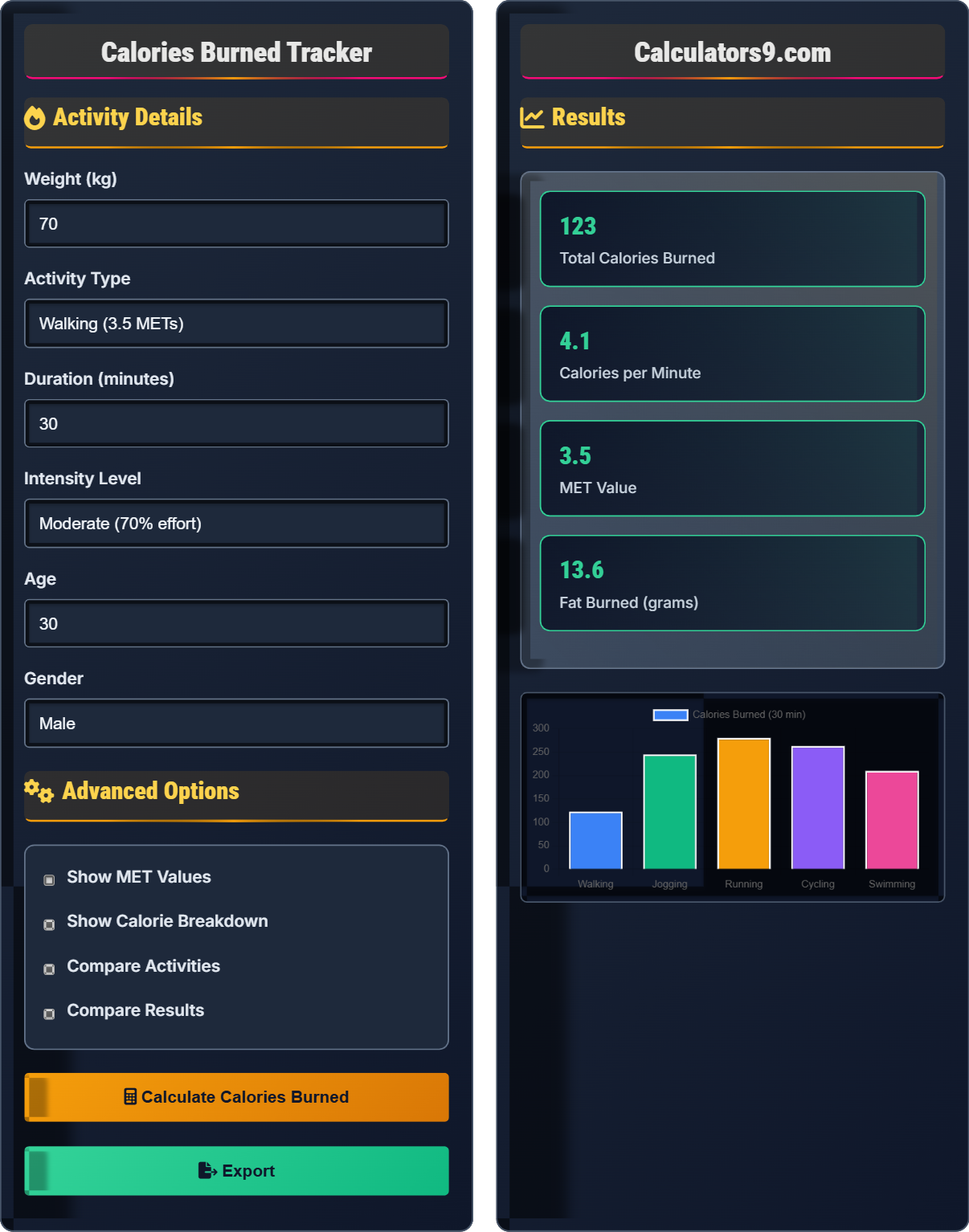
Results
| Component | Value | Percentage | Details |
|---|
| Activity | MET Value | Calories (30 min) | Efficiency |
|---|
Calories Burned Fundamentals
Metabolic Equivalent of Task (MET) is a measure of the energy cost of physical activities. One MET is defined as the energy you use when sitting quietly at rest. Activities are classified by how many times more energy they require compared to resting. For example, walking at a moderate pace is about 3.5 METs, meaning it requires 3.5 times more energy than sitting still.
The standard formula for calculating calories burned during exercise is:
Where time must be converted from minutes to hours by dividing by 60. This formula provides a good estimate of energy expenditure based on body weight, activity intensity, and duration.
Several factors influence how many calories you burn during exercise:
- Body Weight: Heavier individuals burn more calories for the same activity
- Intensity: Higher intensity activities burn more calories per minute
- Duration: Longer activities burn more total calories
- Fitness Level: Fitter individuals may burn calories differently
- Age: Metabolism typically decreases with age
- Gender: Men typically have higher muscle mass and metabolic rate
- High-Intensity Interval Training (HIIT): Alternating high and low intensity
- Strength Training: Builds muscle that burns calories at rest
- Compound Movements: Exercises that engage multiple muscle groups
- Consistency: Regular exercise builds metabolic efficiency
- Progressive Overload: Gradually increasing intensity over time
Calorie Burn Training Quiz
What does 1 MET represent?
The answer is B) Energy used at rest while sitting quietly. One MET is defined as the energy expenditure while sitting quietly at rest. It serves as a baseline for measuring the energy cost of physical activities. For example, an activity rated at 3.5 METs requires 3.5 times more energy than sitting quietly.
MET stands for Metabolic Equivalent of Task. It's a standardized way to measure the intensity of physical activities. The concept was developed to make it easier to compare the energy demands of different activities. By establishing resting metabolism as 1 MET, researchers can quantify how much more energy-intensive other activities are compared to baseline.
MET: Metabolic Equivalent of Task
Energy Expenditure: Calories burned during activity
Baseline: Resting metabolic rate
• 1 MET = Resting energy expenditure
• Higher MET = More intense activity
• METs are standardized across populations
• Use MET values to compare activities
• Remember: METs are relative to resting state
• Higher body weight increases calorie burn
• Confusing MET with calories burned directly
• Thinking METs are absolute values
• Not considering individual differences
Calculate the calories burned during 45 minutes of cycling (MET=7.5) by a 75kg person.
Using the formula: Calories = MET × Weight(kg) × Time(hours)
Time in hours = 45 ÷ 60 = 0.75 hours
Calories = 7.5 × 75 × 0.75
Calories = 421.875
Therefore, the person burns approximately 422 calories during the 45-minute cycling session.
This calculation demonstrates the direct relationship between MET value, body weight, and time in determining energy expenditure. The formula shows that all three factors multiply together, meaning that heavier individuals burn more calories, more intense activities burn more calories per minute, and longer durations result in more total calories burned.
Calorie: Unit of energy
Energy Expenditure: Calories burned during activity
Formula Variables: MET, weight, time
• Time must be in hours
• Weight must be in kilograms
• Formula: Calories = MET × Weight × Time
• Convert minutes to hours by dividing by 60
• Use consistent units (kg, hours)
• Remember that this is an estimate
• Forgetting to convert minutes to hours
• Using pounds instead of kilograms
• Not accounting for rounding
A 65kg person exercises for 30 minutes. Compare the calories burned between walking (3.5 METs) and running (8.0 METs). How much more efficient is running for calorie burning?
Walking: Calories = 3.5 × 65 × 0.5 = 113.75 calories
Running: Calories = 8.0 × 65 × 0.5 = 260 calories
Difference: 260 - 113.75 = 146.25 calories
Efficiency ratio: 260 ÷ 113.75 = 2.29
Running burns approximately 2.3 times more calories than walking in the same time period.
This comparison illustrates the significant impact that exercise intensity has on calorie expenditure. Even though running has roughly 2.3 times the MET value of walking, it results in more than twice the calorie burn. This demonstrates why higher-intensity activities are more time-efficient for those looking to maximize calorie burn.
Efficiency: Calories burned per unit of time
Intensity: Energy demand of activity
Time Efficiency: Maximizing results in minimal time
• Higher MET = More calories per minute
• Same time = Direct comparison
• Efficiency = Ratio of outcomes
• Higher MET activities are more time-efficient
• Consider fitness level when choosing intensity
• Balance intensity with sustainability
• Not accounting for individual fitness differences
• Ignoring safety considerations with high-intensity
• Overestimating calorie burn
Two friends exercise together for 40 minutes doing the same activity (6.0 METs). Person A weighs 70kg and Person B weighs 85kg. How many more calories does Person B burn, and what percentage is this difference?
Person A: Calories = 6.0 × 70 × (40÷60) = 6.0 × 70 × 0.667 = 280 calories
Person B: Calories = 6.0 × 85 × (40÷60) = 6.0 × 85 × 0.667 = 340 calories
Difference: 340 - 280 = 60 calories
Percentage difference: (60 ÷ 280) × 100 = 21.4%
Person B burns 60 more calories, which is 21.4% more than Person A.
This problem demonstrates the direct relationship between body weight and calorie expenditure. Since the formula multiplies weight by MET value and time, heavier individuals will always burn more calories for the same activity. This is why weight loss can sometimes accelerate as you lose weight - you burn fewer calories for the same activity as you become lighter.
Direct Proportionality: Linear relationship between variables
Body Weight Factor: Weight's role in energy expenditure
Percentage Difference: Relative comparison of values
• Calories proportional to body weight
• Heavier = More calories burned
• Same activity = Direct weight comparison
• Use exact weight measurements for accuracy
• Consider that this is an estimate
• Track changes in weight for recalculations
• Using approximate weights instead of exact
• Forgetting that this is a simplified model
• Not considering body composition differences
Which of the following factors does NOT directly affect the number of calories burned during exercise?
The answer is C) Ambient temperature. While ambient temperature can indirectly affect calorie burn (through shivering in cold weather or cooling efforts in hot weather), it is not directly incorporated into the standard MET-based calorie calculation formula. The direct factors are body weight, duration, and intensity (represented by MET value).
It's important to distinguish between factors that directly affect the calculation formula and those that may have indirect effects. The standard formula focuses on the primary determinants: body weight, exercise duration, and exercise intensity. While environmental conditions can influence metabolism, they're not part of the basic calculation methodology.
Direct Factors: Variables in the calculation formula
Indirect Factors: Variables that may influence outcomes
Standard Formula: Established calculation method
• Direct factors: weight, time, intensity
• Indirect factors: environment, fitness level
• Formula only includes primary variables
• Focus on controllable factors (weight, time, intensity)
• Understand the limitations of the model
• Consider other factors for comprehensive planning
• Including too many variables in basic calculations
• Assuming all factors are equally important
• Not understanding the formula's scope
Calorie Basics
Unit of energy used to measure food energy and exercise expenditure.
\( \text{Calories} = \text{MET} \times \text{Weight(kg)} \times \text{Time(hours)} \)
Where MET = metabolic equivalent, Weight in kg, Time in hours.
- Higher MET = More calories burned
- Heavier individuals burn more calories
- Longer duration = More total calories
Activity Intensity
Light: 2-3 METs. Moderate: 4-6 METs. Vigorous: 7+ METs.
- Light: Active recovery, circulation
- Moderate: Endurance, weight management
- Vigorous: Cardiovascular fitness
- HIIT: Metabolic boost
- Individual fitness affects MET values
- Age impacts energy expenditure
- Consistency over intensity
- Balance different intensities
FAQ
Q: How accurate are these calorie calculations?
A: These calculations provide good estimates but can vary by ±10-15% for individuals. Actual burn depends on fitness level, body composition, and exercise efficiency. Use as guidelines, not exact numbers.
Q: Does exercise intensity matter for weight loss?
A: Both duration and intensity matter. Higher intensity burns more calories per minute, but moderate intensity may be sustainable longer. Total weekly energy expenditure is key for weight loss.