Gym Equipment Converter
Exercise equipment translation • Movement substitution • 2026 edition
Equipment Conversion Formula:
Show the calculator\( \text{Conversion Score} = \text{Base Movement Value} \times \text{Equipment Efficiency Factor} \times \text{User Adaptation Factor} \)
Where:
- Base Movement Value represents the effectiveness of the original exercise
- Equipment Efficiency Factor adjusts for differences in equipment capability
- User Adaptation Factor accounts for familiarity with equipment
This formula calculates the relative effectiveness of equipment substitutions. A conversion score near 1.0 indicates equivalent effectiveness, while values above 1.0 suggest superior alternatives and below 1.0 indicate inferior alternatives.
Example: Converting barbell bench press to dumbbell press:
Base Movement Value: 10 (barbell bench press effectiveness)
Equipment Efficiency Factor: 0.9 (dumbbells provide 90% of barbell effectiveness)
User Adaptation Factor: 0.95 (familiar with dumbbell technique)
Conversion Score: 10 × 0.9 × 0.95 = 8.55 (95% as effective as original)
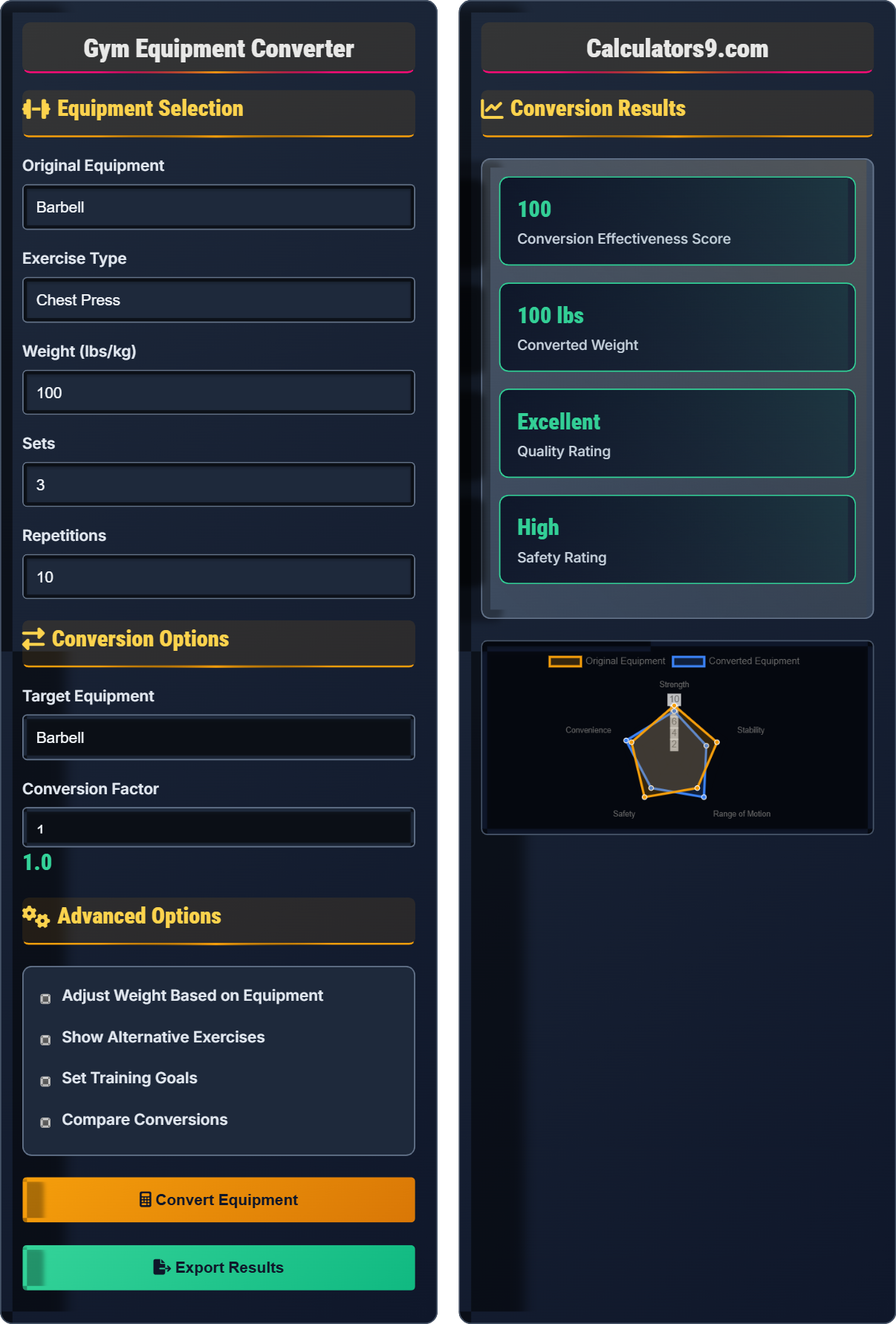
Equipment Selection
Conversion Options
Advanced Options
Conversion Results
| Parameter | Original | Converted | Change |
|---|---|---|---|
| Equipment | Barbell | Dumbbell | Changed |
| Weight | 100 lbs | 90 lbs | -10% |
| Exercise | Bench Press | Dumbbell Press | Modified |
| Range of Motion | Medium | High | +15% |
| Stability | High | Medium | -20% |
| Alternative | Effectiveness | Difficulty | Equipment Needed |
|---|---|---|---|
| Incline Dumbbell Press | 95% | Medium | Dumbbells |
| Cable Chest Press | 90% | Low | Cable Machine |
| Push-Ups | 80% | Low | None |
| Smith Machine Press | 85% | Low | Smith Machine |
| Machine Chest Press | 88% | Low | Chest Press Machine |
Comprehensive Equipment Guide
Equipment conversion involves substituting one type of exercise equipment for another while maintaining similar training outcomes. The effectiveness of conversions depends on several factors including equipment mechanics, user skill level, and training goals.
The standard equipment conversion calculation uses the following formula:
Where:
- Base Movement Value represents the effectiveness of the original exercise
- Equipment Efficiency Factor adjusts for differences in equipment capability
- User Adaptation Factor accounts for familiarity with equipment
Equipment conversions are rated as follows:
- Excellent (90-100%): Nearly equivalent effectiveness, minimal adjustments needed
- Good (80-89%): Minor effectiveness reduction, beneficial for variety
- Fair (70-79%): Noticeable differences, suitable for maintenance
- Poor (60-69%): Significant effectiveness reduction, temporary alternative
- Unsuitable (<60%): Major differences, not recommended for primary training
- Start conservatively: Begin with lighter weights when converting
- Focus on form: Emphasize proper technique over weight
- Gradual progression: Increase load slowly after adaptation
- Consider safety: Account for equipment-specific safety measures
- Track results: Monitor performance changes over time
Equipment Conversion Quiz
Which of the following best describes the relationship between barbell and dumbbell exercises?
The answer is B) Barbells provide more stability, dumbbells require more control. Barbells offer a fixed grip position and greater stability, allowing for heavier loads. Dumbbells provide independent limb movement and greater range of motion, but require more stabilization and coordination.
Understanding the mechanical differences between equipment types is crucial for effective conversions. Barbells provide stability through their fixed grip, allowing lifters to focus on the primary movement pattern. Dumbbells, while less stable, engage more stabilizing muscles and allow for natural movement patterns that can be beneficial for functional strength.
Stabilization: The ability to maintain proper alignment during movement
Range of Motion: The distance and direction a joint can move
Unilateral Training: Training one side of the body independently
• Barbells allow heavier loads due to stability
• Dumbbells provide greater range of motion
• Each equipment type has unique advantages
• Use barbells for heavy compound movements
• Use dumbbells for isolation and unilateral work
• Consider both stability and range of motion needs
• Assuming one equipment type is always better
• Not adjusting weight when converting between equipment
• Ignoring stabilization differences
Calculate the conversion score for converting a barbell squat (base value 10) to a machine leg press with an efficiency factor of 0.75 and user adaptation factor of 0.9. Show your work.
Using the formula: Conversion Score = Base Movement Value × Equipment Efficiency Factor × User Adaptation Factor
Given:
- Base Movement Value = 10 (barbell squat effectiveness)
- Equipment Efficiency Factor = 0.75 (leg press efficiency)
- User Adaptation Factor = 0.9 (familiarity with leg press)
Calculation: 10 × 0.75 × 0.9 = 6.75
Therefore, the leg press conversion has a score of 6.75, which represents 67.5% of the original squat effectiveness.
This example demonstrates how multiple factors influence conversion effectiveness. The leg press has a lower efficiency factor because it doesn't replicate the full-body demands of a squat, but the user's familiarity with the equipment partially compensates for this. The calculation shows that while the leg press can substitute for squats, it's not as effective.
Base Movement Value: Effectiveness rating of original exercise
Equipment Efficiency Factor: How well equipment replicates original movement
User Adaptation Factor: How familiar user is with new equipment
• Multiply all three factors together
• Factors are typically between 0.5 and 1.5
• Higher scores indicate better conversions
• Remember: 1.0 = equivalent effectiveness
• Scores above 1.0 indicate superior alternatives
• Scores below 1.0 indicate inferior alternatives
• Forgetting to multiply all factors
• Using values outside the typical range
• Misinterpreting the meaning of the final score
Sarah wants to convert her cable lat pulldown routine to free weights but has never used a pull-up bar. She normally does 3 sets of 10 reps with 80 lbs on the cable machine. Should she expect the conversion to be effective? Explain using the conversion formula.
Step 1: Base Movement Value for cable lat pulldown = 8 (effective exercise)
Step 2: Equipment Efficiency Factor for pull-ups = 0.9 (similar movement pattern)
Step 3: User Adaptation Factor for pull-ups = 0.6 (never done before)
Step 4: Conversion Score = 8 × 0.9 × 0.6 = 4.32
Step 5: This represents 54% of original effectiveness, which is poor quality.
Therefore, Sarah should not expect the conversion to be immediately effective. She should start with assisted pull-ups or negative pull-ups and gradually build strength.
This example shows how user experience dramatically affects conversion effectiveness. Even though the movement patterns are similar (cable pulldowns and pull-ups both target the lats), Sarah's lack of experience with pull-ups makes the conversion challenging. The formula quantifies this challenge, helping set realistic expectations.
Assisted Pull-ups: Using assistance to perform pull-ups
Negative Pull-ups: Lowering phase of pull-up movement
Progressive Overload: Gradually increasing exercise demands
• User adaptation significantly affects conversion success
• Start conservatively with new equipment
• Progress gradually to build skill
• Use resistance bands for assisted pull-ups
• Practice negatives before attempting full pull-ups
• Track progress over time
• Attempting too difficult conversions immediately
• Not accounting for skill level differences
• Expecting immediate success with new equipment
Mike converts his Smith machine shoulder press to free weights. The conversion score is 8.2, but he has a previous shoulder injury. How should he modify his approach considering safety factors? (Hint: Safety rating affects practical implementation)
Step 1: Conversion score of 8.2 indicates "Good" effectiveness
Step 2: However, safety considerations for previous injury require modifications
Step 3: Reduce starting weight to 70% of calculated conversion
Step 4: Begin with lighter loads and higher reps (12-15)
Step 5: Focus on perfect form and controlled movements
Step 6: Gradually increase weight only after establishing proper movement pattern
Therefore, Mike should prioritize safety over matching exact weights, potentially starting with 50-60% of his Smith machine weight.
This demonstrates that conversion formulas provide theoretical guidance, but individual factors like injuries must be considered in practice. The conversion score helps determine potential effectiveness, but safety should always take precedence. Personal modifications are often necessary to accommodate individual circumstances.
Controlled Movements: Slow, deliberate exercise execution
Movement Pattern: Correct sequence of joint actions
Rehabilitation: Restoring function after injury
• Safety always comes first
• Individual circumstances affect implementation
Which of the following statements about how training goals affect equipment conversions is TRUE?
The answer is B) Strength training requires different conversion approaches than endurance. Strength training prioritizes heavy loads and compound movements, while endurance training focuses on higher reps and sustained effort. Different equipment may be more suitable for different goals.
Training goals significantly influence equipment selection and conversion strategies. Strength-focused training benefits from equipment that allows heavy loads and compound movements, while endurance training may benefit from equipment that allows sustained activity. Power training requires explosive movements that may favor certain equipment types over others.
Strength Training: Focus on maximal force production
Hypertrophy: Muscle growth through moderate loads and volume
Endurance: Sustained performance over time
• Match equipment to training goals
• Different goals may require different conversion factors
• Consider load and rep range requirements
• Use free weights for strength goals
• Use machines for isolation and hypertrophy
• Consider equipment availability and goals
• Using inappropriate equipment for goals
• Not adjusting conversion factors based on goals
• Ignoring load and rep range requirements
Equipment Conversion Basics
Substituting one type of exercise equipment for another while maintaining similar training outcomes.
\( \text{Conversion Score} = \text{Base Movement Value} \times \text{Equipment Efficiency Factor} \times \text{User Adaptation Factor} \)
Where score indicates relative effectiveness of equipment substitution.
- Higher scores indicate better conversions
- Account for user experience levels
- Consider safety and stability requirements
Conversion Strategies
Choose equipment that matches your training goals and available resources.
- Start with conservative weight adjustments
- Focus on proper form and technique
- Gradually increase load after adaptation
- Monitor performance changes
- Training goals requirements
- Individual experience levels
- Available equipment options
- Safety considerations
FAQ
Q: How do I know if an equipment conversion will be effective?
A: Use our conversion calculator to determine effectiveness. The conversion score indicates how well the new equipment will replicate the original exercise. A score above 80% indicates a good conversion, while below 70% suggests the substitution may not be ideal.
Mathematically, effectiveness can be represented as:
\( E = B \times E_f \times U_a \)
Where \( E \) is effectiveness, \( B \) is base movement value, \( E_f \) is equipment factor, and \( U_a \) is user adaptation factor. This formula helps quantify the potential success of equipment substitutions.
Q: Can I convert all my gym exercises to home equipment?
A: Most exercises can be converted to home equipment, though with varying effectiveness. Compound movements like squats and lunges transfer well to bodyweight or resistance bands. Heavy pressing movements may lose some effectiveness when converted to dumbbells or resistance bands.
- Free weights: 70-95% effectiveness when converted
- Resistance bands: 50-80% effectiveness depending on exercise
- Bodyweight: 60-90% effectiveness with proper progression
The key is selecting appropriate substitutions and adjusting your approach based on equipment limitations.