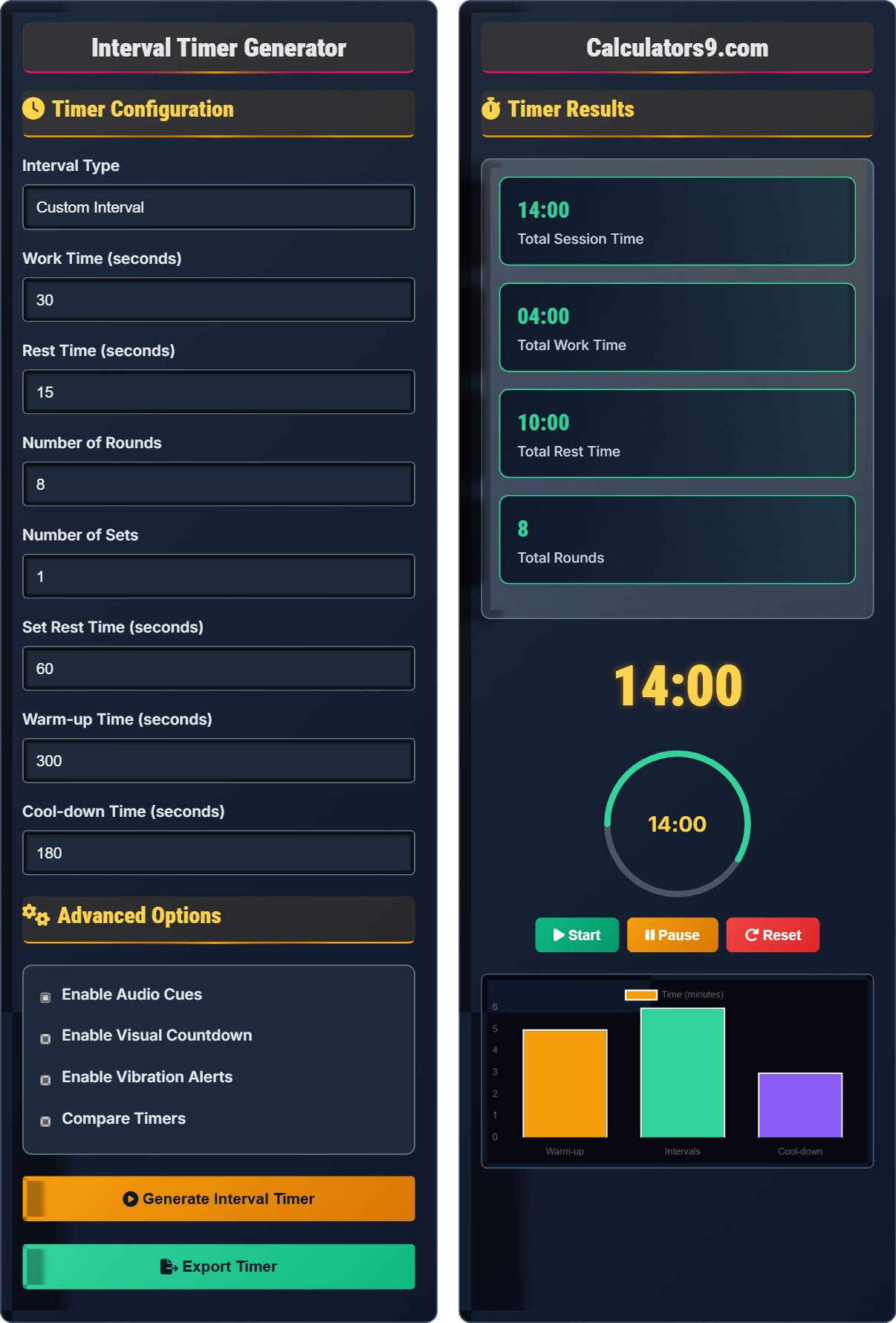
Interval Timer Generator
HIIT & circuit training timer • 2026 edition
Timer Configuration
Advanced Options
Timer Results
| Round | Exercise | Duration | Intensity |
|---|
Interval Training Fundamentals
Interval training alternates between high-intensity work periods and lower-intensity recovery periods. This method maximizes cardiovascular and metabolic adaptations while improving performance and efficiency. The varying intensity creates stress that triggers beneficial physiological adaptations.
Key calculations for interval training:
For example, 30 seconds work, 15 seconds rest = 2:1 ratio. 8 rounds = (30+15) × 8 = 360 seconds total work time.
Interval training provides numerous benefits:
- Time Efficiency: Significant benefits in shorter time periods
- Calorie Burn: Elevated metabolism continues post-exercise
- Cardiovascular Health: Improves heart function and endurance
- Metabolic Adaptations: Enhances fat oxidation and glucose control
- Muscle Preservation: Maintains lean muscle mass during fat loss
- Performance Enhancement: Improves both power and endurance
- Pyramid Intervals: Gradually increase then decrease intensity
- Wave Training: Alternate between different protocols
- Progressive Overload: Gradually increase rounds or intensity
- Active Recovery: Light movement during rest periods
- Periodization: Vary protocols throughout training cycles
- Supersetting: Combine exercises within work periods
Interval Training Quiz
What is the standard Tabata interval protocol?
The answer is B) 20s work, 10s rest, 8 rounds. The Tabata protocol consists of 20 seconds of maximum intensity work followed by 10 seconds of rest, repeated for 8 rounds (total of 4 minutes). This protocol was developed by Dr. Izumi Tabata and proven to improve both aerobic and anaerobic capacity.
The Tabata protocol is one of the most researched high-intensity interval training protocols. The 2:1 work-to-rest ratio with 8 rounds creates a unique metabolic stress that simultaneously improves both aerobic and anaerobic energy systems.
Tabata Protocol: 20s work, 10s rest, 8 rounds
Work-to-Rest Ratio: Proportion of work to rest time
Aerobic Capacity: Oxygen utilization ability
• 20 seconds work
• 10 seconds rest
• 8 rounds
• Maintain maximum effort during work periods
• Use a reliable timer
• Focus on compound movements
• Extending rest periods
• Not going to maximum effort
• Changing the standard protocol
Calculate the work-to-rest ratio for a HIIT protocol of 45 seconds work and 15 seconds rest.
Work-to-rest ratio = Work Duration ÷ Rest Duration
Ratio = 45 ÷ 15 = 3
Therefore, the work-to-rest ratio is 3:1 (read as "three to one").
The work-to-rest ratio is a fundamental concept in interval training that describes the relationship between work and recovery periods. This ratio determines the intensity and metabolic demands of the workout. A higher ratio means more work relative to rest.
Work-to-Rest Ratio: Proportion of work time to rest time
HIIT: High-Intensity Interval Training
Metabolic Demand: Energy system requirements
• Ratio = Work ÷ Rest
• Express as X:1
• Higher ratios = More intense
• Lower ratios for beginners
• Higher ratios for advanced athletes
• Adjust based on fitness level
• Confusing numerator and denominator
• Not simplifying ratios
• Using inconsistent units
A workout consists of 10 rounds of 30 seconds work and 20 seconds rest, preceded by a 5-minute warm-up and followed by a 3-minute cool-down. What is the total session time?
Work time: 10 rounds × 30 seconds = 300 seconds = 5 minutes
Rest time: 10 rounds × 20 seconds = 200 seconds = 3.33 minutes
Interval time: 5 + 3.33 = 8.33 minutes
Warm-up: 5 minutes
Cool-down: 3 minutes
Total time: 8.33 + 5 + 3 = 16.33 minutes ≈ 16 minutes 20 seconds
This calculation demonstrates how to determine total workout time by adding all components: warm-up, intervals (work + rest), and cool-down. It's important to account for all phases when planning workout schedules.
Session Time: Total workout duration
Warm-up: Preparation phase
Cool-down: Recovery phase
• Total = Warm-up + Intervals + Cool-down
• Intervals = (Work + Rest) × Rounds
• Always include preparation/recovery
• Plan time realistically
• Include transition time
• Account for equipment setup
• Forgetting warm-up/cool-down
• Not accounting for all rest periods
• Miscalculating total rounds
A beginner finds a 30s:15s interval protocol too difficult. How should they modify the protocol to make it more manageable while still getting benefits?
Several modifications could make the protocol more manageable:
- Increase rest time: 30s work, 30s rest (1:1 ratio)
- Reduce work time: 20s work, 15s rest
- Decrease rounds: 5 rounds instead of 8
- Lower intensity: 70-80% max instead of 90-100%
- Combine approaches: 20s work, 20s rest, 5 rounds
The key is to maintain the interval structure while making it sustainable.
Interval training should be progressive and individualized. Beginners need to build work capacity gradually. The protocol can be modified by adjusting work time, rest time, rounds, or intensity level while maintaining the core interval structure.
Work Capacity: Ability to sustain high-intensity work
Progressive: Gradually increasing demands
Sustainable: Maintainable over time
• Start with manageable ratios
• Progress gradually
• Listen to your body
• Use RPE scale to monitor intensity
• Adjust one variable at a time
• Focus on consistency over intensity
• Starting too intense
• Not adjusting for fitness level
• Ignoring signs of overexertion
For a multi-set interval workout, what is the recommended rest period between sets?
The answer is C) 2-5 minutes. For high-intensity interval sets, 2-5 minutes of rest allows for adequate recovery of the phosphocreatine system and helps maintain performance across sets. Shorter rest periods would compromise intensity in subsequent sets.
Recovery between sets is crucial for maintaining high-intensity efforts. The phosphocreatine system, which provides energy for short bursts, takes 2-5 minutes to fully recover. Inadequate rest compromises performance and training effectiveness.
Phosphocreatine System: Energy system for short bursts
High-Intensity: Maximum or near-maximum effort
Performance Maintenance: Consistent output across sets
• 2-5 minutes between sets
• Maintain intensity across sets
• Recovery enables adaptation
• Use rest periods for hydration
• Monitor heart rate recovery
• Prepare for next set during rest
• Resting too little between sets
• Not recovering adequately
• Compromising intensity over time
Interval Training Basics
Alternating high and low intensity periods for maximum adaptation.
\( \text{Work:Rest Ratio} = \frac{\text{Work Time}}{\text{Rest Time}} \)
Example: 30s work, 15s rest = 2:1 ratio.
- Work periods at high intensity
- Rest periods for recovery
- Adjust ratios to fitness level
Protocol Selection
Tabata: 2:1. HIIT: 2-4:1. EMOM: Variable. AMRAP: Fixed time.
- Choose appropriate protocol
- Set work/rest ratio
- Determine rounds
- Add warm-up/cool-down
- Individual fitness level
- Training goals
- Available time
- Equipment access
FAQ
Q: How often should I do interval training?
A: 2-3 times per week with at least 48 hours between sessions. HIIT is demanding and requires recovery time. Beginners should start with 1-2 sessions per week and gradually increase frequency.
Q: Can I combine interval training with other workouts?
A: Yes! Interval training complements strength, endurance, and flexibility training. Schedule HIIT on non-strength days or as active recovery. Balance high-intensity work with recovery and other training modalities.