Progressive Overload Calculator
Strength training progression • 2026 edition
Training Parameters
Advanced Options
Progression Results
| Method | Formula | Rate | Best For |
|---|
Progressive Overload Fundamentals
Progressive overload is the gradual increase of stress placed upon the body during exercise training. It's the fundamental principle that drives muscle growth, strength gains, and fitness improvements. By systematically increasing training variables like weight, reps, sets, or frequency, you force your body to adapt and become stronger.
Standard progressive overload calculations:
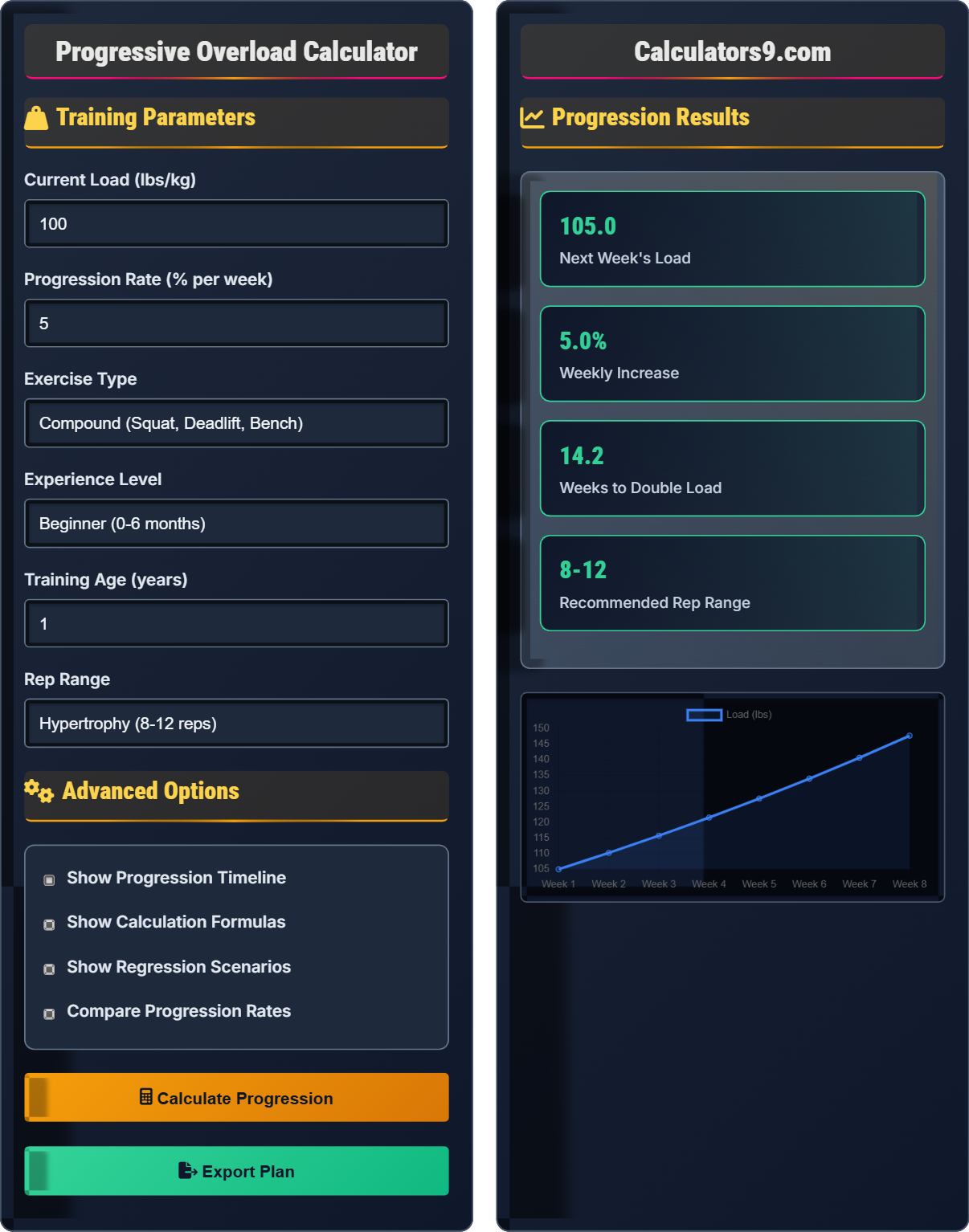
For example, if your current load is 100 lbs and you increase by 5%: New Load = 100 × 1.05 = 105 lbs.
Progression rates should be adjusted based on experience level:
- Beginners: 5-10% weekly increases for compound movements
- Intermediates: 2-5% weekly increases for major lifts
- Advanced: 1-2% weekly increases or micro-increments
- Accessories: 2-3% weekly increases regardless of level
- Power Movements: 1-3% weekly increases due to technical nature
- Isolation: 2-4% weekly increases for muscle building
- Load: Increase weight lifted (primary method)
- Volume: Increase sets, reps, or frequency
- Intensity: Increase effort or RPE
- Time: Increase time under tension
- Frequency: Increase training frequency
- Technique: Improve movement efficiency
Progressive Overload Quiz
What is the primary purpose of progressive overload in strength training?
The answer is B) To gradually increase training stress. Progressive overload is the systematic increase of stress placed on the body during exercise. This forces the body to adapt by growing stronger, bigger, or more efficient, which is essential for continuous improvement.
Without progressive overload, the body adapts to the same training stimulus and progress stops. This principle is based on the biological law of adaptation - organisms respond to stress by becoming stronger to handle similar stress in the future.
Progressive Overload: Gradual increase in training stress
Adaptation: Body's response to training stress
Stimulus: Stress applied to the body
• Stress must exceed current capacity
• Increases must be systematic
• Body adapts to repeated stress
• Track your progress consistently
• Start with small increases
• Focus on one variable at a time
• Increasing load too rapidly
• Not tracking progress properly
• Changing multiple variables simultaneously
If you lift 120 lbs for squats and want to progress at 3% per week, what will your load be in 4 weeks?
Using the compound growth formula: New Load = Current Load × (1 + Progression Rate)^Weeks
New Load = 120 × (1.03)^4
New Load = 120 × 1.1255
New Load = 135.06 lbs
After 4 weeks, your squat load will be approximately 135 lbs.
This calculation demonstrates compound growth in strength training. Each week's increase builds on the previous week's total, creating exponential growth over time. This is why consistent, small increases lead to significant long-term gains.
Compound Growth: Growth that builds on previous growth
Exponential Increase: Growth that accelerates over time
Systematic Progression: Planned, consistent increases
• Use compound growth formula
• (1 + rate) ^ weeks
• Small increases compound over time
• Use a calculator for compound growth
• Plan progression in advance
• Account for deloads periodically
• Adding percentages instead of compounding
• Not accounting for recovery needs
• Assuming linear growth
A beginner with 6 months of training experience and an advanced lifter with 5 years of experience both want to progress their bench press. The beginner is currently lifting 135 lbs, while the advanced lifter is lifting 225 lbs. What are appropriate weekly progression rates for each, and why?
Beginner: 5-10% weekly increase (6.75-13.5 lbs)
Advanced: 1-2% weekly increase (2.25-4.5 lbs)
Beginners can progress faster because they're further from genetic potential and have greater neural adaptations available. Advanced lifters are closer to their limits and require smaller, more precise increases to continue progressing.
Training age affects progression rates because the body's adaptive capacity decreases as it approaches its genetic limits. Beginners experience rapid improvements due to neurological adaptations, while advanced lifters must rely on more subtle physiological changes.
Training Age: Years of consistent training
Genetic Potential: Natural limits of development
Neural Adaptations: Nervous system improvements
• Beginners: 5-10% weekly
• Intermediates: 2-5% weekly
• Advanced: 1-2% weekly
• Adjust rates based on experience
• Be patient with advanced training
• Focus on technique as load increases
• Using same rate for all experience levels
• Expecting beginner gains at advanced levels
• Not accounting for individual differences
A lifter has been progressing linearly at 5% per week for 8 weeks and now feels stuck. Their current load is 150 lbs. What should their deload strategy be, and what will their load be after the deload?
Standard deload: Reduce load by 10-15% for 1-2 weeks.
Deloaded Load = 150 × 0.90 = 135 lbs (for 10% deload)
After the deload period, resume progression from the reduced load. This allows for recovery and often results in better long-term progress than pushing through plateaus.
Deloading is a strategic reduction in training load to allow for recovery and adaptation. It helps manage fatigue, prevent overtraining, and often leads to breakthroughs when returning to normal training loads.
Deload: Strategic reduction in training load
Recovery: Process of restoring capacity
Overreaching: Temporary performance decline
• Deload every 4-8 weeks
• Reduce by 10-15%
• Resume from deloaded load
• Plan deloads in advance
• Use deloads for technique work
• Don't panic during deloads
• Continuing progression through plateaus
• Deloading too frequently
• Returning to previous loads immediately
Why should compound exercises typically progress at a different rate than accessory exercises?
The answer is B) Compound exercises involve multiple joints and systems. Compound movements recruit multiple muscle groups simultaneously, requiring greater coordination and placing higher systemic demands. This means they typically progress more slowly than isolation exercises.
Compound exercises like squats, deadlifts, and bench presses involve complex movement patterns and multiple muscle groups. This complexity means smaller, more careful increases are needed compared to simpler isolation movements.
Compound Exercise: Movement involving multiple joints
Accessory Exercise: Isolation or supporting movement
Systemic Demand: Overall stress on the body
• Compounds: Slower progression
• Accessories: Faster progression
• Consider exercise complexity
• Prioritize compound progression
• Use accessories for volume
• Match progression rates to exercise type
• Applying same rate to all exercises
• Neglecting accessory movements
• Not considering exercise complexity
Progression Basics
Gradual increase in training stress to drive adaptation.
\( \text{New Load} = \text{Current Load} \times (1 + \text{Progression Rate}) \)
Example: 100 lbs × (1 + 0.05) = 105 lbs
- Stress must exceed current capacity
- Increases should be systematic
- Match rate to experience level
Training Levels
Beginners: 5-10%. Intermediate: 2-5%. Advanced: 1-2%.
- Compound: Slower progression
- Accessory: Moderate progression
- Isolation: Faster progression
- Power: Careful progression
- Individual recovery capacity
- Training age matters
- Consistency over speed
- Quality over quantity
FAQ
Q: How fast should I expect to progress?
A: Beginners can expect 5-10% weekly increases for 3-6 months. This slows to 2-5% as you advance. Focus on consistent form and technique before heavy loads.
Q: What if I can't progress every week?
A: Plateaus are normal. Consider deloading, adjusting recovery, or changing training variables. Sometimes taking a step back leads to better long-term progress.