Rest Day Scheduler
Recovery & wellness planner • 2026 edition
Training Profile
Advanced Options
Schedule Results
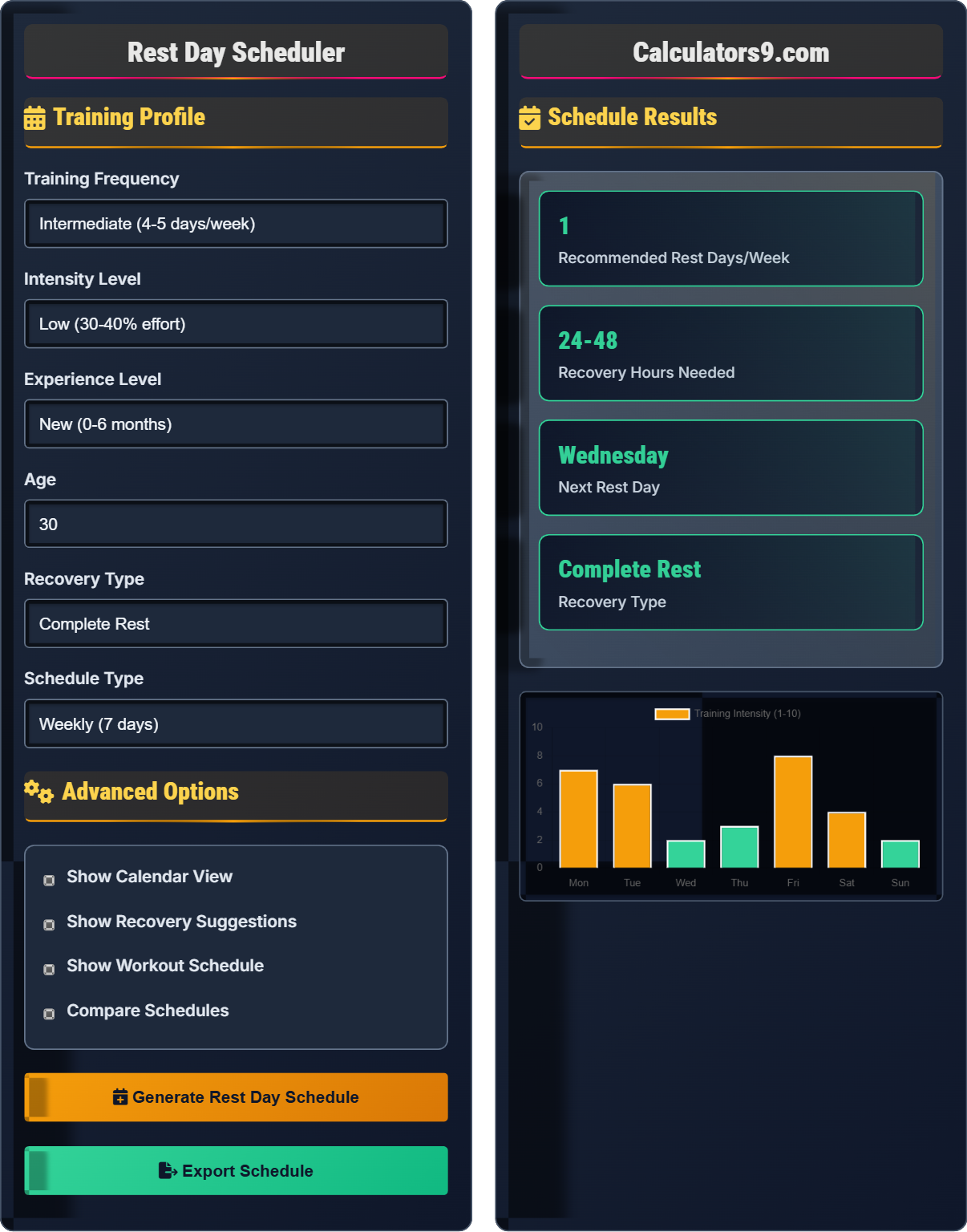
| Day | Type | Activity | Duration |
|---|
| Activity | Duration | Benefits | Intensity |
|---|
Rest & Recovery Fundamentals
Rest days are crucial for optimal performance and injury prevention. During rest, your body repairs muscle tissue, replenishes energy stores, and adapts to training stress. Without adequate recovery, performance decreases, injury risk increases, and motivation diminishes. Proper recovery is as important as the workout itself.
Research-based recovery recommendations:
For beginners: 2 rest days per week. Intermediate: 1-2 rest days. Advanced: 1 rest day plus active recovery.
Consistent rest and recovery provide numerous benefits:
- Performance Enhancement: Muscles grow stronger during rest
- Injury Prevention: Reduces overuse injuries
- Mental Refreshment: Maintains motivation and focus
- Hormonal Balance: Regulates cortisol and testosterone
- Energy Restoration: Replenishes glycogen stores
- Sleep Quality: Improves overall sleep patterns
- Sleep: 7-9 hours of quality sleep nightly
- Nutrition: Adequate protein and carbohydrates
- Hydration: Drink water throughout the day
- Stress Management: Meditation, breathing exercises
- Massage: Professional or self-massage
- Contrast Therapy: Alternating hot and cold
Recovery Knowledge Quiz
Why are rest days important for training performance?
The answer is B) To allow muscle repair and adaptation. During rest days, your body repairs microscopic muscle damage caused by training, replenishes energy stores, and adapts to the stress placed on it. This adaptation process is what leads to strength gains and performance improvements.
Recovery is when actual fitness improvements occur. The training stimulus creates micro-tears in muscle fibers, and during rest, the body repairs these tears, making muscles stronger and more resilient. This is known as the supercompensation principle.
Supercompensation: Process where body adapts beyond baseline after stress
Muscle Repair: Healing of microscopic muscle damage
Adaptation: Physiological changes in response to training
• Training + Recovery = Adaptation
• Growth occurs during rest, not training
• Inadequate recovery = No progress
• Listen to your body's signals
• Don't skip scheduled rest days
• Focus on sleep quality
• Thinking more training always equals more progress
• Ignoring signs of overtraining
• Not prioritizing recovery
How long should you typically wait between training the same muscle group?
For most people, you should wait 48-72 hours between training the same muscle group. This allows adequate time for muscle repair and recovery. Beginners may need closer to 72 hours, while advanced athletes might recover in 48 hours with proper nutrition and recovery practices.
The 48-72 hour rule is based on the time it takes for muscle protein synthesis to peak and for inflammation to subside after training. This timeframe allows for complete recovery and adaptation, leading to optimal results.
Muscle Protein Synthesis: Process of building new muscle proteins
Recovery Window: Time needed for full recovery
Inflammation: Natural response to muscle damage
• Wait 48-72 hours between same muscle groups
• Beginners may need longer recovery
• Advanced athletes may recover faster
• Monitor soreness levels
• Track performance between sessions
• Adjust based on individual response
• Training same muscle groups too frequently
• Not adjusting recovery time for intensity
• Ignoring individual recovery differences
A person trains Monday (chest/back), Tuesday (legs), Wednesday (shoulders/arms), Thursday (rest), Friday (chest/back), Saturday (legs), Sunday (shoulders/arms). How many rest days per week does this schedule include, and what is problematic about it?
Rest days: 1 per week (Thursday)
Problems: This schedule violates the 48-hour recovery rule. The person trains chest and back on Monday and Friday (only 4 days apart), and legs on Tuesday and Saturday (only 4 days apart). This doesn't allow adequate recovery time between sessions for the same muscle groups.
This schedule demonstrates the importance of proper recovery planning. Training the same muscle groups too frequently without adequate recovery time leads to overtraining, decreased performance, and increased injury risk.
Overtraining: Excessive training without adequate recovery
Recovery Rule: 48-72 hours between same muscle groups
Training Frequency: How often muscle groups are trained
• Follow 48-72 hour recovery rule
• Include 1-2 rest days per week minimum
• Allow adequate recovery between sessions
• Plan recovery into your schedule
• Consider alternating muscle groups
• Track your recovery patterns
• Not planning adequate recovery time
• Training same muscles too frequently
• Underestimating recovery needs
On a planned rest day, which activities would be most beneficial for recovery: high-intensity interval training, heavy weightlifting, gentle yoga, or watching TV all day?
Gentle yoga would be most beneficial for recovery. It provides active recovery through light movement and stretching, which promotes blood flow to muscles without creating additional stress. High-intensity training and heavy lifting would be counterproductive on rest days. While watching TV isn't harmful, it doesn't promote recovery.
Active recovery involves low-intensity movement that promotes circulation and nutrient delivery to muscles without creating additional training stress. This accelerates the recovery process compared to complete inactivity.
Active Recovery: Light movement to promote recovery
Passive Recovery: Complete rest and inactivity
Circulation: Blood flow to muscles
• Light movement promotes recovery
• Avoid high-intensity work on rest days
• Balance activity with rest
• Try walking, swimming, or yoga
• Keep intensity low (50-60% max)
• Focus on stretching and mobility
• Treating rest days as "cheat days" with intense training
• Being completely sedentary
• Not distinguishing between rest and recovery
Which of the following is a sign that you need more rest days?
The answer is C) Persistent muscle soreness and fatigue. These are classic signs of inadequate recovery. Other warning signs include decreased performance, irritability, poor sleep, and increased injury susceptibility. If you experience these symptoms, you likely need more rest days.
Your body sends signals when recovery is insufficient. Persistent soreness beyond 48-72 hours, chronic fatigue, and declining performance indicate that the training-recovery balance is off and more rest is needed.
DOMS: Delayed onset muscle soreness
Overtraining: Training without adequate recovery
Recovery Signals: Body's indicators of recovery needs
• Listen to your body's signals
• Persistent soreness = Insufficient recovery
• Adjust schedule based on response
• Track your recovery metrics
• Monitor performance trends
• Adjust rest days as needed
• Ignoring signs of overtraining
• Pushing through persistent fatigue
• Not adjusting schedule based on response
Recovery Basics
Process of restoring and adapting after exercise stress.
\( \text{Rest Days} = \frac{\text{Training Days}}{3-4} \)
Beginners: 2 rest days/week. Advanced: 1 rest day + active recovery.
- Recovery is as important as training
- Wait 48-72 hours between same muscle groups
- Listen to your body's signals
Schedule Planning
Complete rest: Full recovery. Active recovery: Light movement. Passive recovery: Massage, therapy.
- Assess training frequency
- Determine intensity level
- Plan rest days strategically
- Include recovery activities
- Individual recovery needs vary
- Beginners need more rest
- Consistency over perfection
- Adjust based on response
FAQ
Q: Can I work out every day?
A: You can do some form of activity daily, but you need at least 1-2 complete rest days per week. On "active recovery" days, keep intensity low (50-60% max effort). True rest days are crucial for muscle repair and adaptation.
Q: How do I know if I'm overtraining?
A: Signs include persistent fatigue, decreased performance, mood changes, poor sleep, frequent illness, and increased injury. If you notice these symptoms, reduce training volume/intensity and prioritize recovery.