Run Pace Calculator
Convert time & distance to pace • 2026 edition
Run Details
Advanced Options
Results
| Distance | Time | Cumulative Time | Pace |
|---|
| Type | Target Pace | Range | Notes |
|---|
Running Pace Fundamentals
Running pace is the speed at which you run, typically expressed as time per unit distance (minutes per kilometer or minute per mile). It's a fundamental metric for runners to track performance, set goals, and plan training sessions. Unlike speed (distance per time), pace is time per distance, making it easier to understand and compare across different distances.
The basic pace calculation uses the following formula:
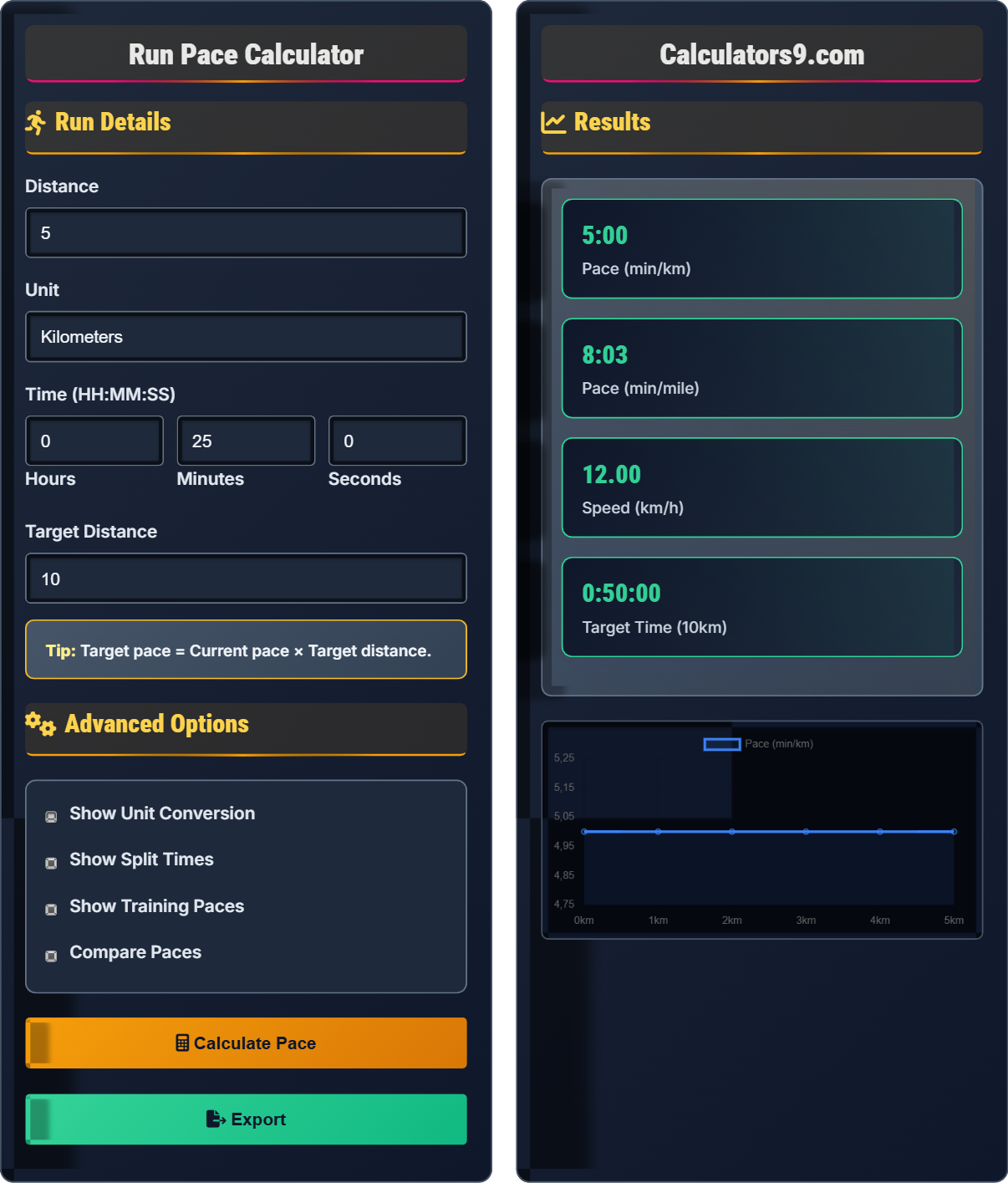
For example, if you ran 5 kilometers in 25 minutes, your pace would be 25 minutes ÷ 5 kilometers = 5 minutes per kilometer (5:00/km).
Converting between different pace units is essential for international runners:
- Kilometer to Mile: Multiply pace by 1.60934 to convert from min/km to min/mile
- Mile to Kilometer: Divide pace by 1.60934 to convert from min/mile to min/km
- Pace to Speed: Speed (km/h) = 60 ÷ pace (min/km)
- Speed to Pace: Pace (min/km) = 60 ÷ speed (km/h)
- Negative Splits: Run second half faster than first half to conserve energy
- Progressive Runs: Gradually increase pace throughout the run
- Even Pacing: Maintain consistent pace for optimal efficiency
- Goal Pace Practice: Train at target race pace regularly
- Recovery Runs: Run significantly slower than race pace for active recovery
Running Pace Learning Quiz
If a runner completes a 10km race in 50 minutes, what is their average pace?
The answer is B) 5:00/km. Using the pace formula: Pace = Time ÷ Distance = 50 minutes ÷ 10 km = 5 minutes per kilometer. This means the runner maintained an average pace of 5 minutes per kilometer throughout the race.
Understanding pace calculation is fundamental to running performance. The pace formula (Pace = Time ÷ Distance) gives you the time taken to cover each unit of distance. In this case, dividing total time (50 minutes) by total distance (10 km) gives us the average time per kilometer. This calculation helps runners set realistic goals and track improvements over time.
Pace: Time per unit distance (typically minutes per kilometer or mile)
Distance: Total length of the run (kilometers or miles)
Time: Total duration of the run (hours, minutes, seconds)
• Pace = Total Time ÷ Distance
• Lower pace numbers indicate faster running
• Pace is time per distance, not distance per time
• Remember: Lower pace = Faster running
• Use the formula: Time ÷ Distance = Pace
• Practice with common distances (5K, 10K) to build intuition
• Dividing distance by time instead of time by distance
• Confusing pace with speed (distance/time)
• Forgetting to convert time units properly
A runner's pace is 6:00 per kilometer. What is their pace in minutes per mile? (Use 1 mile = 1.60934 km)
To convert from min/km to min/mile, multiply by 1.60934:
6:00/km × 1.60934 = 9.656 minutes per mile
Converting 0.656 minutes to seconds: 0.656 × 60 = 39.36 seconds
Therefore, 6:00/km = 9:39/mile
Converting between pace units is essential for international runners. Since 1 mile is longer than 1 kilometer (1.60934 times longer), the pace in minutes per mile will be greater than the pace in minutes per kilometer. The conversion factor is the same as the distance conversion factor. This knowledge is crucial when comparing performances or following training plans from different countries.
Conversion Factor: 1.60934 (kilometers per mile)
Pace Conversion: Multiply min/km by 1.60934 to get min/mile
Unit Conversion: Process of changing measurement units
• To convert min/km to min/mile: multiply by 1.60934
• To convert min/mile to min/km: divide by 1.60934
• Always verify conversions make sense (mile pace > km pace)
• Remember: 1 mile ≈ 1.6 km
• Mile pace is always greater than km pace
• Use 1.6 as approximation for quick mental math
• Dividing instead of multiplying when converting km to mile pace
• Forgetting that mile pace should be numerically larger than km pace
• Incorrectly handling decimal to time conversion
Sarah maintains a pace of 5:30 per kilometer during a 21.1km half-marathon. How long will it take her to complete the race? Express your answer in hours, minutes, and seconds.
Step 1: Convert pace to decimal minutes = 5:30 = 5.5 minutes per km
Step 2: Calculate total time = 5.5 min/km × 21.1 km = 116.05 minutes
Step 3: Convert to hours:minutes:seconds
Hours: 116.05 ÷ 60 = 1.934 hours
Hours = 1, Remaining minutes = 0.934 × 60 = 56.04 minutes
Minutes = 56, Remaining seconds = 0.04 × 60 = 2.4 seconds
Therefore, Sarah will complete the half-marathon in approximately 1 hour, 56 minutes, and 2 seconds.
This problem demonstrates how pace can be used to predict race times. The calculation involves converting the pace to a decimal format for easier multiplication, then converting the result back to the standard time format. Understanding this process helps runners set realistic expectations and plan pacing strategies for races of various distances.
Half-Marathon: 21.1 km (13.1 miles) running distance
Predicted Time: Estimated completion time based on current pace
Pacing Strategy: Plan for maintaining desired pace throughout a race
• Total Time = Pace × Distance
• Convert pace to decimal minutes for calculations
• Convert final result back to standard time format
• Convert pace to decimal for easier calculations
• Use a calculator for complex time conversions
• Practice with common race distances (5K, 10K, half-marathon)
• Forgetting to convert pace to decimal format
• Making errors in time unit conversions
• Confusing pace with speed in calculations
Mike's current 5K race pace is 4:00 per kilometer. Calculate his recommended pace zones for different types of training runs: easy run (90 seconds slower), tempo run (20 seconds slower), and interval pace (10 seconds faster). Express all paces in min/km.
Step 1: Race pace = 4:00/km
Step 2: Easy run pace = 4:00 + 1:30 = 5:30/km
Step 3: Tempo run pace = 4:00 + 0:20 = 4:20/km
Step 4: Interval pace = 4:00 - 0:10 = 3:50/km
Therefore: Easy run = 5:30/km, Tempo run = 4:20/km, Interval pace = 3:50/km
Training pace zones are critical for effective running programs. Different types of workouts require specific pace ranges to achieve desired physiological adaptations. Easy runs should be significantly slower than race pace to build aerobic capacity, while tempo runs are slightly slower than race pace to improve lactate threshold. Interval training is faster than race pace to improve speed and VO2 max.
Training Zones: Specific pace ranges for different workout types
Easy Run: Aerobic training at comfortable pace
Tempo Run: Sustained effort at challenging but manageable pace
• Easy runs: 60-90 seconds slower than race pace
• Tempo runs: 15-25 seconds slower than race pace
• Interval pace: Faster than race pace
• Use current race pace as baseline for training zones
• Adjust pace zones based on individual fitness and goals
• Monitor heart rate along with pace for better training
• Running easy runs too fast
• Not accounting for fatigue in training pace adjustments
• Confusing race pace with training pace zones
Which of the following statements about pace and speed is TRUE?
The answer is B) A pace of 5:00/km equals a speed of 12 km/h. Speed = 60 ÷ pace (in min/km), so 60 ÷ 5 = 12 km/h. Pace and speed are inversely related - as pace decreases (faster), speed increases, and vice versa. This relationship is crucial for understanding running performance metrics.
Understanding the relationship between pace and speed is fundamental to running performance analysis. Pace measures time per distance (minutes per kilometer), while speed measures distance per time (kilometers per hour). They are inversely related, meaning when one increases, the other decreases. The conversion formula is: Speed (km/h) = 60 ÷ Pace (min/km), and Pace (min/km) = 60 ÷ Speed (km/h).
Pace: Time per unit distance (min/km or min/mile)
Speed: Distance per unit time (km/h or mph)
Inverse Relationship: As pace decreases, speed increases
• Speed = 60 ÷ Pace (min/km)
• Pace = 60 ÷ Speed (km/h)
• Lower pace numbers = faster running
• Remember: Lower pace = Faster running
• Use 60 ÷ pace = speed formula
• Practice conversions to build intuition
• Confusing pace with speed
• Thinking higher pace numbers mean faster running
• Using incorrect conversion formulas
Pace Basics
Time per unit distance (minutes per kilometer/mile).
\( \text{Pace} = \frac{\text{Time}}{\text{Distance}} \)
Where Pace=time/distance, Time=total duration, Distance=total distance.
- Lower pace = faster running
- Convert: 1 mile = 1.60934 km
- Speed = 60 ÷ pace (min/km)
Training Paces
Easy: 60-90s slower than race pace. Tempo: 15-25s slower. Interval: faster than race pace.
- Easy runs (conversational pace)
- Tempo runs (threshold pace)
- Intervals (speed work)
- Long runs (endurance pace)
- Weather affects pace
- Elevation changes impact effort
- Recovery between workouts
- Consistency over intensity
FAQ
Q: How do I find my race pace?
A: Run a timed 5K or 10K at maximum effort. Use 10K pace to estimate marathon pace. Your 5K pace is roughly your threshold pace.
Q: How do I convert pace between km and mile?
A: Multiply min/km by 1.60934 to get min/mile. Divide min/mile by 1.60934 to get min/km. Example: 5:00/km = 8:03/mile.