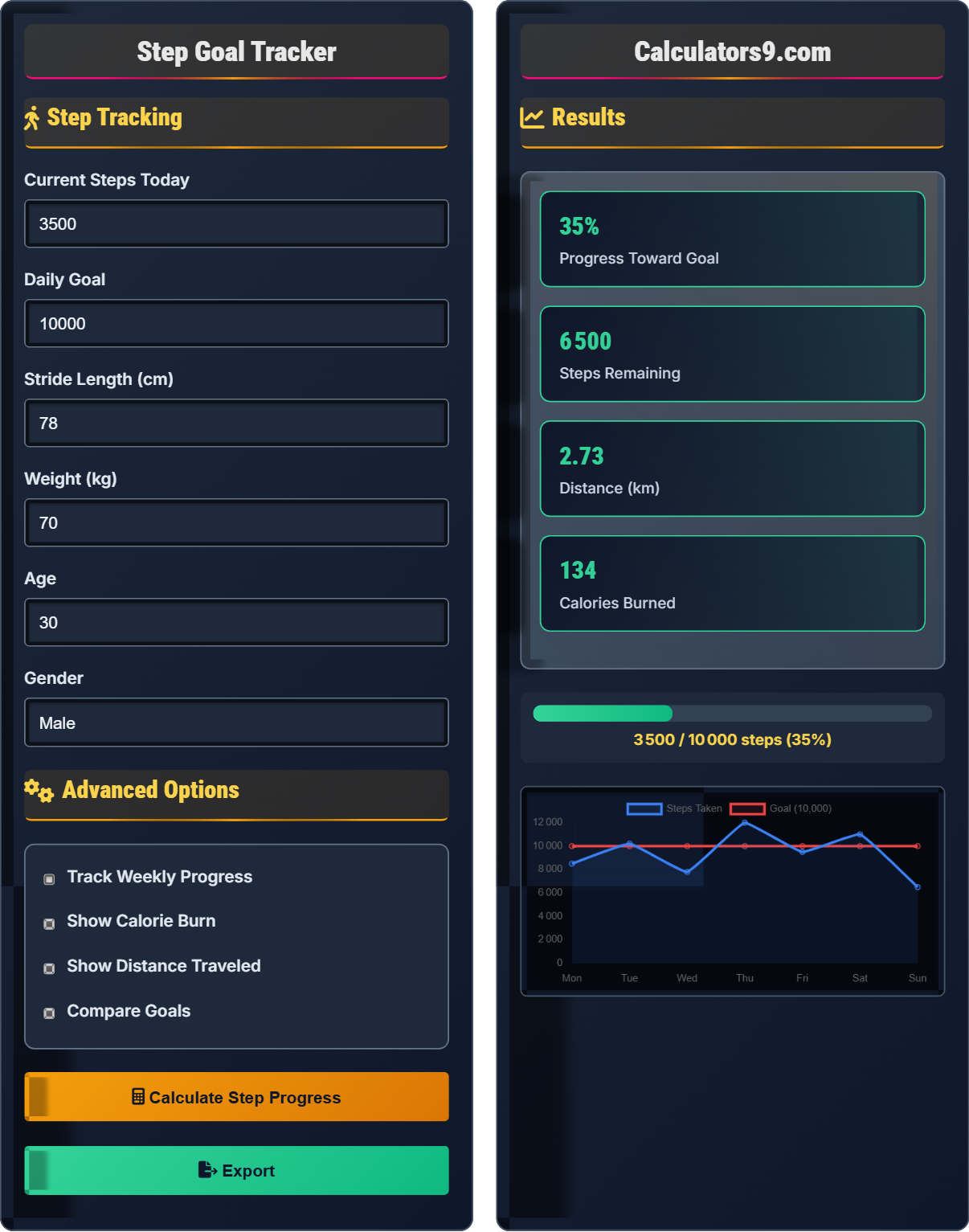
Step Goal Tracker
Daily steps calculator • 2026 edition
Step Tracking
Advanced Options
Results
| Metric | Value | Target | Status |
|---|
| Day | Steps | Goal | Completion |
|---|
Step Tracking Fundamentals
Step tracking is one of the simplest ways to monitor physical activity and encourage movement throughout the day. Research consistently shows that taking 10,000 steps per day is associated with improved cardiovascular health, weight management, and overall wellness. Modern research suggests that even 7,000-8,000 steps daily provides significant health benefits.
Converting steps to meaningful metrics:
These formulas provide estimates based on average stride lengths and metabolic rates.
Regular step tracking provides numerous benefits:
- Motivation: Visual progress encourages continued activity
- Awareness: Highlights sedentary periods during the day
- Goal Setting: Provides measurable targets for improvement
- Health Monitoring: Correlates with cardiovascular health markers
- Weight Management: Helps track activity for calorie balance
- Habit Formation: Encourages consistent movement patterns
- Take the stairs: Replace elevator rides with stair climbing
- Park farther away: Increase walking distance during errands
- Walking meetings: Conduct discussions while walking
- Micro walks: Take 5-minute walks every hour
- Active commuting: Walk or cycle to work when possible
- Set reminders: Use apps to prompt movement breaks
Step Tracking Quiz
According to health experts, what is the recommended daily step count for optimal health?
The answer is C) 10,000 steps. The 10,000-step goal became popular in the 1960s and has been widely adopted by health organizations. However, recent research suggests that 7,000-8,000 steps daily provides significant health benefits, and any increase from sedentary levels is beneficial.
The 10,000-step recommendation originated from Japanese marketing of a pedometer called "Manpo-kei" (10,000 steps meter). While this number wasn't based on rigorous scientific research initially, subsequent studies have validated its health benefits. It represents approximately 5 miles of walking for most people and provides cardiovascular and metabolic advantages.
Step Count: Number of steps taken in a given period
Physical Activity: Movement that increases energy expenditure
Health Benefits: Positive effects on physical and mental health
• 10,000 steps is the traditional target
• 7,000+ steps provide significant benefits
• Any increase from sedentary is beneficial
• Start with realistic goals and gradually increase
• Use a pedometer or smartphone app for tracking
• Break steps into smaller daily chunks
• Setting unrealistic initial goals
• Not accounting for stride length variations
• Focusing only on quantity over quality
Calculate the distance traveled in kilometers for 8,000 steps with a stride length of 75 cm.
Using the formula: Distance (km) = (Steps × Stride Length) ÷ 100,000
Distance = (8,000 × 75) ÷ 100,000
Distance = 600,000 ÷ 100,000
Distance = 6.0 km
Therefore, 8,000 steps with a 75 cm stride equals 6.0 kilometers.
This calculation demonstrates the relationship between steps, stride length, and distance. The conversion factor of 100,000 accounts for converting centimeters to kilometers (100,000 cm = 1 km). Knowing this relationship helps interpret step counts in more meaningful distance terms.
Stride Length: Distance covered in one step
Distance: Total length traveledConversion: Mathematical transformation between units
• Distance = (Steps × Stride) ÷ 100,000
• Stride length varies by individual
• Conversion factor is constant
• Measure your actual stride length for accuracy
• Use average values (75cm for women, 80cm for men)
• Remember that 10,000 steps ≈ 8km
• Using incorrect conversion factor
• Forgetting to convert units
• Applying average stride to everyone
A 70kg person takes 10,000 steps with an average stride length of 78cm. Estimate the calories burned during this walking activity.
Step 1: Calculate distance = (10,000 × 78) ÷ 100,000 = 7.8 km
Step 2: Calculate calories burned = Weight × Distance × 0.7
Step 3: Calories = 70 × 7.8 × 0.7 = 382.2 calories
Therefore, the person burns approximately 382 calories walking 10,000 steps.
This problem combines multiple concepts: distance calculation, weight factor, and calorie estimation. The 0.7 multiplier represents an average metabolic equivalent for walking. This calculation shows how body weight directly affects energy expenditure during physical activity.
Calorie Burn: Energy expended during activity
Metabolic Rate: Rate of energy expenditure
Body Weight Factor: Influence of weight on energy needs
• Calories = Weight × Distance × 0.7
• Heavier individuals burn more calories
• Longer distances = More calories
• Higher intensity walking burns more calories
• Terrain affects calorie expenditure
• This is an estimate for moderate walking
• Using incorrect weight units
• Not accounting for walking intensity
• Forgetting distance calculation step
A person sets a goal of 12,000 steps per day. After 4 hours of activity, they've taken 3,000 steps. At this rate, how many total steps will they take in 12 hours, and will they meet their goal?
Step 1: Calculate rate = 3,000 steps ÷ 4 hours = 750 steps/hour
Step 2: Project total steps = 750 steps/hour × 12 hours = 9,000 steps
Step 3: Compare to goal: 9,000 < 12,000
At this rate, they will take 9,000 steps in 12 hours, which is 25% below their goal of 12,000 steps.
This problem demonstrates the importance of monitoring progress throughout the day. By calculating the hourly rate, we can project total daily activity and make adjustments if needed. This approach helps identify when you need to increase activity to meet your goals.
Rate Calculation: Steps per unit time
Projection: Estimating future outcomes
Goal Adjustment: Modifying plans based on progress
• Rate = Steps ÷ Time
• Projection = Rate × Total Time
• Adjust activities based on progress
• Check progress regularly throughout the day
• Plan additional activity if behind schedule
• Consider activity patterns and timing
• Assuming consistent activity throughout the day
• Not accounting for busy periods with less walking
• Forgetting to make up for slow periods
Which of the following step ranges represents an "active" lifestyle?
The answer is D) 7,500-9,999 steps. According to step counting research, this range represents an active lifestyle. The classification system is: Sedentary (<5,000), Low Active (5,000-7,499), Active (7,500-9,999), Very Active (10,000+). This range meets minimum physical activity guidelines.
Step counting provides a simple, objective measure of physical activity. The classification system helps individuals understand their activity level and set appropriate goals. The "Active" range represents meeting basic physical activity recommendations for health benefits.
Activity Level: Classification based on daily steps
Health Guidelines: Recommended activity for health
Physical Activity: Movement that increases energy
• 7,500-9,999 = Active lifestyle
• 10,000+ = Very active
• Any movement is better than none
• Aim for the active range for health benefits
• Gradually increase to avoid injury
• Consistency matters more than perfection
• Confusing activity level classifications
• Setting goals too high too quickly
• Not considering individual capabilities
Step Tracking Basics
Unit of measurement for physical activity and walking.
\( \text{Distance(km)} = \frac{\text{Steps} \times \text{Stride(cm)}}{100,000} \)
Where Stride length typically ranges from 70-85cm.
- 10,000 steps ≈ 8km of walking
- Higher steps = More calories burned
- Consistency is more important than intensity
Activity Levels
Sedentary: <5,000. Low Active: 5,000-7,499. Active: 7,500-9,999. Very Active: 10,000+.
- Start with current average
- Increase by 500-1,000 steps weekly
- Set realistic goals
- Track consistently
- Individual stride length varies
- Walking speed affects intensity
- Consistency over perfection
- Listen to your body
FAQ
Q: How accurate are step counters?
A: Modern step counters are typically 90-95% accurate for regular walking. Accuracy may decrease with irregular movements, arm swinging, or certain activities. For best results, wear devices on your wrist or hip.
Q: Is 10,000 steps really necessary for health?
A: Recent studies suggest 7,000-8,000 steps provide significant health benefits. The key is consistency and gradual progression from your current level. Any increase in steps from sedentary levels is beneficial.