Stretch Timer
Yoga & flexibility timer • 2026 edition
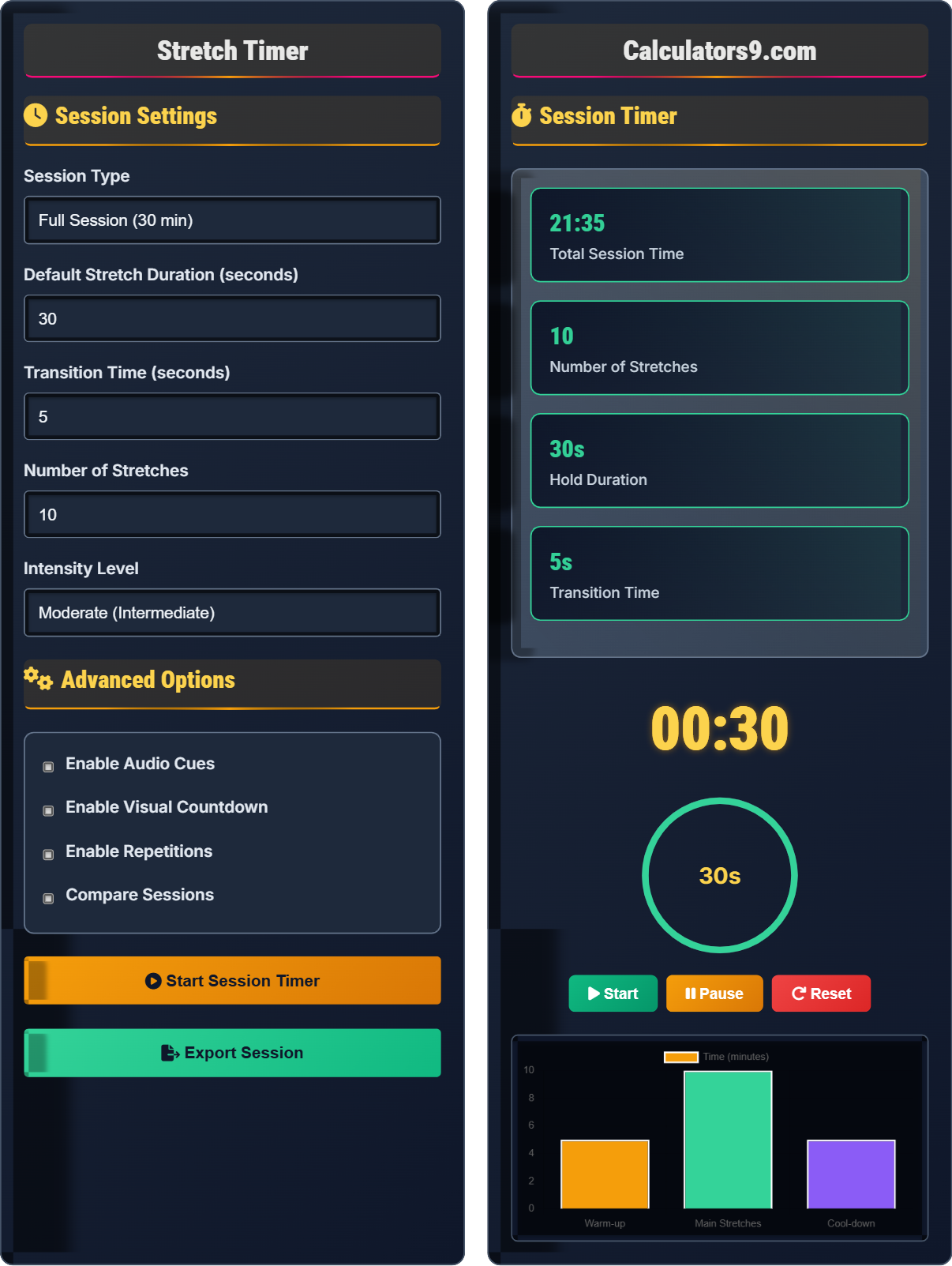
Session Settings
Advanced Options
Session Timer
| Position | Stretch | Time | Instructions |
|---|
| Muscle Group | Stretch Name | Duration | Benefits |
|---|
Stretching Fundamentals
Stretching is crucial for maintaining flexibility, preventing injuries, and improving overall physical performance. Regular stretching increases range of motion, reduces muscle tension, and promotes relaxation. It also helps improve posture, decrease pain, and enhance athletic performance by preparing muscles for activity.
Research shows optimal stretching durations:
For flexibility gains, hold stretches for 30-60 seconds. For maintenance, 15-30 seconds is sufficient. Repeat each stretch 2-3 times for optimal results.
Consistent stretching provides numerous benefits:
- Improved Flexibility: Increased range of motion in joints
- Injury Prevention: Reduced risk of muscle strains and tears
- Enhanced Performance: Better movement efficiency and power
- Stress Relief: Physical and mental relaxation
- Better Posture: Corrects muscle imbalances
- Pain Reduction: Alleviates muscle tension and stiffness
- Warm up first: Light activity before stretching
- Hold steadily: Avoid bouncing movements
- Breathe deeply: Relax into the stretch
- Progress gradually: Increase intensity over time
- Focus on tight areas: Address problem spots
- Be consistent: Stretch regularly for best results
Stretching Knowledge Quiz
According to research, what is the optimal duration for holding a static stretch to improve flexibility?
The answer is D) 30-60 seconds. Research consistently shows that holding stretches for 30-60 seconds provides optimal results for improving flexibility. This duration allows sufficient time for the muscle spindle to adapt and for connective tissue to elongate.
The optimal stretch duration is based on the physiological response of muscles and connective tissues. The 30-60 second range allows for activation of the Golgi tendon organs, which inhibit muscle contraction and allow for greater relaxation and elongation of muscle fibers.
Static Stretching: Holding a stretch position without movement
Muscle Spindle: Sensory receptor that detects muscle length changes
Golgi Tendon Organ: Sensory receptor that detects muscle tension
• Hold for 30-60 seconds for flexibility gains
• 15-30 seconds for maintenance
• Repeat 2-3 times per stretch
• Use a timer to ensure consistent duration
• Breathe deeply while stretching
• Gradually increase hold time over weeks
• Holding stretches too briefly
• Bouncing during static stretches
• Overstretching to the point of pain
If you want to perform 12 stretches with 30-second holds and 5-second transitions, what will be the total duration of your stretching session?
Calculation:
Stretch time: 12 × 30 seconds = 360 seconds
Transition time: 11 × 5 seconds = 55 seconds (11 transitions between 12 stretches)
Total time: 360 + 55 = 415 seconds
Convert to minutes: 415 ÷ 60 = 6.92 minutes ≈ 7 minutes
The total session duration will be approximately 7 minutes.
This calculation demonstrates the importance of accounting for both active stretching time and transition time between stretches. The number of transitions is always one less than the number of stretches, as transitions occur between stretches rather than after the last one.
Transition Time: Time between stretches for position changes
Session Duration: Total time including all activities
Active Stretching: Time spent in actual stretches
• Transitions = Stretches - 1
• Total time = (Stretches × Duration) + Transitions
• Plan realistic time allocations
• Include buffer time for adjustments
• Consider your schedule constraints
• Plan transitions to minimize movement
• Forgetting to count transition time
• Miscalculating number of transitions
• Not accounting for position changes
A beginner starts with gentle stretching (15-second holds) and progresses to moderate intensity (30-second holds) after 2 weeks, then to deep stretching (45-second holds) after another 4 weeks. If they perform 8 stretches per session, how much additional time does the deep intensity session take compared to the gentle session?
Gentle session: 8 × 15 seconds = 120 seconds
Deep session: 8 × 45 seconds = 360 seconds
Difference: 360 - 120 = 240 seconds
Convert to minutes: 240 ÷ 60 = 4 minutes
The deep intensity session takes 4 additional minutes compared to the gentle session.
This problem illustrates progressive overload in flexibility training. Gradually increasing intensity and duration allows the body to adapt safely while continuing to make improvements. The time investment increases proportionally with the intensity level.
Progressive Overload: Gradually increasing training demands
Flexibility Adaptation: Body's response to stretching
Training Progression: Systematic advancement of difficulty
• Progress gradually to avoid injury
• Allow 2-4 weeks between intensity increases
• Listen to your body's response
• Track your progress over time
• Increase one variable at a time
• Maintain consistency in practice
• Progressing too quickly
• Increasing multiple variables simultaneously
• Ignoring signs of overstretching
A person wants to include 5 minutes of dynamic warm-up, 10 stretches at 30 seconds each, and 3 minutes of cool-down. What is the total session time, and what percentage of the session is dedicated to static stretching?
Warm-up: 5 minutes
Static stretching: 10 × 30 seconds = 300 seconds = 5 minutes
Cool-down: 3 minutes
Total time: 5 + 5 + 3 = 13 minutes
Percentage for static stretching: (5 ÷ 13) × 100 = 38.5%
The total session time is 13 minutes, with 38.5% dedicated to static stretching.
This problem demonstrates the importance of structuring a complete flexibility session with proper warm-up and cool-down phases. The warm-up prepares muscles for stretching, while the cool-down helps with recovery and relaxation.
Dynamic Warm-up: Movement-based preparation
Static Stretching: Stationary flexibility work
Cool-down: Recovery phase after activity
• Always warm up before static stretching
• Include cool-down after stretching
• Balance different phases appropriately
• Dynamic movements before static holds
• Gradual progression in intensity
• Consistent session structure
• Skipping warm-up before stretching
• Not allocating enough time for each phase
• Focusing only on static stretching
Which of the following is the safest approach to stretching?
The answer is D) Hold stretches comfortably without pain. Safe stretching involves moving to a position of mild tension and holding without causing pain. Pain indicates potential injury, and bouncing or forcing stretches can cause muscle damage.
Safe stretching follows the principle of "mild tension, no pain." The goal is to feel a gentle pull in the target muscle, not sharp or severe discomfort. This approach allows for safe elongation of muscle and connective tissue without causing damage.
Safe Stretching: Stretching without causing pain or injury
Mild Tension: Gentle sensation during stretching
Proprioceptive Response: Body's protective mechanism
• Never stretch to the point of pain
• Avoid bouncing movements
• Progress gradually and safely
• Breathe normally while stretching
• Move slowly and deliberately
• Stop if you feel sharp pain
• Using ballistic (bouncing) movements
• Stretching injured areas
• Forcing beyond comfortable range
Stretching Basics
Controlled movement to lengthen muscles and increase flexibility.
\( \text{Maintenance: 15-30s} \)
\( \text{Improvement: 30-60s} \)
Repeat 2-3 times per stretch.
- Always warm up before static stretching
- Hold without bouncing
- Never stretch to pain
Session Planning
Warm-up: 5-10 min. Static holds: 30-60 sec. Cool-down: 5-10 min.
- Assess flexibility goals
- Choose appropriate duration
- Select targeted muscle groups
- Schedule regular sessions
- Individual flexibility levels vary
- Consistency over intensity
- Listen to your body
- Progress gradually
FAQ
Q: How often should I stretch?
A: Daily stretching is ideal for optimal flexibility. Even 5-10 minutes daily is better than longer sessions once or twice a week. Consistency helps maintain and improve flexibility over time.
Q: Should I stretch before or after exercise?
A: Dynamic stretches before exercise, static stretches after. Pre-exercise: 5-10 min dynamic warm-up. Post-exercise: 10-15 min static stretching when muscles are warm.