Target Heart Rate Calculator
Exercise zone calculator • 2026 edition
Personal Details
Advanced Options
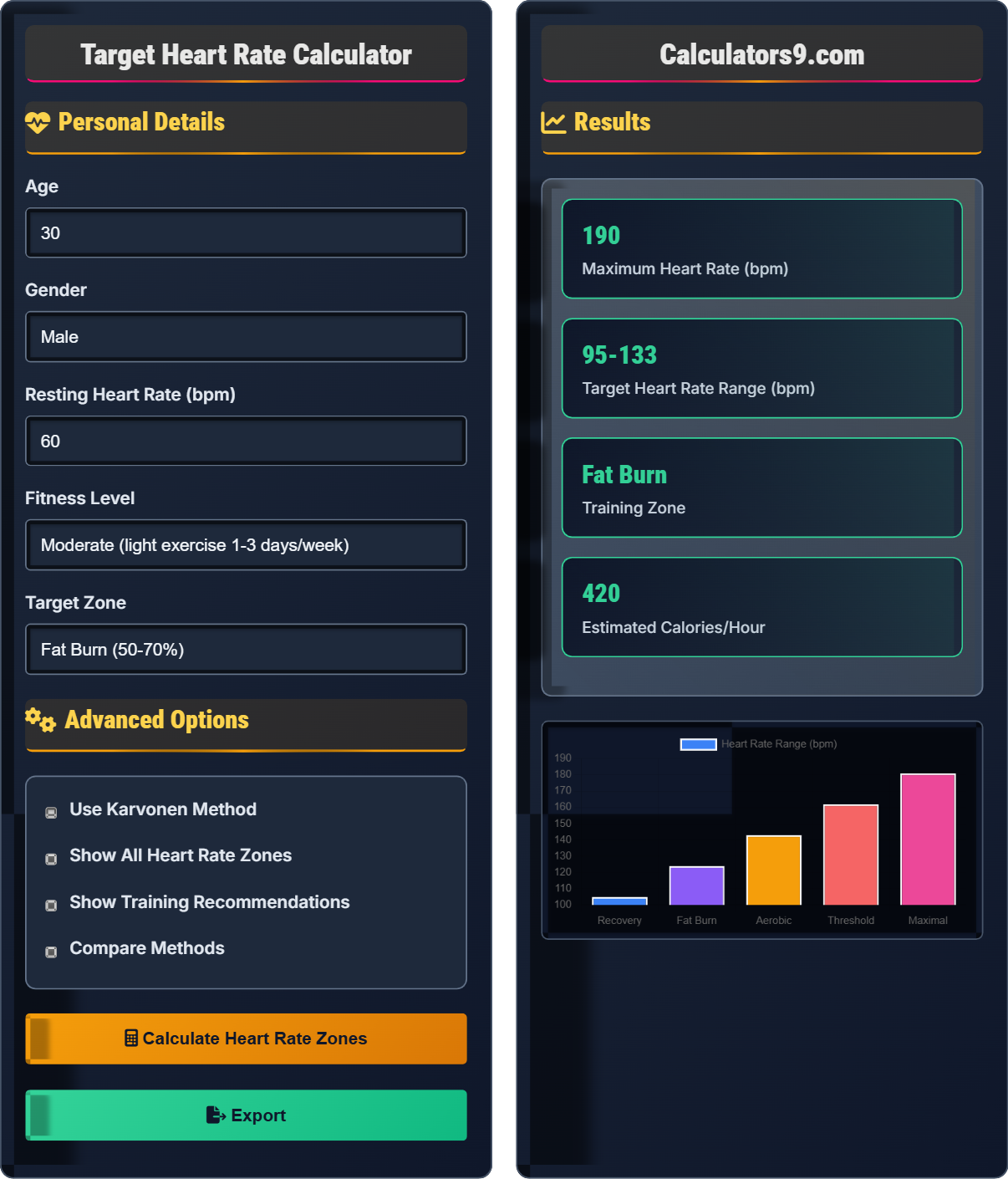
Results
| Zone | % of Max HR | Heart Rate Range | Purpose |
|---|
| Zone | Activity Type | Duration | Frequency |
|---|
Cardiovascular Training Fundamentals
Target heart rate is the range of heartbeats per minute that optimizes cardiovascular exercise benefits. It's calculated based on your age and fitness level. Training within your target heart rate zone ensures you're working at the right intensity to achieve your fitness goals, whether that's fat burning, endurance building, or cardiovascular improvement.
There are two main methods for calculating target heart rate:
The Karvonen method is considered more accurate as it accounts for your resting heart rate.
Different heart rate zones provide distinct training benefits:
- 50-60%: Active recovery, stress reduction, improved circulation
- 60-70%: Fat burning, improved aerobic capacity, weight management
- 70-80%: Cardiovascular improvement, increased stamina, enhanced oxygen utilization
- 80-90%: Anaerobic threshold improvement, speed development, lactate clearance
- 90-100%: Maximal power, speed, and neuromuscular adaptations
- Periodization: Cycle through different zones throughout the week
- Interval Training: Alternate between high and low zones
- Steady State: Maintain consistent zone for extended periods
- HIIT: High-intensity intervals in threshold zones
- Recovery Days: Focus on lower zones for active recovery
Heart Rate Training Quiz
What is the estimated maximum heart rate for a 35-year-old person using the standard formula?
The answer is A) 185 bpm. Using the standard formula: Max HR = 220 - Age = 220 - 35 = 185 bpm. This is the theoretical maximum number of beats per minute your heart should reach during maximal exercise.
The standard formula (220 - age) is a widely used estimation for maximum heart rate. While it's not perfectly accurate for everyone, it provides a good starting point for calculating target heart rate zones. The formula assumes that maximum heart rate decreases linearly with age, which is generally true for most people.
Maximum Heart Rate (Max HR): Highest heart rate achieved during maximal exercise
Standard Formula: Traditional method (220 - age) for estimating Max HR
Beats Per Minute (bpm): Unit of measurement for heart rate
• Max HR = 220 - Age (standard formula)
• Heart rate zones are percentages of Max HR
• Individual variations exist in actual Max HR
• Use the formula as a starting point
• Test your actual Max HR under supervision
• Adjust zones based on performance feedback
• Forgetting to subtract age from 220
• Using Max HR instead of target range for exercise
• Not accounting for individual fitness differences
A 30-year-old person wants to train in the aerobic zone (70-80% of max HR). Calculate their target heart rate range using the standard formula.
Step 1: Calculate Max HR = 220 - 30 = 190 bpm
Step 2: Calculate lower limit = 190 × 0.70 = 133 bpm
Step 3: Calculate upper limit = 190 × 0.80 = 152 bpm
Therefore, the target heart rate range is 133-152 bpm for aerobic training.
Calculating target heart rate ranges involves first determining maximum heart rate, then multiplying by the desired percentage range. The aerobic zone (70-80% of max HR) is ideal for improving cardiovascular fitness and endurance. This calculation helps ensure you're exercising at the right intensity for your goals.
Aerobic Zone: 70-80% of maximum heart rate
Target Range: Desired heart rate during exercise
Percentage of Max HR: Intensity level as % of maximum
• Target HR = Max HR × Percentage
• Calculate both lower and upper limits
• Different zones serve different training purposes
• Memorize the percentage ranges for each zone
• Use a heart rate monitor for accuracy
• Adjust zones based on how you feel
• Forgetting to calculate both ends of the range
• Using the wrong percentage for the desired zone
• Not accounting for individual fitness variations
Sarah is 28 years old with a resting heart rate of 55 bpm. She wants to train in the moderate zone (60-70% of heart rate reserve). Calculate her target heart rate range using the Karvonen method.
Step 1: Calculate Max HR = 220 - 28 = 192 bpm
Step 2: Calculate Heart Rate Reserve (HRR) = Max HR - Resting HR = 192 - 55 = 137 bpm
Step 3: Calculate lower limit = (HRR × 0.60) + Resting HR = (137 × 0.60) + 55 = 82.2 + 55 = 137.2 bpm
Step 4: Calculate upper limit = (HRR × 0.70) + Resting HR = (137 × 0.70) + 55 = 95.9 + 55 = 150.9 bpm
Therefore, Sarah's target heart rate range is 137-151 bpm.
The Karvonen method accounts for resting heart rate, making it more personalized than the standard formula. Heart Rate Reserve (HRR) is the difference between maximum and resting heart rate. By calculating the percentage of HRR and adding back the resting heart rate, we get a more accurate target range that considers individual fitness levels.
Karvonen Method: Heart rate calculation that includes resting heart rate
Heart Rate Reserve (HRR): Difference between Max HR and Resting HR
Moderate Zone: 60-70% of heart rate reserve
• HRR = Max HR - Resting HR
• Target HR = (HRR × %) + Resting HR
• More accurate than standard method
• Measure resting HR in the morning after waking
• Use the Karvonen method for more accuracy
• Reassess resting HR periodically as fitness improves
• Forgetting to add resting HR back to the result
• Calculating HRR incorrectly
• Using the wrong resting HR measurement
Mike wants to improve his endurance for a marathon. Which heart rate zone should he spend most of his training time in, and why? What are the specific benefits of training in this zone?
Mike should spend most of his training time in the aerobic zone (70-80% of max HR). This zone provides the greatest benefits for endurance training including:
- Improved cardiovascular efficiency
- Enhanced oxygen delivery to muscles
- Increased capillary density
- Improved mitochondrial function
- Better lactate clearance
- Enhanced fat oxidation
Training in the aerobic zone builds the foundation necessary for marathon success.
Endurance training requires developing the aerobic energy system, which operates most efficiently in the 70-80% heart rate zone. This intensity allows for sustained training while still providing enough stimulus to trigger physiological adaptations. Marathon training typically follows the 80/20 rule: 80% of training in aerobic zones, 20% in higher intensity zones.
Aerobic Zone: 70-80% of max heart rate
Endurance Training: Training focused on cardiovascular capacity
Oxygen Delivery: How efficiently oxygen reaches muscles
• Endurance = Aerobic zone focus (70-80%)
• Adaptations occur with consistent training
• Balance with higher intensity for complete development
• Use heart rate monitor to stay in zone
• Combine with perceived exertion scale
• Include some higher intensity for complete fitness
• Training too hard too often
• Not spending enough time in aerobic zone
• Ignoring the importance of easy days
Which of the following adaptations occurs primarily in the anaerobic threshold zone (80-90% of max HR)?
The answer is B) Improved lactate threshold. Training in the 80-90% zone specifically targets the anaerobic threshold, improving the body's ability to clear lactate and maintain higher intensities for longer periods. This adaptation is crucial for performance in events lasting 30 minutes to several hours.
Each heart rate zone triggers specific physiological adaptations. The anaerobic threshold zone (80-90% of max HR) specifically improves lactate threshold - the point at which lactate begins to accumulate in the blood faster than it can be cleared. This adaptation allows athletes to sustain higher intensities for longer periods without fatigue.
Lactate Threshold: Point where lactate accumulates faster than cleared
Anaerobic Threshold Zone: 80-90% of maximum heart rate
Lactate Clearance: Body's ability to remove lactate from blood
• Each zone triggers specific adaptations
• Include threshold training 1-2x per week
• Monitor lactate response to adjust intensity
• Combine with other zones for balanced training
• Training threshold too frequently
• Not allowing adequate recovery
• Confusing lactate threshold with VO2 max
Heart Rate Basics
Optimal heart rate range for exercise benefits.
\( \text{Max HR} = 220 - \text{Age} \)
Where Max HR = Maximum heart rate, Age = Your age in years.
- Max HR decreases with age
- Target zones: 50-70% (fat burn), 70-85% (aerobic)
- Higher intensity = greater adaptation
Training Zones
Recovery: 50-60%. Fat burn: 60-70%. Aerobic: 70-80%. Anaerobic: 80-90%. Maximal: 90-100%.
- Recovery: Active recovery, circulation
- Fat burn: Weight management, endurance
- Aerobic: Cardiovascular fitness
- Threshold: Lactate clearance, speed
- Maximal: Power, speed
- Individual variations exist
- Adjust based on fitness level
- Balance different zones
- Monitor regularly
FAQ
Q: How do I know if I'm in the right heart rate zone?
A: Use a heart rate monitor or check pulse manually. In fat burn zone (60-70%), you should be able to talk comfortably. In aerobic zone (70-80%), talking becomes challenging but possible.
Q: Should I train in the same zone all the time?
A: No! Periodization is key. Mix zones: 80% aerobic, 20% higher intensity. This maximizes adaptations and prevents overtraining. Recovery days in low zones are crucial.