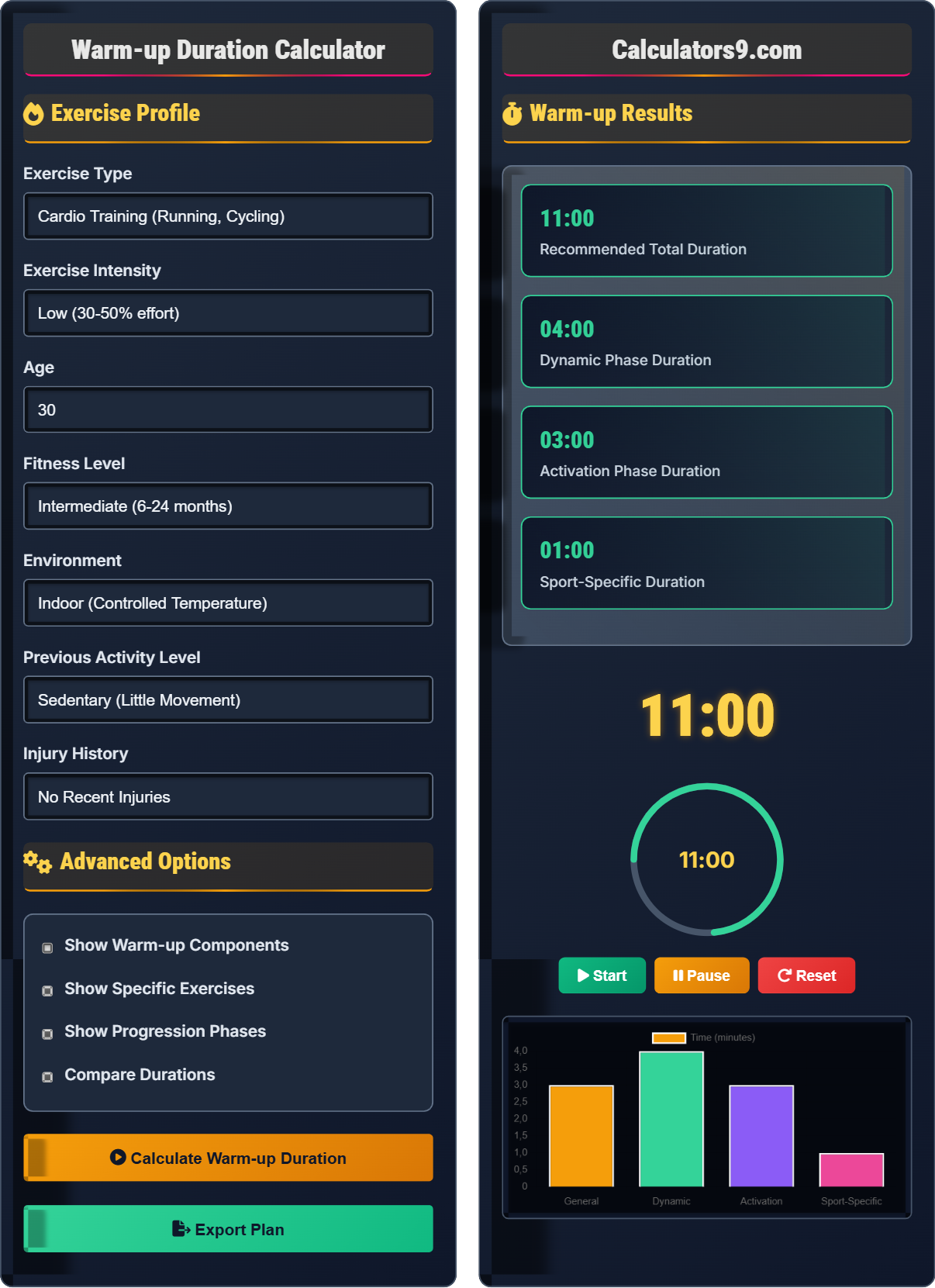
Warm-up Duration Calculator
Exercise preparation timer • 2026 edition
Exercise Profile
Advanced Options
Warm-up Results
| Phase | Exercise | Duration | Benefits |
|---|
Warm-up Fundamentals
Warming up is essential for preparing your body for exercise. It gradually increases heart rate, raises body temperature, and improves blood flow to muscles. This preparation reduces injury risk, enhances performance, and helps you get the most out of your workout. A proper warm-up should mimic the movements of your upcoming activity.
Research-based warm-up duration guidelines:
Additional factors include fitness level, injury history, and environmental conditions. For example, older individuals may need 2-3 extra minutes.
A comprehensive warm-up provides numerous benefits:
- Injury Prevention: Reduces muscle strain and joint injury risk
- Performance Enhancement: Improves power, speed, and coordination
- Mental Preparation: Focuses mind on upcoming activity
- Improved Flexibility: Increases range of motion temporarily
- Enhanced Blood Flow: Delivers oxygen and nutrients to muscles
- Temperature Regulation: Prepares body for increased heat production
- Progressive Intensity: Gradually increase from low to moderate intensity
- Sport-Specific: Mimic movements of main activity
- Dynamic Focus: Emphasize active movements over static stretching
- Individual Needs: Adapt based on age, fitness, and injury history
- Environmental Awareness: Adjust for temperature and conditions
- Consistency: Use the same sequence for routine and familiarity
Warm-up Knowledge Quiz
What is the primary purpose of a warm-up?
The answer is B) To gradually prepare the body for exercise. The primary purpose of a warm-up is to progressively prepare the cardiovascular, muscular, and nervous systems for the demands of the upcoming activity. This reduces injury risk and enhances performance.
A warm-up serves as a transition from rest to activity. It increases core body temperature, enhances blood flow to muscles, and activates the nervous system. This preparation makes the body more efficient and safer for the main exercise session.
Warm-up: Preparation phase before main activity
Cardiovascular System: Heart and blood vessels
Nervous System: Brain and nerve pathways
• Gradual progression is key
• Should match main activity
• Individual factors matter
• Start with light movement
• Mirror your main activity
• Focus on weak points
• Skipping warm-up entirely
• Not matching to main activity
Calculate the recommended warm-up duration for a 40-year-old intermediate exerciser doing high-intensity strength training, using the formula: Base Duration = 5 + (Intensity × 2) + Age Factor, where Age Factor = (Age - 20) ÷ 10.
Step 1: Calculate Age Factor = (40 - 20) ÷ 10 = 2
Step 2: Determine Intensity Factor (High = 3)
Step 3: Calculate Base Duration = 5 + (3 × 2) + 2 = 5 + 6 + 2 = 13 minutes
Step 4: Add 2-3 minutes for strength training specificity = 15-16 minutes
Recommended warm-up duration: 15-16 minutes.
This calculation demonstrates how multiple factors influence warm-up duration. Age affects recovery and flexibility, intensity determines preparation needs, and activity type influences specific preparation requirements.
Age Factor: Adjustment based on age
Intensity Factor: Adjustment based on exercise intensity
Specificity: Matching preparation to activity
• Age factor: (Age - 20) ÷ 10
• Higher intensity = longer warm-up
• Add specificity time
• Round to nearest 5 minutes
• Add extra time for older adults
• Consider environmental factors
• Forgetting age factor calculation
• Not accounting for activity type
• Using same duration for everyone
A person normally needs 12 minutes for their warm-up routine. How much additional time should they add for outdoor winter exercise, and why?
For cold weather, add 3-5 extra minutes to warm-up duration. In cold temperatures, muscles are stiffer and circulation is reduced, requiring more time to achieve optimal body temperature and muscle elasticity. The body also needs additional time to adapt to temperature differences between internal and external environments.
Environmental conditions significantly affect warm-up requirements. Cold weather reduces muscle elasticity and blood flow, increasing injury risk. Additional time allows for proper tissue warming and neural activation despite challenging conditions.
Environmental Factors: External conditions affecting exercise
Muscle Elasticity: Ability to stretch and contract
Thermoregulation: Body temperature control
• Cold weather: +3-5 minutes
• Hot weather: Monitor closely
• Wind/chill: Adjust accordingly
• Dress in layers for cold weather
• Focus on core warming
• Monitor body temperature
• Not adjusting for weather conditions
• Underestimating cold weather effects
• Ignoring environmental factors
A person with a major previous knee injury wants to start running again. How should their warm-up differ from a person without injury history, and what specific components should be emphasized?
For someone with major previous knee injury:
- Extend warm-up duration by 3-5 minutes
- Emphasize knee stabilization exercises
- Include proprioceptive training
- Focus on surrounding muscle activation
- Gradually progress intensity
- Monitor for pain or discomfort
Specific components: leg swings, knee circles, single-leg balance, hip strengthening movements.
Injury history requires special consideration in warm-up planning. Previous injuries may have led to muscle imbalances, reduced proprioception, or compensatory movement patterns. The warm-up should address these vulnerabilities while preparing for activity.
Proprioception: Body's position awareness
Stabilization: Joint support and control
Compensatory Patterns: Altered movement due to injury
• Increase duration for injury history
• Target vulnerable areas
• Monitor for warning signs
• Consult healthcare provider
• Start conservatively
• Focus on quality over speed
• Not addressing previous injuries
• Going too intense too quickly
• Ignoring pain signals
Which of the following is the most important component of an effective warm-up?
The answer is B) Dynamic movement preparation. Dynamic movements that mimic the upcoming activity are most effective for warming up. They increase body temperature, activate muscles, improve range of motion, and prepare the nervous system for the specific demands of the exercise.
Dynamic warm-ups are superior to static stretching for pre-exercise preparation. Dynamic movements create functional range of motion, activate muscle chains, and prepare the body for coordinated movement patterns needed in the main activity.
Dynamic Movement: Active range of motion
Static Stretching: Holding positions
Functional Range: Movement-specific flexibility
• Dynamic > Static before exercise
• Match movements to activity
• Progress from low to moderate
• Use sport-specific movements
• Focus on major joints
• Include multi-planar movements
• Static stretching before exercise
• Not matching to activity
• Going too intense too quickly
Warm-up Basics
Gradual preparation of body systems for exercise.
\( \text{Duration} = 5 + (\text{Intensity} \times 2) + \text{Age Factor} \)
Where Age Factor = (Age - 20) ÷ 10 (for ages > 20).
- Always include dynamic movements
- Match to main activity
- Progress from low to moderate intensity
Component Structure
General: 2-3 min. Dynamic: 5-8 min. Activation: 3-5 min. Sport-specific: 2-4 min.
- General cardiovascular activation
- Dynamic movement preparation
- Muscle activation exercises
- Sport-specific movement patterns
- Individual fitness levels vary
- Age affects warm-up needs
- Environmental factors matter
- Previous injuries require attention
FAQ
Q: How long should my warm-up be?
A: Generally 10-15 minutes for most activities. Beginners should start with 5-10 minutes. Advanced athletes may need 15-20 minutes. The key is gradual preparation, not duration. Quality matters more than quantity.
Q: Should I stretch before or after exercise?
A: Dynamic stretches before exercise, static stretches after. Dynamic movements prepare muscles for activity. Static stretching after exercise improves flexibility and aids recovery. Pre-exercise static stretching may reduce performance.