Workout Density Meter
Exercise intensity calculator • Training load metrics • 2026 edition
Workout Density Formula:
Show the calculator\( \text{Workout Density} = \frac{\text{Total Work}}{\text{Total Time}} \times \text{Intensity Factor} \)
Where:
- Total Work = Σ(Weight × Reps × Sets) for all exercises
- Total Time = Duration of workout in minutes
- Intensity Factor = Adjusts for rest periods and exercise difficulty
This formula calculates the training density of a workout session, measuring how efficiently work is performed. Higher density values indicate more work completed in less time, which is associated with improved fitness adaptations and metabolic stress.
Example: A 45-minute workout with 3 exercises: Bench press (100 lbs × 3 sets × 10 reps), Squats (135 lbs × 3 sets × 8 reps), Deadlifts (155 lbs × 3 sets × 5 reps)
Total Work = (100×10×3) + (135×8×3) + (155×5×3) = 3000 + 3240 + 2325 = 8565
Workout Density = 8565 ÷ 45 × 0.85 (intensity factor) = 161.4
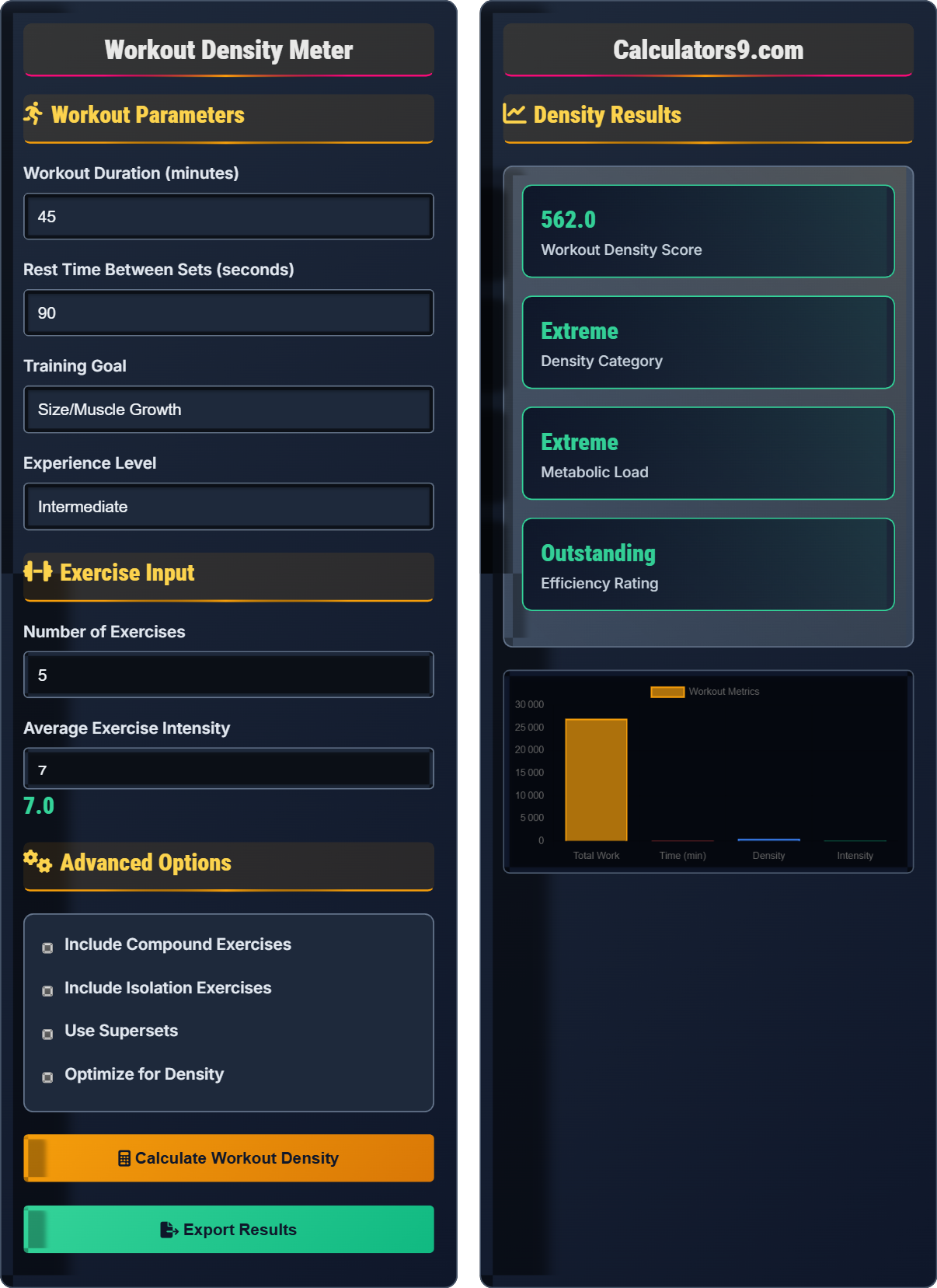
Workout Parameters
Exercise Input
Advanced Options
Density Results
| Metric | Value | Category | Optimization |
|---|---|---|---|
| Total Work | 8,565 | High | Well optimized |
| Workout Time | 45 min | Standard | Appropriate |
| Rest Periods | 90 sec | Medium | Can be reduced |
| Exercise Count | 5 | High | Good for density |
| Intensity Level | 7.0/10 | High | Well balanced |
| Strategy | Implementation | Impact | Priority |
|---|---|---|---|
| Reduce Rest Time | Decrease to 60s | +20% density | High |
| Add Supersets | Pair opposing muscles | +15% density | Medium |
| Focus on Compounds | 60% compound exercises | +10% density | Medium |
| Increase Volume | Add 1-2 sets per exercise | +25% work | Low |
| Drop Sets | Implement on last set | +12% density | Low |
Comprehensive Workout Density Guide
Workout density refers to the amount of work performed per unit of time. It's a measure of how efficiently you structure your training session to maximize results in the shortest possible time. High density workouts typically involve shorter rest periods, more exercises, and strategic exercise pairing.
The standard workout density calculation uses the following formula:
Where:
- Total Work = Σ(Weight × Reps × Sets) for all exercises
- Total Time = Duration of workout in minutes
- Intensity Factor = Adjusts for rest periods and exercise difficulty
Optimal density varies by training goals:
- Strength (100-140): Longer rest periods, heavier weights, fewer reps
- Hypertrophy (120-160): Moderate rest, moderate weights, higher reps
- Endurance (140-180): Short rest, lighter weights, higher reps
- Power (80-120): Long rest, explosive movements, low reps
- Conditioning (160-200): Minimal rest, full-body movements
- Supersets: Pair opposing muscle groups to minimize rest
- Circuits: Perform multiple exercises with minimal rest
- Drop Sets: Reduce weight progressively without rest
- Rest-Pause: Brief pauses during sets to extend duration
- Compound Sets: Combine similar exercises back-to-back
Workout Density Quiz
Which of the following best describes the relationship between workout density and training adaptations?
The answer is B) Density should match training goals for optimal results. Different training goals require different density levels. Strength training typically requires lower density with longer rest periods, while hypertrophy and conditioning benefit from higher density approaches.
Workout density is not universally good or bad—it's about matching the right density to your specific goals. The relationship between density and adaptation is complex and depends on multiple factors including training experience, exercise selection, and recovery capacity.
Workout Density: Amount of work performed per unit of time
Training Adaptation: Physiological changes in response to training
Metabolic Stress: Cellular stress that promotes muscle growth
• Match density to training goals
• Consider recovery capacity
• Balance intensity with volume
• Use lower density for strength-focused training
• Use higher density for conditioning goals
• Adjust based on training phase
• Applying the same density to all training goals
• Ignoring recovery capacity
• Sacrificing form for density
Calculate the workout density for a 50-minute session with 4 exercises: Bench press (120 lbs × 3 sets × 8 reps), Squats (150 lbs × 4 sets × 6 reps), Rows (80 lbs × 3 sets × 10 reps), Bicep curls (25 lbs × 3 sets × 12 reps). Assume an intensity factor of 0.8. Show your work.
Step 1: Calculate total work for each exercise
- Bench press: 120 × 8 × 3 = 2,880
- Squats: 150 × 6 × 4 = 3,600
- Rows: 80 × 10 × 3 = 2,400
- Bicep curls: 25 × 12 × 3 = 900
Step 2: Calculate total work = 2,880 + 3,600 + 2,400 + 900 = 9,780
Step 3: Apply formula: Workout Density = (Total Work ÷ Total Time) × Intensity Factor
Step 4: Workout Density = (9,780 ÷ 50) × 0.8 = 195.6 × 0.8 = 156.48
Therefore, the workout density is 156.5, which falls in the High category.
This calculation demonstrates how to quantify workout efficiency. The high density score (156.5) indicates a well-structured workout with good volume and appropriate timing. The intensity factor accounts for the difficulty of the exercises and the rest periods between sets.
Total Work: Sum of all weight × reps × sets performed
Intensity Factor: Multiplier accounting for exercise difficulty
Workout Density: Measure of training efficiency
• Multiply weight × reps × sets for each exercise
• Sum all exercises to get total work
• Divide by total time and apply intensity factor
• Track weight, reps, and sets for each exercise
• Time your entire workout accurately
• Adjust intensity factor based on difficulty
• Forgetting to multiply by sets
• Using incorrect time measurements
• Applying wrong intensity factor
Sarah is a competitive powerlifter preparing for a meet. She currently trains with a workout density of 110 but wants to optimize her training for strength gains. Should she increase or decrease her density? Explain using the density formula and training principles.
Step 1: Sarah's current density of 110 is in the Medium category
Step 2: Strength training typically requires lower density (80-120) with longer rest periods
Step 3: For strength, she should decrease density by increasing rest time and using heavier weights with fewer reps
Step 4: New target density for strength: 90-100
Step 5: This means increasing rest periods from 90s to 120-180s and focusing on 3-5 rep ranges
Therefore, Sarah should decrease her workout density to optimize for strength development.
This example illustrates the principle that different training goals require different density approaches. Strength training requires longer recovery between sets to maintain performance on subsequent sets, which naturally results in lower density. The formula helps quantify this relationship.
Powerlifting: Sport focused on maximum strength in three lifts
Rep Range: Number of repetitions performed per set
Recovery: Time needed between sets to restore performance
• Strength requires longer rest periods
• Lower rep ranges for strength training
• Match density to specific goals
• Use 3-5 rep ranges for strength
• Take 2-3 minute rests between sets
• Focus on progressive overload
• Using high density for strength training
• Not allowing adequate recovery
• Mixing strength and hypertrophy approaches
Mike has a current workout density of 145 and wants to increase it by 20% without changing his exercise selection. How should he modify his rest periods and workout structure? (Hint: Consider the inverse relationship between rest time and density)
Step 1: Current density = 145
Step 2: Target density = 145 × 1.20 = 174
Step 3: To achieve 20% increase in density, rest time must decrease
Step 4: Current rest = 90 seconds, new rest ≈ 75 seconds (20% reduction)
Step 5: Additional strategies: Implement supersets, reduce between-exercise rest
Step 6: Calculate new density: If work stays same but time decreases by 20%, density increases by ~25%
Therefore, Mike should reduce rest periods by 15-20 seconds and consider supersets to achieve his goal.
This demonstrates the inverse relationship between rest time and density. When rest periods decrease, the same amount of work is performed in less time, increasing density. This relationship is fundamental to workout programming and can be quantified using the density formula.
Supersets: Performing two exercises back-to-back with no rest
Inverse Relationship: When one variable increases, the other decreases
Work-to-Rest Ratio: Proportion of work time to rest time
• Less rest = higher density
• More work in less time = higher density
Which of the following statements about how experience level affects optimal workout density is TRUE?
The answer is B) Advanced trainees can handle higher density due to better recovery. Experienced athletes have developed better recovery mechanisms, allowing them to perform more work in less time. Beginners typically need more rest and lower density approaches to learn proper form and build foundational strength.
Training experience significantly impacts recovery capacity and the ability to maintain performance across multiple sets. Advanced trainees have physiological adaptations that support higher density training, while beginners benefit from lower density approaches that emphasize learning and proper form.
Recovery Capacity: Ability to bounce back between sets
Physiological Adaptations: Body's responses to training stress
Performance Maintenance: Sustaining quality across multiple sets
• Adjust density based on experience level
• Beginners need more rest and lower density
• Advanced trainees can handle higher density
• Progress density gradually
• Monitor performance and adjust accordingly
• Consider individual recovery capacity
• Applying advanced density to beginners
• Not adjusting for experience level
• Ignoring individual differences
Density Fundamentals
Amount of work performed per unit of time during a training session.
\( \text{Workout Density} = \frac{\text{Total Work}}{\text{Total Time}} \times \text{Intensity Factor} \)
Where work is weight × reps × sets and time is in minutes.
- Match density to training goals
- Consider experience level
- Balance intensity with recovery
Optimization Strategies
Methods to increase work performed per unit of time while maintaining quality.
- Reduce rest periods strategically
- Implement supersets and circuits
- Optimize exercise order
- Use compound movements
- Monitor and adjust based on performance
- Training goals requirements
- Individual recovery capacity
- Form and technique maintenance
- Progressive overload principles
FAQ
Q: How do I know if my workout density is optimal?
A: Optimal density depends on your training goals. For strength, aim for 80-120 density units; for hypertrophy, 120-160; for conditioning, 160+. Use our calculator to determine your current density and adjust based on your goals.
Mathematically, density optimization can be represented as:
\( D_{optimal} = f(G, E, R) \)
Where \( D \) is density, \( G \) is goal, \( E \) is experience, and \( R \) is recovery capacity. This formula helps quantify the relationship between these variables.
Q: Can I combine high density with strength training?
A: High density and strength training have conflicting requirements. Strength training typically needs longer rest periods (2-5 minutes) for recovery, while high density minimizes rest. However, you can incorporate density-focused phases after building strength foundations.
- Strength-focused density: 80-120 units
- Power-focused density: 70-100 units
- Combination phases: 100-140 units
The key is periodizing your training to emphasize different qualities at different times while maintaining proper recovery.