Workout Split Designer
Exercise routine generator • Training program
Workout Split Formula:
Show the calculator\( \text{Training Frequency} = \frac{\text{Available Days}}{\text{Split Pattern}} \times \text{Recovery Factor} \)
Where:
- \( \text{Available Days} \): Days per week you can train
- \( \text{Split Pattern} \): Days per cycle (e.g., 3 for upper/lower, 5 for bro split)
- \( \text{Recovery Factor} \): 0.8-1.2 based on experience and recovery
- \( \text{Muscle Groups} \): Target each group 2-3x per week
This formula determines optimal training frequency based on available time, experience level, and recovery capacity. The goal is to hit each muscle group 2-3 times per week while allowing adequate recovery. Recovery factor accounts for individual differences in recovery ability, training experience, and stress levels.
Example: For 5 available training days with a push/pull/legs split:
Frequency: (5 ÷ 3) × 1.0 = 1.67 cycles per week
Each muscle group is trained approximately 1.67 times per week, which is within the optimal range of 2-3 times for most intermediate lifters.
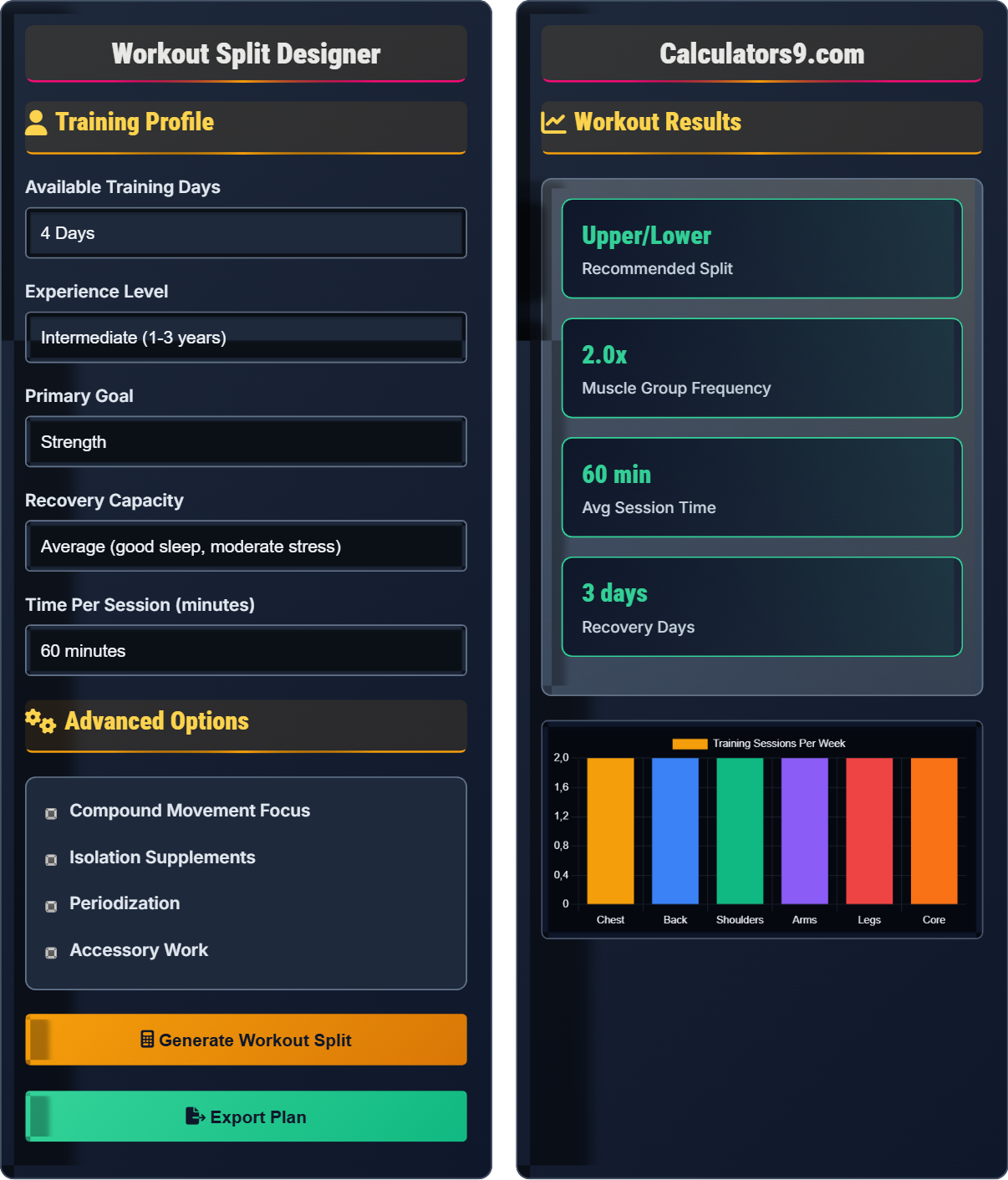
Training Profile
Advanced Options
Workout Results
| Day | Focus | Compound | Isolation | Time |
|---|
| Exercise | Muscles | Type | Reps/Sets |
|---|
| Week | Focus | Load | Volume |
|---|
Comprehensive Workout Split Guide
Workout splits organize your training by body parts or movement patterns across different days. The goal is to allow adequate recovery while maximizing training frequency for each muscle group. Research shows that training each muscle group 2-3 times per week yields optimal results for strength and hypertrophy. The best split depends on your available time, experience level, recovery capacity, and personal preferences.
The standard split calculation uses the following approach:
Where:
- \( \text{Training Days} \): Days you can realistically train
- \( \text{Cycles Per Week} \): How many times you repeat the split pattern
- \( \text{Muscle Groups} \): Major muscle groups to target
- \( \text{Optimal Range} \): 2-3 times per week for most muscle groups
Successful splits balance multiple training variables:
- Frequency: How often you train each muscle group
- Volume: Total sets per muscle group per week
- Intensity: Percentage of maximum effort
- Exercise Selection: Compound vs isolation movements
- Recovery: Rest between sessions and sleep quality
- Beginners: Start with full-body or upper/lower splits
- Time Limited: Focus on compound movements in shorter sessions
- Advanced: Consider bro splits or specialized approaches
- Recovery Issues: Reduce volume and increase rest days
- Weak Points: Include targeted accessory work
Split Fundamentals
Division of exercises across different training days.
\( \text{Frequency} = \frac{\text{Training Days} \times \text{Cycles}}{\text{Muscle Groups}} \)
Where: Days per week, cycles per week, muscle groups.
- Target each muscle 2-3x per week
- Include compound movements
- Allow adequate recovery
Training Strategies
Multi-joint vs single-joint exercise selection.
- Start with compound movements
- Add isolation for weak points
- Balance pushing and pulling
- Include leg and core work
- Experience level matters
- Time availability is key
- Recovery capacity varies
- Goals determine focus
Workout Split Learning Quiz
What is the optimal training frequency for muscle groups to maximize hypertrophy?
The answer is B) 2-3 times per week. Research consistently shows that training each muscle group 2-3 times per week provides optimal stimulus for muscle protein synthesis and recovery. This frequency allows for adequate recovery while maintaining consistent training stimulus, which is crucial for hypertrophy.
Training frequency affects muscle protein synthesis rates and recovery capacity. Too little frequency doesn't provide enough stimulus, while too much frequency can lead to overtraining and inadequate recovery. The 2-3 times per week range strikes the optimal balance between stimulus and recovery for most individuals.
Training Frequency: How often muscle groups are trained
Hypertrophy: Muscle growth through exercise
Protein Synthesis: Muscle building process
• Optimal: 2-3x per week
• Minimum: 1x per week
• Maximum: 5x per week
• Use upper/lower for 2x frequency
• Push/pull/legs for 3x frequency
• Adjust based on recovery
• Training too frequently without recovery
• Only training once per week
• Not considering individual factors
A 4-day per week intermediate lifter wants to train each muscle group twice per week. Calculate the number of different training sessions needed in their split pattern and explain the reasoning.
Using the formula: Frequency = (Training Days × Cycles) ÷ Muscle Groups
If training 4 days and targeting 2x frequency: 2 = (4 × Cycles) ÷ Muscle Groups
For a typical 6 muscle group split (chest, back, shoulders, arms, legs, core):
2 = (4 × Cycles) ÷ 6
Cycles = 3
Therefore, they need a 3-day split pattern repeated 1.33 times per week.
Split patterns must balance training days with desired frequency. A 4-day schedule with 2x frequency for 6 muscle groups requires a 3-day pattern that repeats approximately 1.33 times per week. This could be implemented as Upper/Lower/Full Body or Push/Pull/Legs with one day off.
Training Cycles: Complete split pattern repetitions
Split Pattern: Days required to complete one full cycle• Frequency = (Days × Cycles) ÷ Groups
• Optimal: 2-3x per week
• Adjust pattern length accordingly
• Plan pattern length before scheduling
• Consider rest day placement
• Balance compound and isolation work
• Not calculating frequency mathematically
• Choosing pattern that doesn't match days
• Forgetting to account for recovery
John has only 45 minutes per session but wants to train 5 days per week with a push/pull/legs split. Calculate how much time he should allocate to compound vs isolation movements if he wants to spend 70% of his time on compounds and explain the reasoning.
Compound movements: 45 min × 0.70 = 31.5 minutes
Isolation movements: 45 min × 0.30 = 13.5 minutes
This allocation prioritizes compound movements that work multiple muscle groups efficiently, maximizing the benefit from limited time while still addressing specific muscle groups with isolation work.
Time management in training requires prioritizing movements that provide the most benefit. Compound movements offer the best return on time investment by working multiple muscle groups simultaneously. With limited time, maximizing compound work while including some isolation ensures both functional strength and aesthetic development.
Compound Movement: Exercises involving multiple joints
Isolation Movement: Exercises targeting single muscle
Time Efficiency: Benefit per time unit
• Prioritize compounds in limited time
• Maintain balance with isolation
• Adjust ratios based on goals
• Start with compounds first when fresh
• Use supersets to save time
• Focus on form over quantity
• Spending too much time on isolation work
• Not prioritizing strength movements
• Rushing through compound movements
Explain how recovery capacity affects workout split selection and provide examples of how someone with poor recovery capacity should modify their training compared to someone with excellent recovery.
Recovery capacity affects volume, frequency, and intensity. Poor recovery: Reduce training days to 3-4, decrease sets per muscle group, focus on moderate intensity. Excellent recovery: Can handle 5-6 training days, higher volume, more intense sessions. Recovery factors include sleep, stress, nutrition, age, and training experience.
Recovery capacity determines how much training stress the body can handle. Those with poor recovery need to reduce training variables to prevent overtraining, while those with excellent recovery can handle more demanding programs. Recovery is influenced by lifestyle factors, genetics, and training history.
Recovery Capacity: Ability to recover from training
Overtraining: Excessive stress without adequate recovery
• Match training to recovery capacity
• Adjust volume based on recovery
• Monitor for overtraining signs
• Assess recovery regularly
• Start conservatively
• Increase gradually
• Ignoring individual recovery differences
• Following generic programs blindly
• Not adjusting for life stress
Which split pattern is most appropriate for a beginner who can only train 3 days per week?
The answer is B) Full body each session. For beginners with limited time, full body workouts provide the best stimulus for adaptation. Each session hits all major muscle groups, allowing for adequate frequency while learning proper form and movement patterns. This approach maximizes the benefits of limited training time.
Beginners respond well to full-body training because their nervous system is adapting to new movement patterns. With only 3 days, full-body ensures each muscle group is trained 3x per week, which is optimal for beginners. As experience increases, more specialized splits become beneficial for addressing specific weaknesses.
Beginner Response: Adaptation to new training
Neural Adaptation: Nervous system improvements
• Beginners: Full body 3x/week
• Intermediates: Upper/lower 4x/week
• Advanced: Specialized splits
• Start with basic movements
• Focus on form over weight
• Progress systematically
• Using advanced splits too early
• Not focusing on fundamentals
• Overcomplicating the routine
FAQ
Q: Should I change my workout split every few weeks?
A: Changing splits every 4-8 weeks can be beneficial for advanced lifters, but beginners should stick with one split for at least 8-12 weeks to master movements. Periodization involves planned changes in training variables. Common rotation patterns include strength phases, hypertrophy phases, and deload weeks. The key is progressive overload within your chosen split rather than frequent changes.
Q: How do I know if my split is working effectively?
A: Effective splits show consistent progress in strength, endurance, or body composition changes. Key indicators include: progressive overload in major compound movements, adequate recovery between sessions (no persistent fatigue), consistent training attendance, and measurable improvements in target areas. If you're not progressing after 4-6 weeks, consider adjusting volume, intensity, or exercise selection rather than changing the entire split.
Q: Can I combine different split patterns within the same week?
A: Yes, advanced lifters often use hybrid approaches like upper/lower on Monday/Wednesday/Friday with accessory work on weekends. This allows for higher frequency while maintaining specialization. For example, you might do main lifts on upper/lower days and focus on lagging body parts on accessory days. The key is managing total weekly volume and ensuring adequate recovery between sessions targeting the same muscles.