Air Fryer Calculator
Healthy Cooking Time & Temperature Converter • 2026 Standards
Air Fryer Conversion Formulas:
Show the calculatorTime Conversion: \( \text{Air Fryer Time} = \text{Original Time} \times 0.75 \)
Temperature Conversion: \( \text{Air Fryer Temp} = \text{Original Temp} - 25°F \)
Oil Reduction: \( \text{Air Fryer Oil} = \text{Original Oil} \times 0.1 \)
Nutrition Improvement: \( \text{Calories Reduced} = \text{Original Calories} \times 0.25 \)
Moisture Retention: \( \text{Moisture \%} = \text{Original Moisture} \times 1.05 \)
These formulas help convert conventional cooking methods to air fryer settings while maintaining food quality. Air frying reduces oil usage by up to 80% and cooking time by 20-25% while preserving nutrients and achieving similar crispiness.
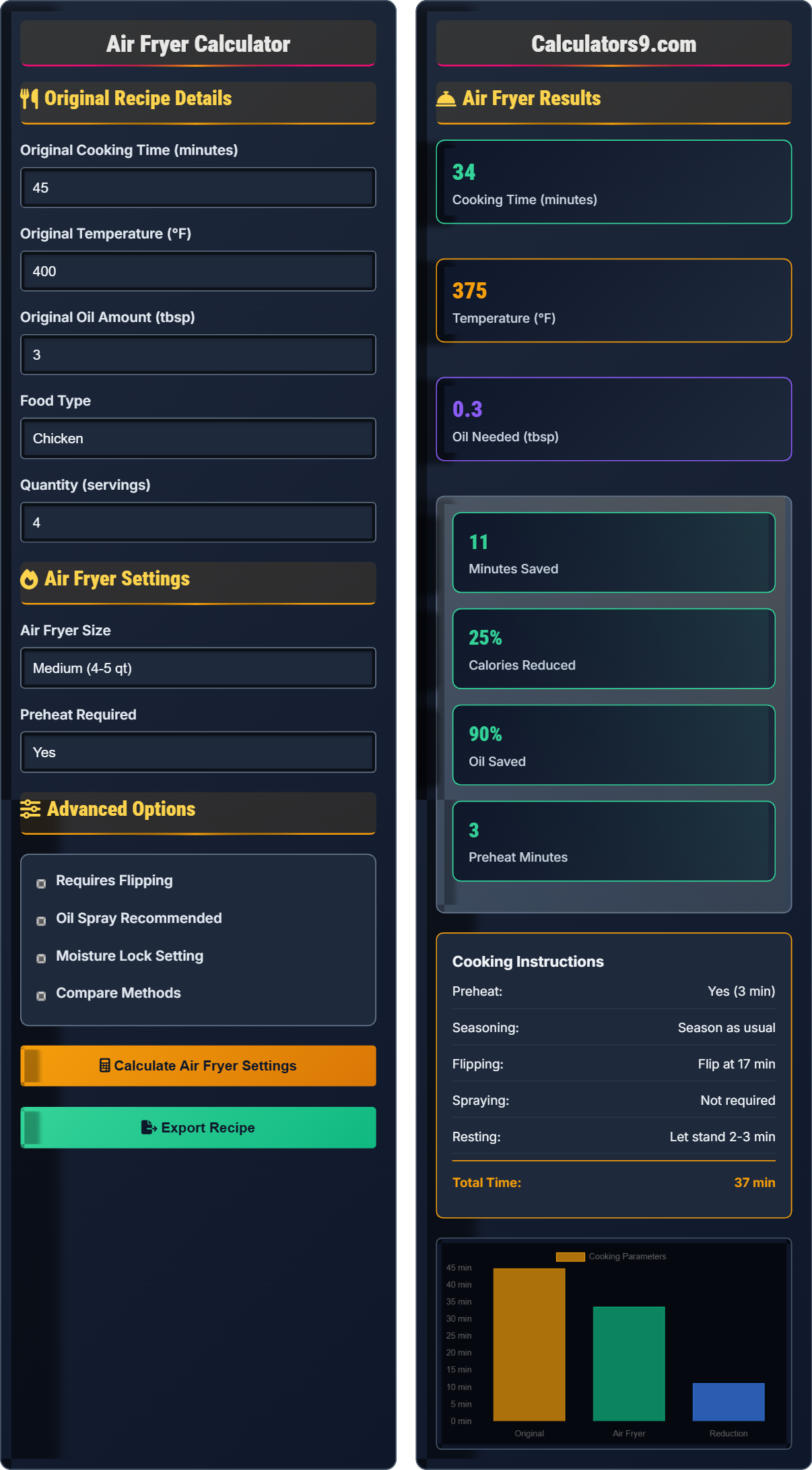
Example: For oven-baked chicken wings at 400°F for 45 minutes:
- Air fryer time: 45 × 0.75 = 34 minutes
- Air fryer temperature: 400 - 25 = 375°F
- Oil reduction: 80% less oil needed
- Calorie reduction: ~25% fewer calories
- Nutrient retention: 90-95% preserved
Original Recipe Details
Air Fryer Settings
Advanced Options
Air Fryer Results
Cooking Instructions
Comprehensive Air Fryer Cooking Guide
Air frying is a healthier alternative to traditional deep frying that uses rapid air circulation to cook food. This method reduces oil usage by up to 80% while maintaining the crispy texture that many people enjoy. Studies show that air frying can reduce calories by 20-30% compared to deep-fried alternatives while preserving nutrients better than conventional frying methods.
Converting recipes to air fryer settings requires adjusting time and temperature:
- Time Reduction: Reduce cooking time by 20-25% (multiply by 0.75)
- Temperature Adjustment: Lower temperature by 25°F
- Oil Reduction: Use 10-20% of original oil amount
- Space Consideration: Cook in batches for even heating
- Preheating: Many foods benefit from preheating (3-5 minutes)
Research indicates significant nutritional advantages of air frying:
- Up to 80% reduction in oil usage
- 20-30% fewer calories compared to deep frying
- Preserves 85-95% of nutrients (better than deep frying)
- Reduces formation of harmful acrylamides
- Maintains protein quality and structure
- Don't overcrowd: Leave space for air circulation
- Shake/baste: Mid-cooking shake for even browning
- Preheat: Especially important for frozen foods
- Pat dry: Remove moisture for better crispiness
- Check early: Cooking times may vary by appliance
Cooking Science
Air fryers use convection heating with circulating hot air to create crispy textures.
Hot air circulates at high velocity around food, creating Maillard reactions for browning.
- Air circulation is crucial for even cooking
- Temperature and time adjustments are necessary
- Less oil is needed than traditional methods
Recipe Optimization
Creating crispy exteriors while maintaining moist interiors requires technique.
- Pat food dry before cooking
- Light oil coating for browning
- Proper spacing for air circulation
- Mid-cooking agitation for even browning
- Adjust time based on food thickness
- Consider batch cooking for quantity
- Monitor closely to prevent burning
- Let food rest after cooking
Air Fryer Cooking Quiz
What is the primary mechanism by which air fryers create crispy textures?
The answer is B) Rapid air circulation and convection heating. Air fryers use a heating element and fan to circulate hot air rapidly around the food, creating a crispy exterior through the Maillard reaction while using minimal oil.
The Maillard reaction occurs when proteins and sugars in food are exposed to heat, creating the browned, flavorful compounds associated with cooked food. Air fryers accelerate this process by using high-velocity hot air circulation, mimicking the effects of deep frying with significantly less oil.
Convection Heating: Heat transfer through the movement of air or liquid
Maillard Reaction: Chemical reaction between amino acids and reducing sugars that creates browning and flavor
Rapid Air Circulation: High-speed movement of heated air around food
• Air circulation is essential for even cooking
• Higher temperatures create more browning
• Less oil is needed than traditional frying
• Ensure adequate spacing for air circulation
• Shake or flip food midway for even browning
• Preheat for best results with frozen foods
• Overcrowding the basket preventing air circulation
• Not adjusting cooking time for air fryer use
• Using too much oil defeating the purpose
If a recipe calls for baking chicken at 425°F for 50 minutes in a conventional oven, what would be the approximate air fryer settings?
Using air fryer conversion formulas:
Time conversion: Air Fryer Time = Original Time × 0.75
Air Fryer Time = 50 × 0.75 = 37.5 minutes ≈ 38 minutes
Temperature conversion: Air Fryer Temp = Original Temp - 25°F
Air Fryer Temp = 425 - 25 = 400°F
Therefore, cook at 400°F for approximately 38 minutes.
These conversion factors (75% of original time, 25°F reduction in temperature) are general guidelines based on the efficient heat transfer of air fryers. The rapid air circulation cooks food faster and more evenly than conventional ovens, requiring less time and slightly lower temperatures.
Time Conversion: Reducing cooking time for air fryer use
Temperature Adjustment: Lowering temperature for air fryer cooking
Heat Transfer Efficiency: How effectively heat reaches food
• Reduce time by approximately 25%
• Lower temperature by 25°F
• Monitor closely as appliances vary
• Start with conversion guidelines then adjust based on results
• Check food earlier than converted time suggests
• Consider food thickness in addition to standard conversions
• Using same time and temperature as original recipe
• Not accounting for air fryer size limitations
• Overcooking due to faster cooking process
Sarah's traditional fried chicken recipe requires 1 cup (16 tablespoons) of oil for deep frying. If she converts to air frying, how much oil will she need, and what percentage of oil will she save? Assume air frying requires 10% of the original oil amount.
Step 1: Calculate air fryer oil requirement
Air Fryer Oil = Original Oil × 0.10
Air Fryer Oil = 16 tbsp × 0.10 = 1.6 tbsp
Step 2: Calculate oil savings
Oil Saved = Original Oil - Air Fryer Oil
Oil Saved = 16 - 1.6 = 14.4 tbsp
Step 3: Calculate percentage saved
Percentage Saved = (Oil Saved / Original Oil) × 100
Percentage Saved = (14.4 / 16) × 100 = 90%
Therefore, Sarah will need 1.6 tablespoons of oil and save 90% of the original oil.
This calculation demonstrates one of the primary benefits of air frying: dramatic reduction in oil usage. The 90% oil reduction translates to significantly fewer calories from fat, making dishes healthier while maintaining desirable textures.
Oil Reduction: Decreasing fat content in cooking
Calorie Density: Calories per unit of food
Healthy Cooking: Methods that preserve nutrition while reducing unhealthy components
• Air frying typically requires 10-20% of original oil
• Some foods may need light oil coating
• Oil reduction contributes to calorie reduction
• Use oil spray for even distribution
• Some frozen foods don't need additional oil
• Light brushing is often sufficient
• Not using any oil when a light coating is needed
• Over-oiling which defeats health benefits
Mike wants to air fry 2 pounds of chicken wings that normally take 40 minutes at 400°F in a conventional oven. His air fryer is medium-sized (4-5 qt). The wings require flipping halfway through cooking. How should he adjust his approach for the air fryer, and what is the total cooking time including preheating?
Step 1: Convert cooking time and temperature
Air Fryer Time = 40 × 0.75 = 30 minutes
Air Fryer Temp = 400 - 25 = 375°F
Step 2: Determine batch cooking needs
2 pounds of wings may not fit in a medium air fryer basket at once, so batch cooking is needed
Step 3: Calculate flip time
Flip at 15 minutes (halfway through cooking)
Step 4: Calculate total time
Preheating: 3 minutes
Cooking first batch: 30 minutes
Cooking second batch: 30 minutes
Total time: 3 + 30 + 30 = 63 minutes
Therefore, Mike should cook in batches at 375°F for 30 minutes each, flipping at 15 minutes, with 3 minutes preheating.
This example highlights the importance of considering air fryer capacity when converting recipes. Unlike ovens, air fryers have limited space that requires batch cooking for larger quantities, increasing total preparation time. The efficient heat transfer still provides benefits even with batch cooking.
Batch Cooking: Cooking food in multiple portions due to space limitations
Capacity Limitations: Physical constraints of cooking appliance size
Efficient Processing: Maximizing output within equipment constraints
• Don't overcrowd air fryer basket
• Cut larger pieces for better air circulation
• Cook similar sized pieces together
• Plan for multiple batches when needed
• Overcrowding the air fryer basket
• Not accounting for batch cooking time
• Expecting same capacity as conventional ovens
Which of the following is the MOST important food safety consideration when using an air fryer?
The answer is B) Reaching proper internal temperature. Food safety depends on achieving the correct internal temperature to kill harmful bacteria, regardless of cooking method. Visual indicators like color aren't reliable for safety, and cooking times can vary based on food size and air fryer model.
Food safety is paramount in all cooking methods. The air fryer's faster cooking time doesn't eliminate the need for proper internal temperatures. Using a food thermometer is essential to verify safety, as visual cues can be misleading in air fryers due to the rapid browning effect.
Internal Temperature: Temperature at center of food, indicating safety
Food Safety: Practices ensuring food is safe to consume
Safe Minimum Temperatures: Temperatures required to kill pathogens
• Always use food thermometer for verification
• Safe temps: poultry 165°F, beef 145°F
• Time is less reliable than temperature
• Insert thermometer into thickest part of food
• Check multiple spots for uneven cooking
• Let meat rest after cooking for temperature equilibrium
• Relying on visual appearance instead of temperature
• Not checking internal temperature of thick foods
• Assuming faster cooking means safer food
FAQ
Q: How much healthier is air frying compared to traditional frying?
A: Air frying significantly reduces calories and fat content:
- Oil Reduction: Up to 80% less oil needed
- Calorie Reduction: Approximately 20-30% fewer calories
- Acrylamide Formation: Reduced by 90% compared to deep frying
- Nutrient Retention: Better preservation of vitamins and minerals
Mathematically: \( \text{Calorie Reduction} = \text{Original Calories} \times 0.25 \) and \( \text{Oil Saved} = \text{Original Oil} \times 0.90 \). Air frying maintains the satisfying texture while dramatically reducing health risks associated with excess oil consumption.
Q: Can I cook frozen foods directly in an air fryer?
A: Yes, air fryers excel at cooking frozen foods. The rapid air circulation thaws and cooks food simultaneously, often producing better results than thawing first. For frozen foods:
- Add 2-3 minutes to cooking time
- Preheat for 3-5 minutes
- No need to defrost beforehand
- May need light oil spray for browning
Many frozen foods are specifically designed for air fryer cooking, with optimized packaging instructions.