Cycling Calorie Calculator
Bike Ride Calorie Burn Tracker • 2026 Standards
Cycling Calorie Burn Formulas:
Show the calculatorBasic Calorie Calculation: \( \text{Calories} = \text{MET} \times \text{Weight (kg)} \times \text{Time (hours)} \)
Standard Cycling MET Values:
- Leisurely cycling (<10 mph): 4.0 METs
- Moderate cycling (10-12 mph): 6.0 METs
- Brisk cycling (12-14 mph): 7.5 METs
- Fast cycling (14-16 mph): 9.0 METs
- Very fast cycling (>16 mph): 12.0 METs
Heart Rate Adjusted: \( \text{Adjusted Calories} = \text{Base Calories} \times (1 + \frac{\text{Heart Rate} - \text{Resting HR}}{\text{Max HR} - \text{Resting HR}} \times 0.2) \)
These formulas help calculate energy expenditure during cycling based on intensity, duration, body weight, and physiological factors. MET (Metabolic Equivalent of Task) values represent the energy cost of physical activities.
Example: For a 70kg person cycling at moderate pace (6.0 METs) for 1 hour:
- Base calories = 6.0 × 70 × 1 = 420 calories
- With heart rate adjustment (if above resting): ~450-500 calories
- This equals approximately 7-8 calories per minute of cycling
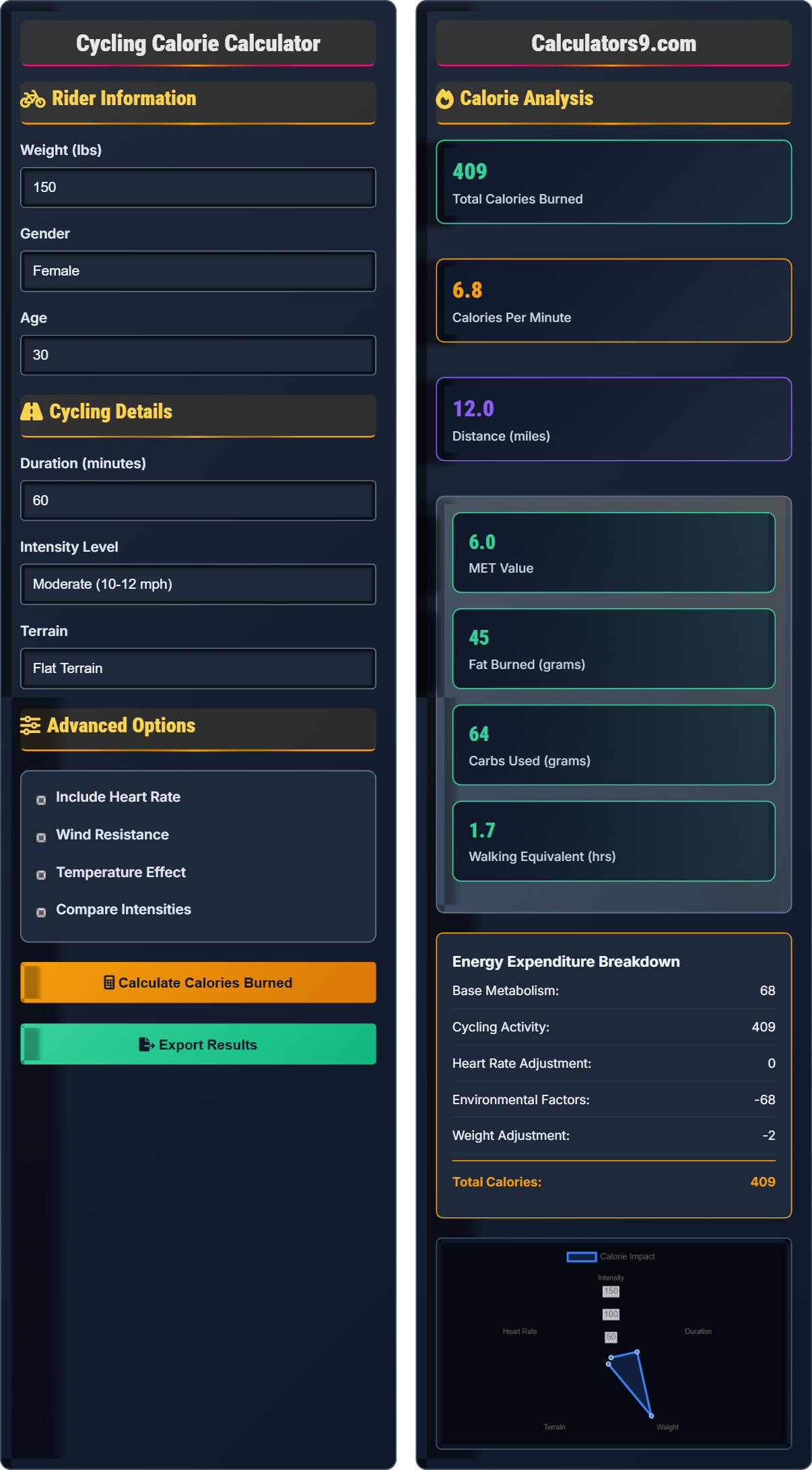
Rider Information
Cycling Details
Advanced Options
Calorie Analysis
Energy Expenditure Breakdown
Comprehensive Cycling Calorie Burn Guide
Cycling is an excellent cardiovascular exercise that burns significant calories while being low-impact. The number of calories burned during cycling depends on several factors including body weight, intensity, duration, and environmental conditions. On average, cycling burns 400-1000 calories per hour depending on intensity and individual factors.
Multiple variables influence cycling calorie expenditure:
- Body Weight: Heavier individuals burn more calories
- Intensity Level: Higher intensity = more calories
- Duration: Longer rides burn more total calories
- Heart Rate: Higher HR increases metabolic rate
- Terrain: Hills and resistance increase effort
Based on research studies and fitness tracking data:
- 150lb person burns ~420 calories/hour at moderate pace
- 200lb person burns ~560 calories/hour at moderate pace
- Cycling burns 3-4 times more calories than walking
- Interval training can boost post-exercise calorie burn
- Cycling efficiency improves with training, burning fewer calories at same pace
- Interval Training: Alternate high and low intensities
- Hill Climbing: Increase resistance naturally
- Longer Duration: Consistent aerobic activity
- Proper Hydration: Maintain metabolic efficiency
- Resistance Training: Build muscle for higher RMR
Exercise Physiology
Metabolic Equivalent of Task measures energy expenditure relative to resting metabolism.
1 MET = 3.5 ml O₂/kg/min = ~1 kcal/kg/hour
Calories = MET × Weight(kg) × Time(hours)
- Resting metabolism = 1 MET
- Higher METs = higher calorie burn
- Individual variation exists in MET values
Performance Optimization
Target heart rate zones optimize training effectiveness and calorie burn.
- Max HR = 220 - Age
- Zone 1 (50-60%): Recovery zone
- Zone 2 (60-70%): Endurance zone
- Zone 3 (70-80%): Tempo zone
- Zone 4 (80-90%): Threshold zone
- Zone 5 (90-100%): Anaerobic zone
- Higher heart rates burn more calories
- Zone 2-3 optimal for fat burning
- Zone 4-5 for maximum calorie burn
- Recovery is important for adaptation
Cycling Calorie Burn Quiz
What does 1 MET represent in terms of energy expenditure?
The answer is B) Resting metabolic rate. 1 MET represents the energy expenditure while sitting quietly at rest, which is approximately 3.5 ml of oxygen per kilogram of body weight per minute, or about 1 kcal/kg/hour.
MET (Metabolic Equivalent of Task) is a standardized unit that measures the energy cost of physical activities. It provides a universal scale to compare different exercises. Activities are classified by their MET value relative to resting metabolism, making it easier to prescribe exercise intensity and calculate energy expenditure.
MET: Metabolic Equivalent of Task - energy expenditure relative to rest
Resting Metabolism: Energy used while at complete rest
Energy Expenditure: Calories burned during activity
• 1 MET = resting metabolic rate
• Higher METs = higher energy expenditure
• MET values are standardized across populations
• Use MET values to compare different exercises
• Multiply MET by body weight and time to calculate calories
• Moderate exercise is typically 3-6 METs
• Confusing MET with heart rate measurements
• Thinking MET values are absolute rather than relative to rest
• Not considering individual variation in MET values
Calculate the calories burned by a 70kg person cycling at moderate intensity (6.0 METs) for 45 minutes.
Using the calorie formula: Calories = MET × Weight(kg) × Time(hours)
Given:
- Weight: 70 kg
- MET Value: 6.0
- Time: 45 minutes = 0.75 hours
Step 1: Calories = 6.0 × 70 × 0.75
Step 2: Calories = 315
Therefore, the person burns 315 calories during the 45-minute moderate cycling session.
This calculation demonstrates the direct relationship between body weight, exercise intensity (METs), and duration in determining energy expenditure. The formula is straightforward but requires consistent units of measurement. Converting time to hours is essential for accurate calculations.
Energy Expenditure: The amount of calories burned during physical activity
Body Weight Factor: Heavier individuals burn more calories for the same activity
Intensity Factor: Higher intensity activities burn more calories per minute
• Convert time to hours for the formula
• Weight must be in kilograms
• The relationship is multiplicative
• Remember: 1 hour = 60 minutes
• Convert pounds to kg by dividing by 2.2
• For quick estimates: 1 MET × kg × hours
• Forgetting to convert minutes to hours
• Using pounds instead of kilograms for weight
• Not accounting for the multiplicative nature of the formula
Sarah weighs 130 lbs and cycles for 1 hour. During the first 30 minutes, she cycles at a moderate pace (6.0 METs). For the second 30 minutes, she increases to a brisk pace (7.5 METs). How many total calories does she burn?
First, convert weight to kg: 130 lbs ÷ 2.2 = 59 kg
For the first 30 minutes (0.5 hours) at 6.0 METs:
Calories₁ = 6.0 × 59 × 0.5 = 177 calories
For the second 30 minutes (0.5 hours) at 7.5 METs:
Calories₂ = 7.5 × 59 × 0.5 = 221.25 calories
Total calories = 177 + 221.25 = 398.25 ≈ 398 calories
Therefore, Sarah burns approximately 398 calories during her 1-hour cycling session.
This example demonstrates how to calculate calories for variable intensity workouts. The total calories are the sum of calories burned during each segment. This approach can be applied to interval training or any workout with changing intensities.
Variable Intensity: Exercise with changing effort levels
Segmented Calculation: Calculating calories for each workout segment separately
Total Energy Expenditure: Sum of calories burned across all workout segments
• Calculate each segment separately
• Sum all segment calories for total
• Ensure consistent units across segments
• Break complex workouts into time segments
• Apply the formula to each segment independently
• Sum segment results for total calories
• Not calculating each segment separately
• Forgetting to convert weight to kilograms
Mike wants to burn 600 calories in a 60-minute cycling session. He can choose between three intensity levels: moderate (6.0 METs), brisk (7.5 METs), or fast (9.0 METs). Which intensity level should he choose, and how many calories will he burn at each level if he weighs 170 lbs?
First, convert weight to kg: 170 lbs ÷ 2.2 = 77 kg
Time = 60 minutes = 1 hour
At moderate intensity (6.0 METs):
Calories = 6.0 × 77 × 1 = 462 calories
At brisk intensity (7.5 METs):
Calories = 7.5 × 77 × 1 = 577.5 calories
At fast intensity (9.0 METs):
Calories = 9.0 × 77 × 1 = 693 calories
To burn 600 calories, Mike should choose the fast intensity level, which will burn 693 calories, exceeding his goal.
This example shows how to use the calorie formula to plan workouts for specific goals. By calculating calories for different intensities, individuals can select the appropriate effort level to meet their targets. The relationship between METs and calories burned is directly proportional.
Workout Planning: Using calculations to achieve specific fitness goals
Intensity Selection: Choosing appropriate effort level for desired outcomes
Goal-Oriented Exercise: Structuring workouts to meet specific targets
• Higher METs = more calories burned in same time
• Adjust intensity to meet calorie goals
• Consider fitness level when selecting intensity
• Calculate calories for your target intensity
• Adjust time or intensity to hit calorie goals
• Consider your fitness level when selecting intensity
• Selecting an intensity that's too high for fitness level
• Not accounting for individual fitness differences
• Ignoring the sustainability of chosen intensity
Which of the following has the LEAST impact on calories burned during cycling?
The answer is C) Color of the bicycle. The color of the bicycle has no impact on the physiological processes that determine calorie burn during cycling. The main factors affecting calorie expenditure are body weight, exercise intensity, duration, and environmental conditions.
This question tests understanding of which factors actually influence energy expenditure. Physiological factors like body weight, exercise intensity, and duration directly affect metabolism and energy consumption. External factors like equipment appearance do not affect the underlying metabolic processes.
Physiological Factors: Internal body characteristics affecting energy expenditure
External Factors: Environmental conditions affecting exercise
Non-Factors: Characteristics that don't affect energy expenditure
• Focus on physiological and environmental factors
• Equipment aesthetics don't affect calorie burn
• Only measurable physical factors matter
• Focus on modifiable factors like intensity and duration
• Don't be misled by marketing claims about equipment
• Understand the science behind calorie burn
• Believing that equipment appearance affects performance
• Overlooking the importance of intensity
• Focusing on irrelevant external factors
FAQ
Q: How accurate are calorie counters on exercise bikes and fitness trackers?
A: Calorie counters on exercise equipment and fitness trackers have an accuracy range of ±10-15% for most users, but can vary up to 40% for some individuals. The calculations are based on population averages and may not account for individual metabolic differences.
The basic formula used is: \( \text{Calories} = \text{MET} \times \text{Weight(kg)} \times \text{Time(hours)} \)
Accuracy depends on correct input of weight, age, and gender. More sophisticated devices that monitor heart rate can provide better estimates by adjusting for individual effort levels.
Q: Does cycling burn more calories than running at the same perceived effort?
A: Running typically burns more calories than cycling at the same perceived effort. This is because running is weight-bearing and engages more muscle groups simultaneously. For example:
- Moderate running (6 mph): ~600 calories/hour for 150-lb person
- Moderate cycling (12 mph): ~420 calories/hour for 150-lb person
However, cycling allows for potentially longer duration exercise due to its lower impact nature, which can result in comparable total daily calorie burn.