Alcohol Unit Calculator
Standard Drink Tracker • 2026 Guidelines
Alcohol Unit Calculation Formulas:
Show the calculatorAlcohol Units: \( \text{Units} = \frac{\text{Volume (ml)} \times \text{ABV (\%)}}{1000} \)
Standard Drink: 1 unit = 10ml pure alcohol = 8g ethanol
Blood Alcohol Content (BAC): \( \text{BAC} = \frac{\text{Alcohol Consumed (g)}}{\text{Body Water (kg)} \times \text{Distribution Ratio}} - (\text{Elimination Rate} \times \text{Time}) \)
Body Water Calculation: \( \text{Body Water (kg)} = \text{Weight (kg)} \times \begin{cases} 0.68 & \text{Men} \\ 0.55 & \text{Women} \end{cases} \)
Alcohol Elimination Rate: 0.015% per hour (average)
These formulas help calculate alcohol consumption in standard units and estimate blood alcohol concentration. One unit equals 10ml or 8g of pure alcohol. Standard drinks vary by country: US (14g), UK (8g), Australia (10g). The Widmark formula estimates BAC considering body composition and time.
Example: For 250ml of wine at 12% ABV:
- Units = (250 × 12) ÷ 1000 = 3 units
- For 70kg man: Body water = 70 × 0.68 = 47.6kg
- BAC after 2 hours ≈ (24g ÷ (47.6kg × 0.7)) - (0.015 × 2) ≈ 0.055%
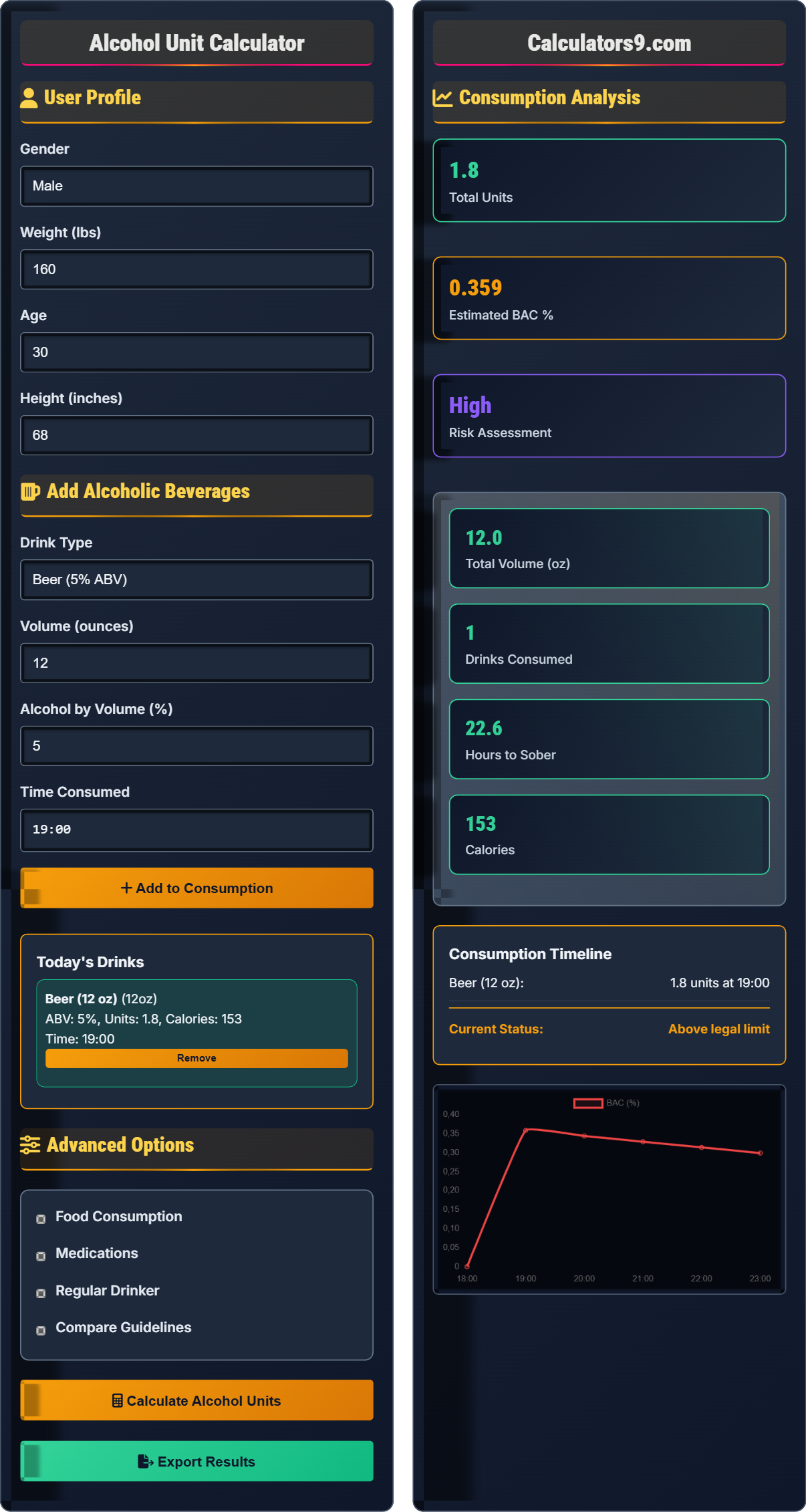
User Profile
Add Alcoholic Beverages
Today's Drinks
Advanced Options
Consumption Analysis
Consumption Timeline
Comprehensive Alcohol Unit Guide
An alcohol unit represents a standard measure of pure alcohol. In the UK, one unit equals 10ml (8g) of pure alcohol. Standard drinks vary by country: US (14g), UK (8g), Australia (10g). Understanding units helps track consumption against recommended guidelines and estimate effects.
Common beverages and their unit content:
- Beer (5% ABV, 12 oz): 1.5 units
- Wine (12% ABV, 5 oz): 1.5 units
- Spirits (40% ABV, 1.5 oz): 1 unit
- Strong Beer (7% ABV, 12 oz): 2.1 units
- Champagne (12% ABV, 5 oz): 1.5 units
- Cocktail (varies): 1-3 units
Effects at different BAC levels:
- 0.02%: Mild euphoria, relaxation
- 0.05%: Reduced inhibition, impaired judgment
- 0.08%: Legally intoxicated in most states
- 0.10%: Significant impairment, slurred speech
- 0.15%: Severe impairment, nausea
- 0.30%+: Life-threatening, potential coma
- Know Your Limits: Track consumption in standard units
- Hydrate: Alternate alcoholic drinks with water
- Eat Before Drinking: Food slows absorption
- Space Drinks: Allow 1 hour between drinks
- Never Drive: Wait 1 hour per standard drink
Alcohol Pharmacology
Alcohol is absorbed through the stomach and small intestine, affecting the brain within minutes.
The liver metabolizes alcohol at a rate of approximately 0.015% BAC per hour.
- Elimination rate is constant
- No way to speed up metabolism
- Effects depend on BAC, not volume
Safety Guidelines
Driving limits vary by jurisdiction and individual factors.
- Legal driving: 0.08% BAC (most states)
- Impaired effects: 0.05% BAC
- Recommended weekly: 14 units or less
- Maximum daily: 3-4 units occasionally
- Individual factors affect tolerance
- Medications can interact dangerously
- Food delays but doesn't prevent absorption
- Time is the only way to sober up
Alcohol Unit Knowledge Quiz
How many units of alcohol are in a 250ml glass of wine with 12% ABV?
The answer is B) 3.0 units. Using the formula: Units = (Volume × ABV) ÷ 1000 = (250 × 12) ÷ 1000 = 3000 ÷ 1000 = 3.0 units. This is a standard serving that represents 30ml of pure alcohol.
The unit calculation formula is simple: multiply volume in milliliters by alcohol percentage, then divide by 1000. This gives you the number of standard units. One unit equals 10ml (8g) of pure alcohol in the UK system, which is commonly used for measuring consumption against guidelines.
Alcohol Unit: Standard measure of pure alcohol content
ABV: Alcohol by Volume percentage
Pure Alcohol: Ethanol content without dilution
• Units = (Volume × ABV) ÷ 1000
• 1 unit = 10ml pure alcohol
• 1 unit = 8g ethanol
• Remember: Units = (ml × %) ÷ 1000
• Check bottle labels for ABV
• Convert ounces to ml if needed (1 oz = 29.57 ml)
• Forgetting to divide by 1000 in the formula
• Confusing ABV with proof values
• Not converting units consistently
Calculate the estimated BAC for a 170lb male who has consumed 4 standard units of alcohol over 2 hours. (Use Widmark formula: BAC = [Alcohol(g) ÷ (Body Water(kg) × r)] - (0.015 × hours))
Step 1: Convert weight to kg
170 lbs ÷ 2.2 = 77.3 kg
Step 2: Calculate body water
For males: 77.3 kg × 0.68 = 52.6 kg
Step 3: Convert units to grams of alcohol
4 units × 8g/unit = 32g
Step 4: Apply Widmark formula
BAC = (32 ÷ (52.6 × 0.7)) - (0.015 × 2)
BAC = (32 ÷ 36.8) - 0.03 = 0.87 - 0.03 = 0.057%
Estimated BAC is approximately 0.057%.
The Widmark formula estimates BAC by considering body composition, alcohol consumed, and time elapsed. The distribution ratio (r) accounts for gender differences in body water content. This formula provides an estimate, as actual BAC varies based on individual factors.
Widmark Formula: Mathematical model for BAC estimation
Body Water: Percentage of body mass that is water
Distribution Ratio: Factor accounting for body composition
• Distribution ratio: 0.68 for men, 0.55 for women
• Elimination rate: 0.015%/hour
• 1 unit = 8g of pure alcohol
• Remember distribution ratios for each gender
• Convert units to grams (×8)
• Always subtract elimination component
• Forgetting to subtract elimination component
• Not converting units properly
Sarah follows UK guidelines of 14 units per week. She drinks 3 glasses of wine (175ml each at 12% ABV) on Friday night. How many units does this represent, and how many units can she safely consume for the rest of the week?
Step 1: Calculate units per glass of wine
Units per glass = (175 × 12) ÷ 1000 = 2100 ÷ 1000 = 2.1 units
Step 2: Calculate total units for 3 glasses
Total units = 3 × 2.1 = 6.3 units
Step 3: Calculate remaining weekly allowance
Remaining units = 14 - 6.3 = 7.7 units
Sarah consumed 6.3 units on Friday and can safely consume 7.7 units for the rest of the week.
This example demonstrates how to calculate consumption against weekly limits. It's important to track units throughout the week to stay within guidelines. The UK recommends 14 units per week for both men and women, with no more than 3 units in a single day.
Weekly Limits: Recommended maximum consumption per week
Daily Limits: Maximum recommended consumption per day
Guideline Compliance: Staying within recommended limits
• UK weekly limit: 14 units
• Daily limit: No more than 3 units
• At least 2 alcohol-free days per week
• Track consumption daily
• Plan ahead to stay within limits
• Allow for 2 alcohol-free days
• Forgetting to subtract consumed units from allowance
• Not considering daily limits within weekly totals
John has a BAC of 0.08% and needs to drive home. If alcohol is eliminated at a rate of 0.015% per hour, how long must he wait before his BAC drops below the legal limit of 0.05%?
Step 1: Calculate the difference needed
Required reduction = 0.08% - 0.05% = 0.03%
Step 2: Calculate time needed
Time = Difference ÷ Elimination rate
Time = 0.03 ÷ 0.015 = 2 hours
John must wait 2 hours before his BAC drops to the legal limit.
This calculation shows that BAC decreases at a constant rate of approximately 0.015% per hour, regardless of how much alcohol was consumed. There's no way to speed up this process - time is the only factor that reduces BAC. Coffee, cold showers, or exercise won't accelerate sobering.
Sobering Time: Duration needed for BAC to drop to safe levels
Elimination Rate: Rate at which the body processes alcohol
Legal Limit: Maximum BAC allowed for driving
• Elimination rate is constant (~0.015%/hour)
• Plan for 1 hour per standard drink to sober
• Never rely on coffee or cold showers
• Arrange alternate transportation if needed
• Not accounting for the constant elimination rate
• Underestimating time needed to sober
Why do women typically reach higher BAC levels than men when consuming the same amount of alcohol?
The answer is A) Women have less body water and different enzymes. Women typically have a higher percentage of body fat and lower percentage of body water than men, resulting in higher concentrations of alcohol in the bloodstream. Additionally, women have lower levels of alcohol dehydrogenase, the enzyme that breaks down alcohol in the stomach.
Physiological differences between men and women significantly affect alcohol metabolism. The Widmark distribution ratio reflects these differences: 0.68 for men and 0.55 for women. This is why standard drink recommendations often differ by gender in many countries' guidelines.
Body Composition: Ratio of fat to water in the body
Alcohol Dehydrogenase: Enzyme that breaks down alcohol
Distribution Ratio: Factor accounting for body water content
• Women: Lower body water percentage
• Women: Lower alcohol dehydrogenase levels
• Results in higher BAC for same consumption
• Women should be more conservative with alcohol
• Same consumption affects women more
• Consider gender in BAC calculations
• Not considering physiological differences
• Using same guidelines for all genders
FAQ
Q: How long does it take to eliminate alcohol from the body?
A: The body eliminates alcohol at a relatively constant rate of approximately 0.015% BAC per hour. This means that if your BAC is 0.08%, it will take about 5-6 hours to reach zero. The elimination formula is: \( \text{Time} = \frac{\text{Current BAC}}{0.015} \). This rate cannot be accelerated by coffee, cold showers, or exercise - time is the only factor that reduces BAC.
Q: Why do women get drunk faster than men?
A: Women typically reach higher BAC levels due to physiological differences:
- Lower body water: Women have about 55% body water vs 68% in men
- Lower enzyme activity: Less alcohol dehydrogenase in the stomach
- Higher body fat: Fat tissue absorbs little alcohol
The Widmark formula accounts for this: \( \text{BAC} = \frac{\text{Alcohol(g)}}{\text{Body Weight(kg)} \times \text{Distribution Ratio}} \), where the distribution ratio is 0.55 for women vs 0.68 for men.