Caffeine Intake Tracker
Daily Coffee Consumption Calculator • 2026 Safety
Caffeine Intake Formulas:
Show the calculatorDaily Caffeine Intake: \( \text{Total Caffeine} = \sum(\text{Caffeine Content of Each Item}) \)
Caffeine Content: \( \text{Caffeine (mg)} = \text{Serving Size} \times \text{Caffeine Concentration} \)
Safe Limit: \( \text{Safe Daily Limit} = \begin{cases} 400\text{mg} & \text{Adults} \\ 200\text{mg} & \text{Pregnant} \\ 100\text{mg} & \text{Sensitive Individuals} \end{cases} \)
Half-Life Calculation: \( \text{Caffeine Remaining} = \text{Initial Amount} \times \left(\frac{1}{2}\right)^{\frac{\text{Time Elapsed}}{\text{Half-Life}}} \)
Time Until Sleep Safe: \( \text{Hours} = \text{Half-Life} \times \log_2\left(\frac{\text{Current Caffeine}}{\text{Safe Evening Level}}\right) \)
These formulas help track caffeine consumption and ensure safe limits are maintained. The half-life of caffeine is approximately 5 hours, meaning it takes about 5 hours for half of the consumed caffeine to be eliminated from the body.
Example: For 2 cups of coffee (95mg each) consumed at 8 AM:
- Total caffeine: 2 × 95mg = 190mg
- Safe limit: 400mg (adult)
- Remaining at 1 PM: 190 × (1/2)^(5/5) = 95mg
- Safe for sleep: 8 AM + (5 × 2) = 6 PM (allowing 2 half-lives)
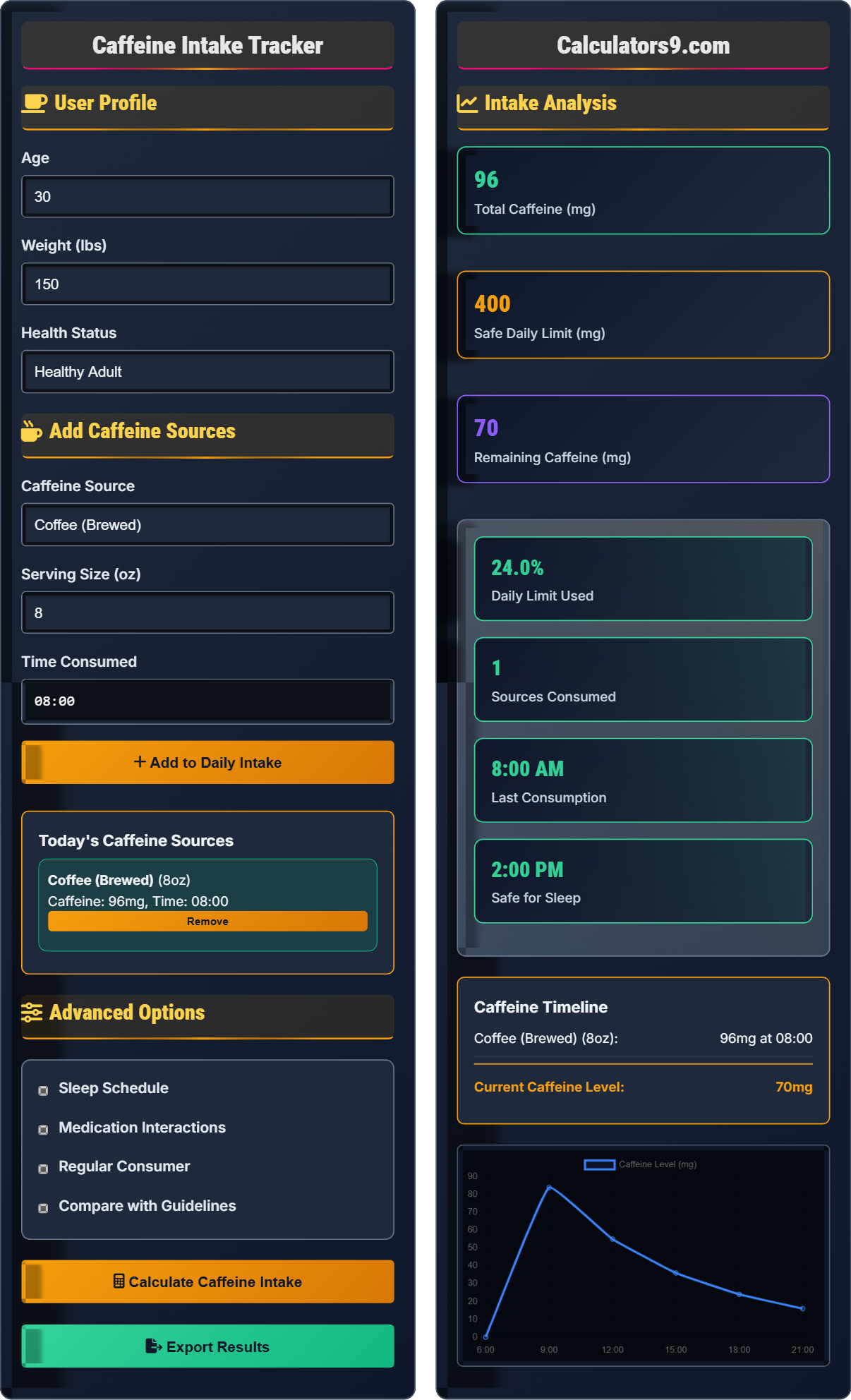
User Profile
Add Caffeine Sources
Today's Caffeine Sources
Advanced Options
Intake Analysis
Caffeine Timeline
Comprehensive Caffeine Intake Guide
Caffeine is a central nervous system stimulant found in coffee, tea, chocolate, and many other products. The FDA recommends a daily limit of 400mg for healthy adults, which is equivalent to about 4-5 cups of coffee. However, individual tolerance varies significantly based on genetics, body weight, and consumption habits.
Common caffeine sources and their typical content:
- Espresso (1 shot): 63mg
- Coffee (8 oz): 95mg
- Energy Drink (8 oz): 80mg
- Black Tea (8 oz): 47mg
- Green Tea (8 oz): 28mg
- Cola (12 oz): 34mg
- Dark Chocolate (1 oz): 12mg
- Milk Chocolate (1 oz): 9mg
Caffeine has a half-life of approximately 5 hours, meaning it takes about 5 hours for half of the consumed caffeine to be eliminated from the body. Effects peak 15-45 minutes after consumption and can last 4-6 hours. For optimal sleep, avoid caffeine 6-8 hours before bedtime.
- Spread Consumption: Distribute intake throughout the day
- Know Your Sources: Read labels carefully
- Listen to Your Body: Adjust based on sensitivity
- Time Appropriately: Stop 6-8 hours before sleep
- Stay Hydrated: Balance with water intake
Caffeine Pharmacology
Caffeine's half-life determines how long effects persist in the body.
Caffeine is absorbed in the small intestine and distributed throughout the body.
- Half-life averages 5 hours
- Effects last 4-6 hours
- Complete elimination takes 10-15 hours
Safety Guidelines
Excessive intake can lead to serious health consequences.
- Daily limit: 400mg for adults
- Single dose: 200mg maximum
- Weekly limit: 2,800mg
- Gradual reduction for dependency
- Individual tolerance varies
- Medications can affect metabolism
- Pregnancy requires lower limits
- Genetics influence sensitivity
Caffeine Intake Knowledge Quiz
What is the recommended daily caffeine limit for healthy adults according to FDA guidelines?
The answer is B) 400mg. The FDA recommends a daily caffeine limit of 400mg for healthy adults, which is equivalent to about 4-5 cups of coffee. This amount is generally considered safe for most people without causing adverse effects.
The 400mg daily limit is based on extensive research showing that this amount is safe for most healthy adults. It represents the threshold above which negative side effects like anxiety, insomnia, and heart palpitations become more likely. Individual tolerance may vary based on genetics, body weight, and consumption habits.
Daily Limit: Maximum safe amount of caffeine per day
Safe Consumption: Amount that doesn't cause adverse effects
Individual Tolerance: Person-specific sensitivity to caffeine
• FDA recommends 400mg daily for adults
• Equivalent to 4-5 cups of coffee
• Individual factors may require lower limits
• Track your intake using apps or journals
• Read labels on drinks and medications
• Spread consumption throughout the day
• Not accounting for caffeine in medications
• Underestimating caffeine content in energy drinks
• Ignoring individual sensitivity factors
If someone consumes 200mg of caffeine at 8:00 AM, how much caffeine will remain in their system at 1:00 PM? (Assume a 5-hour half-life)
Using the half-life formula: \( \text{Remaining} = \text{Initial} \times \left(\frac{1}{2}\right)^{\frac{\text{Time Elapsed}}{\text{Half-Life}}} \)
Time elapsed: 5 hours (8:00 AM to 1:00 PM)
Half-life: 5 hours
Calculations:
Remaining = 200 × (1/2)^(5/5) = 200 × (1/2)^1 = 200 × 0.5 = 100mg
Therefore, 100mg of caffeine will remain in the system at 1:00 PM.
The half-life concept is crucial for understanding caffeine's persistence in the body. After one half-life period, half of the caffeine remains. After two half-lives, only a quarter remains, and so on. This exponential decay explains why caffeine consumed in the afternoon can still affect sleep later.
Half-Life: Time for half of a substance to be eliminated
Exponential Decay: Decrease following a geometric progression
Elimination Rate: How quickly caffeine leaves the body
• Caffeine half-life is ~5 hours
• Effects last 4-6 hours
• Complete elimination takes 10-15 hours
• Allow 2 half-lives before sleep (10 hours)
• 50mg is the minimum noticeable effect
• Calculate backwards from bedtime
• Not accounting for half-life in sleep planning
• Assuming all caffeine is eliminated after 4-6 hours
Sarah is pregnant and needs to keep her daily caffeine intake under 200mg. She drinks 2 cups of coffee (95mg each) in the morning and takes a medication containing 30mg of caffeine. She wants to have an energy drink in the afternoon. If the energy drink contains 80mg of caffeine, will she exceed the safe limit for pregnant women?
Step 1: Calculate coffee caffeine
2 cups × 95mg = 190mg
Step 2: Add medication caffeine
190mg + 30mg = 220mg
Step 3: Add energy drink caffeine
220mg + 80mg = 300mg
Step 4: Compare to safe limit
300mg > 200mg safe limit for pregnancy
Yes, Sarah would exceed the safe limit by 100mg if she drinks the energy drink.
This example highlights the importance of tracking all caffeine sources, including medications. Pregnant women have stricter limits (200mg) compared to healthy adults (400mg). Even seemingly small amounts from medications can significantly impact total intake.
Therapeutic Limit: Safe maximum for specific populations
Hidden Sources: Caffeine in medications and supplements
Population-Specific Limits: Different guidelines for demographics
• Pregnancy limit: 200mg daily
• Check medication ingredients for caffeine
• Plan ahead to stay within limits
• Choose decaf options when possible
• Not accounting for all daily sources
• Not adjusting limits for special populations
John drinks coffee at 6:00 PM and has trouble sleeping until midnight. He typically goes to bed at 10:00 PM. If caffeine has a 5-hour half-life and sleep issues occur with more than 50mg in his system, how much caffeine was in his evening coffee?
Time from coffee to bedtime: 4 hours (6:00 PM to 10:00 PM)
Half-life: 5 hours
Using the formula: \( \text{Remaining} = \text{Initial} \times \left(\frac{1}{2}\right)^{\frac{\text{Time}}{\text{Half-Life}}} \)
We know: Remaining = 50mg (threshold for sleep issues)
50 = Initial × (1/2)^(4/5)
50 = Initial × (1/2)^0.8
50 = Initial × 0.546
Initial = 50 ÷ 0.546 = 91.6mg
John's evening coffee contained approximately 92mg of caffeine.
This problem demonstrates how to work backward from observed effects to determine intake. The timing between consumption and sleep is crucial for avoiding sleep disruption. Even moderate amounts of caffeine consumed too close to bedtime can interfere with sleep quality.
Threshold Effect: Minimum amount causing symptoms
Timing Optimization: Scheduling intake to avoid adverse effects
Sleep Disruption: Caffeine's interference with sleep patterns
• Stop caffeine 6-8 hours before sleep
• Sleep threshold: ~50mg remaining
• Half-life affects timing recommendations
• Calculate backwards from bedtime
• Allow 2 half-lives before sleep (10 hours)
• Adjust based on individual sensitivity
• Assuming caffeine effects disappear quickly
• Not accounting for individual sensitivity
Which of the following factors does NOT significantly affect caffeine metabolism and tolerance?
The answer is C) Eye color and vision acuity. These characteristics do not affect caffeine metabolism or tolerance. Genetic variations in the CYP1A2 enzyme, body weight, and consumption patterns all significantly influence how caffeine affects individuals.
Caffeine metabolism varies significantly between individuals due to genetic, physiological, and behavioral factors. The CYP1A2 enzyme primarily metabolizes caffeine in the liver, and genetic variations determine whether someone is a "fast" or "slow" metabolizer. Body weight affects concentration, and regular consumption leads to tolerance development.
CYP1A2 Enzyme: Primary enzyme metabolizing caffeine
Individual Variability: Differences in caffeine response
Tolerance Development: Reduced sensitivity with regular use
• Genetics significantly affect metabolism
• Body weight influences concentration
• Regular use develops tolerance
• Adjust intake based on individual response
• Consider genetic testing for metabolism
• Take breaks to reset tolerance
• Not considering genetic factors in recommendations
• Ignoring tolerance development over time
FAQ
Q: Is decaf coffee completely free of caffeine?
A: No, decaf coffee is not completely caffeine-free. According to FDA regulations, decaf coffee must have at least 97% of caffeine removed, leaving approximately 2-5mg per 8oz cup. For pregnant women needing to limit caffeine to 200mg daily, decaf is generally safe but should still be counted in total intake. The formula for calculating remaining caffeine is: \( \text{Decaf Caffeine} = \text{Regular Caffeine} \times 0.03 \).
Q: How late is too late for caffeine consumption?
A: As a general rule, avoid caffeine at least 6-8 hours before bedtime. Since caffeine has a 5-hour half-life, consuming it too close to sleep can leave significant amounts in your system. For example, if you go to bed at 10 PM, avoid caffeine after 2-4 PM. The formula to calculate safe cutoff time is: \( \text{Safe Cutoff} = \text{Bedtime} - (\text{Half-Life} \times 2) \). This ensures adequate clearance for quality sleep.