Heart Rate Calculator
Cardio health • Fitness tracking • 2026 edition
Heart Rate Formulas:
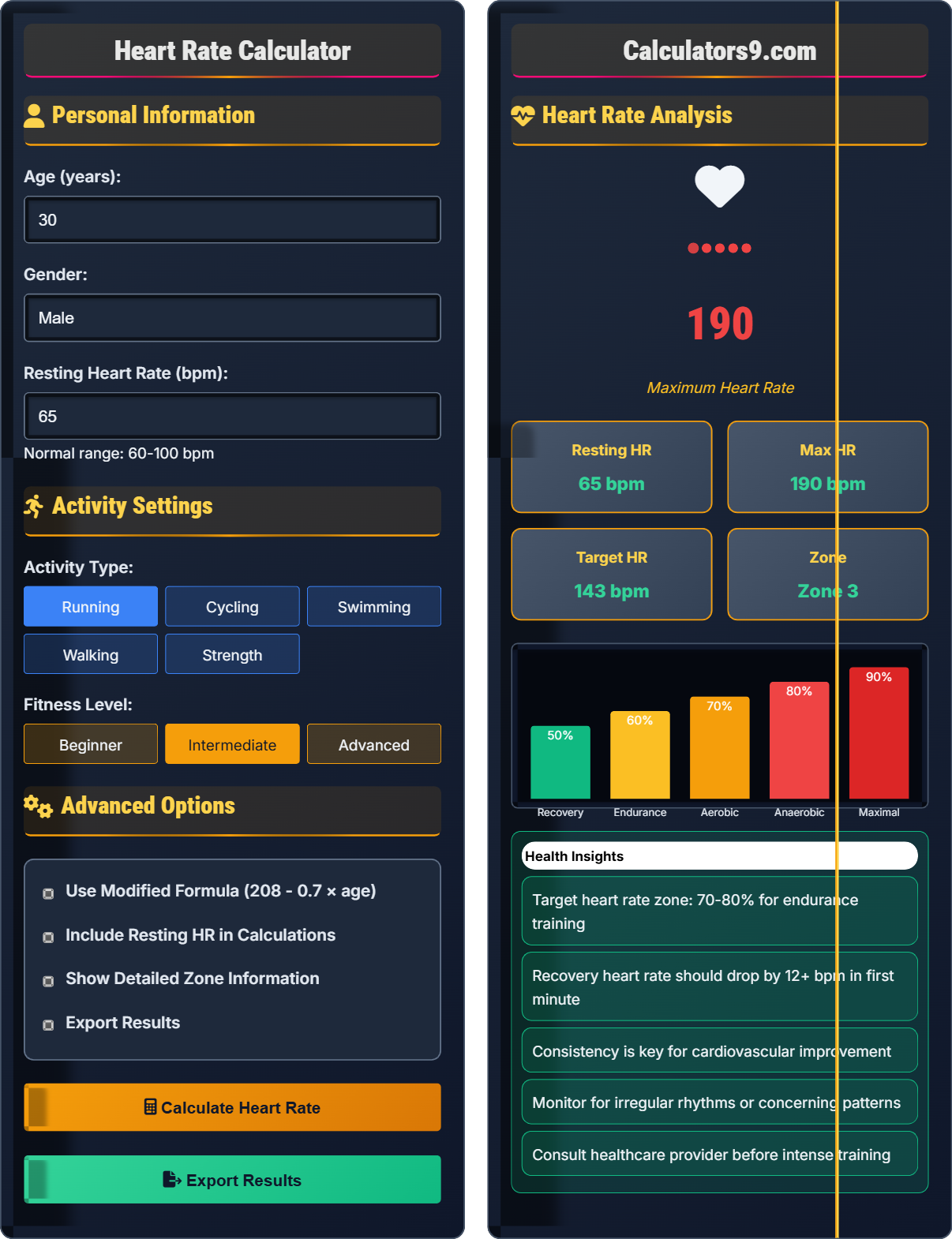
Show the calculatorMax Heart Rate: \(220 - Age\)
Target Zones:
• Zone 1 (50-60%): Recovery
• Zone 2 (60-70%): Endurance
• Zone 3 (70-80%): Aerobic
• Zone 4 (80-90%): Anaerobic
• Zone 5 (90-100%): Maximal
Where:
- Age: Chronological age in years
- Resting HR: Heart rate at rest (60-100 bpm)
- Target Zones: Percentages of max heart rate
- Activity Level: Influences zone recommendations
These formulas help determine safe and effective exercise intensities.
Personal Information
Activity Settings
Advanced Options
Heart Rate Analysis
- Target heart rate zone: 70-80% for endurance training
- Recovery heart rate should drop by 12+ bpm in first minute
- Consistency is key for cardiovascular improvement
- Monitor for irregular rhythms or concerning patterns
- Consult healthcare provider before intense training
Comprehensive Heart Rate Guide
Heart rate is the number of times your heart beats per minute (bpm). It's a vital sign that indicates cardiovascular health and fitness level. Normal resting heart rate ranges from 60-100 bpm, though athletes may have lower resting rates due to improved cardiac efficiency.
Traditional formula: Max HR = 220 - Age
Modified formula: Max HR = 208 - (0.7 × Age)
Karvonen formula (includes resting HR): Target HR = [(Max HR - Resting HR) × %Intensity] + Resting HR
These formulas help determine safe exercise intensities.
- Consistency: Monitor regularly for accurate baselines
- Safety: Stay within appropriate zones for your fitness level
- Progression: Gradually increase intensity over time
- Recovery: Allow adequate rest between intense sessions
- Hydration: Maintain proper hydration for accurate readings
Heart Rate Standards
Resting: 60-100 bpm, Athletes: 40-60 bpm.
Manual pulse, chest strap monitors, wrist-based devices.
- Stay within 50-85% of max HR during exercise
- Consult doctor before intense training
- Stop if experiencing chest pain
- Monitor recovery heart rate
Training Optimization
Train in specific heart rate zones for targeted adaptations.
- Establish baseline measurements
- Track resting heart rate trends
- Monitor recovery rate
- Adjust training intensity accordingly
- Measure in consistent conditions
- Take readings at same time daily
- Record and track trends
- Use for workout guidance
Heart Rate Training Learning Quiz
What is the primary purpose of training in Zone 2 (60-70% of maximum heart rate)?
The answer is B) Fat burning and aerobic base building. Zone 2 training (60-70% of maximum heart rate) is ideal for developing aerobic capacity and promoting fat oxidation. This zone allows for longer duration workouts while building the cardiovascular foundation necessary for higher intensity training. It's often called the "aerobic base" or "fat burning" zone because the body primarily uses fat as fuel during exercise at this intensity.
Understanding heart rate zones is fundamental to effective cardiovascular training. Zone 2 represents the sweet spot for aerobic development, where you can train for extended periods while building endurance. The body adapts by increasing capillary density, mitochondrial density, and oxygen utilization efficiency. This foundational training prepares the body for higher intensity work and improves overall cardiovascular health.
Zone 2: 60-70% of maximum heart rate
Aerobic Base: Foundation of cardiovascular fitness
Fat Oxidation: Body's use of fat as energy source
• Zone 2 builds aerobic capacity
• Long duration, moderate intensity
• Primarily fat metabolism
• Spend 60-70% of training time in Zone 2
• Build gradually over weeks/months
• Use for active recovery sessions
• Spending too little time in Zone 2
• Training too hard too often
• Not building aerobic base properly
Calculate the maximum heart rate and target heart rate for Zone 3 training (70-80% of max HR) for a 35-year-old person using the traditional formula (220 - age). Show your work.
Using the traditional formula: Max HR = 220 - Age
Step 1: Calculate maximum heart rate
Max HR = 220 - 35 = 185 bpm
Step 2: Calculate Zone 3 range (70-80% of max HR)
Lower limit: 185 × 0.70 = 129.5 ≈ 130 bpm
Upper limit: 185 × 0.80 = 148 bpm
Step 3: Determine target heart rate for Zone 3
Target HR = (130 + 148) ÷ 2 = 139 bpm (average)
For a 35-year-old, Zone 3 training occurs between 130-148 bpm.
This calculation demonstrates the practical application of heart rate formulas. The 70-80% range represents the aerobic training zone where cardiovascular improvements occur. Training in this zone builds aerobic capacity, improves lactate threshold, and enhances the body's ability to sustain higher intensities. Understanding these calculations allows for personalized training programs based on individual age and fitness level.
Max HR: Maximum heart rate achieved during exertion
Zone 3: 70-80% of maximum heart rate
Aerobic Training: Exercise that improves cardiovascular capacity
• Max HR = 220 - Age (traditional)
• Zone 3 = 70-80% of Max HR
• Calculate range for safety
• Use 208 - (0.7 × age) for more accurate results
• Consider individual variations
• Monitor heart rate during exercise
• Using inaccurate age in formula
• Not calculating proper ranges
• Ignoring individual variations
A 40-year-old beginner runner wants to start a training program. Using the traditional formula (220 - age), calculate their maximum heart rate and determine the heart rate range for Zone 2 training. If they want to train 3 times per week for 30 minutes each session, what would be the total weekly training volume in minutes for Zone 2 training?
Step 1: Calculate maximum heart rate
Max HR = 220 - 40 = 180 bpm
Step 2: Calculate Zone 2 range (60-70% of max HR)
Lower limit: 180 × 0.60 = 108 bpm
Upper limit: 180 × 0.70 = 126 bpm
Zone 2 range: 108-126 bpm
Step 3: Calculate weekly training volume
Training sessions per week: 3
Duration per session: 30 minutes
Total weekly volume: 3 × 30 = 90 minutes
The runner should train in Zone 2 (108-126 bpm) for 90 minutes per week.
This problem demonstrates practical program design for beginners. Zone 2 training is ideal for beginners as it builds aerobic base safely while developing exercise tolerance. The 90-minute weekly volume provides sufficient stimulus for improvement without excessive stress. This approach allows the cardiovascular system to adapt gradually while establishing exercise habits.
Training Volume: Total time spent exercising
Beginner Training: Low to moderate intensity initially
Progressive Adaptation: Gradual increase in training load
• Beginners start with Zone 2 training
• Gradual progression is key
• Adequate volume for adaptation
• Start with 2-3 sessions per week
• Increase volume gradually
• Focus on consistency over intensity
• Starting with too high intensity
• Not considering fitness level
• Ignoring gradual progression
An athlete completes a high-intensity workout and their peak heart rate reaches 180 bpm. After stopping exercise, their heart rate drops to 140 bpm after 1 minute and to 120 bpm after 2 minutes. Calculate the heart rate recovery (HRR) for the first minute and determine if this indicates good or poor cardiovascular fitness. (Note: Normal HRR should be 12+ bpm in the first minute).
Step 1: Calculate heart rate recovery for first minute
Peak HR: 180 bpm
HR after 1 minute: 140 bpm
HRR = 180 - 140 = 40 bpm in first minute
Step 2: Assess cardiovascular fitness
Normal HRR: 12+ bpm in first minute
Actual HRR: 40 bpm
Since 40 bpm > 12 bpm, this indicates excellent cardiovascular fitness.
The athlete's heart rate recovered 40 bpm in the first minute, which is well above the normal threshold.
Heart rate recovery (HRR) is an important indicator of cardiovascular fitness and autonomic nervous system function. A rapid drop in heart rate after exercise cessation indicates good parasympathetic reactivation and cardiovascular efficiency. The standard benchmark is 12+ bpm drop in the first minute, but elite athletes often show 20+ bpm recovery. This metric helps assess fitness level and training effectiveness.
HRR: Heart Rate Recovery - drop in HR after exercise
Parasympathetic: Nervous system component that promotes recovery
Cardiovascular Efficiency: Heart's ability to pump blood effectively
• Normal HRR ≥ 12 bpm in first minute
• Higher HRR indicates better fitness
• Monitor recovery trends
• Measure HRR consistently
• Track changes over time
• Use as fitness indicator
• Not measuring HRR consistently
• Ignoring recovery as fitness indicator
• Not tracking trends over time
Which of the following statements about heart rate safety during exercise is TRUE?
The answer is C) Individuals should stay within 50-85% of maximum heart rate for most exercises. This range encompasses Zones 1-4 and provides a safe and effective training stimulus for most people. The 50-85% range allows for various training intensities while maintaining safety. Exercise above 85% should be reserved for trained individuals and brief intervals, while Zone 1 (50-60%) provides active recovery.
This question addresses critical safety guidelines for cardiovascular exercise. The 50-85% range provides the optimal balance between training effectiveness and safety for most individuals. Exercise below 50% may not provide sufficient stimulus, while exercise above 85% may pose risks for untrained individuals or those with health conditions. This range accommodates different fitness levels and training goals while maintaining safety.
Safe Range: 50-85% of maximum heart rate
Training Zones: Percentages of maximum heart rate
Exercise Safety: Guidelines to prevent injury and overexertion
• Stay within 50-85% for most exercise
• Higher intensities for trained individuals only
• Consult physician before intense training
• Use heart rate monitors for accuracy
• Listen to your body's signals
• Gradually increase intensity over time
• Exercising at maximum heart rate regularly
• Not monitoring heart rate during exercise
• Ignoring individual fitness levels
FAQ
Q: How accurate is the traditional 220-age formula for predicting maximum heart rate?
A: The traditional formula (220 - age) has significant limitations:
- Accuracy: Standard deviation of ±10-15 bpm
- Individual Variation: Can vary by 20+ bpm between individuals
- Modified Formula: 208 - (0.7 × age) is more accurate
- Lab Testing: Most accurate method for precise max HR
For training purposes, the traditional formula provides reasonable approximations, but laboratory testing or field tests (like the Bruce protocol) offer greater accuracy for serious athletes.
Q: Should I use heart rate zones if I'm on medication that affects heart rate?
A: Medications can significantly alter heart rate responses:
- Beta-blockers: Lower maximum heart rate and response
- Target HR: May need percentage of reduced max HR
- RPE Scale: Rating of perceived exertion may be more reliable
- Medical Supervision: Essential for cardiac patients
Always consult your cardiologist before using standard heart rate zones if you're on cardiac medications. Individualized targets based on stress testing may be more appropriate than population-based formulas.