Blood Pressure Logger
Hypertension tracker • Cardiovascular monitor • 2026 edition
Blood Pressure Classification Formula:
Show the calculator\( \text{Classification} = \begin{cases} \text{Normal} & \text{if } \text{Systolic} < 120 \text{ and } \text{Diastolic} < 80 \\ \text{Elevated} & \text{if } 120 \leq \text{Systolic} < 130 \text{ and } \text{Diastolic} < 80 \\ \text{Stage 1 HTN} & \text{if } 130 \leq \text{Systolic} < 140 \text{ or } 80 \leq \text{Diastolic} < 90 \\ \text{Stage 2 HTN} & \text{if } \text{Systolic} \geq 140 \text{ or } \text{Diastolic} \geq 90 \\ \text{Hypertensive Crisis} & \text{if } \text{Systolic} > 180 \text{ or } \text{Diastolic} > 120 \end{cases} \)
This formula classifies blood pressure readings according to American Heart Association guidelines. The classification helps determine appropriate management and treatment strategies.
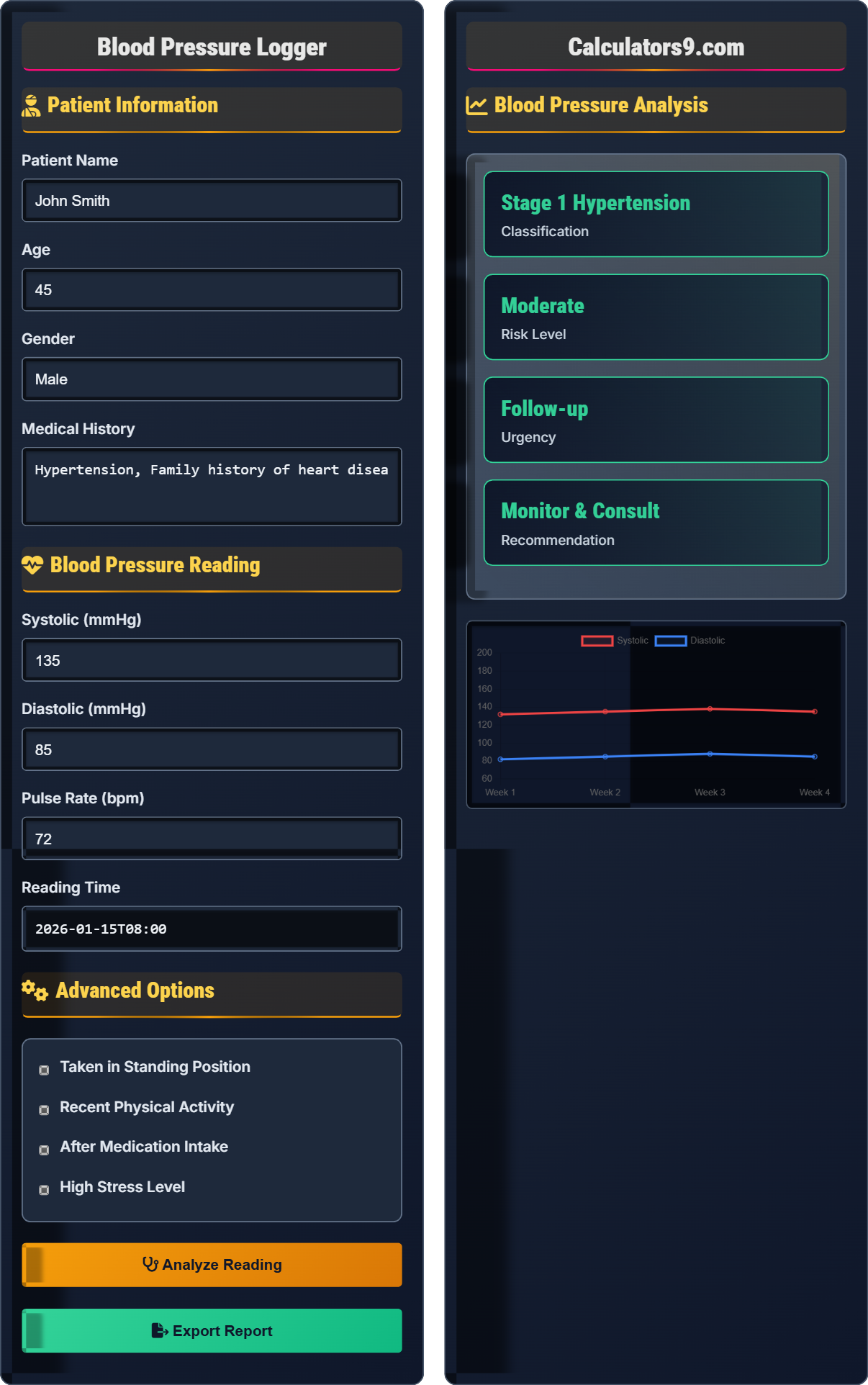
Example: For a reading of 135/85 mmHg:
Systolic = 135 (≥130 and <140)
Diastolic = 85 (≥80 and <90)
Since systolic is in Stage 1 range OR diastolic is in Stage 1 range, this is classified as Stage 1 Hypertension.
Patient Information
Blood Pressure Reading
Advanced Options
Blood Pressure Analysis
| Parameter | Value | Normal Range | Status |
|---|---|---|---|
| Systolic | 135 mmHg | <120 mmHg | Elevated |
| Diastolic | 85 mmHg | <80 mmHg | Elevated |
| Pulse Rate | 72 bpm | 60-100 bpm | Normal |
| Mean Arterial Pressure | 102 mmHg | 70-100 mmHg | Elevated |
| Date | Systolic | Diastolic | Classification |
|---|---|---|---|
| Jan 10, 2026 | 132 | 82 | Stage 1 HTN |
| Jan 11, 2026 | 138 | 86 | Stage 1 HTN |
| Jan 12, 2026 | 135 | 84 | Stage 1 HTN |
| Jan 13, 2026 | 137 | 85 | Stage 1 HTN |
| Jan 14, 2026 | 133 | 83 | Stage 1 HTN |
| Jan 15, 2026 | 135 | 85 | Stage 1 HTN |
Comprehensive Blood Pressure Guide
Blood pressure is the force exerted by circulating blood against the walls of blood vessels. It's measured in millimeters of mercury (mmHg) and consists of two numbers: systolic (top number) and diastolic (bottom number). Regular monitoring helps detect hypertension early.
Blood pressure categories according to American Heart Association:
Key factors affecting blood pressure:
- Diet: High sodium intake increases BP
- Exercise: Regular activity helps maintain healthy BP
- Weight: Excess weight contributes to hypertension
- Stress: Chronic stress elevates BP levels
- Genetics: Family history plays a role
- Consistency: Measure at same time daily
- Rest: Sit quietly for 5 minutes before reading
- Position: Arm at heart level, feet flat on floor
- Environment: Avoid caffeine, smoking 30 mins before
- Multiple Readings: Take 2-3 readings and average
Blood Pressure Knowledge Quiz
According to AHA guidelines, which blood pressure reading would be classified as Stage 1 Hypertension?
The answer is B) 135/85 mmHg. According to AHA guidelines, Stage 1 Hypertension is defined as systolic pressure 130-139 mmHg OR diastolic pressure 80-89 mmHg. The reading 135/85 falls within this range.
It's important to understand that Stage 1 Hypertension is diagnosed when EITHER the systolic OR diastolic pressure meets the criteria. In this case, 135 is in the 130-139 range (satisfying systolic criteria) AND 85 is in the 80-89 range (satisfying diastolic criteria).
Systolic Pressure: Pressure when heart beats and pumps blood
Diastolic Pressure: Pressure when heart rests between beats
Stage 1 HTN: Mild elevation in blood pressure
• Either systolic OR diastolic criteria must be met
• Both pressures contribute to overall risk
• Consistent readings confirm diagnosis
• Remember: 130-139/80-89 = Stage 1
• Use the "OR" rule for classification
• Take multiple readings for accuracy
• Thinking both pressures must be elevated
• Confusing Stage 1 with Stage 2
• Not considering isolated systolic/diastolic HTN
Calculate the Mean Arterial Pressure (MAP) for a blood pressure reading of 140/90 mmHg. Use the formula: MAP = Diastolic + 1/3(Systolic - Diastolic). Show your work.
Given: Systolic = 140 mmHg, Diastolic = 90 mmHg
Formula: MAP = Diastolic + 1/3(Systolic - Diastolic)
Step 1: Calculate pulse pressure = Systolic - Diastolic
- 140 - 90 = 50 mmHg
Step 2: Calculate 1/3 of pulse pressure
- 50 ÷ 3 = 16.67 mmHg
Step 3: Add to diastolic pressure
- MAP = 90 + 16.67 = 106.67 mmHg
Therefore, the Mean Arterial Pressure is approximately 107 mmHg.
Mean Arterial Pressure represents the average pressure in arteries during one cardiac cycle. It's important because it reflects perfusion pressure to organs. Normal MAP ranges from 70-100 mmHg, so 107 mmHg indicates elevated perfusion pressure.
Mean Arterial Pressure: Average arterial pressure during cardiac cycle
Pulse Pressure: Difference between systolic and diastolic
Perfusion Pressure: Pressure needed for organ blood flow
• MAP = Diastolic + 1/3(Pulse Pressure)
• Normal range: 70-100 mmHg
• Critical below 60 mmHg
• MAP approximates organ perfusion pressure
• Useful in critical care settings
• Remember: Diastolic + (Sys-Dia)/3
• Forgetting to divide by 3
• Using wrong formula components
• Not understanding clinical significance
Sarah has been monitoring her blood pressure for 2 weeks. Her readings show: Week 1 average 128/82, Week 2 average 132/85. She takes medication daily. What does this trend suggest, and what action should she take?
Step 1: Analyze the trend
- Week 1: 128/82 = Elevated category
- Week 2: 132/85 = Stage 1 Hypertension
- Change: Systolic +4, Diastolic +3
Step 2: Interpret the significance
- Progression from Elevated to Stage 1 HTN
- Current medication may be insufficient
- Possibly non-adherent to lifestyle changes
Step 3: Recommended actions
- Consult healthcare provider promptly
- Review medication adherence
- Assess dietary sodium intake
- Consider medication adjustment
The upward trend despite medication indicates the need for intervention.
This example demonstrates the importance of trend analysis in blood pressure management. Even though Sarah was taking medication, the progression from Elevated to Stage 1 HTN suggests that her current treatment plan isn't adequately controlling her blood pressure. This is a critical finding that requires professional attention.
Trend Analysis: Examining changes over time
Medication Adherence: Taking medication as prescribed
Progression: Worsening of condition over time
• Monitor trends, not just individual readings
• Consistent upward trends require attention
• Medication effectiveness can change over time
• Track readings over 2-4 weeks
• Look for patterns and trends
• Share data with healthcare providers
• Ignoring gradual increases
• Not sharing trend data with doctors
• Assuming stable medication works forever
Mr. Johnson takes a reading of 190/110 mmHg and feels dizzy and nauseous. According to the classification system, what category does this fall into, and what immediate action should be taken? (Hint: Consider the urgency based on both classification and symptoms)
Step 1: Classify the reading
- Systolic: 190 mmHg (>180) - meets Hypertensive Crisis criteria
- Diastolic: 110 mmHg (>120) - meets Hypertensive Crisis criteria
- Classification: Hypertensive Crisis
Step 2: Assess the urgency
- Reading qualifies as medical emergency
- Patient has symptoms (dizziness, nausea)
- Both factors increase urgency
Step 3: Immediate actions
- Call emergency services (911) immediately
- Have patient sit/lie down safely
- Stay with patient until help arrives
- Do not give food or water
This is a true medical emergency requiring immediate professional intervention.
This example highlights the critical importance of recognizing hypertensive crisis. Readings above 180/120 mmHg constitute a medical emergency, especially when accompanied by symptoms. The combination of extremely high pressure and symptoms indicates potential organ damage and requires immediate medical attention.
Hypertensive Crisis: Blood pressure >180/120 mmHg
Medical Emergency: Situation requiring immediate care
Organ Damage: Harm to vital organs from high pressure
• BP >180/120 = Emergency
• Call emergency services immediately
Which of the following factors can significantly affect the accuracy of blood pressure readings?
The answer is D) All of the above. All listed factors can significantly affect blood pressure readings. Morning readings tend to be higher due to circadian rhythms, caffeine can temporarily elevate BP, and bladder fullness can cause slight increases. Proper technique requires avoiding these factors.
Accurate blood pressure measurement requires controlling for multiple variables. Environmental and physiological factors can all influence readings. Understanding these factors helps ensure reliable data for proper classification and management decisions.
Circadian Rhythms: Natural body cycles over 24 hours
Vasoconstriction: Narrowing of blood vessels
Measurement Variables: Factors affecting readings
• Avoid caffeine 30 minutes before reading
• Empty bladder before measuring
• Rest for 5 minutes before reading
• Standardize measurement conditions
• Take multiple readings and average
• Use proper cuff size
• Measuring immediately after eating/drinking
• Talking during measurement
• Using wrong cuff size
Blood Pressure Fundamentals
Force of blood pushing against artery walls during heartbeats and rest periods, measured in mmHg.
\( \text{Classification} = \begin{cases} \text{Normal} & \text{if } \text{Systolic} < 120 \text{ and } \text{Diastolic} < 80 \\ \text{Elevated} & \text{if } 120 \leq \text{Systolic} < 130 \text{ and } \text{Diastolic} < 80 \\ \text{Stage 1 HTN} & \text{if } 130 \leq \text{Systolic} < 140 \text{ or } 80 \leq \text{Diastolic} < 90 \\ \text{Stage 2 HTN} & \text{if } \text{Systolic} \geq 140 \text{ or } \text{Diastolic} \geq 90 \\ \text{Hypertensive Crisis} & \text{if } \text{Systolic} > 180 \text{ or } \text{Diastolic} > 120 \end{cases} \)
Where classifications guide treatment and monitoring recommendations.
- Measure at consistent times
- Rest before taking readings
- Take multiple readings and average
Monitoring Enhancement Strategies
Methods to improve the accuracy and usefulness of blood pressure data collection.
- Standardize measurement conditions
- Track readings over time
- Monitor for trends and patterns
- Record environmental factors
- Regular data review with healthcare provider
- Individual variation factors
- Medication timing
- Physical activity effects
- Stress and emotional states
FAQ
Q: How often should I check my blood pressure if I have hypertension?
A: For newly diagnosed hypertension, check twice daily for 1-2 weeks, then weekly once stabilized. If on medication adjustments, daily monitoring is recommended. Consistent timing improves data quality.
Mathematical approach to monitoring frequency:
\( \text{Monitoring Frequency} = \frac{\text{Risk Level} \times \text{Treatment Phase}}{\text{Stability Factor}} \)
Higher risk and treatment changes require more frequent monitoring.
Q: What should I do if I get a very high reading?
A: If BP is >180/120 mmHg, wait 5 minutes and recheck. If still high with symptoms (severe headache, chest pain, shortness of breath), call 911 immediately. If asymptomatic, contact healthcare provider within 24 hours.
- Remain calm and seated
- Do not take additional medication
- Recheck after rest
- Document the reading
Always err on the side of caution with extremely high readings.