Blood Sugar Tracker
Diabetes management • Glucose monitoring • 2026 edition
Blood Sugar Classification Formula:
Show the calculator\( \text{Classification} = \begin{cases} \text{Hypoglycemia} & \text{if } \text{Glucose} < 70 \text{ mg/dL} \\ \text{Normal} & \text{if } 70 \leq \text{Glucose} \leq 99 \text{ mg/dL} \\ \text{Prediabetes} & \text{if } 100 \leq \text{Glucose} \leq 125 \text{ mg/dL} \\ \text{Diabetes} & \text{if } \text{Glucose} \geq 126 \text{ mg/dL} \end{cases} \)
This formula classifies blood glucose readings according to American Diabetes Association guidelines. The classification helps determine appropriate management and treatment strategies.
Example: For a fasting glucose reading of 110 mg/dL:
Since 100 ≤ 110 ≤ 125, this is classified as Prediabetes.
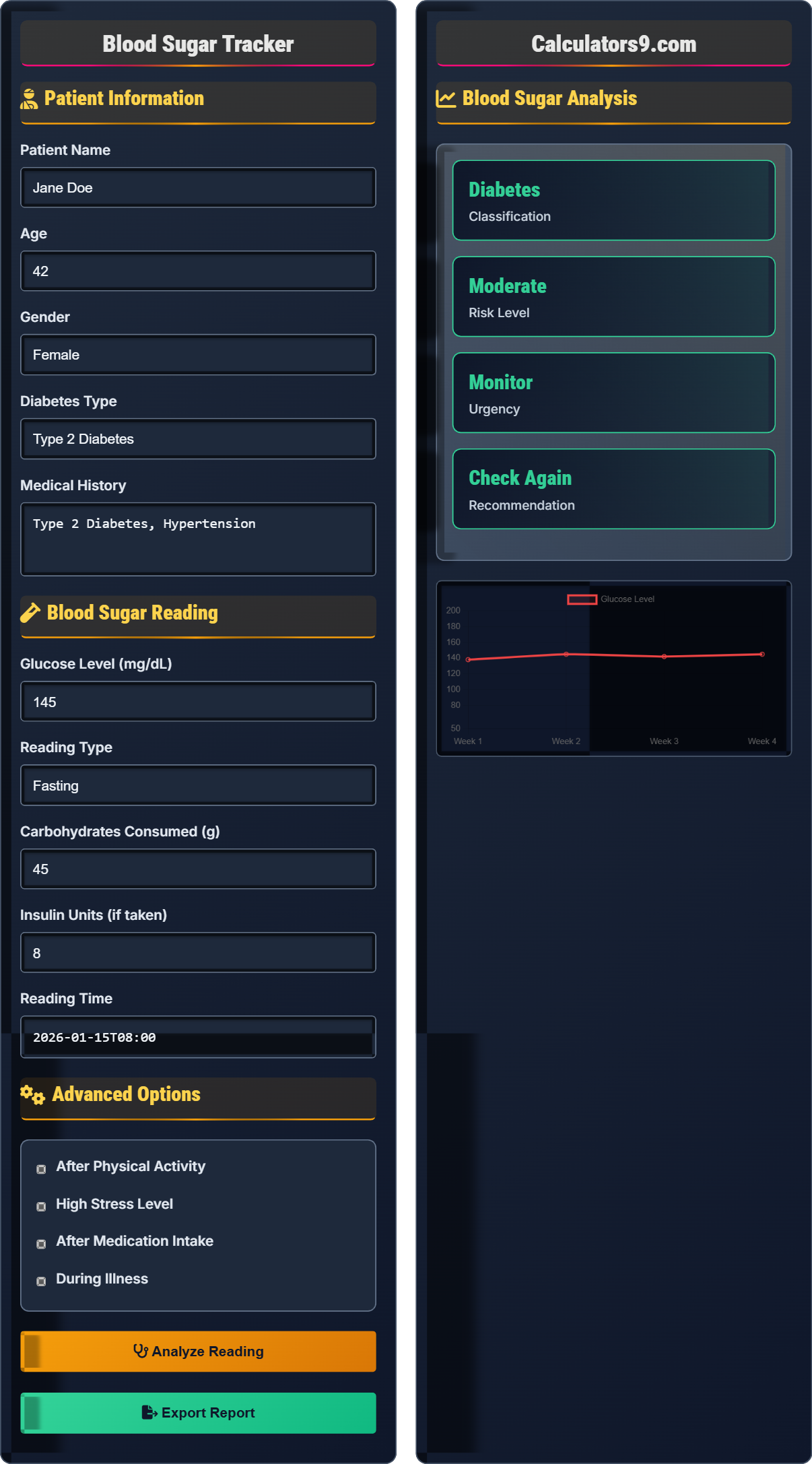
Patient Information
Blood Sugar Reading
Advanced Options
Blood Sugar Analysis
| Parameter | Value | Target Range | Status |
|---|---|---|---|
| Glucose Level | 145 mg/dL | 70-140 mg/dL | Elevated |
| Carbohydrates | 45 g | <45 g | Normal |
| Insulin | 8 units | Based on carbs | Appropriate |
| Glucose Variability | 25 mg/dL | <40 mg/dL | Good |
| Date | Glucose | Type | Classification |
|---|---|---|---|
| Jan 10, 2026 | 138 | Post-Meal | Diabetes |
| Jan 11, 2026 | 152 | Post-Meal | Diabetes |
| Jan 12, 2026 | 141 | Post-Meal | Diabetes |
| Jan 13, 2026 | 147 | Post-Meal | Diabetes |
| Jan 14, 2026 | 139 | Post-Meal | Diabetes |
| Jan 15, 2026 | 145 | Post-Meal | Diabetes |
Comprehensive Blood Sugar Guide
Blood sugar (glucose) is the main source of energy for the body's cells. It's regulated by insulin and other hormones. Regular monitoring helps manage diabetes and prevent complications. Normal glucose levels vary by time of day and recent food intake.
Blood glucose categories according to American Diabetes Association:
Optimal glucose levels vary by reading type:
- Fasting: 80-130 mg/dL
- Post-Meal (2 hours): <140 mg/dL
- Before Meal: 80-130 mg/dL
- Bedtime: 100-140 mg/dL
- Random: <180 mg/dL
- Consistency: Test at same times daily
- Hygiene: Wash hands before testing
- Calibration: Ensure meter accuracy
- Documentation: Record readings with context
- Pattern Recognition: Look for trends and triggers
Blood Sugar Knowledge Quiz
According to ADA guidelines, which blood glucose reading would be classified as Prediabetes?
The answer is C) 110 mg/dL. According to ADA guidelines, Prediabetes is defined as a fasting glucose level of 100-125 mg/dL. The reading 110 falls within this range.
Prediabetes represents a critical stage where glucose levels are elevated but not yet in the diabetic range. It serves as a warning sign and opportunity for intervention through lifestyle changes to prevent progression to diabetes. The range of 100-125 mg/dL specifically indicates impaired fasting glucose.
Glucose: Blood sugar, the body's primary energy source
Prediabetes: Elevated glucose levels, not yet diabetic
ADA: American Diabetes Association• Prediabetes range: 100-125 mg/dL
• Represents increased diabetes risk
• Manageable with lifestyle changes
• Remember: 100-125 = Prediabetes
• This is a reversible condition
• Early intervention is key
• Confusing prediabetes with diabetes
• Thinking prediabetes is irreversible
• Not taking prediabetes seriously
Calculate the glucose variability for a patient with readings of 120, 135, 110, 140, and 125 mg/dL over 5 days. Use the formula: Standard Deviation = √[Σ(x - mean)²/n]. Show your work.
Step 1: Calculate the mean
- Mean = (120 + 135 + 110 + 140 + 125) ÷ 5 = 630 ÷ 5 = 126 mg/dL
Step 2: Calculate squared differences from mean
- (120 - 126)² = (-6)² = 36
- (135 - 126)² = (9)² = 81
- (110 - 126)² = (-16)² = 256
- (140 - 126)² = (14)² = 196
- (125 - 126)² = (-1)² = 1
Step 3: Calculate variance
- Variance = (36 + 81 + 256 + 196 + 1) ÷ 5 = 570 ÷ 5 = 114
Step 4: Calculate standard deviation
- SD = √114 = 10.68 mg/dL
Therefore, the glucose variability is approximately 10.7 mg/dL.
Glucose variability measures how much blood sugar fluctuates over time. Lower variability (typically <40 mg/dL) indicates better glucose control. In this example, the 10.7 mg/dL variability is excellent, indicating stable glucose management.
Glucose Variability: Measure of glucose fluctuations
Standard Deviation: Statistical measure of spread
Glucose Control: Stability of blood sugar levels
• Lower variability indicates better control
• Calculate mean first
• Square differences before averaging
• Variability <40 mg/dL is good
• <20 mg/dL is excellent
• Helps assess treatment effectiveness
• Forgetting to square the differences
• Dividing by n-1 instead of n
• Not taking the square root
Michael has been monitoring his blood sugar for 2 weeks. His fasting readings show: Week 1 average 140 mg/dL, Week 2 average 135 mg/dL. He takes metformin daily. What does this trend suggest, and what action should he take?
Step 1: Analyze the trend
- Week 1: 140 mg/dL (Diabetes category)
- Week 2: 135 mg/dL (Diabetes category)
- Change: Decrease of 5 mg/dL
Step 2: Interpret the significance
- Positive trend showing medication effectiveness
- Still in diabetic range requiring management
- Consistent downward trend is encouraging
Step 3: Recommended actions
- Continue current medication regimen
- Maintain monitoring schedule
- Consult healthcare provider for medication review
- Consider dietary adjustments
The slight improvement suggests the medication is working, but continued management is needed.
This example demonstrates how to interpret glucose trends. Even a modest 5 mg/dL decrease over two weeks indicates positive response to medication. However, since both readings remain in the diabetic range, continued management and potential medication adjustments may be necessary.
Trend Analysis: Examining changes over time
Metformin: Diabetes medication for glucose control
Glucose Response: Change in levels due to treatment
• Monitor trends, not just individual readings
• Small improvements indicate progress
• Consistent patterns guide treatment
• Track readings over 2-4 weeks
• Look for consistent patterns
• Share data with healthcare providers
• Expecting immediate dramatic changes
• Ignoring small but consistent improvements
• Not continuing treatment for modest progress
Sarah takes a reading of 55 mg/dL and feels shaky, sweaty, and confused. According to the classification system, what category does this fall into, and what immediate action should be taken? (Hint: Consider the urgency based on both classification and symptoms)
Step 1: Classify the reading
- Glucose: 55 mg/dL (<70 mg/dL)
- Classification: Hypoglycemia
Step 2: Assess the urgency
- Severe hypoglycemia (symptomatic)
- Patient experiencing classic symptoms
- Immediate treatment required
Step 3: Immediate actions (Rule of 15)
- Consume 15g fast-acting carbs (glucose tablets, juice)
- Wait 15 minutes
- Retest glucose
- If still <70 mg/dL, repeat treatment
This is a medical emergency requiring immediate glucose administration.
This example highlights the critical importance of recognizing and treating hypoglycemia. Readings below 70 mg/dL require immediate action, especially when accompanied by symptoms. The Rule of 15 is a standard protocol for treating mild to moderate hypoglycemia.
Hypoglycemia: Low blood sugar levels
Rule of 15: Treatment protocol for low glucoseFast-Acting Carbs: Quickly absorbed sugars
• <70 mg/dL = Hypoglycemia
• Follow Rule of 15 protocol
What is the recommended target glucose level 2 hours after a meal for someone with diabetes?
The answer is B) <140 mg/dL. According to ADA guidelines, the target glucose level 2 hours after a meal (postprandial) should be less than 140 mg/dL for people with diabetes.
Post-meal glucose targets are important because elevated postprandial levels are associated with increased risk of complications. The 2-hour post-meal target of <140 mg/dL balances optimal control with practicality for meal planning and medication timing.
Postprandial: After eating
Glucose Target: Desired blood sugar level
ADA Guidelines: American Diabetes Association standards
• 2-hour post-meal target: <140 mg/dL
• Fasting target: 80-130 mg/dL
• Bedtime target: 100-140 mg/dL
• Test 2 hours after first bite
• Consistent timing improves accuracy
• Correlate with food intake
• Testing at inconsistent times
• Not correlating with meals
• Confusing different target ranges
Blood Sugar Fundamentals
Glucose concentration in blood, the primary source of cellular energy regulated by insulin and other hormones.
\( \text{Classification} = \begin{cases} \text{Hypoglycemia} & \text{if } \text{Glucose} < 70 \text{ mg/dL} \\ \text{Normal} & \text{if } 70 \leq \text{Glucose} \leq 99 \text{ mg/dL} \\ \text{Prediabetes} & \text{if } 100 \leq \text{Glucose} \leq 125 \text{ mg/dL} \\ \text{Diabetes} & \text{if } \text{Glucose} \geq 126 \text{ mg/dL} \end{cases} \)
Where classifications guide treatment and monitoring recommendations.
- Test at consistent times
- Record with meal context
- Look for patterns and trends
Monitoring Enhancement Strategies
Methods to improve the accuracy and usefulness of blood sugar data collection.
- Standardize testing conditions
- Track readings over time
- Monitor for trends and patterns
- Record associated factors
- Regular data review with healthcare provider
- Individual variation factors
- Medication timing
- Food and exercise effects
- Stress and illness impacts
FAQ
Q: How often should I check my blood sugar if I have Type 2 diabetes?
A: For Type 2 diabetes, check 1-2 times daily initially, focusing on fasting and post-meal readings. If on insulin, more frequent monitoring (3-4 times daily) may be needed. Consistent timing improves data quality.
Mathematical approach to monitoring frequency:
\( \text{Monitoring Frequency} = \frac{\text{Risk Level} \times \text{Treatment Intensity}}{\text{Stability Factor}} \)
Higher risk and intensive treatment require more frequent monitoring.
Q: What should I do if someone has a very low blood sugar reading?
A: If glucose is <70 mg/dL with symptoms, follow the Rule of 15: give 15g fast-acting carbs (glucose tablets, 4 oz juice), wait 15 minutes, retest. If still low, repeat. For unconscious patients, never give food/drink, call 911.
- Recognize symptoms: shakiness, sweating, confusion
- Act quickly but calmly
- Retest after treatment
- Document the episode
Always err on the side of caution with hypoglycemia.