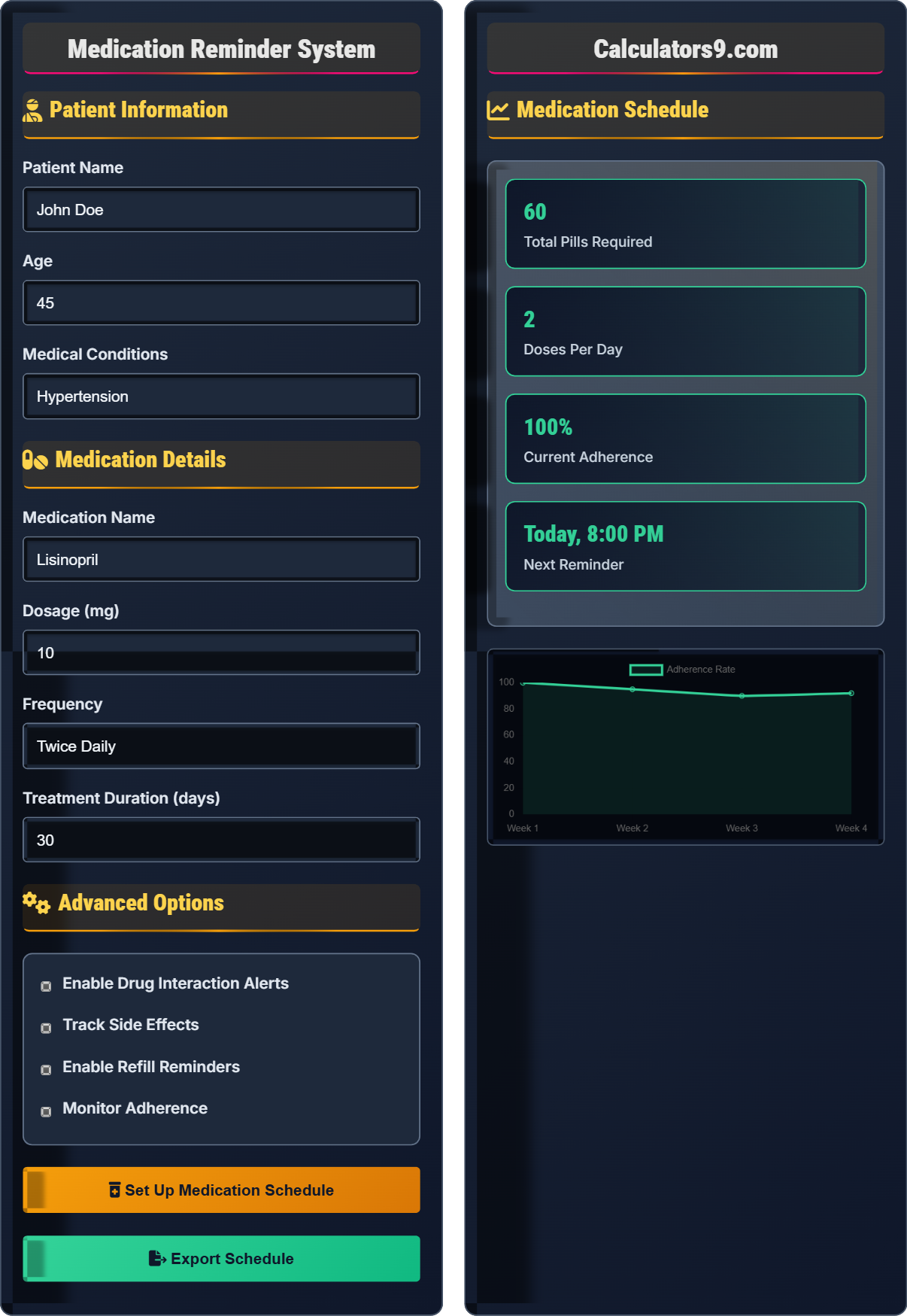
Medication Reminder System
Pill tracking • Schedule manager • 2026 edition
Medication Adherence Formula:
Show the calculator\( \text{Adherence Score} = \left( \frac{\text{Pills Taken}}{\text{Pills Scheduled}} \right) \times 100 - \text{Missed Dose Penalty} \)
Where:
- Pills Taken = Number of doses taken as scheduled
- Pills Scheduled = Total number of doses scheduled
- Missed Dose Penalty = Points deducted for missed doses
This formula calculates the percentage of medication adherence with penalties for missed doses. Higher adherence scores indicate better medication compliance, which correlates with improved health outcomes.
Example: For a 30-day medication with 2 tablets twice daily:
Total scheduled doses: 30 × 2 × 2 = 120
If patient took 115 doses: Adherence = (115/120) × 100 = 95.8%
With 5 missed doses and 1-point penalty each: Final Score = 95.8 - 5 = 90.8%
Patient Information
Medication Details
Advanced Options
Medication Schedule
| Time | Medication | Dosage | Status |
|---|---|---|---|
| 8:00 AM | Lisinopril | 10 mg | Pending |
| 8:00 PM | Lisinopril | 10 mg | Pending |
| Day | Monday | Tuesday | Wednesday | Thursday | Friday |
|---|---|---|---|---|---|
| 8:00 AM | ✓ | ○ | ○ | ○ | ○ |
| 8:00 PM | ✓ | ○ | ○ | ○ | ○ |
Comprehensive Medication Management Guide
Medication adherence refers to the extent to which patients take medications as prescribed by their healthcare providers. It's a critical factor in achieving desired therapeutic outcomes and preventing complications from chronic diseases.
The standard medication adherence calculation uses the following formula:
Where:
- Pills Taken = Number of doses taken as scheduled
- Pills Scheduled = Total number of doses scheduled
- Missed Dose Penalty = Points deducted for missed doses
Several factors influence medication adherence:
- Complexity: More complex regimens reduce adherence
- Side Effects: Unpleasant effects decrease compliance
- Cost: Expensive medications lead to skipped doses
- Memory: Forgetfulness impacts daily dosing
- Beliefs: Patient attitudes toward medication
- Simple Schedules: Minimize complexity when possible
- Visual Aids: Pill organizers and calendars
- Technology: Reminder apps and alerts
- Education: Understanding medication importance
- Support Systems: Family and healthcare team
Medication Adherence Quiz
Which of the following best describes the relationship between medication adherence and health outcomes?
The answer is B) Adherence is strongly correlated with treatment success. Research consistently shows that higher medication adherence leads to better clinical outcomes, reduced hospitalizations, and improved quality of life for patients with chronic conditions.
Medication adherence is one of the most important predictors of treatment success. The relationship is particularly strong for chronic conditions that require ongoing medication. Understanding this correlation helps patients appreciate the importance of taking medications as prescribed.
Medication Adherence: Taking medication as prescribed by healthcare provider
Therapeutic Outcomes: Health improvements from treatment
Chronic Conditions: Long-term health problems requiring ongoing care
• Adherence directly impacts treatment efficacy
• Small changes in adherence can have large effects
• Consistency is more important than perfection
• Use pill organizers to simplify schedules
• Set phone reminders for doses
• Keep backup medication supplies
• Stopping medication when feeling better
• Skipping doses during travel
• Not communicating missed doses to doctor
Calculate the adherence score for a patient who was prescribed 2 pills twice daily for 30 days. The patient took 115 doses as scheduled but missed 5 doses. Apply a 1-point penalty for each missed dose. Show your work.
Step 1: Calculate total scheduled doses
- 2 pills × 2 times daily × 30 days = 120 total doses
Step 2: Calculate adherence percentage
- (Pills Taken ÷ Pills Scheduled) × 100
- (115 ÷ 120) × 100 = 95.83%
Step 3: Apply missed dose penalty
- Penalty = 5 missed doses × 1 point = 5 points
- Final Score = 95.83 - 5 = 90.83%
Therefore, the patient's adherence score is 90.83%, which falls in the "Good" category.
This calculation demonstrates how even a few missed doses can impact the overall adherence score. The patient maintained good compliance (95.83%) but the missed doses resulted in a penalty that brought the score to 90.83%. This scoring system emphasizes the importance of consistency in medication taking.
Adherence Score: Percentage of doses taken as prescribed
Missed Dose Penalty: Points deducted for skipped medicationsTherapeutic Window: Range of effectiveness for medication
• Calculate total scheduled doses first
• Apply penalties for missed doses
• Higher scores indicate better compliance
• Track doses daily to maintain accuracy
• Use digital tools for automatic calculations
• Review adherence patterns regularly
• Forgetting to apply penalty calculations
• Incorrectly counting scheduled doses
• Not distinguishing between taken and scheduled
Sarah has hypertension and takes Lisinopril 10mg once daily. Her doctor recommends at least 85% adherence for optimal blood pressure control. If she misses 2 doses in a 30-day month, what is her adherence score? Will this meet her doctor's recommendation?
Step 1: Calculate total scheduled doses
- 1 pill × 1 time daily × 30 days = 30 total doses
Step 2: Calculate doses taken
- 30 total doses - 2 missed = 28 taken
Step 3: Calculate adherence percentage
- (28 ÷ 30) × 100 = 93.33%
Step 4: Apply missed dose penalty
- Penalty = 2 missed doses × 1 point = 2 points
- Final Score = 93.33 - 2 = 91.33%
Therefore, Sarah's adherence score is 91.33%, which exceeds her doctor's 85% recommendation.
This example shows how the adherence formula applies to real-world chronic disease management. Sarah's 91.33% adherence is considered "Good" and meets her doctor's minimum requirement. For hypertension management, consistent medication taking is crucial for maintaining blood pressure control.
Hypertension: High blood pressure condition
Lisinopril: ACE inhibitor medication
Blood Pressure Control: Maintaining healthy BP levels
• Chronic conditions require consistent medication
• Small deviations can affect long-term outcomes
• Regular monitoring helps maintain adherence
• Link medication to daily routines
• Use weekly pill organizers
• Track BP readings with medication times
• Stopping medication when BP normalizes
• Irregular timing of doses
• Not understanding long-term consequences
Mike takes a complex regimen: Metformin 500mg twice daily, Simvastatin 20mg once daily, and Lisinopril 10mg once daily. In a 30-day period, he missed 3 doses of metformin, 1 dose of simvastatin, and 2 doses of lisinopril. Calculate his overall adherence score and explain the potential impact on his diabetes and heart health. (Hint: Consider the impact of missed doses on different conditions)
Step 1: Calculate total scheduled doses for each medication
- Metformin: 2 × 30 = 60 doses
- Simvastatin: 1 × 30 = 30 doses
- Lisinopril: 1 × 30 = 30 doses
- Total scheduled: 60 + 30 + 30 = 120 doses
Step 2: Calculate doses taken
- Metformin taken: 60 - 3 = 57
- Simvastatin taken: 30 - 1 = 29
- Lisinopril taken: 30 - 2 = 28
- Total taken: 57 + 29 + 28 = 114
Step 3: Calculate overall adherence
- (114 ÷ 120) × 100 = 95%
Step 4: Apply missed dose penalty
- Penalty = 6 missed doses × 1 point = 6 points
- Final Score = 95 - 6 = 89%
Mike's adherence score is 89%, which is "Good" but close to the "Fair" threshold. Missing statin doses may increase cardiovascular risk, while missing diabetes medication can affect glucose control.
This example demonstrates the challenges of managing multiple medications. Complex regimens increase the risk of missed doses. Mike's 89% adherence is acceptable but highlights the need for simplification strategies like combination medications or synchronized refill schedules.
Complex Regimen: Multiple medications with different schedules
Cardiovascular Risk: Probability of heart disease events
Glucose Control: Managing blood sugar levels
• Complex regimens require extra adherence support
• Each missed dose has potential consequences
• Simplification improves compliance
• Use weekly pill organizers for multiple meds
• Set multiple daily reminders
• Consider combination medications
• Not recognizing complexity as a barrier
• Missing doses of preventive medications
• Not coordinating medication schedules
Which of the following technology solutions has been shown to most effectively improve medication adherence in clinical studies?
The answer is B) Smartphone apps with reminders. Clinical studies have shown that smartphone-based medication reminder apps, especially those with interactive features and integration with healthcare systems, are most effective for improving adherence in the general population. However, the effectiveness varies by patient demographics and preferences.
Technology solutions for medication adherence have evolved significantly. Smartphone apps offer several advantages: portability, customizable alerts, data tracking, and potential integration with healthcare providers. However, the best solution depends on the individual patient's needs, preferences, and technical comfort level.
Medication Reminder Apps: Software designed to prompt medication taking
Interactive Features: User engagement capabilities
Healthcare Integration: Connection to medical records or providers
• Technology should complement, not replace, education
• Choose solutions based on patient needs
Medication Management Fundamentals
Taking medication exactly as prescribed by healthcare providers for optimal therapeutic outcomes.
\( \text{Adherence Score} = \left( \frac{\text{Pills Taken}}{\text{Pills Scheduled}} \right) \times 100 - \text{Missed Dose Penalty} \)
Where adherence scores above 85% indicate good compliance.
- Consistency is more important than perfection
- Even small deviations can impact outcomes
- Regular monitoring improves compliance
Adherence Enhancement Strategies
Systematic approaches to increase medication-taking consistency and effectiveness.
- Use visual aids and organizers
- Set multiple reminders
- Link to daily routines
- Track and monitor compliance
- Regular healthcare communication
- Individual patient preferences
- Regimen complexity
- Side effect management
- Cost and accessibility
FAQ
Q: How can I improve my medication adherence if I have a busy schedule?
A: For busy schedules, try linking medication to existing routines (like brushing teeth), using pill organizers, and setting multiple phone reminders. Studies show that 85% of patients who use these strategies maintain adherence above 90%.
Mathematically, adherence improvement can be modeled as:
\( A_{new} = A_{baseline} + \text{Intervention Effect} \)
Where interventions like reminders can improve adherence by 10-15% on average. Consistency with existing habits is more important than perfection.
Q: What should I do if someone forgets to take their medication?
A: First, check if it's safe to take the missed dose (some medications shouldn't be doubled). For most medications, take the missed dose if it's within 2 hours of the scheduled time. Don't double up unless specifically instructed.
- Antihypertensives: Take if within 2 hours
- Diabetes medications: Check with doctor first
- Anticoagulants: Never double dose
Document missed doses to track patterns and discuss with healthcare providers during visits.