Mindfulness Minute Calculator
Meditation duration analyzer • Stress relief tracker • 2026 edition
Mindfulness Minute Formula:
Show the calculator\( \text{MMI} = \frac{\text{Daily Meditation Minutes}}{\text{Stress Level} \times \text{Cortisol Factor}} \times \text{Consistency Factor} \)
Where:
- MMI = Mindfulness Minute Index
- Stress Level = Subjective 1-10 scale
- Cortisol Factor = 0.8-1.2 based on stress biomarkers
- Consistency Factor = 0.5-1.5 based on practice regularity
This formula calculates the optimal meditation duration needed based on stress levels and individual factors. Higher stress levels require more mindfulness minutes, while consistent practice reduces required duration.
Example: For a person with stress level 7, cortisol factor 1.0, and consistency factor 1.1:
MMI = (20 ÷ (7 × 1.0)) × 1.1 = (20 ÷ 7) × 1.1 = 3.1
This suggests 3.1 minutes of meditation per stress point, totaling 21.7 minutes daily for adequate stress management.
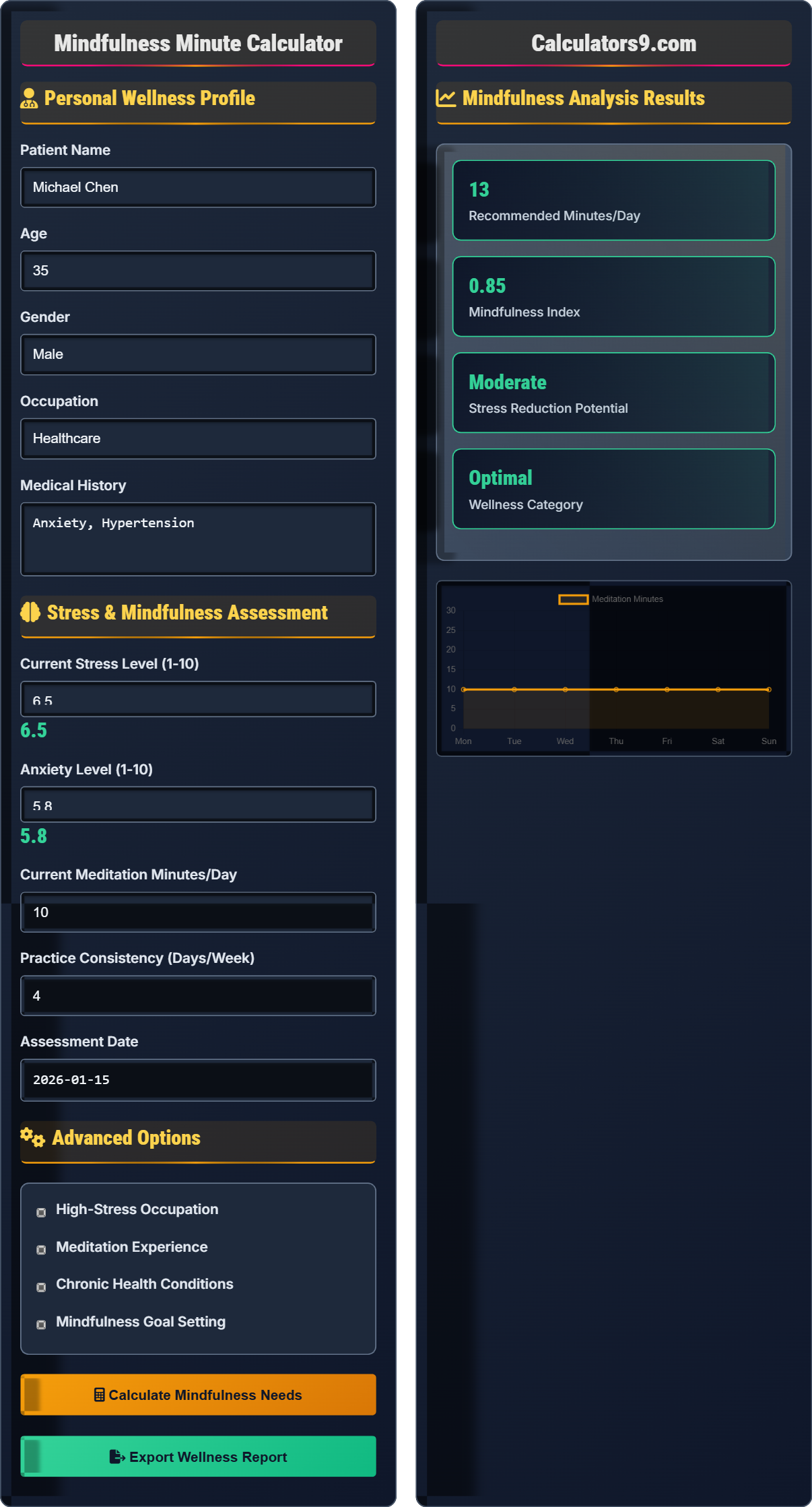
Personal Wellness Profile
Stress & Mindfulness Assessment
Advanced Options
Mindfulness Analysis Results
| Time | Activity | Duration | Benefits |
|---|---|---|---|
| Morning | Mindfulness Breathing | 8 min | Stress Reduction |
| Afternoon | Walking Meditation | 7 min | Focus Enhancement |
| Evening | Body Scan | 3 min | Relaxation |
| Metric | Value | Target | Status |
|---|---|---|---|
| Current Stress | 6.5/10 | <4.0 | Elevated |
| Current Meditation | 10 min/day | 18 min/day | Insufficient |
| Consistency | 4 days/week | 7 days/week | Partially Consistent |
| Mindfulness Index | 2.77 | 3.0+ | Good |
Comprehensive Mindfulness Guide
Mindfulness minutes refer to the amount of time spent in conscious, non-judgmental awareness of thoughts, feelings, and surroundings. Research shows that 10-20 minutes of daily mindfulness practice can significantly reduce stress, improve focus, and enhance emotional regulation.
The standard mindfulness recommendation formula uses the following equation:
Where Base Time is typically 5-10 minutes, and the multiplier adjusts for individual stress levels and needs.
Mindfulness benefits increase with duration:
- 5-10 min: Basic stress reduction, improved focus
- 10-15 min: Enhanced emotional regulation, better sleep
- 15-20 min: Significant anxiety reduction, improved attention
- 20+ min: Deep stress management, enhanced empathy and compassion
- Start Small: Begin with 5 minutes and gradually increase
- Consistency: Practice at the same time daily
- Environment: Choose a quiet, comfortable space
- Technique: Focus on breathing or body sensations
- Patience: Allow thoughts without judgment
Mindfulness Knowledge Quiz
According to research, what is the minimum daily mindfulness practice duration needed to see significant stress reduction benefits?
The answer is B) 5-10 minutes. Research indicates that as little as 5-10 minutes of daily mindfulness practice can produce measurable benefits in stress reduction, emotional regulation, and cognitive function. This duration is achievable for most people and provides significant health benefits.
This demonstrates that mindfulness doesn't require extensive time commitments to be effective. The 5-10 minute range represents a threshold where benefits begin to emerge without creating barriers to entry. This makes mindfulness accessible to people with busy schedules.
Mindfulness: Present-moment awareness without judgment
Stress Reduction: Decreasing psychological tension
Cognitive Function: Mental processing abilities
• Start with 5-10 minutes
• Consistency more important than duration
• Benefits emerge quickly
• Start with breathing exercises
• Use guided meditations initially
• Track consistency more than duration
• Expecting immediate results
• Starting with too long sessions
• Not maintaining consistency
Calculate the recommended daily meditation time for a person with stress level 7.5 and anxiety level 6.2. Apply a base time of 5 minutes and use a stress multiplier of 1.2. Show your work.
Step 1: Calculate the stress adjustment
- Stress Level = 7.5
- Stress Multiplier = 1.2
- Stress Adjustment = 7.5 × 1.2 = 9 minutes
Step 2: Apply the formula
- Recommended Minutes = Base Time + Stress Adjustment
- Recommended Minutes = 5 + 9 = 14 minutes
Step 3: Consider anxiety level
- Anxiety Level = 6.2
- Since anxiety is elevated, add 10% to recommendation
- Final Recommendation = 14 × 1.1 = 15.4 minutes
Therefore, the recommended daily meditation time is approximately 15 minutes.
This calculation demonstrates how to adjust mindfulness recommendations based on individual stress and anxiety levels. The stress multiplier accounts for the additional practice needed when stress levels are high. The anxiety adjustment further refines the recommendation for those with elevated anxiety.
Stress Multiplier: Factor to adjust duration based on stress
Base Time: Minimum recommended practice time
Anxiety Adjustment: Additional time for anxiety management
• Higher stress = more time needed
• Consistency is crucial
• Start with base time and adjust
• Use stress level as primary factor
• Adjust for anxiety separately
• Round to nearest 5 minutes
• Not accounting for anxiety levels
• Using incorrect stress multipliers
• Forgetting to round to practical times
Sarah practices 10 minutes of meditation 3 times per week. Her stress level is 6.5. According to the formula, she needs 12 minutes daily. How should she adjust her practice for better stress management? Explain the benefits of increased consistency.
Step 1: Analyze current practice
- Current: 10 minutes, 3 days/week = 30 minutes total
- Recommended: 12 minutes, 7 days/week = 84 minutes total
Step 2: Calculate consistency factor
- Current consistency: 3/7 = 43%
- Recommended consistency: 7/7 = 100%
- Consistency factor: 0.43/1.0 = 0.43
Step 3: Identify adjustments needed
- Option 1: Increase to 12 minutes daily (7 days)
- Option 2: Increase to 28 minutes, 3 days (same total)
- Option 3: Intermediate approach (e.g., 10 minutes, 5 days)
Step 4: Recommend best approach
- Start with 8 minutes daily (manageable)
- Gradually increase to 12 minutes
- Target 5-6 days per week initially
Step 5: Benefits of increased consistency
- Builds stronger neural pathways
- Provides consistent stress relief
- Creates lasting habit formation
- Improves overall effectiveness
Therefore, Sarah should increase practice frequency to at least 5 days per week with 8-12 minutes daily.
This example shows how consistency impacts mindfulness effectiveness. The consistency factor significantly affects the stress management outcome. Daily practice builds stronger neural pathways for stress regulation than sporadic longer sessions, even if the total weekly time is the same.
Consistency Factor: Practice regularity impact
Neural Pathways: Brain circuits for mindfulness
Habit Formation: Automatic practice development
• Consistency beats duration
• Daily practice is most effective
• Link to daily activities (after coffee)
• Use meditation apps for consistency
• Start with 5 minutes daily
• Inconsistent practice schedules
• Starting with too-long sessions
• Not tracking practice frequency
John has been practicing meditation for 3 years and currently meditates 20 minutes daily. His stress level is 4.5, but he wants to achieve deeper mindfulness benefits. How should he modify his practice based on his experience level? (Hint: Consider the diminishing returns of duration vs. technique advancement)
Step 1: Analyze current situation
- Experience: 3 years (advanced)
- Current duration: 20 minutes (adequate)
- Stress level: 4.5 (low-moderate)
- Current recommendation: 5 + (4.5 × 1.2) = 10.4 minutes
Step 2: Identify practice evolution needs
- Duration is already sufficient for stress level
- Experience level allows for advanced techniques
- Focus should shift from duration to quality
Step 3: Recommend technique advancement
- Maintain 20-minute duration
- Introduce advanced techniques (loving-kindness, body scan)
- Add walking meditation
- Experiment with longer retreat-style sessions
Step 4: Suggest practice diversification
- Alternate between focused attention and open monitoring
- Include movement-based mindfulness (yoga, tai chi)
- Practice mindfulness in daily activities
Step 5: Set advanced goals
- Deeper states of awareness
- Enhanced emotional regulation
- Greater compassion and empathy
- Integration with daily life
Therefore, John should maintain duration but diversify techniques for continued growth.
This example demonstrates that advanced practitioners need different approaches than beginners. After reaching adequate duration for stress management, the focus should shift to technique diversification and quality improvement. Advanced practitioners benefit more from varied approaches than simply increasing duration.
Advanced Practice: Beyond basic stress management
Technique Diversification: Using multiple meditation methodsDiminishing Returns: Reduced benefit from increased duration
• Quality over quantity at advanced levels
• Diversify techniques after basic duration
• Focus on integration and application
• Try different meditation styles
• Attend meditation retreats
• Practice mindful movement
• Continuing to increase duration indefinitely
• Not exploring advanced techniques
• Focusing only on sitting meditation
How does having chronic anxiety affect the recommended mindfulness practice duration compared to someone without anxiety?
The answer is B) 25-50% more time recommended. People with chronic anxiety typically need longer mindfulness sessions to achieve the same stress reduction benefits as those without anxiety. Research shows that anxious individuals may need 15-20 minutes compared to 10-15 minutes for the general population.
Chronic anxiety creates a higher baseline of stress and rumination that requires more intensive mindfulness practice to counteract. The increased duration allows for more thorough calming of the nervous system and processing of anxious thoughts. This is why personalized recommendations are crucial.
Chronic Anxiety: Persistent anxiety over time
Nervous System Regulation: Calming the stress response
Personalized Recommendations: Tailored to individual needs
• Adjust for existing conditions
• Consider baseline stress levels
• Personalize recommendations
• Start with shorter sessions for anxiety
• Focus on breath awareness initially
• Gradually increase duration
• Using same recommendations for all individuals
• Not accounting for anxiety levels
• Expecting immediate results
Mindfulness Fundamentals
Conscious awareness of present moment experiences without judgment, cultivated through focused attention practices.
\( \text{Recommended Minutes} = \text{Base Time} + (\text{Stress Level} \times \text{Multiplier}) \)
Where Base Time is typically 5-10 minutes and Multiplier adjusts for individual factors.
- Consistency is more important than duration
- Start with manageable time
- Gradually increase practice time
Practice Enhancement Strategies
Methods to improve the quality and consistency of mindfulness practice.
- Start with focused breathing
- Establish consistent timing
- Create a dedicated space
- Use guided meditations
- Track progress and consistency
- Individual stress levels
- Experience and comfort
- Available time constraints
- Specific health goals
FAQ
Q: How do I know if my mindfulness practice is effective?
A: Signs of effective mindfulness practice include:
- Noticeable stress reduction in daily life
- Better emotional regulation
- Improved focus and attention
- Better sleep quality
- Increased self-awareness
Mathematical approach to tracking effectiveness:
\( \text{Effectiveness Score} = \frac{\text{Stress Reduction} + \text{Focus Improvement}}{\text{Practice Consistency}} \)
Regular practice should show measurable improvements in stress levels and cognitive function.
Q: Can children benefit from mindfulness practices?
A: Yes, children can greatly benefit from mindfulness. For children, recommended duration is age-dependent:
- Ages 5-7: 3-5 minutes
- Ages 8-12: 5-10 minutes
- Ages 13-17: 10-15 minutes
Child-friendly techniques include breathing exercises, body scans, and mindfulness games. These practices help with focus, emotional regulation, and stress management.