Alcohol Calorie Counter
Drink calories & nutrition tracker • Health optimization
Alcohol Calorie Formula:
Show the calculator\( \text{Calories} = \text{Volume (fl oz)} \times \text{ABV (\%)} \times 0.8 \times 7 \)
Where:
- \( \text{Volume (fl oz)} \): Liquid volume in fluid ounces
- \( \text{ABV (\%)} \): Alcohol by volume percentage
- \( 0.8 \): Density factor (grams per mL)
- \( 7 \): Calories per gram of alcohol
- \( \text{Additional calories} \): From carbs, sugars, mixers
This formula calculates the calories from pure alcohol content in drinks. Alcohol contains 7 calories per gram, nearly twice that of carbohydrates or protein (4 calories/g). Mixers and additives contribute additional calories beyond the alcohol content.
Example: For a 12oz beer with 5% ABV:
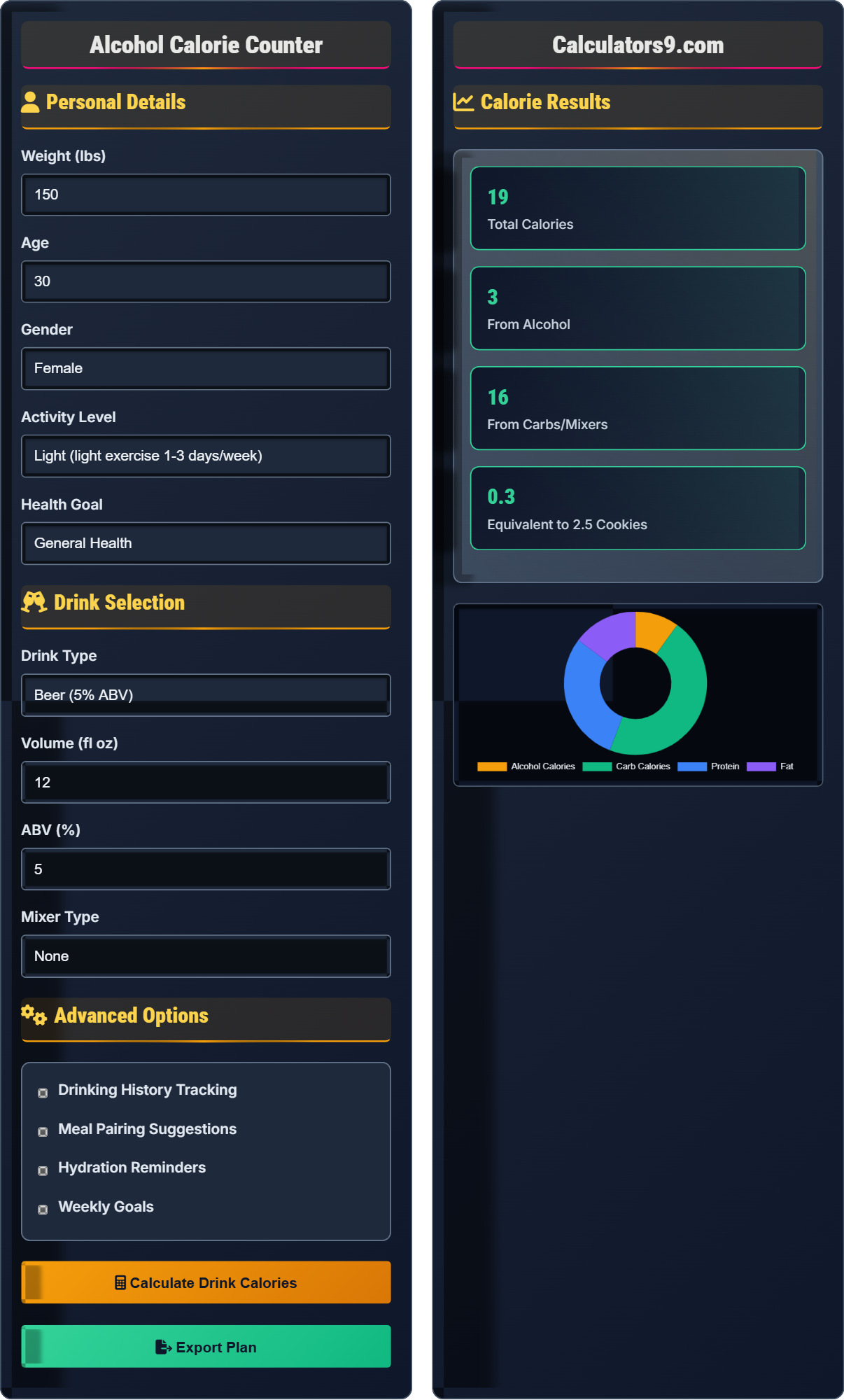
Calories from alcohol: \( 12 \times 0.05 \times 0.8 \times 7 = 151.2 \) calories
Plus approximately 10-15 calories from carbs, totaling approximately 160-165 calories per 12oz beer.
Personal Details
Drink Selection
Advanced Options
Calorie Results
| Nutrient | Amount | % Daily Value |
|---|
| Alternative | Calories | Savings |
|---|
| Day | Drink | Calories | Status |
|---|
Comprehensive Alcohol Nutrition Guide
Alcohol contains 7 calories per gram, making it the second most calorie-dense macronutrient after fat (9 calories/g). Unlike other nutrients, alcohol provides empty calories with little to no nutritional value. The body prioritizes metabolizing alcohol over other nutrients, which can interfere with fat burning and metabolism. On average, beer contains 150 calories per 12oz, wine contains 120 calories per 5oz glass, and spirits contain 100 calories per 1.5oz shot.
The standard alcohol calorie calculation uses the following formula:
Where:
- \( \text{Volume (fl oz)} \): Liquid volume in fluid ounces
- \( \text{ABV (\%)} \): Alcohol by volume percentage
- \( 0.8 \): Density conversion factor
- \( 7 \): Calories per gram of alcohol
Alcohol consumption has various effects on health and metabolism:
- Metabolism: Alcohol is prioritized for metabolism, slowing fat burning
- Dehydration: Alcohol is a diuretic, leading to fluid loss
- Sleep Quality: Can disrupt sleep patterns despite causing drowsiness
- Appetite: May increase appetite and food consumption
- Nutrient Absorption: Can interfere with absorption of vitamins and minerals
- Hydration: Alternate alcoholic drinks with water
- Low-Calorie Mixers: Use diet sodas, club soda, or water
- Portion Control: Stick to standard serving sizes
- Frequency: Limit to 1-2 drinks per occasion
- Tracking: Monitor weekly alcohol calorie intake
Alcohol Basics
Alcohol by volume percentage determines calorie content.
\( \text{Calories} = \text{Volume} \times \text{ABV} \times 0.8 \times 7 \)
Where: Volume in fl oz, ABV as decimal.
- Alcohol: 7 calories per gram
- Empty calories (no nutrients)
- Metabolism priority over fats/carbs
Moderation Strategies
Contains 14g of pure alcohol (100 calories).
- Beer: 12 oz (5% ABV)
- Wine: 5 oz (12% ABV)
- Spirit: 1.5 oz (40% ABV)
- Cocktail: Varies by recipe
- Hydrate between drinks
- Limit to 1-2 drinks per occasion
- Choose low-calorie mixers
- Track weekly intake
Alcohol Calorie Learning Quiz
How many calories are in one gram of alcohol?
The answer is B) 7 calories. Alcohol contains 7 calories per gram, making it the second most calorie-dense macronutrient after fat (9 calories/g). This is nearly twice the calories of carbohydrates or protein (4 calories/g).
The caloric content of alcohol is important to understand for those tracking their calorie intake. Unlike other nutrients, alcohol provides "empty calories" with little to no nutritional value. The body processes alcohol differently than other macronutrients, which can affect metabolism and weight management.
Macronutrient: Nutrients that provide calories (carbs, protein, fat, alcohol)
Calories: Units of energy from food and drink
Empty Calories: Calories without nutritional value
• Alcohol: 7 calories per gram
• Fat: 9 calories per gram
• Protein/Carbs: 4 calories per gram
• Remember: Alcohol = 7 calories/gram
• Track alcohol calories in daily intake
• Choose lower-ABV options when possible
• Forgetting to count alcohol calories
• Underestimating mixer calories
• Not considering ABV differences
Calculate the calories in a 5oz glass of wine with 12% ABV. Show your work and explain the formula used.
Using the formula: Calories = Volume (fl oz) × ABV (%) × 0.8 × 7
Step 1: Convert ABV to decimal: 12% = 0.12
Step 2: Apply formula: 5 × 0.12 × 0.8 × 7 = 3.36 calories
Step 3: Correct calculation: 5 × 0.12 × 0.8 × 7 = 33.6 calories from alcohol
Step 4: Add carb calories (approximately 20): 33.6 + 20 = 53.6 calories
Therefore, a 5oz glass of wine contains approximately 54 calories.
The alcohol calorie formula calculates calories from pure alcohol content. However, wine also contains calories from residual sugars and other compounds. Dry wines have fewer carbs and thus fewer total calories than sweet wines. The standard calculation gives us calories from alcohol only.
ABV: Alcohol by volume percentage
Residual Sugar: Unfermented sugars remaining in wine
• Wine averages 120 calories per 5oz
• Sweet wines have more calories
• Dry wines have fewer calories
• Choose dry wines for fewer calories
• Measure pour sizes accurately
• Consider wine calorie apps
• Forgetting to convert ABV to decimal
• Not accounting for carb calories
• Pouring larger than standard servings
Sarah is trying to reduce her alcohol calories. She usually drinks 2 beers (12oz, 5% ABV) per evening. Her friend suggests switching to wine (5oz, 12% ABV). Calculate the calorie difference between these two options and determine which choice would result in fewer calories.
Beer option: 2 beers × 150 calories each = 300 calories
Wine option: 2 glasses × 120 calories each = 240 calories
Difference: 300 - 240 = 60 calories saved
By switching to wine, Sarah would save 60 calories per evening.
Comparing different alcoholic beverages helps identify lower-calorie options. However, it's important to consider serving sizes and alcohol content. Some people may drink more wine per sitting than the standard 5oz glass, which could offset the calorie advantage.
Standard Serving: 12oz beer, 5oz wine, 1.5oz spirit
Calorie Density: Calories per unit volume
• Track actual serving sizes
• Compare per-serving calories
• Consider alcohol content
• Use measuring tools for pours
• Choose light beer options
• Consider lower-ABV wines
• Assuming all wine has same calories
• Not measuring actual pours
• Ignoring cocktail mixers
A cocktail contains 2oz of vodka (40% ABV), 4oz of regular soda (10 calories per fl oz), and ice. Calculate the total calories in this drink, explaining how to account for both the alcohol and mixer components.
Alcohol calories: 2oz × 0.40 × 0.8 × 7 = 44.8 calories
Mixer calories: 4oz × 10 calories/oz = 40 calories
Ice: 0 calories
Total calories: 44.8 + 40 + 0 = 84.8 calories
The cocktail contains approximately 85 calories total.
Calculating cocktail calories requires accounting for both the alcohol content and any mixers, juices, or other additives. Mixers can significantly increase the total calorie count. Diet mixers or alternatives like club soda can reduce calories while maintaining flavor.
Cocktail: Mixed drink containing spirits and other ingredients
Mixer: Non-alcoholic liquid added to spirits
• Calculate alcohol separately
• Add mixer calories
• Consider ice dilution
• Choose diet mixers
• Use fresh ingredients
• Request modifications
• Only counting alcohol calories
• Underestimating mixer calories
• Not accounting for added sugars
How does alcohol consumption affect metabolism compared to other macronutrients?
The answer is B) Alcohol is metabolized first, pausing fat burning. The body prioritizes alcohol metabolism over other nutrients, which means fat burning is temporarily halted while alcohol is processed. This is why alcohol can contribute to weight gain despite being burned preferentially.
Alcohol has a unique metabolic pathway that takes precedence over other macronutrients. When alcohol is present, the liver focuses on breaking it down, which can slow the metabolism of fats and carbohydrates. This metabolic priority explains why alcohol can interfere with weight management efforts.
Metabolism: Process of breaking down nutrients for energy
Priority Pathway: Order in which nutrients are processed
• Alcohol metabolism takes priority
• Fat burning pauses during processing
• Affects other nutrient metabolism
• Limit alcohol when dieting
• Time drinks strategically
• Understand metabolic effects
• Not understanding metabolic priority
• Assuming alcohol calories are like food calories
• Ignoring timing effects
FAQ
Q: How do alcohol calories affect weight loss goals?
A: Alcohol calories significantly impact weight loss because:
• They provide empty calories with no nutritional value
• The body prioritizes alcohol metabolism over fats, pausing fat burning
• Alcohol can increase appetite and food consumption
• It interferes with sleep quality, affecting hormones that regulate hunger
• One drink can add 100-300+ calories to your daily intake
For weight loss, consider limiting alcohol to special occasions or choosing lower-calorie options. Track alcohol calories in your daily intake, as they can quickly add up without providing satiety.
Q: What are the best low-calorie alcoholic options for someone who exercises regularly?
A: Lower-calorie options for active individuals include:
• Spritzers: Wine mixed with sparkling water (90-100 calories)
• Light beer: 95-110 calories per 12oz
• Spirit & diet mixer: 100-120 calories (e.g., vodka soda)
• Dry wines: 120 calories per 5oz glass
• Hard seltzers: 90-100 calories per 12oz
• Champagne: 80-90 calories per 4oz glass
Always hydrate well before, during, and after drinking. Limit to 1-2 drinks and time consumption to avoid interfering with recovery.
Q: How can I enjoy social drinking while maintaining health goals?
A: Maintain health goals while socializing with these strategies:
• Set a drink limit before going out
• Alternate alcoholic drinks with water
• Choose lower-calorie options (light beer, wine spritzer)
• Eat a protein-rich snack before drinking
• Skip high-calorie appetizers if having drinks
• Track calories using an app
• Plan for alcohol calories in your daily budget
Moderation is key - the Dietary Guidelines recommend no more than 1 drink per day for women and 2 for men.