BMR Estimator
Calculate your basal metabolic rate • 2026 guidelines
BMR Formula (Mifflin-St Jeor):
Show the calculator\( \text{BMR (Men)} = 10 \times \text{weight (kg)} + 6.25 \times \text{height (cm)} - 5 \times \text{age} + 5 \)
\( \text{BMR (Women)} = 10 \times \text{weight (kg)} + 6.25 \times \text{height (cm)} - 5 \times \text{age} - 161 \)
Where:
- BMR = Basal Metabolic Rate (calories burned at rest)
- Weight in kilograms
- Height in centimeters
- Age in years
- Alternative formulas: Harris-Benedict, Katch-McArdle
- Katch-McArdle: BMR = 370 + (21.6 × lean mass in kg)
This formula calculates the number of calories your body needs at complete rest.
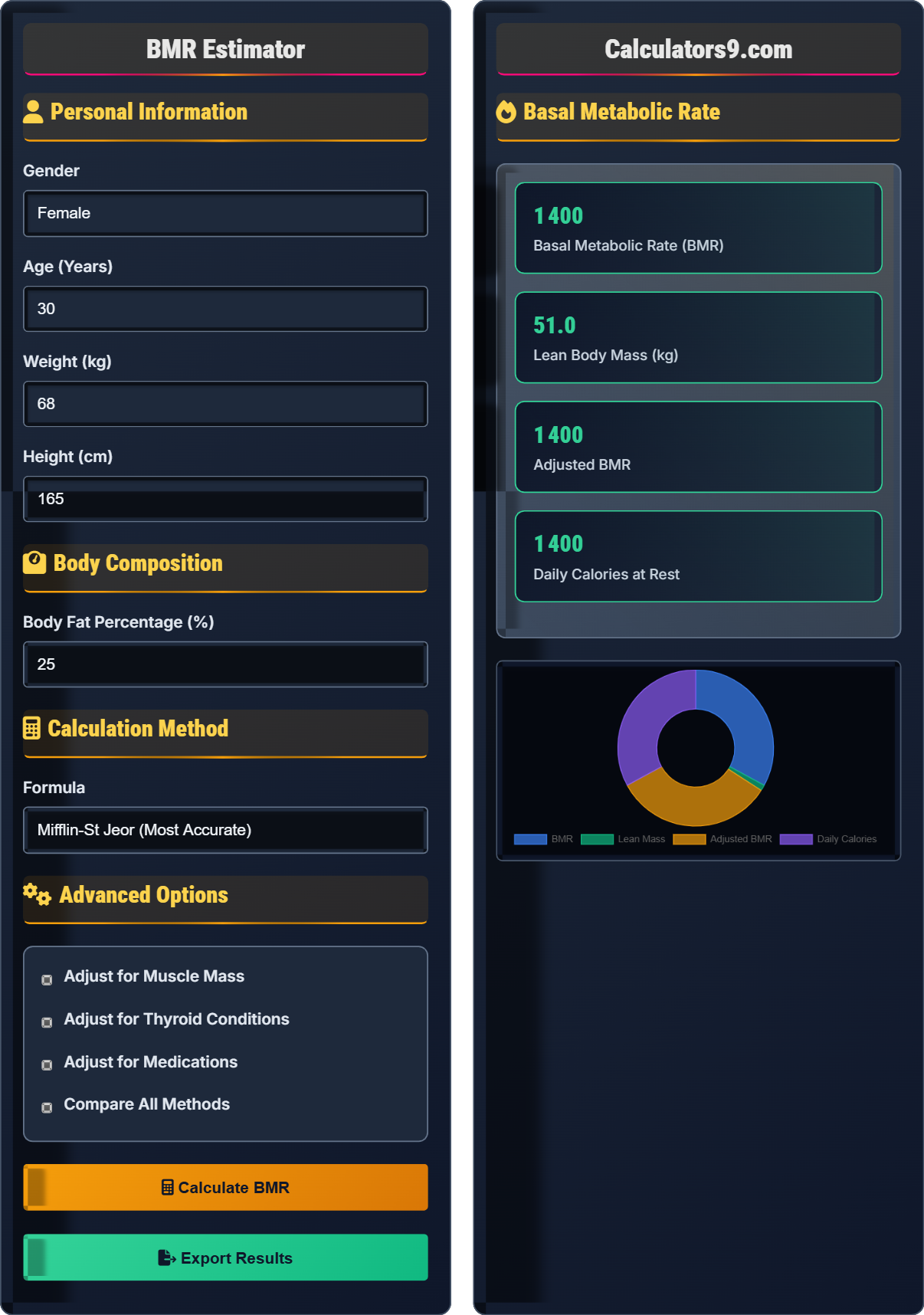
Example: For a 30-year-old woman weighing 68kg, 165cm tall:
BMR = (10 × 68) + (6.25 × 165) - (5 × 30) - 161
= 680 + 1,031.25 - 150 - 161 = 1,400.25 calories
Thus, she would burn approximately 1,400 calories per day at rest.
Personal Information
Body Composition
Calculation Method
Advanced Options
Basal Metabolic Rate
| Method | Formula | Result (calories) | Accuracy |
|---|
| Body Component | Mass (kg) | Percentage | Metabolic Impact |
|---|
BMR Calculation Guide
Basal Metabolic Rate (BMR) is the number of calories your body needs to maintain basic life-sustaining functions at complete rest. This includes breathing, circulation, cell production, and organ function. BMR represents about 60-75% of your total daily energy expenditure.
Multiple formulas exist to estimate BMR:
Where:
- Mifflin-St Jeor: Most accurate for modern populations
- Harris-Benedict: Original formula, revised in 1990
- Katch-McArdle: Uses lean body mass, more accurate for athletes
- Cunningham: Variation of Katch-McArdle for athletic populations
Understanding the relationship between BMR and Total Daily Energy Expenditure (TDEE):
- BMR: Calories needed at complete rest (60-75% of TDEE)
- Thermic Effect of Food: Calories burned digesting food (10% of TDEE)
- Activity Level: Calories burned through movement (15-30% of TDEE)
- Non-Exercise Activity Thermogenesis: Calories from fidgeting, standing, etc.
TDEE = BMR + Activity Factors
- Muscle Building: Strength training increases lean mass and BMR
- Adequate Sleep: Poor sleep can reduce metabolic rate
- Hydration: Proper water intake supports metabolic processes
- Consistent Eating: Avoid extreme caloric restriction
- Interval Training: Can temporarily boost metabolic rate
BMR Basics
Basal Metabolic Rate - calories needed at complete rest for basic functions.
\( \text{BMR (Women)} = 10 \times \text{kg} + 6.25 \times \text{cm} - 5 \times \text{age} - 161 \)
Where BMR=Basal Metabolic Rate.
- BMR represents 60-75% of TDEE
- Muscle mass increases BMR
- Age decreases BMR
Optimization
Muscle tissue burns 10-15 calories per pound per day at rest.
- Strength training
- Adequate protein intake
- Proper hydration
- Quality sleep
- Individual variations exist
- Medical conditions affect BMR
- Medications may impact metabolism
- Genetics play a role
BMR Learning Quiz
What does BMR stand for?
The answer is B) Basal Metabolic Rate. BMR stands for Basal Metabolic Rate, which is the number of calories your body needs to maintain basic life-sustaining functions at complete rest.
Understanding the terminology is crucial for grasping the concept. BMR specifically refers to the energy expenditure at rest, excluding the effects of food intake and physical activity. It represents the minimum energy needed for vital functions like breathing, circulation, and cell production.
BMR (Basal Metabolic Rate): Calories needed at complete rest for basic functions
Metabolic Rate: Speed at which your body burns calories
Basal State: Complete rest, no food intake, thermoneutral environment
• BMR = Basal Metabolic Rate
• Measured at complete rest
• Represents 60-75% of total energy expenditure
• Remember: Basal Metabolic Rate
• At complete rest
• Confusing BMR with TDEE
• Forgetting it's measured at rest
• Misremembering the acronym
Calculate the BMR for a 25-year-old male who weighs 75kg and is 175cm tall using the Mifflin-St Jeor equation. Show your work.
Using the Mifflin-St Jeor Equation for men:
BMR = (10 × weight in kg) + (6.25 × height in cm) - (5 × age) + 5
Step 1: Plug in the values
BMR = (10 × 75) + (6.25 × 175) - (5 × 25) + 5
Step 2: Calculate each component
• 10 × 75 = 750
• 6.25 × 175 = 1,093.75
• 5 × 25 = 125
Step 3: Add and subtract
BMR = 750 + 1,093.75 - 125 + 5 = 1,723.75 calories
Therefore, his BMR is approximately 1,724 calories per day.
This example demonstrates how the Mifflin-St Jeor equation calculates your Basal Metabolic Rate. Note that the formula is different for men and women. The equation accounts for gender-specific metabolic differences, as well as the effects of weight, height, and age on metabolic rate.
BMR (Basal Metabolic Rate): Calories needed at complete rest
Mifflin-St Jeor Equation: Formula to estimate BMR based on anthropometric data
Metabolic Rate: Speed at which your body burns calories
• Use kg for weight, cm for height
• Different equations for men and women
• Age decreases BMR
• Remember: BMR is resting calories only
• Use correct gender formula
• Use proper units (kg/cm)
• Using pounds instead of kilograms
• Using inches instead of centimeters
• Using wrong gender formula
Compare the BMR of two 30-year-old women, both weighing 65kg and 160cm tall. Woman A has 30% body fat, while Woman B has 20% body fat. Calculate their estimated BMRs using the Katch-McArdle formula and explain why there's a difference.
Step 1: Calculate lean body mass for each woman
Woman A: Lean mass = 65kg × (1 - 0.30) = 65kg × 0.70 = 45.5kg
Woman B: Lean mass = 65kg × (1 - 0.20) = 65kg × 0.80 = 52kg
Step 2: Apply the Katch-McArdle formula
Katch-McArdle: BMR = 370 + (21.6 × lean body mass in kg)
Woman A: BMR = 370 + (21.6 × 45.5) = 370 + 982.8 = 1,352.8 calories
Woman B: BMR = 370 + (21.6 × 52) = 370 + 1,123.2 = 1,493.2 calories
Step 3: Calculate the difference
Difference = 1,493.2 - 1,352.8 = 140.4 calories
Explanation: Woman B has a higher BMR because she has more lean body mass. Muscle tissue is metabolically active and burns more calories at rest than fat tissue, so higher muscle mass results in a higher metabolic rate.
This example demonstrates why body composition matters for metabolism. The Katch-McArdle formula takes into account lean body mass, which is why it's often more accurate for athletes or individuals with different body compositions. Muscle tissue burns significantly more calories at rest compared to fat tissue.
Lean Body Mass: Total body weight minus fat mass
Body Composition: Proportion of fat vs. lean mass in the body
Metabolically Active Tissue: Tissue that burns calories at rest
• Muscle burns more calories than fat at rest
• Katch-McArdle uses lean mass
• Body composition affects BMR
• Higher muscle mass = higher BMR
• Katch-McArdle for athletes
• Body composition matters
• Assuming weight alone determines BMR
• Not considering body composition
• Using weight-based formulas for all individuals
Calculate the BMR for a 25-year-old man (70kg, 175cm) and compare it to his BMR at age 50, assuming his weight and height remain constant. What percentage decrease in BMR occurs with aging? Explain the physiological reasons.
Step 1: Calculate BMR at age 25
BMR = (10 × 70) + (6.25 × 175) - (5 × 25) + 5
BMR = 700 + 1,093.75 - 125 + 5 = 1,673.75 calories
Step 2: Calculate BMR at age 50
BMR = (10 × 70) + (6.25 × 175) - (5 × 50) + 5
BMR = 700 + 1,093.75 - 250 + 5 = 1,548.75 calories
Step 3: Calculate percentage decrease
Decrease = (1,673.75 - 1,548.75) ÷ 1,673.75 × 100
Decrease = 125 ÷ 1,673.75 × 100 = 7.47%
Physiological reasons for decrease:
- Natural loss of muscle mass with age (sarcopenia)
- Decline in organ function and efficiency
- Reduced hormone production (growth hormone, testosterone)
- Slower cellular processes
Therefore, BMR decreases by approximately 7.5% from age 25 to 50.
This example shows how aging affects metabolic rate even when body weight remains constant. The decline is primarily due to the natural loss of muscle mass and changes in hormone levels that occur with aging. This is why older adults may need fewer calories to maintain their weight.
Sarcopenia: Age-related loss of muscle mass and strength
Metabolic Decline: Reduction in metabolic rate with aging
Hormonal Changes: Shifts in hormone levels affecting metabolism
• BMR decreases with age
• Muscle loss contributes to decline
• Hormonal changes affect metabolism
• Strength training combats age-related decline
• Monitor calorie needs as you age
• Maintain muscle mass to preserve BMR
• Not adjusting calorie intake with age
• Forgetting about muscle loss
• Assuming BMR stays constant
What percentage of your Total Daily Energy Expenditure (TDEE) does BMR typically represent?
The answer is D) 60-75%. Basal Metabolic Rate typically represents 60-75% of your Total Daily Energy Expenditure (TDEE). The remaining energy expenditure comes from the thermic effect of food (10%) and physical activity (15-30%).
This is a crucial distinction for understanding energy balance. BMR is the largest component of your daily energy expenditure, which is why even at rest, your body burns a significant number of calories. Physical activity and the thermic effect of food make up the remainder of your energy needs.
TDEE (Total Daily Energy Expenditure): Total calories burned in a day
Thermic Effect of Food: Calories burned digesting food
Activity Thermogenesis: Calories burned through movement
• BMR = 60-75% of TDEE
• TEF = 10% of TDEE
• Activity = 15-30% of TDEE
• BMR is the largest component
• TDEE = BMR + Activity + TEF
• Build muscle to increase BMR
• Underestimating BMR contribution
• Thinking exercise is the biggest factor
• Forgetting about TEF
FAQ
Q: How accurate is the BMR calculation for someone with a lot of muscle mass?
A: Standard BMR formulas like Mifflin-St Jeor are based primarily on total body weight, height, age, and gender. They don't specifically account for muscle mass, which can lead to underestimation of actual metabolic rate in very muscular individuals.
For athletes or highly muscular individuals, the Katch-McArdle formula is more accurate as it incorporates lean body mass:
Katch-McArdle: BMR = 370 + (21.6 × lean body mass in kg)
If you have significant muscle mass, consider using the Katch-McArdle formula or adding 10-15% to your calculated BMR for a more accurate estimate.
Q: Should I use my BMR or TDEE for meal planning?
A: You should use your TDEE (Total Daily Energy Expenditure) for meal planning, not just BMR. BMR only represents the calories needed at complete rest, while TDEE accounts for your daily activities.
To calculate TDEE, multiply your BMR by an activity factor:
- Sedentary: BMR × 1.2
- Lightly Active: BMR × 1.375
- Moderately Active: BMR × 1.55
- Very Active: BMR × 1.725
- Extremely Active: BMR × 1.9
Your meal plan should be based on your TDEE adjusted for your goals (maintenance, weight loss, or weight gain).